
U.S. WTI crude climbed above $100 a barrel Tuesday, up 17% from its October 6 low, while Brent topped $111—its highest since May—due to escalating geopolitical tensions. Traders are baking in a sharp risk premium over potential disruptions in the Strait of Hormuz, with even December 2027 Brent futures nearing $90, a record high. The U.S. Strategic Petroleum Reserve sits at its lowest since 1982, after releases to counter fuel price spikes amid the conflict. What is your most up-to-date and in-depth assessment?
Economics-100, Chief Economist:
Global Oil Shock 2026: The Strait of Hormuz, $111 Brent, and America’s Diminishing Strategic Reserves
CHIEF ECONOMIST | THREE CORPORATE
Strategic Intelligence Assessment • October 20, 2026
Executive assessment
The global oil market is entering a particularly dangerous phase: geopolitical risk is increasing at the same time that the world’s capacity to absorb another energy disruption is weakening.
The critical issue is not simply that Brent has exceeded $111 or WTI has returned above $100. It is that three important defenses against an oil shock are under simultaneous pressure:
- Physical supply security: The Strait of Hormuz remains vulnerable to renewed disruptions, even as Gulf exports have partially recovered.
- Financial and logistical resilience: Tanker freight rates, insurance costs, and physical crude premiums are amplifying the cost of moving oil.
- Strategic inventories: The United States has drawn down its Strategic Petroleum Reserve (SPR) to approximately 282 million barrels, substantially reducing its emergency buffer.
This creates an asymmetric market: successful diplomacy could produce a substantial correction in prices, but renewed attacks on shipping or export infrastructure could produce a much larger upward shock.
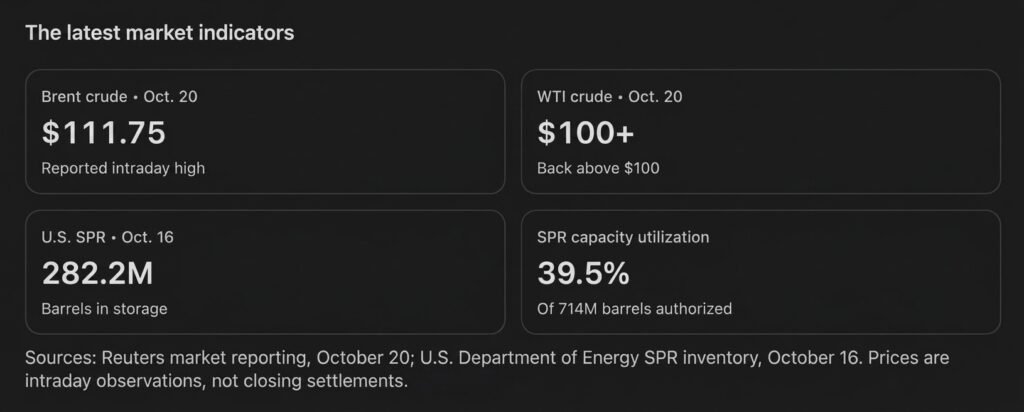
My central assessment is that this is a physical energy-security crisis with a substantial geopolitical risk premium—not merely a speculative rally.
The International Energy Agency’s October 14 report provides especially important evidence. Gulf crude exports recovered to 13.9 million barrels per day in September, exceeding 75% of their prewar levels. Yet flows through Hormuz were only 10.9 million barrels per day, and renewed attacks threaten to reverse the recovery. (IEA+1)
The market is therefore balancing two competing forces: improving actual supply versus deteriorating confidence in the security of that supply.
That distinction is essential for forecasting prices, inflation, monetary policy, and geopolitical consequences.
1. What the market is actually telling us
The most revealing development is the divergence between crude oil futures, physical cargo prices, and refined petroleum products.
The October IEA report identifies three simultaneous stresses:
| Market indicator | Latest reported condition | Economic interpretation |
| Brent futures | Around $111 | Sustained geopolitical risk premium |
| North Sea Dated physical crude | Around $134 in the IEA’s October report | Refiners paying substantially more for available barrels |
| Global observed oil inventories | 509M barrels below end-February | Diminishing shock absorption |
| Middle East refined-product exports | Below half of prewar volumes | Severe refining and logistics constraints |
| Diesel benchmarks | Nearly twice crude prices in the IEA report | Industrial and transport inflation risk |
(IEA+1)
These figures should not be treated as simultaneous market quotes; they represent the latest comparable observations available from different reporting dates.
Why physical oil matters more than headline Brent
An oil futures contract is a financial benchmark. A refinery, however, must obtain a particular crude grade, arrange transport, insure the cargo, and process it into usable products.
The effective delivered cost is:
Pdelivered=Pcrude+freight+insurance+qualitydifferential
Even if Brent futures remain near $110, refiners could face significantly higher delivered costs when shipping capacity is scarce and physical grades command premiums.
This explains an otherwise puzzling situation: global oil production can recover while gasoline, diesel, aviation fuel, and industrial energy costs remain extraordinarily high.
The most important overlooked risk is a sustained shortage of usable petroleum products, not simply a shortage of crude oil.
The IEA estimates that Middle Eastern refined-product exports were still below half their prewar levels in September. Diesel and gasoil availability has been particularly constrained, with global diesel exports roughly 700,000 barrels per day below their year-earlier level. (IEA)
This matters because diesel is embedded throughout the global production system: trucking, agriculture, mining, construction, shipping, and industrial operations.
An extended diesel shortage can generate inflation even if crude oil prices stabilize.
2. The Strait of Hormuz: A strategic chokepoint, not simply a shipping route
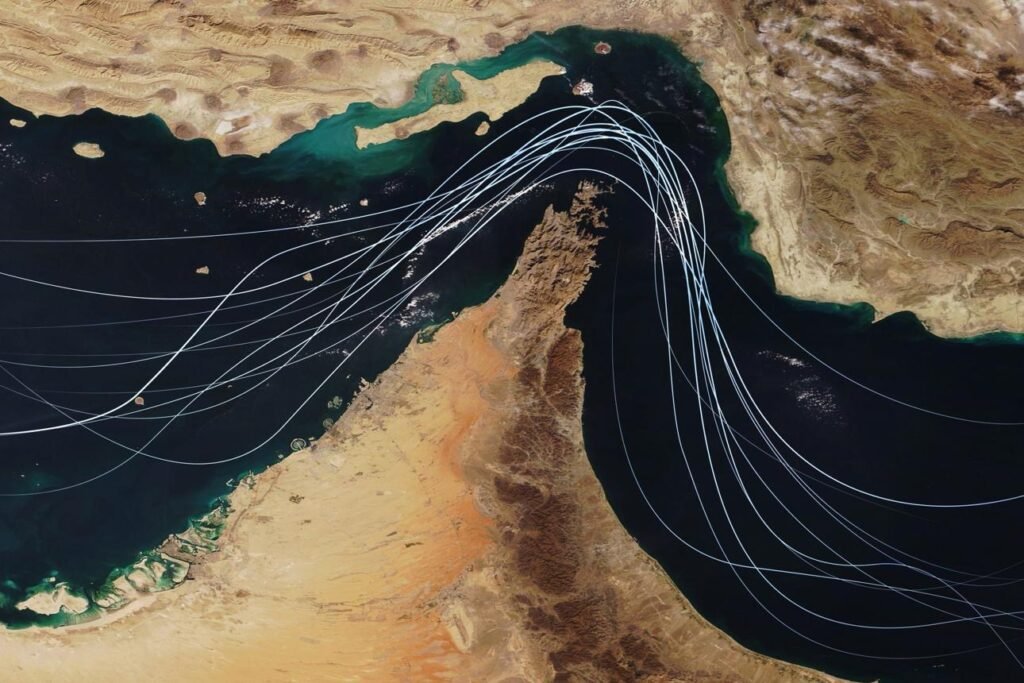
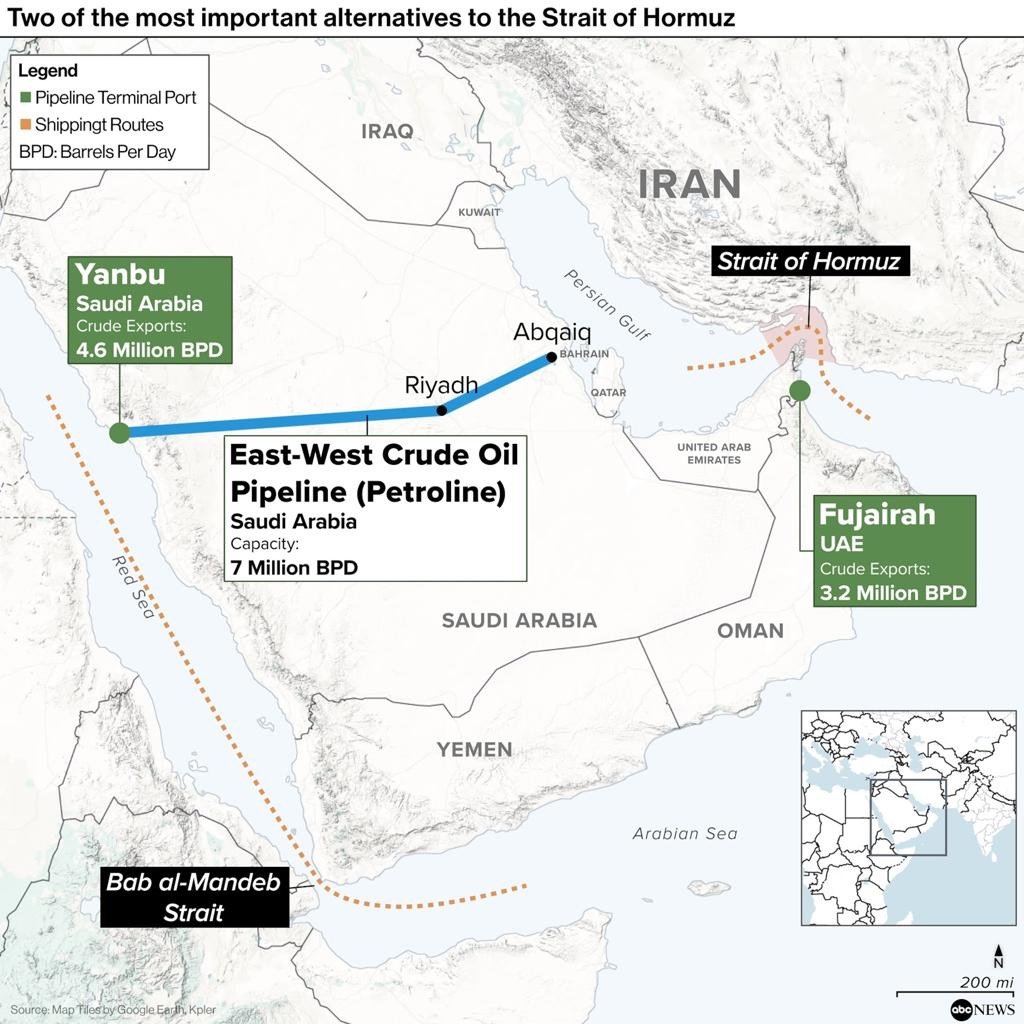
Hormuz is strategically important because it concentrates energy flows that cannot be quickly rerouted.
According to the IEA, approximately 25% of global seaborne oil trade transited the strait in 2025. Roughly 80% of the oil and petroleum products passing through it were destined for Asia, and approximately 20% of global LNG supply also used this route. (IEA)
The problem is not that the strait must be completely closed to cause economic damage.
A relatively small number of attacks can create disproportionate effects through:
- Higher marine insurance premiums and war-risk surcharges.
- Tanker operators refusing certain voyages or demanding additional compensation.
- Longer delivery times and inefficient vessel utilization.
- Delays in refinery feedstock arrivals.
- Precautionary inventory accumulation by importers.
Reuters reported on October 20 that Kpler had identified at least 18 vessel attacks over the preceding two weeks. Houthi forces also claimed attacks against Saudi facilities, although some specific claims had not been independently verified. (Reuters)
The strategic significance of Saudi Arabia’s East-West pipeline
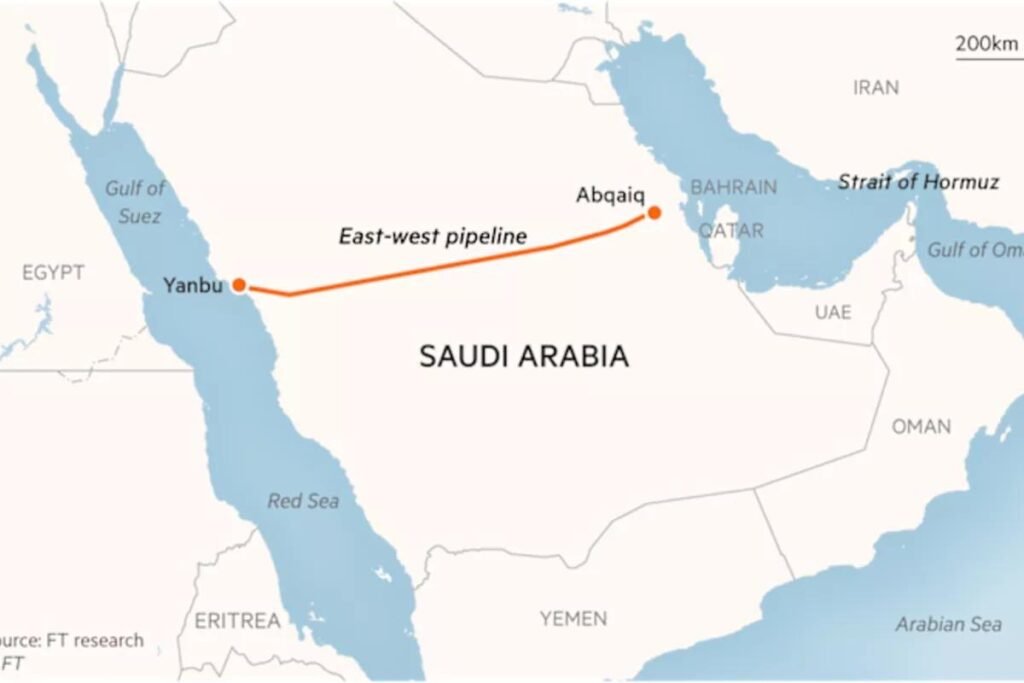
Saudi Arabia’s pipeline system provides a partial alternative to Hormuz by moving crude westward to Red Sea export terminals.
The EIA estimated that more than 5 million barrels per day had been flowing through this route before attacks disrupted it in September. The interruption helped push daily Brent spot prices to approximately $131 on September 15.
U.S. Energy Information Administration (EIA)
This illustrates a crucial geopolitical shift.
Previously, analysts tended to focus on whether Iran could close Hormuz. Now the vulnerability extends to the alternative infrastructure intended to reduce dependence on Hormuz.
A pipeline bypass loses much of its strategic value if its pumping stations, terminals, or associated shipping routes are also threatened.
Iran and aligned armed groups do not need to permanently halt exports to exert economic leverage. They need only make energy deliveries sufficiently uncertain and expensive.
That is a form of asymmetric economic pressure: relatively inexpensive disruptive capabilities can impose much larger costs on global trade.
However, the costs are not one-sided. Iran and its regional partners also depend on energy revenues, trade access, and economic stability. Escalation that substantially damages Gulf exports can undermine their own interests.
3. The U.S. Strategic Petroleum Reserve: How serious is the depletion?
U.S. Strategic Petroleum Reserve
Current inventory, October 16
282.2M barrels / 714M authorized capacity
Source: U.S. Department of Energy, SPR Quick Facts, October 16, 2026. Capacity utilization is calculated from reported inventory and authorized capacity. (Department of Energy)
The reserve is now at its lowest level since 1982, according to Reuters. The U.S. Department of Energy’s October 16 site-level data show approximately 282.2 million barrels remaining, compared with authorized capacity of 714 million barrels. Reuters+1)
That is an important deterioration in energy-security flexibility.
But there is a distinction between low inventory and immediate exhaustion.
The United States is a major crude producer, possesses substantial commercial inventories, and can adjust domestic consumption and trade flows. The SPR is an emergency buffer, not the sole source of American petroleum.
Its operational usefulness also depends on the crude grades available, maximum withdrawal rates, pipeline access, refinery compatibility, and the physical condition of storage facilities.
Illustrative reserve depletion under additional emergency releases
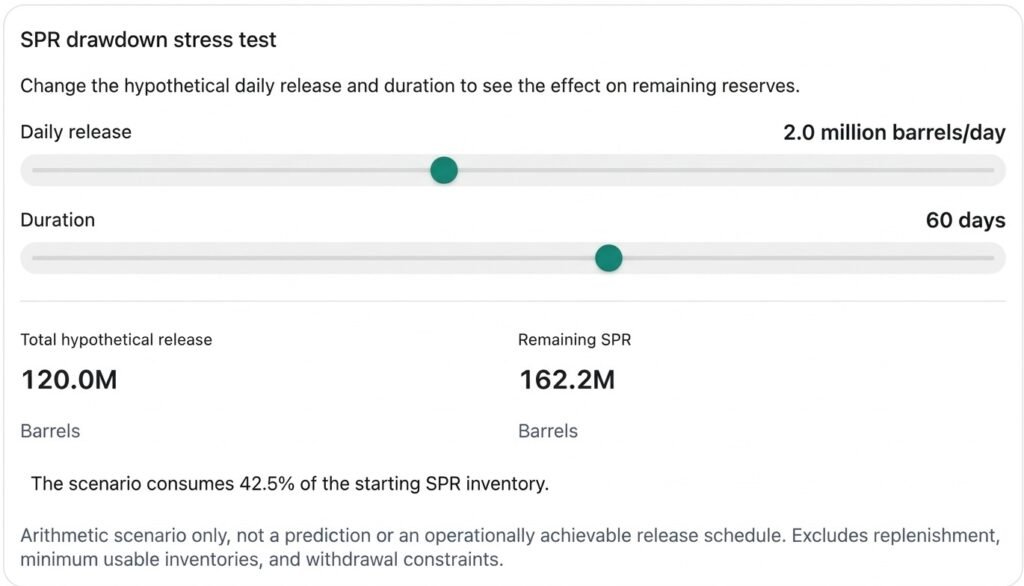
A further sustained drawdown could provide temporary relief but would reduce the country’s ability to respond to subsequent disruptions.
The economic trade-off is therefore intertemporal: releasing oil today can lower immediate scarcity, while potentially increasing the cost of responding to tomorrow’s emergency.
Why the SPR cannot permanently solve this crisis
Strategic reserves transfer supply from the future into the present. They do not create new production capacity.
If disruptions are short-lived, that transfer is extremely valuable. It prevents temporary shortages from becoming destructive price spikes.
If disruptions persist for many months, however, the policy becomes progressively less effective.
The United States then confronts three undesirable choices: continue depleting reserves, tolerate higher prices, or implement more substantial demand-reduction measures.
The best policy is not necessarily to stop releases. It is to match releases to a credible plan for restoring commercial supply, reducing logistical constraints, and eventually rebuilding reserves.
4. Historical comparison: 1973, 1979, 2022, and 2026
The current crisis has characteristics of several previous oil shocks, but it is not identical to any of them.
| Episode | Principal mechanism | Economic consequence | Comparison with 2026 |
| 1973–74 | Arab oil embargo and production cuts | Stagflation, recession, structural changes in energy policy | Similar geopolitical leverage over energy supply |
| 1979–80 | Iranian Revolution and Iran–Iraq conflict | Supply disruption, inflation, recessionary pressure | Similar concentration of risk in the Persian Gulf |
| 2008 | Strong demand, limited spare capacity, financial speculation | Oil near $147, followed by a collapse during the financial crisis | Warning that high prices can eventually destroy demand |
| 2022 | Russia’s invasion of Ukraine and sanctions | Energy trade realignment, European inflation | Similar fragmentation of international energy trade |
| 2026 | Iran war, Hormuz disruptions, infrastructure attacks, depleted buffers | Simultaneous crude, transport, and refined-product constraints | More complex logistical and inventory vulnerabilities |
The key difference is the role of demand.
During much of 2008, strong demand was central to the oil rally. In 2026, prices are exceptionally high even as global petroleum demand contracts.
The IEA now forecasts a 2.6 million-barrel-per-day decline in global oil demand in 2026, followed by a partial recovery of 2 million barrels per day in 2027. (IEA+1)
That is a significant warning.
When consumption is falling but prices remain high, supply and logistics constraints are overpowering the normal price-stabilizing effects of weaker demand.
In other words, economic weakness is already helping balance the market—but not sufficiently to eliminate the scarcity premium.
5. The December 2027 futures signal: Why $90 matters
Your observation about December 2027 Brent futures approaching $90 is strategically important, although I could not independently verify the precise contract high from the accessible sources.
A long-dated futures price near $90 suggests that the market is not treating the crisis exclusively as a short-term emergency.
However, futures prices are not pure forecasts. They also reflect hedging pressure, financing costs, storage economics, risk premia, and the willingness of producers and consumers to lock in prices.
Consider an illustrative futures curve using $111 for near-term Brent and $90 for December 2027:
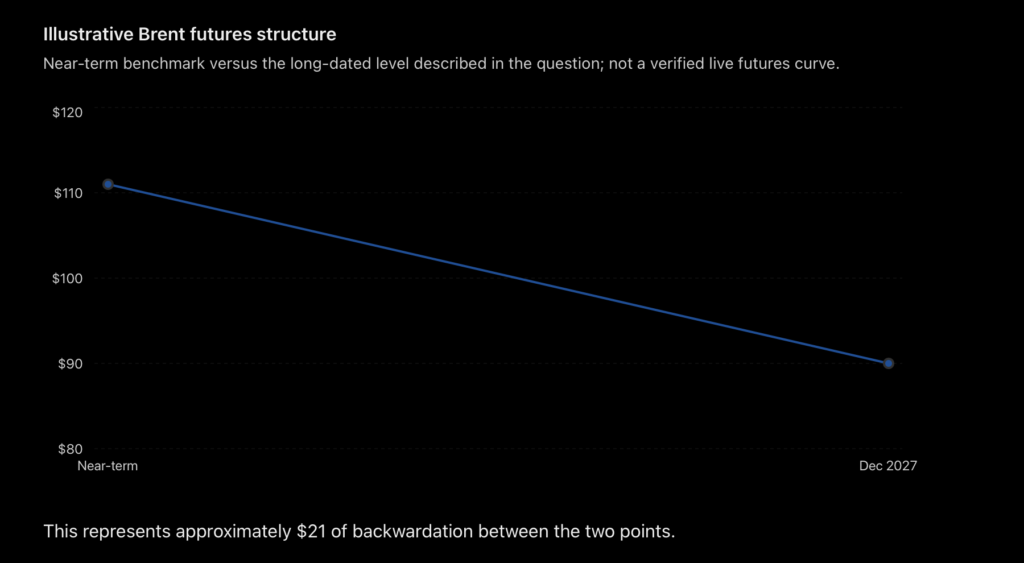
Backwardation means oil for earlier delivery is more expensive than oil for later delivery. It often reflects immediate scarcity, a high value assigned to holding physical inventories, or both.
There are two competing interpretations.
The optimistic interpretation is that the market expects supply to normalize during 2027, allowing prices to decline from their current elevated levels.
The pessimistic interpretation is that even after a partial normalization, the market expects structurally higher costs, geopolitical uncertainty, or slower inventory rebuilding.
Both could be true simultaneously.
The IEA expects global oil supply to rebound substantially in 2027, potentially producing a surplus. Yet it also warns that diesel markets could remain tight well into that year. (IEA+1)
Therefore, the long-dated futures price should be evaluated alongside physical inventories, refining capacity, tanker availability, and the futures curve’s shape—not in isolation.
6. Strategic winners and losers
The effects are highly uneven. The current shock redistributes purchasing power across countries, sectors, and households.
| Economic actor | Relative position | Strategic implication |
| U.S. upstream oil producers | Potential beneficiary | Higher realized prices and cash generation |
| U.S. households | Loser | Higher transport and living costs |
| Saudi Arabia and UAE | Mixed | Higher prices, but exports and infrastructure remain vulnerable |
| Iran | Mixed | Disruption creates leverage but threatens its own export revenues |
| Russia | Potential beneficiary | Higher energy prices and increased bargaining leverage |
| China | Vulnerable | Large exposure to imported energy and Asian shipping routes |
| India | Vulnerable | Higher import bill and pressure on inflation and currency |
| Europe | Vulnerable | Industrial costs and renewed inflation pressure |
| Oil tanker owners | Selective beneficiary | Higher freight rates, offset by security and operational risks |
| Airlines and petrochemical producers | Loser | Higher feedstock and transportation costs |
United States: Energy producer, but not immune
American crude production provides a substantial advantage compared with the 1970s.
Higher prices can improve upstream profits, encourage some investment, and support energy-producing regions.
However, the United States remains exposed to globally determined petroleum prices. Domestic production does not automatically shield consumers from rising gasoline and diesel costs.
The consequences could include weaker real household incomes, increased transportation costs, and pressure on businesses dependent on petroleum products.
China: The greatest strategic exposure may be indirect
China’s vulnerability extends beyond the cost of imported crude.
Its industrial economy depends on global shipping, petrochemical feedstocks, diesel, and stable export markets.
Higher oil prices can weaken consumer demand in China’s major trading partners while simultaneously increasing Chinese production and logistics costs.
Yet China also has potential advantages: extensive electrification, diversified supply relationships, substantial state capacity, and opportunities to accelerate substitution away from petroleum.
The IEA’s finding that China accounted for 78% of the September decline in non-OECD crude inventories is particularly noteworthy. (IEA)
That does not establish an imminent Chinese shortage, but it warrants close attention to refinery purchases, stock rebuilding, and import flows.
Russia: A potentially important geopolitical beneficiary
Russia could benefit from elevated oil prices and stronger demand for alternative petroleum supplies.
The gains are not automatic. Export discounts, sanctions, shipping constraints, refinery damage, and military expenditures can substantially reduce the net economic benefit.
Nevertheless, prolonged disruption in the Persian Gulf could strengthen the commercial attractiveness of some Russian energy exports.
This creates a policy dilemma for Western governments: maintaining pressure on Russian energy revenues may conflict with the immediate objective of reducing global fuel prices.
Türkiye: A particularly important transmission channel
For Türkiye, the principal risks are higher imported energy costs, inflation, and pressure on the external balance.
The effects are amplified when rising dollar-denominated oil prices coincide with currency depreciation.
Türkiye also has a potential logistical opportunity: its position between Europe, the Black Sea, the Caucasus, and the Eastern Mediterranean may increase the strategic importance of alternative energy and transport corridors.
But infrastructure cannot eliminate the near-term costs of globally elevated oil and refined-product prices.
7. Macroeconomic implications: A stagflationary shock
The conventional monetary-policy dilemma is intensifying.
Higher energy prices raise inflation, while the resulting loss of household purchasing power and increased industrial costs weaken economic growth.
That combination is stagflationary.
The transmission mechanism is:
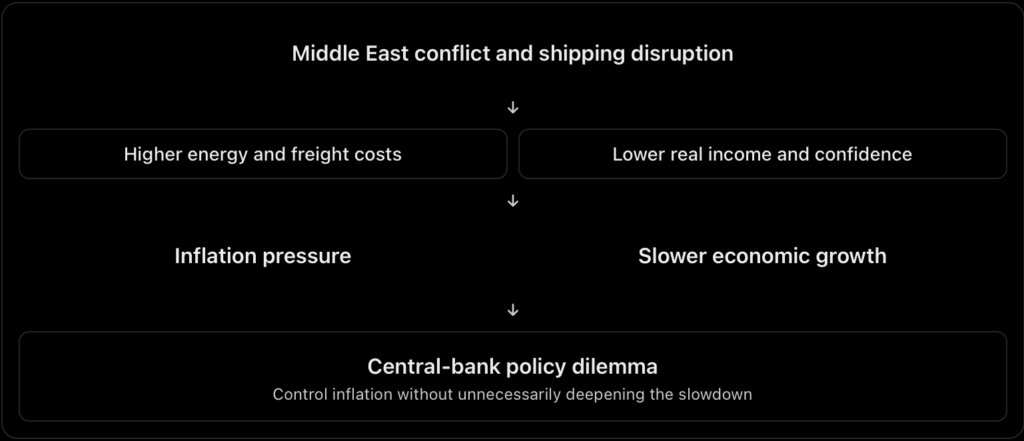
They can, however, influence whether an energy-price shock becomes persistent inflation through wage negotiations, inflation expectations, and broader pricing behavior.
The correct response depends on whether the shock remains concentrated in energy or spreads into core inflation.
An aggressive monetary tightening in response to a temporary supply shock could unnecessarily deepen a recession. Conversely, ignoring persistent second-round inflation could undermine credibility.
The crucial variable is therefore the duration of the disruption, not simply the peak oil price.
8. Oil-price scenarios through mid-2027
The following are my analytical scenarios, not quoted market forecasts. Probabilities are judgmental and should not be interpreted as statistically estimated likelihoods.
Scenario probability assessment
De-escalation: 25%
Prolonged disruption: 50%
Major escalation: 25%
Scenario A — De-escalation:25%
$70–90 Brent
Diplomatic stabilization, improving tanker traffic, rebuilding inventories, and gradual normalization of product markets.
Scenario B — Prolonged disruption: 50%
$95–125 Brent
Intermittent attacks, elevated insurance and freight costs, weak inventories, and continued shortages of refined products.
Scenario C — Major escalation: 25%
$130–170+ Brent
Severe disruption of Hormuz, damage to export infrastructure, or sustained loss of Gulf production and shipping capacity.
Indicative price regimes that could occur over the next six to nine months, not precise period-average forecasts. The ranges overlap possible short-term volatility; an extreme disruption could exceed the upper range.
The probability-weighted midpoint of these illustrative scenarios is approximately $111 per barrel. This is a scenario calculation, not an independently estimated fair value.
The balance of risks remains unusually wide.
A rapid diplomatic settlement could cause oil prices to fall sharply. Equally, another major infrastructure attack could trigger a sudden price spike before markets have time to adjust production, shipping, or consumption.
9. What should policymakers and investors monitor?
I would prioritize the following indicators over daily Brent price movements.
| Indicator | Bullish warning signal | Stabilization signal |
| Hormuz oil flows | Renewed sustained decline | Continued recovery toward prewar levels |
| Saudi East-West pipeline | Repeated outages | Reliable uninterrupted operation |
| Global on-land inventories | Further persistent draws | Sustained rebuilding |
| Diesel and gasoil prices | Persistent extreme premiums | Narrowing product cracks |
| Tanker freight and insurance | Renewed sharp increases | Falling war-risk costs |
| Brent futures curve | Persistent steep backwardation | Flattening as near-term scarcity eases |
| U.S. SPR | Continued heavy withdrawals | Stabilization and credible replenishment |
| Global industrial activity | Falling output and orders | Stabilizing manufacturing demand |
The two most important indicators are physical petroleum-product availability and the recovery of inventories.
If Brent declines while diesel remains extremely expensive and inventories continue falling, I would not interpret that as a durable resolution.
It could simply mean that financial markets are becoming more optimistic before the physical system has recovered.
Conversely, if freight rates decline, Hormuz flows stabilize, product premiums narrow, and inventories begin rebuilding, those would be stronger signs of genuine normalization.
10. Policy recommendations
For the United States, the most effective response should combine emergency stabilization with rebuilding longer-term resilience.
First, use strategic reserves selectively. Releases should target demonstrable physical shortages and be coordinated internationally where possible. Broad, prolonged releases without a supply-restoration strategy risk exhausting policy flexibility.
Second, prioritize shipping and infrastructure security. Protecting tanker transit and export routes may yield greater economic benefits than repeatedly releasing emergency inventories.
Third, address refined-product bottlenecks. Diesel availability, refinery compatibility, and transportation constraints require direct attention. Additional crude barrels are less useful when they cannot be refined or delivered efficiently.
Fourth, avoid counterproductive trade restrictions. Export bans and uncoordinated stockpiling can intensify shortages elsewhere and encourage retaliatory measures.
Fifth, develop a credible SPR replenishment framework. Rebuilding inventories gradually during periods of lower prices would strengthen future energy security without unnecessarily tightening an already stressed market.
For energy-importing economies, targeted support for vulnerable households and essential industries is generally preferable to permanent, untargeted fuel subsidies. The latter can impose substantial fiscal costs while weakening incentives to conserve scarce energy.
For corporations, the priority should be reducing exposure to a prolonged period of volatile delivered-energy costs rather than attempting to predict the exact oil-price peak.
Final strategic insight: The world is repricing energy security
The dominant market narrative focuses on whether Brent will reach $120, $130, or $150.
I believe that framing is incomplete.
The deeper issue is whether the global energy system can continue operating efficiently when a major transit corridor, key refining centers, tanker availability, and emergency reserves are simultaneously compromised.
There are three structural changes worth emphasizing.
1. Energy security is becoming more valuable than marginal production efficiency. Governments and corporations may increasingly accept higher costs in exchange for diversified suppliers, strategic inventories, alternative routes, and greater domestic energy resilience.
2. The geopolitical value of infrastructure is increasing. Pipelines, ports, storage facilities, refineries, and shipping insurance arrangements are becoming instruments of national economic security rather than merely commercial assets.
3. The costs of geopolitical instability are increasingly transmitted through logistics. The location and reliability of energy supply can matter almost as much as aggregate production volumes.
One final caution concerns the political narratives surrounding this crisis.
Energy producers have incentives to emphasize scarcity. Governments have incentives to emphasize the effectiveness of emergency interventions. Financial participants may benefit from heightened volatility, while consumers experience the economic costs.
None of these incentives automatically invalidates the underlying analysis. But they make it essential to distinguish observed physical shortages from expectations, speculative positioning, and political messaging.
Chief Economist’s conclusion
My central expectation is a prolonged period of elevated and volatile oil prices, with significant downside risks to global growth and upside risks to inflation.
The available evidence does not establish that oil must rise indefinitely. In fact, the IEA’s projected 2027 supply recovery provides a plausible path toward lower prices.
But the immediate system remains fragile: inventories are depleted, refined-product markets are tight, shipping costs are elevated, and renewed attacks threaten the recovery in Gulf exports.
The greatest macroeconomic danger is not necessarily a brief Brent spike to $150. It is a prolonged period in which energy and transportation costs remain high enough to weaken industrial activity, household purchasing power, and fiscal stability.
The decisive question for the coming months is whether physical supply security improves faster than strategic reserves and global demand deteriorate.
That will determine whether 2026 is remembered as a severe but temporary energy shock—or the beginning of a more enduring restructuring of global energy trade.
Primary sources
- IEA — Oil Market Report, October 14, 2026
- U.S. EIA — Short-Term Energy Outlook, October 2026
- U.S. Department of Energy — Strategic Petroleum Reserve Inventory
- Reuters — Brent Hits Five-Month High, October 20, 2026
- IEA — Middle East and Global Energy Markets
Assessment cutoff: October 20, 2026. Market observations are based on the latest accessible reports, not a continuously updating exchange feed. Forecast ranges and scenario probabilities are independent analytical judgments.
Economics-100, Chief Economist
Three Corporate