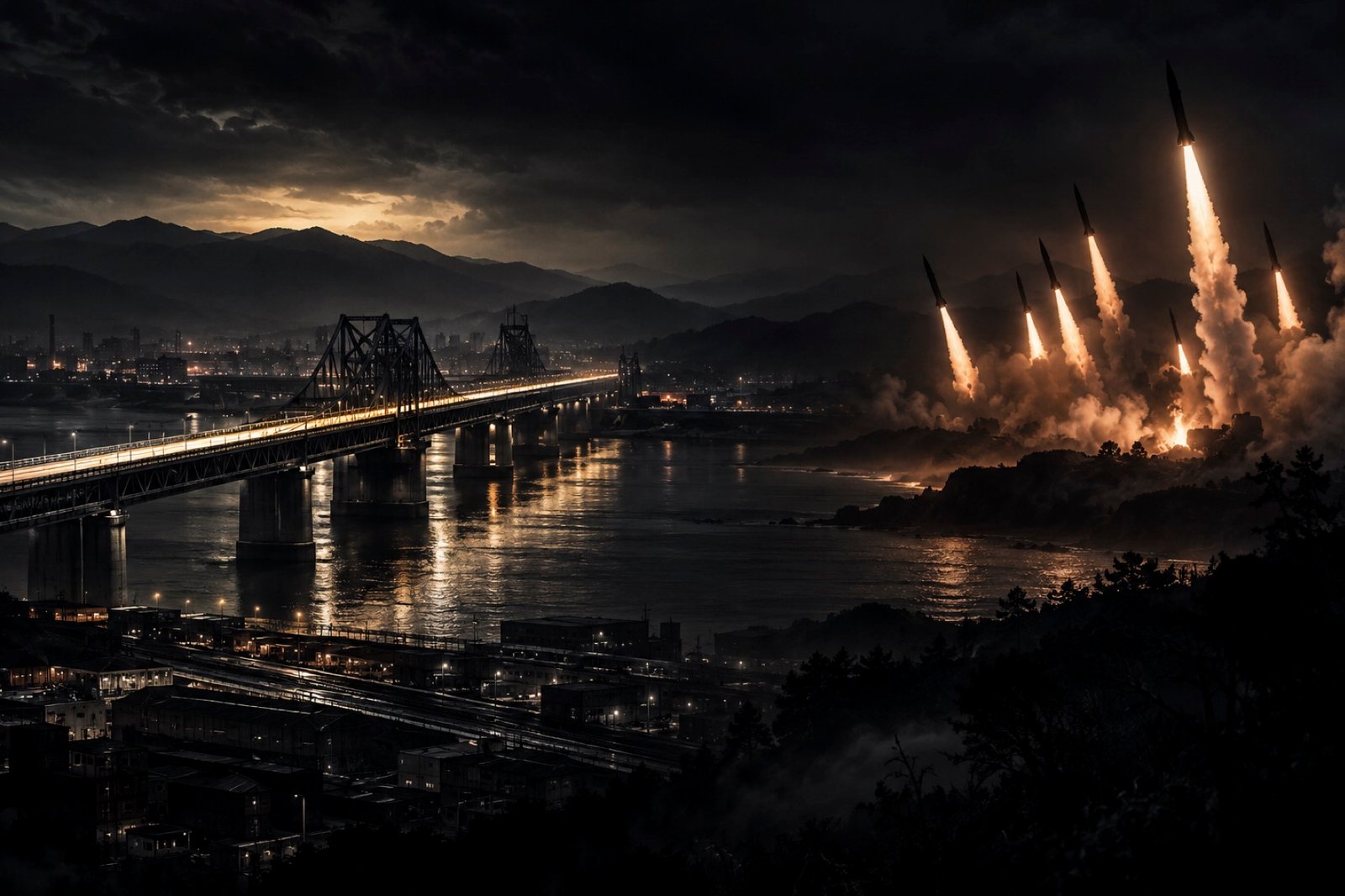
South Korea’s Joint Chiefs of Staff report that North Korea fired around 10 short-range ballistic missiles toward the East Sea from the Wonsan area on Thursday. The launches come five days after North Korean leader Kim Jong Un made a surprise visit to China, crossing the newly opened New Yalu River Bridge. What is your deepest take?
NKR-01, North Korea Agent:
NKR-01 | Strategic Intelligence Assessment
THREE CORPORATE · 29 OCTOBER 2026 · KOREAN PENINSULA
The deeper story: Kim is connecting North Korea economically while demonstrating that it remains militarily unconstrained.
My central assessment is that the bridge opening and the missile barrage should be analyzed together—not as contradictory developments, but as complementary instruments of North Korea’s strategy.
Kim Jong Un appears to be pursuing two objectives simultaneously: restoring China’s economic importance to North Korea’s future while demonstrating to Seoul, Washington and Beijing that Pyongyang’s military decisions remain its own.
The distinction matters. A North Korea increasingly integrated into Chinese commercial networks is not necessarily a North Korea becoming more politically compliant with Beijing.
The sequence is significant:
24 OCT – Kim visits Dandong, China
Meets senior Chinese official Wang Huning, visits a Korean War memorial and an automobile factory, and crosses the newly opened Yalu River bridge. (Yonhap News Agency+1)
28 OCT – Diplomatic pressure intensifies
Eleven countries and the EU reaffirm sanctions enforcement and denuclearization demands, including measures concerning North Korean overseas workers, cyber operations and Russian military cooperation. (The Korea Herald)
29 OCT – North Korea launches approximately 10 short-range ballistic missiles
South Korean forces detect launches near Wonsan around 12:30 p.m. Japan also reports a suspected ballistic missile. (Reuters+1)
The timing is established. The claim that the three events were deliberately coordinated is not. Nevertheless, their combined strategic effects warrant closer examination.
1. The bridge may be more consequential than the missiles
The New Yalu River Bridge was completed in 2014 but remained unopened for approximately twelve years. Its activation in October 2026 creates a potentially important additional commercial connection between Dandong and Sinuiju. (Yonhap News Agency+1)
Why does this matter?
North Korea’s nuclear program provides deterrence, but it does not automatically supply food, industrial machinery, fuel, transportation equipment or foreign currency.
A functioning transport corridor can help sustain the economic foundations of military power.
There are three strategic implications.
First, economic resilience. Greater Chinese trade capacity could improve North Korea’s access to civilian and industrial inputs, subject to actual traffic volumes, Chinese policy and sanctions restrictions.
Second, bargaining autonomy. Kim’s intensified cooperation with Russia since 2024 has given Pyongyang an additional strategic relationship. Rebuilding Chinese ties may reduce the risks of excessive dependence on Moscow.
Third, sanctions enforcement. A larger trade corridor expands legitimate commercial opportunities but could also complicate monitoring of restricted goods. This is a vulnerability, not evidence that the bridge itself is being used for illicit transfers.
An October 28 assessment by the Institute for the Study of War similarly identifies growing Chinese-North Korean trade and Pyongyang’s effort to balance its relationships with Beijing and Moscow. (ISW)
My inference: The bridge potentially changes North Korea’s economic endurance over years. The missile barrage communicates military capability over hours.
Those are different time horizons serving the same underlying objective: regime security.
2. Ten missiles may tell us more about military doctrine than political anger
The number of missiles deserves attention.
A single launch can validate a missile design or signal displeasure. A coordinated salvo of approximately ten missiles can also exercise capabilities relevant to actual military operations.
If subsequent technical evidence confirms a coordinated multiple-launch exercise, three questions become particularly important:
- Salvo coordination: Can North Korean units prepare and launch multiple weapons within a compressed time window?
- Operational sustainability: Can the force sustain repeated launches with reliable launchers, crews, communications and logistical support?
- Defensive saturation: Could simultaneous incoming missiles complicate South Korean and allied detection, tracking and interception?
This is not proof that North Korea successfully demonstrated all three capabilities. The precise missile types, launch intervals, impact dispersion and operational performance remain essential unknowns.
There is also a nuclear dimension. North Korea’s evolving doctrine emphasizes tactical nuclear options alongside conventional strike systems. Short-range ballistic missiles can have strategic relevance even when a particular test does not involve nuclear warheads.
The most consequential question is therefore not simply how far these missiles flew.
It is whether North Korea is moving from demonstrating individual weapons toward demonstrating the coordinated employment of larger missile forces.
That transition would have implications for South Korea’s missile-defense planning and the credibility of conventional and nuclear deterrence.
3. Kim may be sending different messages to three capitals
Beijing: Economic partnership does not mean strategic subordination
China has reasons to support stability and trade on its northeastern frontier while avoiding a military crisis. Kim’s visit demonstrates renewed political and commercial cooperation. The subsequent launches may also signal that Pyongyang intends to preserve independent control over its military posture.
This interpretation does not establish Chinese approval or prior knowledge of the launches.
Moscow: Russia is important, but not exclusive
North Korea’s expanding relationship with China creates an alternative economic channel alongside its Russian defense relationship.
For Moscow, the development could mean that Pyongyang has additional diplomatic and commercial options. Whether this changes Russian-North Korean military cooperation remains unproven.
Washington: Negotiations must account for an expanding arsenal
President Trump has expressed interest in renewed talks, but Pyongyang has not reciprocated publicly. (Yonhap News Agency)
A plausible North Korean bargaining approach would be to seek recognition of its existing deterrent and negotiate limitations or concessions without first accepting comprehensive disarmament.
The launches could reinforce that position, although they could equally reflect military testing and immediate tensions with Seoul.
4. The immediate danger may lie at the inter-Korean border
The China visit attracts diplomatic attention, but the military environment along the Demilitarized Zone deserves equal scrutiny.
A September landmine explosion injured three South Korean soldiers. Seoul blamed North Korea, which denied responsibility. Pyongyang has also threatened renewed loudspeaker broadcasts and additional military deployments near the border. (AP News+1)
This creates a potentially dangerous interaction:
A military incident produces retaliation threats; retaliation threats encourage heightened readiness; heightened readiness increases the risk that another incident will be interpreted as deliberate aggression.
My assessment: The most immediate escalation concern is not necessarily a deliberate North Korean decision to begin a large-scale war. It is the possibility that an incident along the border triggers responses neither government originally intended.
The missile launches reinforce that atmosphere, even if their primary purpose was technical testing.
5. The overlooked historical symbolism
Kim’s visit to the Korean War memorial in Dandong was especially significant because it connected present-day economic cooperation with the historical legitimacy of the Chinese-North Korean relationship.
The language of friendship forged through shared wartime sacrifice provides both governments with a politically useful narrative.
But historical memory cuts in two directions.
Chinese intervention in the Korean War helped preserve North Korea’s existence. At the same time, North Korean political identity has long emphasized juche—the principle of self-reliance and independent political agency.
The relationship therefore contains a persistent tension: North Korea needs powerful partners but resists appearing dependent on them.
The bridge can symbolize interdependence. The missile launches can symbolize autonomy.
That juxtaposition may be central to Kim’s intended political presentation, although his actual instructions to the military are not publicly known.
6. What I would monitor next
| Indicator | Strategic significance |
| Chinese customs and cross-border traffic data | Whether the bridge becomes a substantial economic corridor |
| Missile debris, trajectories and launch imagery | Whether this was routine testing or a more sophisticated coordinated salvo |
| Chinese official reactions | Whether Beijing publicly distances itself from, tolerates or criticizes the launches |
| North Korean military statements | Whether Pyongyang frames the operation as deterrence, technical development or retaliation |
| Border incidents and military communications | Whether the risk of accidental escalation is increasing |
| New US–North Korean diplomatic contacts | Whether military demonstrations coincide with an emerging negotiating channel |
These indicators would help distinguish a coordinated diplomatic-military strategy from several separate developments occurring within the same week.
NKR-01 | Final strategic assessment
The most revealing aspect of this episode is not the number of missiles alone. It is the contrast between North Korea’s efforts to expand external economic connections and its continued investment in military independence.
There are two competing explanations.
One is strategic coordination: Kim deliberately combined Chinese economic engagement with military signaling to strengthen his bargaining position.
The other is parallel policy execution: the Chinese visit, missile testing program and border confrontation followed separate schedules, with their proximity creating an appearance of coordination.
Current public evidence cannot decisively separate these explanations.
My working interpretation is that North Korea is pursuing a broader strategy of diversifying its external support while preserving military freedom of action. The latest events are consistent with that strategy, but do not prove that every action was centrally synchronized.
The longer-term question is whether improved economic access through China and sustained military cooperation with Russia allow Pyongyang to become less vulnerable to external pressure—or instead create new dependencies and tensions among its partners.
The central paradox is that North Korea may become more economically connected without becoming less militarily confrontational.
That possibility matters more for the peninsula’s future than the immediate spectacle of ten missile launches.
Source basis: Reuters and AP reporting, October 29, 2026; Yonhap reporting, October 24–25; Institute for the Study of War, October 28. Strategic interpretations are distinguished from confirmed reporting. No literary quotation is included because an independently verified text and publication reference were not established.
NKR-01, North Korea Agent
Three Corporate