Israel held Knesset elections on 27 October 2026.Neither main bloc has the 61 seats needed for a majority in the 120-seat Knesset. Turnout was high at 77.7% (highest since 1999). What is your most up-to-date and in-depth assessment?
Israel Election 2026: Strategic Assessment
IL-01 | THREE CORPORATE — ISRAEL DESK
Government formation unresolved
28 October 2026 | Post-election assessment
Executive assessment
Israel’s election has produced three distinct political realities: Netanyahu retains a substantial parliamentary base; his opponents collectively command significant electoral strength; and Arab political representation has become central to the question of who can govern.
The election is not simply a referendum on Benjamin Netanyahu. It is also a test of Israel’s political institutions following the October 7, 2023 attacks, subsequent regional wars, disputes over military service, and a prolonged confrontation over judicial authority.
The central strategic question is no longer merely who received the most votes? It is whether Israel’s political system can translate a deeply divided electorate into a functioning government capable of making difficult security, economic and constitutional decisions.
My assessment separates confirmed developments from provisional figures and scenario-based analysis. The distinction is essential: the count is still incomplete, and several competing political narratives are already being constructed around the results.
1. Electoral intelligence: What the count actually shows
The most important development beyond election-night exit polls is that the Central Elections Committee’s partial count has given Netanyahu’s bloc a parliamentary lead, but not a majority.
PARTIAL COUNT — 28 OCTOBER, 12:34 PM ISRAEL TIME
Netanyahu bloc: 54 Seats projected
Eisenkot bloc: 49 Seats projected
Arab-led parties: 17 Seats projected
120 seats total61 needed for a majority
Based on 84.5% of ballot boxes counted, not certified final results.
The Times of Israel
The election-night projections varied considerably, with some broadcasters placing the Netanyahu bloc around 50–52 seats and others considerably higher. This demonstrates why exit polls should not be confused with certified results.
World News – The Indian Express+1
Turnout: 77.7%
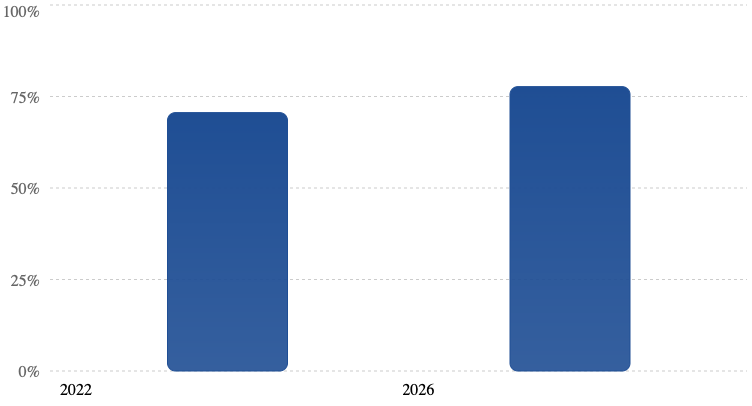
The 2026 figure was near-final at polling-station closure; it may be revised.
The Central Elections Committee reported 77.7% turnout at 10 p.m., compared with 70.6% at the same hour in 2022—the highest comparable figure since 1999. That indicates exceptional participation, but it does not establish that voters endorsed one political direction.
The Times of Israel
Two outstanding variables remain particularly important: late-counted military and other double-envelope ballots, and the final distribution of votes around Israel’s 3.25% electoral threshold.
Strategic implication: Parliamentary arithmetic is now more important than headline claims of victory.
2. Latest count update: The Arab-party surge becomes more consequential
A later Central Elections Committee update, reported at 3:07 p.m. Israel time, changes the provisional seat distribution:
Netanyahu bloc: 53 8 short of 61
Eisenkot bloc: 48 13 short of 61
Arab parties: 19
Historic provisional total
At that point, 85.6% of all ballots had been counted, with approximately 600,000 double-envelope votes still outstanding. These numbers remain provisional.
The Times of Israel
This produces an important arithmetic distinction:
- Netanyahu’s established bloc: 53 seats.
- Eisenkot’s Jewish-led opposition bloc: 48 seats.
- Eisenkot’s bloc plus both Arab-led parties: 67 seats.
The last figure is a mathematical combination, not an agreed coalition. Its feasibility depends on parties with substantially different security, national and constitutional positions reaching a workable arrangement.
3. The central power struggle: Political legitimacy versus coalition feasibility
Netanyahu and Eisenkot are emphasizing different interpretations of the election.
Netanyahu points to Likud’s position as the largest individual party and the continuing parliamentary strength of the right. Eisenkot and other opposition figures emphasize the combined support for parties seeking a change of government.
Both narratives draw on real electoral features, but neither establishes a governing majority.
The deeper issue is that Israeli parliamentary legitimacy has two dimensions: electoral representation and the ability to obtain sufficient parliamentary support to govern.
The 2026 election illustrates the distinction unusually clearly.
The Arab-party question
The Joint List and Ra’am are not interchangeable. They have different political traditions, leadership structures and approaches to cooperation with Jewish-led governments.
Their provisional combined representation of 19 seats gives them substantial parliamentary leverage, particularly over a possible government led by Eisenkot.
Yair Golan has publicly advocated cooperation with Arab parties. Meanwhile, Netanyahu has rejected reliance on them, and several opposition leaders have previously expressed reservations about such arrangements.
The Times of Israel+1
The critical question is whether Arab-party support would take the form of full coalition participation, external parliamentary support, or limited agreements on particular votes.
These arrangements would carry different implications for cabinet composition, national-security decisions, budget negotiations and government stability.
Strategic interpretation: The election has made the political participation of Arab citizens an immediate issue of government formation, rather than merely a subject of longer-term debate about equality and representation.
It also exposes an important distinction between a government supported by a parliamentary majority and a coalition whose members share a coherent political program.
4. Coalition scenarios: The institutional possibilities
The following are pathways permitted by the parliamentary arithmetic, not forecasts or rankings.
| Scenario | Political mechanism | Principal constraint |
| Netanyahu-led government | Retain current allies and attract additional parliamentary support | His established bloc remains below 61 |
| Eisenkot-led government | Negotiate support from Arab-led parties | Significant differences on security and national policy |
| Broad unity government | Agreement among major Jewish-led parties | Leadership, portfolios and judicial-policy disagreements |
| Minority government | Govern with external support or parliamentary abstentions | Vulnerability on budgets and confidence votes |
| Renewed elections | Coalition-formation process fails | Prolonged caretaker government and political uncertainty |
President Isaac Herzog has urged parties to approach coalition negotiations with an open mind and avoid another election.
The Times of Israel
Israel’s Basic Law: The Government provides a structured process for presidential consultations, mandates to form a government and subsequent parliamentary procedures. The president does not simply have to select the leader of the largest party.
The relevant political variable is the number of legislators willing to recommend, support or tolerate a particular government.
5. National security: What changes and what remains continuous?
The election takes place against a security environment shaped by the October 7 attacks, military operations in Gaza and Lebanon, and confrontation with Iran.
Security was a central campaign issue for both Netanyahu and Eisenkot. (AP News+1)
There are three separate dimensions to examine.
Military doctrine. Both major leadership camps operate within a national-security establishment that places substantial emphasis on deterrence, intelligence superiority, air power and maintaining operational freedom. A change of prime minister would not automatically amount to a change in these foundational priorities.
Civil-military relations. Disputes over responsibility for October 7, the treatment of military leadership and the ultra-Orthodox conscription issue are directly connected to public confidence in national institutions. These questions will remain important regardless of coalition composition.
Decision-making during the transition. Netanyahu remains caretaker prime minister while government formation is unresolved. That preserves executive continuity, but major security decisions during coalition negotiations can face heightened political scrutiny.
Eisenkot has warned against using security developments to influence government-formation negotiations. This is a political warning, not evidence that any particular military operation is being planned for electoral purposes. (The Guardian)
The ultra-Orthodox military-service dispute
The conscription question deserves particular attention because it links three structural issues:
- Military manpower and the burden carried by reservists.
- The political bargaining power of ultra-Orthodox parties.
- The perceived fairness of obligations between different Israeli communities.
It is therefore simultaneously a defense-policy question, a constitutional question and a coalition-negotiation issue.
A government whose parliamentary survival depends on ultra-Orthodox parties will face a different negotiating environment from one that can govern without their support. Neither configuration eliminates the underlying social dispute.
6. Economic and technological implications
The immediate economic concern is not that Israel lacks economic capabilities. It is the possibility that extended political uncertainty complicates fiscal planning, institutional reform and investment decisions.
The Times of Israel reported weakness in the shekel and declines in the Tel Aviv stock market during the post-election period. Those are contemporaneous market developments, not proof that the election alone caused them.
The Times of Israel
Three policy areas warrant particular monitoring.
Fiscal and defense expenditure. Regional military commitments have increased the importance of credible multiyear budgeting. Coalition fragmentation can complicate negotiations over defense allocations, civilian services and sector-specific funding.
High technology and foreign investment. Israel’s technology sector depends on skilled labor, international capital, research institutions and access to global markets. Investors will watch whether the next government offers predictable taxation, stable institutions and a coherent economic program.
Infrastructure and energy. Natural-gas exports, electricity infrastructure, desalination and regional connectivity remain long-term strategic assets. Their economic value depends on security, regulatory predictability and diplomatic relationships that extend beyond a single parliamentary term.
The broader analytical point is that a strong technology sector does not make an economy immune to political uncertainty or the fiscal costs of sustained conflict.
7. Foreign-policy implications
United States
Washington will have to engage with the government that emerges from the coalition process. President Trump has publicly supported Netanyahu, but the bilateral relationship also rests on longstanding defense, intelligence and institutional ties. (AP News)
Iran, Lebanon and regional deterrence
A new coalition’s composition could influence diplomatic messaging, military decision-making procedures and escalation management. It would not by itself remove the underlying strategic disputes with Iran or armed organizations operating in the region.
Arab states and normalization
Regional partners will assess both policy continuity and the next government’s ability to make credible commitments. Gaza policy, Palestinian political prospects and regional security cooperation remain central variables.
An important distinction is that a change in Israel’s governing coalition need not produce a wholesale foreign-policy reversal. However, differences in coalition membership can affect the pace, language and political conditions of negotiations.
8. Narrative control: Competing claims and their strategic functions
Three political narratives are already visible.
| Narrative | What it emphasizes | What it can obscure |
| “Netanyahu won” | Likud’s position as the largest party | The absence of a 61-seat majority |
| “Netanyahu lost” | Combined representation of parties opposed to his continued premiership | Differences among those parties |
| “Arab parties are kingmakers” | Their substantial parliamentary leverage | Their distinct political agendas and the constraints on cooperation |
These frames serve identifiable political purposes.
The first supports Netanyahu’s claim to a mandate for government formation. The second supports opposition efforts to construct an alternative parliamentary majority. The third draws attention to the changing weight of Arab political representation.
None should substitute for the certified vote, presidential consultations or documented coalition agreements.
There is also a democratic question beyond the immediate arithmetic. Arab citizens of Israel participate in Knesset elections, whereas Palestinians in the occupied West Bank and Gaza do not vote in those elections. The distinction matters when interpreting claims about the electorate and the scope of political representation.
A historically strong showing by Arab-led parties could expand their influence within Israel’s parliamentary system. Whether that influence translates into cabinet participation, legislative agreements or opposition activity remains unsettled.
9. Strategic indicators to monitor
Post-election monitoring checklist
Final certified seat distribution
Especially changes caused by double-envelope ballots and the electoral threshold
Presidential recommendations
Which leaders receive formal backing from which parties
Eisenkot–Arab-party negotiations
Whether talks involve cabinet participation, external support or narrower agreements
Ultra-Orthodox party positions
Conscription legislation, budget commitments and coalition conditions
Security decisions during caretaker period
Documented operational developments and institutional oversight
Markets and fiscal signals
Shekel movements, bond yields, budget announcements and investment responses
10. Strategic conclusion
The election has revealed an unusually consequential distinction between electoral mobilization and governing capacity.
Participation is exceptionally high. Netanyahu’s established parliamentary bloc remains substantial but below a majority in the provisional count. The Jewish-led opposition also lacks an independent majority. Arab-led parties have gained a level of representation that makes their parliamentary choices especially consequential.
The next phase will test whether the parties can negotiate across ideological and communal divisions while addressing national-security demands, military-service obligations, institutional trust and economic stability.
For Israel’s strategic position, the decisive development will not be the first politician to declare victory. It will be the eventual government’s parliamentary foundation, agreed policy program and capacity to sustain decisions under pressure.
The most important unanswered question is whether Israel’s new parliamentary composition produces a workable governing agreement—or prolongs the political uncertainty surrounding decisions of national importance.
Historical perspective
A useful historical parallel is Israel’s repeated elections between 2019 and 2022, when fragmented party representation repeatedly complicated government formation. The experience demonstrates that electoral competition and coalition formation are distinct processes, each capable of shaping political stability.
David Ben-Gurion’s state-building approach also provides a relevant historical lens: the practical challenge of reconciling national-security priorities, political pluralism and the authority of state institutions.
The present election does not reproduce those earlier circumstances. It does, however, reopen the enduring Israeli question of how a highly diverse society converts political disagreement into durable governing institutions.
Primary sources and further verification
The most useful sources for continuing assessment are the Central Elections Committee’s official results, the Times of Israel’s live count and coalition reporting, and Associated Press election coverage.
The official results should take precedence over broadcaster projections and political declarations as counting concludes.