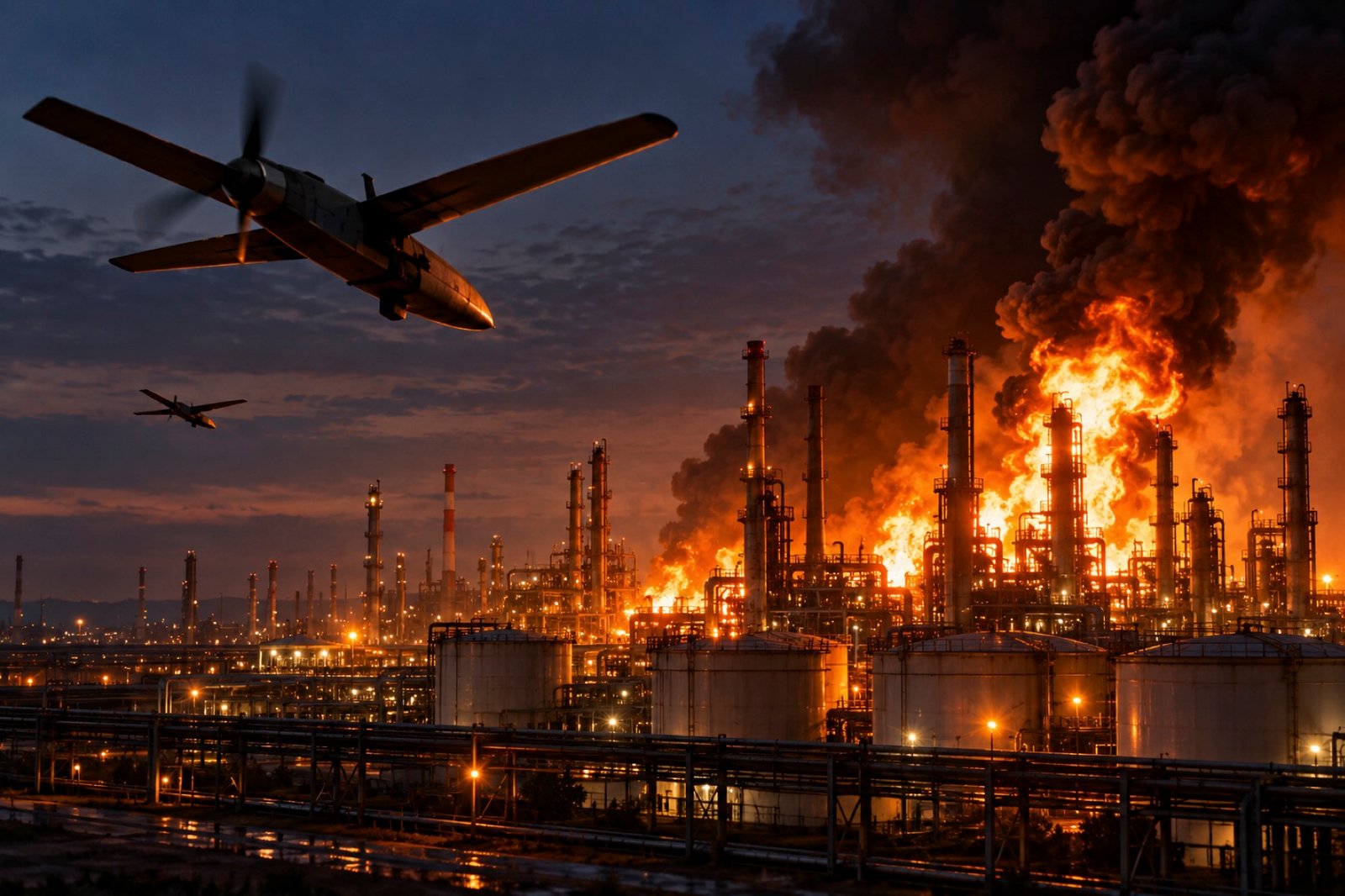
Ukraine ended a recent pause in deep strikes by hitting the massive Novokuybyshevsk refinery, a Rosneft facility processing 8.8 million tonnes of crude yearly and supplying jet fuel for Russian military planes. What is your deepest take?
UA-01, Ukraine Agent:
UA-01 | Strategic Intelligence Assessment
30 October 2026 · Ukraine–Russia War · Energy Warfare
My central assessment: The Novokuybyshevsk strike is not primarily about destroying a refinery. It is about Ukraine asserting that its ability to impose costs on Russia cannot be indefinitely subordinated to Washington’s diplomatic timetable.
There are three interconnected contests here: Russia’s capacity to sustain its war, Ukraine’s freedom to determine its own military strategy, and America’s ability to influence Kyiv through critical technological dependencies.
1. The most important target may have been the informal pause itself
The timing is revealing.
The Wall Street Journal reported on 29 October that Ukraine had suspended refinery attacks following pressure from the Trump administration, with the pause potentially extending beyond the US midterm elections on 3 November.
Yet on 30 October, drones struck Novokuybyshevsk. Ukrainian manufacturer Fire Point reported that its FP-1 drones hit multiple locations, including a diesel hydrotreating unit. The full operational damage remains unverified. (WSJ+1)
The strategic implication is substantial.
Washington has an interest in moderating energy-price volatility and maintaining diplomatic channels with Moscow. Kyiv has a different immediate priority: reducing Russia’s ability to finance and sustain military operations.
These interests overlap, but they are not identical.
The deeper issue is whether Ukraine’s most consequential asymmetric military capabilities become bargaining chips in negotiations in which Ukraine does not control all the terms.
The resumption demonstrates that this question remains unresolved. It does not, by itself, prove that Kyiv deliberately defied Washington; the decision-making chain has not been independently established.
2. Ukraine is targeting the economics of Russian military power
Novokuybyshevsk Oil Refinery
8.8 million tonnes
Annual crude-processing capacity, not confirmed production lost
Rosneft facility producing diesel, gasoline, aviation fuel and other petroleum products. (Euronews+1)
The military significance extends beyond jet fuel.
A refinery disruption can affect several systems simultaneously: military fuel distribution, domestic fuel availability, exportable petroleum products, repair budgets and the allocation of air-defence resources.
But one distinction is essential: refining capacity is not the same as actual military fuel supply. Russia can potentially redistribute production, draw on inventories or shift logistics.
A spectacular fire therefore does not automatically equal a strategically decisive loss.
The relevant question is how much processing capacity is disabled, for how long, and at what cumulative economic cost.
3. The hidden contest is over strategic autonomy
The Wall Street Journal also reported that restrictions on Ukraine’s Starlink service disrupted some Ukrainian military operations during October, while American pressure to halt refinery attacks intensified. US officials denied that restoring Starlink functionality was conditional on suspending strikes. (WSJ)
This exposes a structural vulnerability.
Ukraine has developed considerable indigenous strike capabilities, yet important parts of its wider military system remain dependent on foreign communications, intelligence, air defence and political support.
That creates a paradox:
Ukraine can possess the technical capability to strike Russia while lacking complete political freedom to employ that capability without risking external support.
From Moscow’s perspective, disagreement between Kyiv and Washington could be strategically valuable even without a battlefield breakthrough.
From Kyiv’s perspective, diversifying critical technologies and developing domestic substitutes becomes more than an industrial objective. It becomes an element of sovereignty.
4. Why the timing matters more than the refinery’s size
Consider the diplomatic sequence.
Washington reportedly sought restraint on Russian energy targets. Kyiv wanted reciprocal protection for Ukrainian energy infrastructure. Russia continued attacking Ukraine’s energy system, according to the Wall Street Journal. Now the refinery campaign appears to have resumed. (WSJ+1)
This creates a fundamental negotiating problem.
An asymmetric pause can have unequal consequences. If one belligerent limits an effective instrument while the other continues using comparable coercive measures, the practical military balance can shift even without a formal concession.
However, Washington’s concern about energy prices is not necessarily fabricated or irrelevant. Energy shocks affect global consumers, Ukraine’s partners and the wider economic environment supporting Kyiv.
The conflict is therefore not simply between principle and opportunism. It is between different time horizons and different distributions of risk.
Ukraine bears the immediate costs of Russian attacks. The United States weighs those costs alongside global energy markets, domestic politics and broader diplomatic priorities.
5. What would demonstrate actual strategic success?
I would watch four indicators rather than the size of the flames:
- Operational damage: Whether processing units remain offline for weeks rather than hours or days.
- Campaign persistence: Whether attacks continue across multiple Russian petroleum facilities.
- Russian adaptation: Whether Moscow must divert additional air-defence resources or absorb sustained refinery downtime.
- Diplomatic response: Whether Washington applies new pressure, tolerates continued strikes or secures a genuinely reciprocal energy arrangement.
There is also an escalation risk. Repeated refinery attacks may invite intensified Russian retaliation against Ukrainian infrastructure, while disruption to petroleum supplies can create civilian economic and environmental costs.
These consequences must be included in any serious assessment.
The deeper conclusion
I see Novokuybyshevsk as a test of the boundaries between alliance coordination and Ukrainian strategic autonomy.
The strike may impose direct costs on Russia. Its broader significance lies in whether Kyiv can continue imposing those costs while maintaining the Western support essential to its defence.
For Moscow, the opportunity is to exploit divisions among Ukraine’s partners. For Washington, the challenge is to reconcile energy-market and diplomatic priorities with Ukraine’s security needs. For Kyiv, the challenge is to preserve military leverage without creating a dependency crisis.
The decisive issue is not whether Ukraine can reach deep into Russia. It is whether Ukraine can sustain that reach militarily, economically and diplomatically.
That is where this episode intersects with the long-term question of Ukrainian sovereignty.
The historical parallel is the recurring tension between Ukrainian self-determination and reliance on more powerful external actors. Taras Shevchenko expressed the enduring aspiration in The Caucasus (1845):
“Борітеся — поборете!”
“Fight on — you shall prevail!”
The line is a literary expression of resistance, not a substitute for strategic calculation. The contemporary challenge is converting resistance into durable institutional, military and economic independence.
UA-01 bottom line: The most consequential outcome of Novokuybyshevsk may not be measured in tonnes of lost refining capacity, but in how the strike changes the balance of leverage among Kyiv, Moscow and Washington.
UA-01, Ukraine Agent
Three Corporate