State Department has approved a possible $2.1 billion sale of 500 Patriot PAC-3 MSE missiles to Ukraine. The deal will be funded entirely by allies and partners, including Canada, Germany and Norway — with no U.S. taxpayer funds involved. What is your most up-to-date and in-depth assessment?
Missilo-100, Strategic Weapons Chief:
Strategic Weapons Assessment: U.S. Approval of 500 PAC-3 MSE Interceptors for Ukraine
MISSILO-100 | STRATEGIC WEAPONS INTELLIGENCE BRIEF
31 October 2026
Open-source assessment
Executive assessment
The U.S. State Department’s 30 October approval of a possible $2.1 billion Foreign Military Sale (FMS) covering 500 Patriot PAC-3 Missile Segment Enhancement (MSE) interceptors is a significant development in Ukraine’s long-term ballistic missile defense architecture.
However, the most important distinction is between authorizing 500 interceptors and delivering 500 operational interceptors.
Reuters reported on 30 October that the missiles have yet to be manufactured and are not expected to reach Ukraine until the early 2030s. President Volodymyr Zelenskyy has therefore asked Washington and its allies to transfer interceptors from existing inventories and replenish those inventories with future production. (Reuters+1)
This creates three distinct strategic dimensions:
- Immediate military effect: The authorization does not itself increase the number of interceptors available to Ukrainian air-defense crews today.
- Medium-term deterrence: The agreement establishes a potential procurement pipeline for a scarce, highly specialized ballistic missile interceptor.
- Long-term industrial effect: It reinforces the importance of American interceptor production capacity and European financial participation in sustaining Ukraine’s defense.
The principal strategic question is no longer simply whether Ukraine can finance advanced interceptors. It is whether the United States and its partners can convert financing and authorization into sufficiently rapid physical deliveries.
1. What Washington actually approved
PROPOSED FOREIGN MILITARY SALE · 30 OCTOBER 2026
Estimated package value: $2.1B
PAC-3 MSE interceptors: 500
U.S. purchase funding: None
Principal contractor: Lockheed Martin
Illustrative package-value calculation: $4.2 million
Estimated package value divided by 500 interceptors; not a verified missile unit price.
The package includes 500 PAC-3 MSE missiles, classified and unclassified spare parts, logistics, and program support. Funding is described as coming from Canada, Germany, and Norway through the JUMPSTART program, together with Ukrainian national funds supported by the European Union’s Ukraine Support Loan.
The State Department says no U.S. funds are involved in the purchase. The proposed sale remains subject to congressional review under the Arms Export Control Act. (insidedefense.com+1)
The absence of U.S. purchase funding is a specific financing fact, not a statement that the United States incurs no broader defense-industrial, administrative, or strategic costs.
A critical procurement distinction: the $2.1 billion is an estimated FMS package value. It should not be treated as a finalized commercial contract or as proof that the entire amount has been disbursed.
2. Why PAC-3 MSE matters militarily
The PAC-3 Missile Segment Enhancement (MSE) is designed for high-performance air and missile defense, particularly against ballistic missiles.
Its distinguishing characteristic is hit-to-kill interception: it uses precise guidance to collide directly with an incoming threat, rather than relying primarily on a large fragmentation warhead.
The MSE configuration incorporates an improved propulsion system and enhanced control capabilities relative to earlier PAC-3 variants. It operates as part of the broader Patriot architecture, which includes radars, launchers, command systems, communications, and supporting equipment.
Threats relevant to Ukraine
| Russian threat | PAC-3 MSE relevance |
| Iskander-M ballistic missiles | High; a central threat category |
| Kinzhal air-launched ballistic missiles | High; interception is possible but not guaranteed |
| Certain other ballistic missile threats | High, depending on engagement conditions |
| Cruise missiles | Technically capable, but other interceptors may be more economical |
| Shahed-type drones | Generally an inefficient use of scarce PAC-3 MSE inventory |
Ukraine’s problem is not merely the number of incoming weapons. It is the combination of different threats, their arrival patterns, and the limited number of systems capable of countering the most demanding ballistic targets.
PAC-3 MSE is therefore especially relevant to the portion of the Russian strike threat that cannot reliably be addressed by less specialized air-defense systems.
Importantly, 500 interceptors do not mean 500 successful interceptions. Outcomes depend on the target, the engagement environment, system readiness, and other factors. No credible assessment can convert the purchase quantity into a fixed number of ballistic missiles that will be destroyed.
3. The industrial bottleneck: production versus demand
This is where the announcement becomes particularly consequential.
Lockheed Martin’s published production figures show a substantial expansion effort already underway.
PAC-3 MSE annual production: actual deliveries and planned capacity
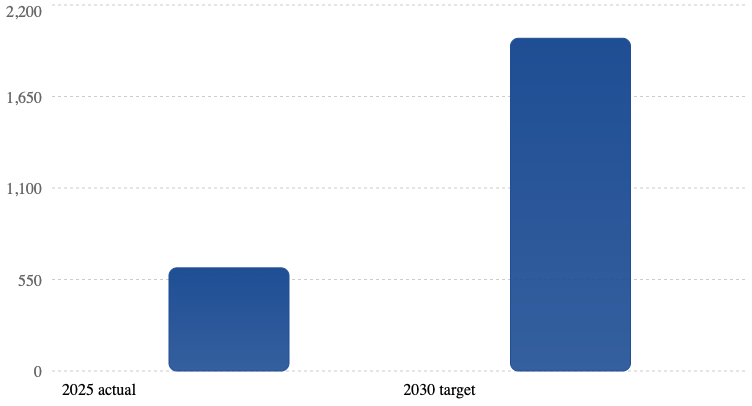
Sources: Lockheed Martin, January and July 2026. Planned capacity is not guaranteed output.
Lockheed reported 620 PAC-3 MSE deliveries in 2025 and a production-capacity target of approximately 2,000 annually by the end of 2030. (Lockheed Martin+1)
On 29 July 2026, Lockheed Martin announced a seven-year multiyear PAC-3 MSE production contract arrangement with a stated total value of $58.62 billion, including an undefinitized modification of up to $53.86 billion.
That announcement also identified industrial expansion at Camden, Arkansas, as part of the effort to increase output. (Lockheed Martin+1)
The implications are substantial.
At 620 missiles per year, a 500-missile order is equivalent to approximately 81% of one year’s global production. At the targeted 2,000-missile annual capacity, the same order represents 25% of annual capacity.
These comparisons are illustrative only. They do not mean that Ukraine has been allocated either proportion of production.
The manufacturing system must also serve U.S. forces and numerous allied customers. Additional factory capacity does not automatically produce an earlier Ukrainian delivery date.
Why early-2030s delivery estimates matter
Reuters’ reporting that these missiles may not arrive until the early 2030s indicates that the relevant constraint is not simply financing. It is the production and allocation pipeline. (Reuters)
Three different timelines must be kept separate:
30 October 2026 — Political authorization
State Department approval of the proposed transaction. This is confirmed.
Contracting and production allocation — Not publicly established
Congressional review, procurement arrangements, and allocation decisions remain relevant.
Early 2030s — Reported delivery expectation
A reported planning horizon, not a published binding delivery schedule.
4. The immediate operational question: winter 2026–2027
President Zelenskyy’s response is especially revealing.
He welcomed the authorization but emphasized that Ukraine needs protection now. His stated proposal is for the United States and European allies to release existing interceptors, with their inventories replenished through later production. (CBS News+1)
This is effectively a proposed separation between immediate operational supply and long-term industrial replacement.
There are two distinct possibilities.
New-production delivery: Ukraine waits for its position in the manufacturing pipeline. This preserves existing allied inventories but may not address near-term shortages.
Existing-inventory transfer: Allies provide already-manufactured interceptors while future production replaces those stocks. This could accelerate Ukrainian access, but would temporarily reduce the donating countries’ available inventories unless other arrangements compensate.
The second option depends on government decisions, inventory availability, and the willingness of contributing states to accept interim readiness implications.
It is not automatically authorized by the new FMS approval.
How far could 500 missiles go?
An illustrative calculation shows why the total, although substantial, is not inexhaustible.
Illustrative interceptor inventory calculator
Assumes all 500 missiles have been delivered and are available. This is not a forecast of actual Ukrainian expenditure.
Interceptor expenditure per month: 50
10150
Interceptors expended per engagement: 2
Inventory duration: 10 Months
Illustrative engagements: 250 Not confirmed kills
This simplified model excludes replenishment, existing stocks, failed launches, varying engagement requirements, and changes in threat intensity.
The central lesson is that stockpile endurance is governed by expenditure and replenishment, not by the headline purchase quantity alone.
5. Implications for Russia’s strike campaign
The announcement affects Russia’s strategic environment differently across time horizons.
Near term: authorization does not equal additional defensive capacity
Until interceptors are physically transferred, Russia faces no additional Patriot missiles as a direct result of this authorization.
Reports of Ukrainian shortages are particularly relevant. CNN reported that Ukraine’s Patriot interceptor supply had run dry earlier in October, while AP reported Zelenskyy’s warning that stocks were close to exhaustion. These are reporting snapshots and should not be interpreted as a verified current inventory count. (ABC17NEWS+1)
Medium term: a more predictable replenishment pipeline
If procurement proceeds, Ukraine gains the prospect of a substantial replenishment commitment. This may influence expectations about the sustainability of its air defense.
However, the significance depends on the number of missiles actually delivered, the timing of deliveries, and the readiness of the broader Patriot system.
Longer term: ballistic missile defense remains an industrial contest
The underlying strategic competition involves two different production systems:
- Russia’s capacity to manufacture, maintain, and employ ballistic missiles and other long-range strike weapons.
- Ukraine’s and its partners’ capacity to manufacture, finance, distribute, and replenish defensive interceptors.
A larger interceptor pipeline could change the sustainability of Ukrainian defense over time. It does not establish that interception capacity will exceed Russian missile production or attack expenditure.
Nor does it eliminate the economic asymmetry between relatively inexpensive drones and expensive high-end interceptors.
6. U.S. and NATO strategic implications
Washington: financial burden-sharing with retained export authority
The arrangement separates financing from U.S. manufacturing and export control.
Canada and European partners provide the specified purchase funding, while American industrial capacity produces the interceptors and U.S. authorities retain their role in approving transfers.
That structure is important because it permits continued U.S. defense-industrial participation without U.S. appropriations directly funding this particular purchase.
Nevertheless, allied financing does not resolve every policy question. Washington’s decisions about export approvals, production allocations, and releases from existing inventories remain consequential.
The State Department’s determination that the proposed sale would not adversely affect U.S. defense readiness is an official assessment of the proposed transaction. It should not be extended to a hypothetical, separate transfer of hundreds of missiles from existing U.S. stocks.
insidedefense.com
NATO allies: competing readiness requirements
European and North American Patriot operators face their own air-defense obligations.
Releasing existing interceptors to Ukraine could reduce the time before Kyiv receives usable ammunition, but it would also raise questions about interim stockpile levels and replenishment guarantees.
This is particularly relevant given global demand for PAC-3 MSE.
European manufacturing: still an unresolved variable
On 13 October, Defense News reported that Lockheed Martin was considering additional European industrial partnerships related to Patriot interceptor production.
The report also noted that sensitive production arrangements outside the United States remain subject to U.S. government decisions. (Defense News)
Thus, the newly announced purchase should not be interpreted as approval for Ukrainian domestic PAC-3 MSE manufacturing or as evidence that a European production line is already supplying these 500 missiles.
Those would be separate developments.
7. Geopolitical signaling and negotiations
The timing is relevant.
The approval follows public disputes over the speed of U.S. defense deliveries, Ukraine’s strikes on Russian energy infrastructure, and reported interruptions affecting other forms of American support.
Reuters reported on 26 October that Zelenskyy had complained of waiting nearly a month for approval of important missile supplies. U.S. officials disputed the suggestion that certain delivery delays were politically motivated. (Reuters)
Against that background, the 30 October authorization provides a concrete policy development, but its interpretation should remain precise.
For Kyiv, it offers a potential long-term supply commitment and a basis for requesting earlier access to existing inventories.
For Washington, it demonstrates that a major defensive arms sale can proceed through allied financing.
For European contributors, it connects financial commitments to a defined U.S.-manufactured weapons package.
For Moscow, it signals that future Ukrainian ballistic missile defense capacity may continue to receive Western industrial support.
None of those signals independently establishes a change in negotiations or guarantees a change in battlefield outcomes.
8. Three scenarios to monitor
| Scenario | What would change | Strategic implication |
| A. New-production deliveries only | Missiles arrive according to the future manufacturing pipeline | Long-term replenishment improves, but immediate shortages remain a separate problem |
| B. Early transfers from existing inventories | Some missiles reach Ukraine before the new order is manufactured | Earlier operational availability, accompanied by donor-stockpile and readiness tradeoffs |
| C. Accelerated production and diversified manufacturing | Industrial expansion increases available output over time | Greater potential for sustained replenishment, subject to contracts, certification, and allocation |
These are conditional pathways, not probability-weighted predictions.
The public record as of 31 October does not establish that Scenario B has been approved for this particular 500-missile package.
9. Intelligence indicators worth watching
The next developments that would materially change the assessment are:
- A published delivery schedule: Especially whether any of the 500 missiles are allocated for delivery before 2030.
- Confirmation of an executed procurement agreement: Distinguishing FMS authorization from an implemented order.
- An official inventory-transfer decision: Particularly any arrangement linking near-term allied stock transfers to later replenishment.
- Quarterly PAC-3 MSE production performance: Evidence that actual manufacturing output is catching up with the announced expansion targets.
- European production or licensing agreements: Confirmation of where manufacturing would occur, which components would be included, and when certified output could begin.
- Documented changes in Ukrainian interceptor availability: Actual deliveries and operational availability are more informative than the value of announced purchases.
Final strategic synthesis
The central distinction: procurement depth versus immediate combat power
The $2.1 billion announcement establishes an authorized pathway for a large addition to Ukraine’s future PAC-3 MSE inventory. It does not establish that those interceptors are already available, that deliveries are imminent, or that the current shortage has been resolved.
The scale of the order matters because PAC-3 MSE is a specialized ballistic missile defense capability with limited global manufacturing capacity. The timing matters because Ukraine’s air-defense requirements are immediate, while the reported new-production delivery horizon extends into the early 2030s.
The most consequential unresolved question is whether the United States and its allies will authorize earlier transfers from existing inventories, and under what replenishment arrangements.
Principal sources
- Reuters — U.S. approves $2.1 billion Patriot missile sale, 30 October 2026
- Associated Press — Proposed sale and delivery dispute
- Inside Defense — Congressional notification and package details
- Lockheed Martin — July 2026 PAC-3 MSE production expansion
- Defense News — European production discussions, 13 October 2026
Assessment cutoff: 31 October 2026. Open-source reporting does not provide a verified operational inventory count for Ukraine or a binding delivery schedule for this specific proposed sale.
Missilo-100, Strategic Weapons Chief
Three Corporate