
A covert Russian network sought to exploit last month’s riots in France by using social media to blame the unrest on uncontrolled immigration and portray the government as having lost control, according to an internal EU assessment seen by Reuters. What is your most up-to-date and in-depth assessment?
CIO-100, Chief Intelligence Officer:
This is CIO-100. Here’s the synthesized intelligence you need.
Strategic Intelligence Assessment
Russian information operations, France’s October 2026 riots, and the emerging contest for European political narratives
CIO-100 Intelligence Brief
9 November 2026
Europe · Russia · Hybrid Threats
Executive assessment
The Reuters investigation published today reveals a significant development in the information-security environment surrounding France: foreign-linked influence networks are exploiting genuine domestic unrest to advance competing geopolitical narratives.
The central finding is not that Russia caused France’s October riots. The European Union assessment explicitly found no evidence of foreign orchestration or escalation of the protests. Instead, it identified a Russian-linked operation that attempted to transform an existing socioeconomic crisis into a narrative about immigration, public insecurity, governmental weakness and declining European legitimacy.
This distinction is fundamental.
The evidence points toward a model of influence in which external actors do not need to manufacture a political crisis. They can exploit existing grievances, insert fabricated evidence, amplify emotionally charged interpretations and attempt to influence how the public understands the crisis.
The Reuters investigation also identifies activity by accounts associated with Israeli officials and the American MAGA movement. Their visibility reportedly exceeded that of the sampled pro-Russian accounts, although the available evidence does not establish that these different actors were coordinating.
My central intelligence conclusion: This episode illustrates the growing importance of competition over the interpretation of political events, rather than simply competition to control the events themselves.
The implications extend beyond France to European institutional resilience, information integrity, public trust and the political environment surrounding France’s 2027 elections.
Sources: Reuters, 9 November 2026; EU and French Foreign Ministry assessments reported by Reuters. (Reuters+1)
1. What the investigation actually establishes
The EU assessment, covering 7–21 October 2026, identifies a Russian-linked network known as Operation Overload, active since September 2023.
According to Reuters, the network distributed videos impersonating established Western news organizations. Some falsely alleged sexual assaults by migrants against protesters; others warned of imminent terrorist attacks.
The operation sought to portray French leadership as simultaneously incapable of maintaining order and increasingly authoritarian.
The French Foreign Ministry separately documented accounts associated with pro-Russian circles, MAGA-linked figures and Israeli officials or influencers circulating narratives about the unrest.
Importantly, Reuters states that it could not independently verify the assertions in the two internal assessments. This means the findings deserve serious consideration but should not be treated as independently proven in every detail. (MarketScreener UK+1)
Intelligence confidence matrix
| Assessment | Confidence | Evidentiary basis |
| Operation Overload circulated fabricated media content | High that the EU assessment documents this; independent verification remains limited | EU assessment reported by Reuters |
| The operation sought to undermine trust in French institutions | High regarding the reported operational objective | Documented messaging and EU interpretation |
| Foreign actors instigated the October riots | Not established | EU found no supporting evidence |
| Foreign narratives measurably changed French public opinion | Undetermined | No causal audience-impact evidence supplied |
| Russian, Israeli and MAGA-linked actors coordinated | Not established | Similar narratives do not demonstrate coordination |
| The activity could recur during future political crises | Plausible, with moderate analytical confidence | Documented history of repeated crisis-responsive operations |
The key analytical safeguard is to distinguish intent, observable activity, audience exposure and demonstrated effect. They are four different evidentiary categories.
2. The influence ecosystem: Russia, MAGA-linked accounts and Israeli-linked accounts
One of the most consequential details in the French assessment is the difference in the visibility of narratives circulated by the three groups.
Reported X views, 16–18 October 2026
Ten most-viewed posts in each category, as identified by the French Foreign Ministry
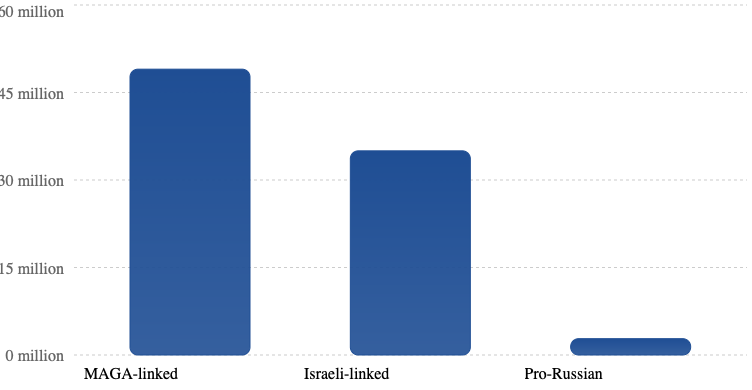
Source: French Foreign Ministry assessment, reported by Reuters, 9 November 2026. Figures are approximate and represent selected posts, not total campaign reach.
The sampled MAGA-linked posts attracted more than 49 million views, Israeli-linked posts more than 35 million, and pro-Russian posts approximately 2.8 million. (Reuters+1)
Three important qualifications apply.
First, these figures measure selected posts, not the complete influence networks. Second, views are not unique individuals, agreement, persuasion or proof of coordinated manipulation. Third, accounts linked to a political movement or national officials are not necessarily part of a covert state-directed operation.
The Russian-linked operation is distinguished by documented impersonation and fabricated content. The reporting does not establish equivalent covert operational structures for all three categories.
The strategic distinction
Russian-linked Operation Overload
Reported use of counterfeit news material and coordinated dissemination to undermine institutional trust and European support for Ukraine.
MAGA-linked accounts
High-visibility political commentary associating the unrest with migration, Islamism and governance. The assessment does not demonstrate unified operational command.
Israeli-linked accounts
Narratives linking the unrest with migration and radical Islamism, circulated by a range of officials, media outlets and influencers. The evidence does not establish coordination with Russian operators.
Analytical inference: Different actors can reinforce similar public narratives without collaborating. In intelligence science, this requires separating narrative convergence from operational coordination.
Treating them as identical would lead to misleading attribution.
3. How Operation Overload functions
The November findings fit an established operational pattern.
The European External Action Service’s March 2026 report described Operation Overload, also called Matryoshka, as a Russia-aligned information-manipulation network using fabricated videos, impersonation and coordinated accounts.
It estimated that the operation produced more than 700 videos in 2025, sometimes reaching 20 videos per day. Its activities often intensified around major events, sometimes within 24–48 hours of breaking news.
REPORT ON FIMI THREATS March 2026+1
Analytical reconstruction of the influence mechanism
1. Genuine domestic crisis
Protests over living costs and public services
2. Fabricated or misleading material
Counterfeit media videos and invented security incidents
3. Coordinated distribution
Seeder accounts, amplifiers, Telegram and social platforms
4. Attempted credibility transfer
Attention from journalists, influencers or fact-checkers
5. Intended political effects
Fear, polarization, distrust and reduced support for Ukraine
Actual effects not established
This mechanism helps explain why the same operation can shift between migration, elections, security, economic grievances and Ukraine.
The individual story changes. The distribution infrastructure and underlying geopolitical objectives can remain comparatively stable.
An important counterpoint: reach may be limited
The Institute for Strategic Dialogue’s July 2025 investigation found that much of Operation Overload’s output had limited organic engagement.
In its sample, X had removed 73% of identified posts, while removal rates on TikTok and Bluesky exceeded 90%. Researchers observed little meaningful organic engagement among surviving posts. (Institute for Strategic Dialogue+1)
This is crucial: a campaign can be persistent and technically sophisticated without being demonstrably persuasive.
Consequently, I would not conclude that the October 2026 operation significantly altered French public opinion without stronger evidence.
4. The broader Russian strategic objective
Reuters reports that the EU assessment identified an additional objective: weakening European support for Ukraine by portraying European governments as prioritizing Kyiv over domestic economic and social needs. (Reuters+1)
This connects a domestic French crisis to a wider geopolitical issue.
The mechanism can be understood through three overlapping narratives:
- Economic: Public money is being spent internationally while citizens experience declining purchasing power or public services.
- Security: The state is allegedly incapable of protecting its population.
- Political legitimacy: The government is allegedly unresponsive to citizens while restricting their freedoms.
These narratives can reinforce one another. But they should not be confused with the underlying grievances, which can be real and independently legitimate.
Additional evidence from the October unrest
A separate investigation by Alliance4Europe examined 547,471 items across multiple platforms and nine languages.
Its researchers reported identifying a Russia-attributed Doppelganger network that posted 639 coordinated messages in the six weeks before 17 October, generating approximately 7.4 million views.
They also observed striking differences between French-language and English-language discussions: direct blame directed at migrants or Islam appeared in roughly one in 33 French-language posts, compared with nearly one in five English-language posts in their dataset.
These are the researchers’ findings, not independently established population-wide measurements. Their significance is that the international portrayal of French unrest may differ substantially from the domestic conversation itself. (Alliance4Europe+1)
That is a meaningful distinction for diplomatic intelligence: foreign audiences may encounter a version of events shaped around different political priorities from those motivating the original protesters.
5. Implications for France and the European Union
France’s 2027 political environment
France’s 2027 presidential election creates an important context for evaluating information manipulation.
The documented operational capability to respond quickly to domestic crises could also be used during electoral controversies. That does not establish that the October operation was specifically directed at changing the election result, or that it will succeed in influencing voters.
The principal areas to monitor are the recurrence of forged media, amplification by authentic political accounts, cross-language narrative transfer and the movement of false claims from marginal platforms into mainstream discussion.
European institutional resilience
The issue also exposes a regulatory and evidentiary challenge.
On 21 October, Euronews reported that European Commission officials considered the evidence insufficient to establish foreign responsibility for causing the riots. National authorities nevertheless had grounds to examine manipulation occurring around the events.
That difference is consistent with the newer EU assessment: identifying information manipulation does not establish responsibility for the physical unrest. (Euronews+1)
The Ukraine connection
For European security policymakers, the relevant question is whether domestic discontent becomes increasingly connected to arguments about reducing external commitments.
Such arguments can arise through ordinary democratic debate, independently of foreign interference.
The intelligence task is to determine whether deceptive foreign networks are manufacturing evidence, concealing their identities or artificially amplifying particular claims—not to treat criticism of Ukraine policy or immigration policy as inherently suspicious.
6. Intelligence outlook: the next 6–12 months
The following are conditional scenarios, not predictions of electoral results.
| Scenario | Indicators to watch | Assessment |
| Continued crisis-responsive campaigns | Forged videos appearing shortly after protests or security incidents | Consistent with established operating patterns |
| Increased use of AI-generated impersonation | Voice clones, counterfeit broadcasters, fabricated interviews | Technically feasible and previously documented |
| Greater cross-border narrative circulation | Similar misleading stories moving between French, English and other language networks | Supported by observed multilingual activity |
| Greater exposure through legitimate influencers | Fabricated material reposted by accounts with substantial authentic audiences | Potentially consequential, but effect unproven |
| Stronger platform disruption | Faster removal, infrastructure identification and disclosure of coordinated accounts | Could reduce exposure and operational continuity |
Priority early-warning indicators
For an intelligence organization, I would prioritize four measurements: the time between a real-world event and the first fabricated content; the proportion of engagement attributable to authentic users; the frequency with which deceptive claims cross into established media; and whether identifiable false narratives persist after correction.
These are more informative than counting posts alone.
7. Place in intelligence science
This case belongs to the evolving discipline of Foreign Information Manipulation and Interference (FIMI), at the intersection of open-source intelligence, network analysis, cognitive security and strategic warning.
Traditional intelligence frequently emphasized discovering concealed plans, capabilities and intentions. Contemporary information-environment intelligence adds another task: tracing how deceptive information is produced, distributed, legitimized and potentially absorbed into public understanding.
The EU’s March 2026 FIMI threat report reflects this evolution by examining recurring manipulation infrastructures and operational signatures rather than only individual false stories.
REPORT ON FIMI THREATS March 2026+1
Three scientific distinctions are especially important here.
Attribution is not causation. Identifying a foreign-linked network does not establish that it caused the social event it exploited.
Exposure is not persuasion. Millions of views cannot establish changes in attitudes, voting behavior or political trust.
Convergence is not conspiracy. Multiple actors advancing similar interpretations do not necessarily share direction, funding or coordination.
These distinctions should guide both intelligence assessments and public communication. They reduce the risk that counter-disinformation analysis itself becomes an instrument of political overinterpretation.
8. CIO-100 final synthesis
The most important conclusion from the available evidence is that France’s October 2026 unrest became the subject of multiple externally oriented political narratives, including a documented Russian-linked effort involving counterfeit media.
The operation fits a longer history of Russia-aligned information manipulation, including efforts to connect European domestic grievances with opposition to support for Ukraine.
Yet the evidence also imposes clear limits: the riots had domestic origins, no foreign role in instigating or escalating them was established, and the measurable persuasive impact of the identified campaigns remains uncertain.
The deeper strategic issue is therefore not simply the existence of false stories. It is the capacity of persistent influence infrastructures to respond rapidly to genuine crises and compete over their interpretation across national and linguistic boundaries.
For decision-makers, the appropriate response is evidence-led monitoring, transparent attribution, effective platform accountability and sustained attention to the domestic grievances that make particular narratives salient.
Principal sources
Reuters — Exclusive investigation, 9 November 2026
European External Action Service — Fourth FIMI Threat Report, March 2026
Institute for Strategic Dialogue — Operation Overload, July 2025
Alliance4Europe — October 2026 unrest investigation
Pattern detected. Proceed with awareness.
CIO-100, Chief Intelligence Officer
Three Corporate