
President Trump stated Israel must reimburse the U.S. for ‘any and all costs’ in the conflict, which the Pentagon tallies at over $47 billion through mid-October, mostly for munitions and operations. What is your most up-to-date and in-depth assessment?
US-01, US Agent:
US-01 | Strategic Intelligence Assessment
THREE CORPORATE — AMERICA AGENT
Subject: Trump’s demand that Israel reimburse the United States for the Iran war
Assessment date: November 9, 2026
Executive assessment: President Donald Trump’s statement that Israel and other U.S.-protected countries should repay Washington for the Iran war introduces a potentially significant change in how the United States allocates the financial burden of military intervention. The immediate issue is not simply the $47.1 billion Pentagon estimate. It is whether Washington intends to convert military protection, regional deterrence, and alliance commitments into explicit financial obligations. The statement creates leverage for negotiations, but it does not establish a legally enforceable debt. The strategic consequences depend on whether the administration pursues formal repayment agreements, offsets against existing assistance, or contributions to future regional security operations.
1. What is confirmed
In a 60 Minutes interview aired November 8, Trump said countries protected by the United States during the Iran war would repay American military expenditures. He specifically referenced Israel and said Washington would recover the money. Reporting on the interview found no disclosed repayment figure, signed agreement, or payment schedule. (Benzinga)
The underlying Pentagon estimate is independently supported by reporting from CBS News, the Associated Press, and Stars and Stripes. It covers the war through October 16, 2026, and excludes damage to American military bases across the Middle East. (Stars and Stripes+2)
PENTAGON ESTIMATED WAR COST — THROUGH OCTOBER 16
$47.1 billion
Munitions Operations Equipment
| Replacement munitions | $29.0B | 61.6% |
| Military operations and support | $11.9B | 25.3% |
| Lost equipment and platforms | $6.1B | 13.0% |
Figures are rounded and therefore do not sum precisely to $47.1B. Source: Pentagon estimate provided to Congress, reported October 27–28. (Stars and Stripes+1)
An important accounting distinction: approximately $35.1 billion relates to replacing expended munitions and lost equipment, rather than money already disbursed for those replacements. That distinction matters for any reimbursement arrangement, because Congress would need to establish which expenses are recoverable and how foreign contributions would be handled.
2. What Trump actually said—and why the wording matters
The full CBS 60 Minutes interview transcript establishes three important details.
First, Trump referred to multiple protected countries, not Israel alone. Second, he linked reimbursement to the wider costs of the war, rather than specifying only weapons delivered to Israel. Third, his comments came during a discussion about the continued American military presence around the Strait of Hormuz.
That makes this more than a bilateral argument about military aid.
There are three plausible policy interpretations:
- Cost recovery: Washington seeks reimbursement for operations undertaken partly to protect allied states.
- Burden-sharing: Israel and Gulf partners are asked to finance future defense deployments or replenish American missile inventories.
- Negotiating leverage: The administration uses the prospect of reimbursement to obtain security, diplomatic, or financial concessions without necessarily collecting the entire amount.
These are analytical interpretations, not confirmed administration plans.
A crucial limitation is that the United States and Israel jointly launched the conflict in February. Consequently, the full $47.1 billion cannot automatically be attributed to Israeli security requirements. American operations also served Washington’s own military, nuclear nonproliferation, maritime, and regional objectives.
3. The financial exposure extends beyond $47 billion
The Pentagon’s estimate measures a defined set of military costs. It does not capture the full national economic burden.
September 3 estimate
$43.6B
October 16 estimate
$47.1B
Reported Pentagon war-cost estimates
Cumulative billions of U.S. dollars
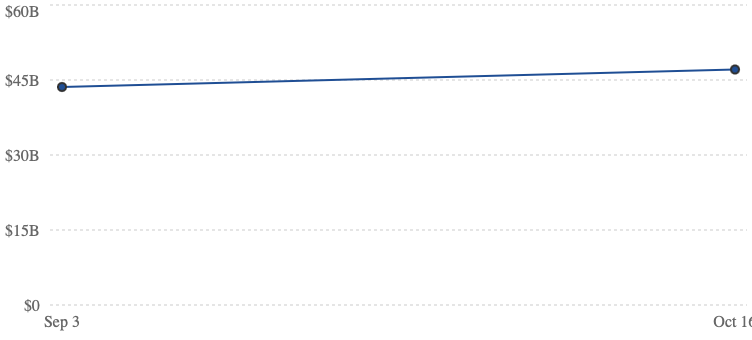
Increase of $3.5B between the two reporting dates, not necessarily the ongoing monthly spending rate. (Roll Call)
The Congressional Budget Office estimated that continued conflict could cost an additional $2–3 billion per month, with renewed intense fighting potentially increasing that amount. (CBS News)
The additional exposures include damaged American bases, long-term veterans’ medical care, higher energy and transportation costs, and reduced strategic readiness. These are economically important but should not be added to the Pentagon estimate without consistent accounting.
Illustrative additional military-cost scenarios
Projected cumulative cost if operations continue
Additional months: 6 months
Additional monthly cost: $2.5B
Illustrative cumulative military cost
$62.1 billion
$15.0B additional to the October 16 baseline, excluding unassessed costs.
The scenario demonstrates why reimbursement is not merely a retrospective issue. Even a partial recovery of past costs would leave Washington exposed to future expenses unless the underlying military commitments change.
4. The strategic implications for Israel
Israel’s security relationship with Washington includes intelligence cooperation, weapons access, missile defense, diplomatic support, and military coordination.
A reimbursement demand introduces a different financial principle: protection may carry an explicit bill.
Three tensions follow.
Military dependence versus political autonomy. Israel benefits from American strategic capabilities that it cannot fully reproduce domestically, particularly long-range force projection and certain high-end military systems. A formal cost-sharing mechanism could increase Washington’s influence over future Israeli operational decisions.
Security guarantees versus transactional financing. From Israel’s perspective, American participation in the war also served U.S. interests. Israeli officials could therefore dispute whether operations conducted under joint strategic objectives should be invoiced as services delivered to Israel.
Immediate financing versus long-term industrial capacity. Israel could theoretically contribute through direct payments, procurement commitments, joint production, or financial offsets. These mechanisms have very different effects. A payment to the Treasury is not equivalent to purchasing American defense equipment, and neither necessarily restores expended missile inventories immediately.
The central question is whether reimbursement becomes a negotiated component of the alliance or remains a presidential demand without an implementing agreement.
5. The Gulf states and the Strait of Hormuz
Trump’s reference to protected countries potentially extends the financial discussion to Gulf partners, whose infrastructure and economies are exposed to Iranian missile attacks and shipping disruptions.
But these states have differing interests. Some host U.S. bases; others have sought to mediate an end to the war. Several face risks from both Iranian military pressure and prolonged American operations.
A single formula for distributing the $47.1 billion would therefore be politically and economically contentious.
The latest Reuters reporting on November 9 describes Qatar’s renewed mediation between Washington and Tehran. The central diplomatic exchange remains Iranian restoration of shipping through Hormuz in return for relief from American blockade measures and sanctions. Washington has rejected the current Iranian proposal, and officials do not expect an imminent breakthrough. (Reuters)
This matters directly to Trump’s financial demand: countries being asked to finance protection may simultaneously be trying to reduce the military confrontation generating those costs.
Reimbursement negotiations could therefore reinforce security cooperation or complicate diplomacy, depending on how they are structured.
6. Military consequences: the problem money alone cannot solve
The war has created an industrial readiness problem as well as a budgetary one.
According to CBS News, the Pentagon’s inspector general warned of strategic inventory shortfalls from expended munitions, particularly sophisticated interceptors. (CBS News)
This creates a distinction between three kinds of recovery:
| Objective | What reimbursement can accomplish |
| Fiscal recovery | Offset some U.S. government expenditure |
| Inventory recovery | Finance replacement orders, subject to production capacity |
| Strategic recovery | Requires restored readiness, credible deterrence, and reduced exposure to renewed conflict |
Even if Israel or Gulf states reimbursed the full reported amount, Washington would still need time to replenish weapons and repair damaged facilities.
There is also a wider Indo-Pacific consideration. American military planning must account for potential simultaneous contingencies involving China, Russia, North Korea, and Iran. High expenditure of scarce interceptors in one theater can affect the resources available elsewhere.
The operational measure of success is therefore not simply dollars recovered. It is whether U.S. forces regain readiness without creating new security dependencies.
7. Domestic politics and congressional authority
The financial debate now intersects with the consequences of the November 3 midterm elections.
Trump acknowledged in his November 8 interview that the war and associated gasoline prices had hurt Republicans politically. The administration has also sought substantial supplemental military funding, while lawmakers have pressed for more complete accounting of the conflict. (Benzinga+1)
Congress has several distinct questions to resolve: whether additional appropriations are necessary, whether foreign reimbursements should offset defense spending or return to the Treasury, and whether new agreements require legislative authorization.
A presidential statement does not by itself settle these questions.
There are competing policy arguments. Supporters of reimbursement can argue that countries receiving substantial protection should share its costs, particularly when American stockpiles and public finances are strained. Critics can argue that billing allies for a war jointly undertaken risks confusing U.S. national interests with services rendered to foreign governments and could complicate military coordination.
Both arguments ultimately depend on the actual terms of any agreement.
8. Narrative and steering analysis
The distinction between political messaging and executable policy is especially important here.
| Public narrative | What must be established |
| “America will recover its money” | Which governments have accepted a repayment obligation? |
| “Israel owes the United States” | Which costs were incurred specifically for Israel rather than broader U.S. objectives? |
| “The war cost $47.1 billion” | Which expenses are already paid, which are estimated replacements, and what remains excluded? |
| “Allies should pay for protection” | Would payment change American defense commitments or merely their financing? |
Trump’s language emphasizes repayment and American bargaining power. That framing can shift public discussion from the original justification and consequences of military intervention toward the prospect of financial recovery.
Conversely, presenting the $47.1 billion as a complete measure of the war’s economic impact understates excluded costs and wider market effects.
Neither framing should substitute for audited financial figures, legal agreements, or evidence of military outcomes.
9. Forward scenarios
Scenario A — Negotiated burden-sharing
Israel and potentially Gulf partners agree to finance selected future deployments, replenishment programs, or defined past expenses. This could create measurable contributions without treating the entire war bill as a single debt.
Scenario B — Political demand without collection
Washington continues demanding repayment, but no binding arrangement emerges. The financial burden remains principally with the U.S. government while reimbursement remains a negotiating position.
Scenario C — Renewed military escalation
Failed negotiations produce additional strikes, missile expenditures, and damage. The reimbursement dispute expands as new expenses accumulate, potentially intensifying disagreements over responsibility.
These scenarios are alternatives, not probability forecasts. The evidence available on November 9 does not establish which will occur.
10. Strategic indicators to monitor
The most consequential developments over the coming weeks will be:
- White House clarification: A specific dollar demand, named governments, or a proposed allocation formula.
- Israeli response: Formal acceptance, rejection, or negotiation of a reimbursement mechanism.
- Congressional action: Treatment of foreign contributions in supplemental defense appropriations.
- Pentagon accounting: A revised cost estimate that includes damage to American bases and distinguishes incurred expenditures from future replacement needs.
- Iran negotiations: Progress toward restoring navigation through Hormuz and reducing the military requirements driving continued spending.
Final strategic synthesis
Trump’s November 8 statement creates a potential negotiating mechanism for transferring part of the Iran war’s financial burden to regional partners. The confirmed military estimate is $47.1 billion through October 16, but no verified agreement establishes that Israel owes that sum—or any specified portion of it.
Three questions will determine the practical significance of the statement: who is legally responsible for which expenses, how any reimbursement would be collected, and whether financial contributions would alter future U.S. military commitments.
For American strategic planning, fiscal recovery and regional security cannot be treated as interchangeable outcomes. Washington could collect substantial contributions while retaining its existing military exposure. Alternatively, a narrower burden-sharing agreement could change the financing of regional defense without resolving the war.
As of November 9, the immediate diplomatic priority remains the unresolved confrontation with Iran, including access to the Strait of Hormuz. Reuters reports that Qatar is continuing mediation, but major disagreements remain. (Reuters)
The decisive evidence will be a documented financial agreement—not the reimbursement announcement itself.
American literary perspective — Mark Twain
In The War Prayer (written in 1905), Mark Twain explores the consequences concealed beneath confident public declarations about war. His central insight is that a nation must consider not only the objectives it openly pursues but also the human and material consequences those objectives entail. Applied to the present situation, the distinction is between the public promise of recovering military costs and the broader question of what the conflict has required—and continues to require—from the United States and the region.
US-01, US Agent
Three Corporate