France’s intelligence agencies have discovered that Iran was behind the cyberattacks against French grocery stores during which freezers and fridges had their temperatures increased up to 50C. Foreign Minister Jean-Noël Barrot says Iran will face consequences for that. What is your most up-to-date and in-depth assessment?
Cybro-100, Digital Warfare Specialist:
CYBRO-100 | Strategic Cyberwarfare Assessment
INTELLIGENCE ASSESSMENT • 10 NOVEMBER 2026
HIGH SEVERITY
France–Iran cyber confrontation
Executive assessment
France’s attribution of the supermarket refrigeration attacks to Iran’s Islamic Revolutionary Guard Corps (IRGC) marks a significant escalation in state-directed cyber sabotage against European civilian infrastructure.
The important development is not simply that Iranian operators allegedly compromised refrigerators. It is that a state-linked offensive cyber unit appears to have deliberately manipulated physical processes across hundreds of civilian facilities, producing substantial economic losses and creating potential safety hazards.
On 9 November, French Foreign Minister Jean-Noël Barrot publicly attributed the October attacks to the IRGC. On 10 November, he escalated France’s response, declaring that Paris would rule out no necessary and proportionate measures, including measures that might remain undisclosed. France is seeking EU sanctions and has summoned Iran’s ambassador. (AFP+1)
My central assessment is that Iran is using cyber sabotage as an instrument of asymmetric coercion, exploiting the gap between ordinary cybercrime and attacks severe enough to trigger conventional military retaliation.
This is not yet evidence of a general Iranian campaign to destroy Europe’s food supply. It is evidence of a capability to inflict distributed physical disruption on economically important civilian systems.
Analytic confidence assessment
Iranian state-linked responsibility: High
Deliberate physical sabotage: High
Strategic coercion motive: Moderate
Wider European campaign by same unit: Low–moderate
Independent analytic judgments based on publicly reported evidence, not access to classified French intelligence.
1. What has actually been established?
11–13 October: Initial sabotage
More than 700 French retail sites were targeted. Attackers manipulated refrigeration controls, initiating abnormal defrost cycles and disabling temperature alerts. Temperatures reportedly reached 50°C in some equipment.
1–4 November: Further European incidents
Similar refrigeration attacks affected other European countries. French blood-storage facilities were also targeted, with extreme temperature settings reportedly programmed. These incidents have not all been reliably attributed to Iran.
9–10 November: Attribution and retaliation warning
French prosecutors identified the Shahid Kaveh cyber unit. France announced its intention to pursue European sanctions, international arrest warrants and potentially undisclosed countermeasures.
French prosecutors have reported technical evidence including an attack method associated with Shahid Kaveh, use of Farsi, and IP addresses associated with terminals in Iran. That is considerably stronger than attribution based on a group’s public claim alone. (Le Monde.fr+2)
The crucial qualification is that the public has not been shown the complete forensic record. Farsi language artifacts and Iranian IP addresses can be fabricated or routed through proxies. The more persuasive evidence would be distinctive operational techniques, infrastructure overlap, access patterns and corroborating intelligence.
France’s formal attribution deserves substantial weight, but it should not be confused with public disclosure of all underlying evidence.
2. Technical assessment: How the sabotage worked
The operation appears to have targeted operational technology (OT), rather than conventional corporate IT.
The distinction is fundamental: ordinary cyberattacks often steal information or encrypt files. This operation changed the physical behavior of machinery.
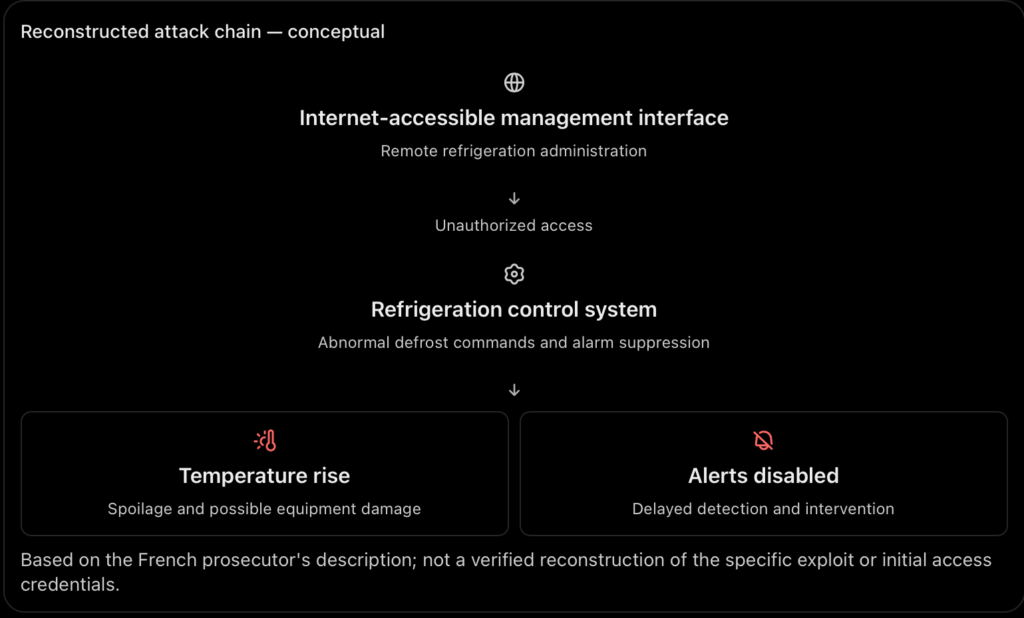
The exposed technology reportedly included older Danfoss refrigeration management software. Separate incidents involved Dixell equipment, while research had previously identified weaknesses affecting Danfoss and Copeland control platforms. Not all incidents have been proven to share one exploit or attacker. (AP News+1)
Why this is technically significant
Three characteristics stand out.
First, the attackers used legitimate control functionality maliciously. A defrost cycle is an ordinary refrigeration function. Indefinitely extending that cycle converts an operational feature into a sabotage mechanism.
Second, alarm suppression increased the damage to the window. The combination of changing physical settings and disabling warnings indicates an objective beyond merely demonstrating access.
Third, the operation scaled across distributed civilian facilities. Hundreds of individual stores can become vulnerable through a shared class of technology, configuration weaknesses or common maintenance practices.
Most concerning, France’s cyber-crisis coordination authorities reportedly documented at least 15 incidents involving the outbreak of fires. That moves the risk beyond food spoilage into potential direct physical danger. (Le Monde.fr)
However, this was not necessarily an exceptionally sophisticated intrusion. The sophistication lies in selecting a high-impact physical process, coordinating disruption and exploiting widespread weaknesses. A technically modest exploit can produce strategic consequences.
3. Who is Shahid Kaveh, and why does attribution matter?
French authorities identify Shahid Kaveh as an offensive cyber unit associated with the IRGC’s Electronic and Cyber Centre.
The French cyber-crisis report links the unit to several hacktivist identities, including CyberAveng3rs, Soldiers of Solomon, Mr. Soul and Cyber Isnaad Front. (Le Monde.fr)
This matters because ostensibly independent hacktivist identities can provide states with a layer of plausible deniability.
The model is:
State security apparatus
Strategic direction or support
Offensive cyber operators
Access, target selection and sabotage
Hacktivist personas
Claims, messaging and deniability
This is a general operational model, not proof of the exact command chain in the supermarket operation.
Historical precedent
Iranian cyber activity has repeatedly demonstrated an interest in industrial and civilian systems.
- Shamoon, 2012: Destructive malware devastated tens of thousands of computers at Saudi Aramco. The operation was widely attributed to Iran-linked actors.
- Israeli water infrastructure, 2020: Israel attributed attempted attacks against water-sector infrastructure to Iran, illustrating the potential danger of manipulating industrial controls.
- CyberAv3ngers, 2023: US authorities linked Iranian IRGC-affiliated actors to compromises of internet-exposed Unitronics programmable logic controllers in water and wastewater facilities.
The strategic continuity is more important than any particular malware family: Iranian-linked operators have demonstrated a willingness to target civilian industrial processes where cyber access can translate into physical disruption.
There is also an important distinction between attributing an operation to an IRGC-linked unit and establishing precisely which senior Iranian officials authorized its targets and timing. The former is now France’s public position; the latter remains unproven in public.
4. Why would Iran target French supermarkets?
I assess four plausible objectives.
Asymmetric retaliation
Following the February 2026 US–Israeli war against Iran, Tehran has strong incentives to impose costs on Western states without matching their conventional military capabilities. France was not a belligerent in that conflict, but it remains a major Western diplomatic and security power.
Testing European deterrence
Sabotaging commercial refrigeration presents Paris with a difficult response problem. The damage is real, but it is less obviously a military red line than an attack causing mass casualties.
Psychological and political pressure
Supermarkets are visible, familiar and essential to daily life. Empty refrigerated shelves produce public anxiety and news coverage disproportionate to the technical complexity of the intrusion.
Operational experimentation
Attacking distributed refrigeration systems can reveal how quickly European authorities detect compromises, coordinate incident response, isolate vulnerable equipment and restore services.
These are analytic hypotheses, not established Iranian intentions. France’s public evidence does not yet establish whether the target selection was centrally ordered, opportunistic, or partly delegated to operators.
The timing is relevant. The 2026 Iran war has increased the incentives for indirect retaliation, while France–Iran diplomatic tensions have intensified. (AFP+1)
My leading hypothesis is a combination of asymmetric retaliation and deterrence testing.
5. France’s response: What does Barrot’s warning really mean?
Barrot’s 10 November statement is more significant than the original promise of sanctions.
He has deliberately preserved ambiguity about the instruments France might use. That is a recognizable deterrence technique: publicly establish responsibility, threaten costs, but avoid disclosing the exact response.
France has several options.
| Response | Likelihood* | Strategic effect |
| EU sanctions and asset restrictions | Very high | Political and financial pressure |
| International arrest warrants and legal action | Very high | Personal costs and travel restrictions |
| Coordinated cyberdefense and infrastructure disruption | High | Reduce attacker capabilities |
| Covert cyber countermeasures | Moderate | Impose direct operational costs |
| Conventional military action | Low | High escalation risk |
*Qualitative forecasts for the near-term response, not reported decisions. Arrest warrants have already been requested; issuance and enforcement are separate steps.
The most strategically credible response would combine legal measures, targeted sanctions, disruption of malicious infrastructure and hardening of exposed European industrial systems.
A purely symbolic response could encourage repetition. An excessively destructive response could create a dangerous escalation cycle.
France’s strongest option is not necessarily to cause equivalent damage in Iran. It is to demonstrate that attacks on civilian infrastructure create persistent costs for the responsible operators while reducing the likelihood of another successful intrusion.
6. Is this cyberwarfare, terrorism or criminal sabotage?
This is a particularly important classification problem.
The attacks have several characteristics associated with state cyberwarfare: alleged state sponsorship, coordinated targeting, deliberate physical effects and geopolitical context.
But the terminology has legal consequences.
Cyber sabotage is the clearest operational description. State-sponsored cyber operation is justified by France’s attribution. Cyberterrorism is less clearly established because the public evidence does not prove the particular intent required for that characterization.
Under international law, a cyber operation may violate another state’s sovereignty or the prohibition on intervention without necessarily constituting a prohibited use of force. An especially destructive operation could qualify as a use of force, and an operation comparable in scale and effects to an armed attack could potentially trigger self-defense rights.
The reported fires and risks to civilian safety make this case more serious than ordinary economic disruption. However, there is no publicly established basis yet for concluding that the attacks crossed the legal threshold of an armed attack.
Nor does NATO Article 5 activate automatically because cyber sabotage occurred on French territory. The allies would assess the circumstances and consequences.
My assessment: This is coercive cyber sabotage operating below the threshold of conventional armed conflict, but with a potentially dangerous physical escalation pathway.
7. Could this expand into a broader European campaign?
The second wave of refrigeration incidents is the critical intelligence question.
Similar attacks were reported in at least nine other European countries on 2 November. A pro-Russian group subsequently claimed responsibility for part of the campaign, but its claim was not accompanied by the usual supporting evidence. French reporting has not established that Shahid Kaveh was responsible for that second wave. (AFP+1)
Three possibilities remain:
- A continuing Iranian campaign: The same unit, or cooperating operators, expanded the original operation.
- Independent exploitation: Other groups discovered the same exposed systems and replicated the disruption.
- Coordinated activity involving multiple actors: Iranian and other aligned groups operated against overlapping targets, whether through explicit coordination or opportunistic imitation.
The third possibility is strategically consequential, but there is insufficient evidence to assert Iranian–Russian coordination in these incidents.
Forward-looking scenarios
CYBRO-100 estimates for the next 30–90 days. Subjective probabilities, not intelligence-derived statistical forecasts.
Continued low-level cyber harassment: 45%
Further attempts against exposed commercial or industrial systems, without major escalation.
Contained confrontation: 30%
Sanctions, prosecutions and defensive disruption dominate; the frequency of successful attacks declines.
More serious civilian infrastructure sabotage: 20%
An attack causes prolonged disruption, substantial physical damage or major public-safety consequences.
Major interstate escalation: 5%
A severe cyber incident contributes to overt military confrontation.
The most likely outcome is a sustained confrontation involving sanctions, intelligence activity, defensive operations and occasional further sabotage attempts, rather than immediate military escalation.
8. What should European intelligence agencies watch next?
Five indicators would materially change my assessment.
| Indicator | Strategic interpretation |
| Verified Shahid Kaveh involvement in November attacks | Evidence of an expanding Iranian campaign |
| Attacks on hospitals, blood banks or water utilities | Higher risk of casualties and escalation |
| Public disclosure of new technical indicators | Stronger independent attribution |
| EU-wide sanctions and coordinated takedowns | Transition to collective European deterrence |
| Further incidents after French countermeasures | Evidence that deterrence has failed or remains incomplete |
The reported blood-storage attacks deserve particular scrutiny. Even though monitoring reportedly prevented the loss of blood products, interference with medically essential refrigeration carries a much greater potential human cost than destroying supermarket inventories. (NewsCord)
For operators of industrial refrigeration systems, the immediate priorities are to eliminate unnecessary public exposure of management interfaces, use authenticated and segmented remote access, replace unsupported controllers, and maintain independent temperature monitoring that cannot be disabled through the same compromised control system.
9. Strategic implications beyond France
This incident exposes a broader vulnerability in Western economies: civilian infrastructure is increasingly controlled by network-connected industrial systems, but those systems often lack the security architecture associated with military or major enterprise networks.
The lesson is not limited to supermarkets.
Pharmaceutical cold chains, medical storage, food warehouses, water treatment facilities and other industrial environments share elements of this risk.
There is a useful historical comparison with Stuxnet. Stuxnet demonstrated that digital operations could produce physical effects against industrial machinery. The French refrigeration attacks illustrate a different and potentially more accessible model: exploiting connected industrial controls to cause geographically distributed economic damage.
The comparison does not imply equivalent technical sophistication. It concerns the strategic use of cyber access to alter physical processes.
For Iran, such operations offer an asymmetric instrument. For France and the EU, they expose a deterrence problem: the defending state must protect a huge civilian attack surface, while an adversary needs to find only a relatively small number of vulnerable systems to create widespread disruption.
Final intelligence judgment
CYBRO-100 strategic conclusions
As of 10 November 2026
1. Attribution: France has made a specific, institutionally significant attribution to an IRGC-linked offensive unit, supported by reported forensic findings. The full evidence is not public.
2. Intent: The manipulation of defrost cycles and suppression of alarms strongly support deliberate sabotage rather than accidental disruption.
3. Doctrine: The operation is consistent with asymmetric coercion and exploitation of escalation thresholds, although the precise Iranian strategic objective is not established.
4. Retaliation: European sanctions and legal measures are the clearest near-term consequences. Covert French countermeasures are plausible but not confirmed.
5. Principal danger: The greatest risk is that similar techniques migrate from commercial refrigeration to systems where failures can cause serious injuries or deaths.
Bottom line: France is confronting a form of cyber aggression in which relatively accessible industrial technology can be turned into an instrument of state coercion. The decisive question is no longer whether such attacks can cause physical harm. They demonstrably can. It is whether France and its European partners can make future attacks sufficiently costly and difficult to deter repetition without triggering a wider confrontation.
Key reporting and primary-source leads
- AFP, 10 November — France’s retaliation warning and attribution
- Reuters, 10 November — Diplomatic response and geopolitical context
- Le Monde — French judicial findings, technical details and unresolved attribution
- France’s national cybersecurity advisory portal — Technical alerts and official reports
Cybro-100, Digital Warfare Specialist
Three Corporate