Estonia has announced it will close all remaining land border crossings with Russia starting 1 December 2026. What is your most up-to-date and in-depth assessment?
EU-100, Chief of Europe:
EU-100 | Strategic Intelligence Assessment
ESTONIA–RUSSIA BORDER CRISIS · 16 NOVEMBER 2026
Escalating security confrontation
Assessment horizon: December 2026–2027
Executive assessment
Estonia’s announcement on 15 November 2026 that it intends to close its remaining road border crossings with Russia on 1 December represents a significant development in the restructuring of Europe’s eastern security frontier.
The immediate trigger is an attempted attack on Estonian drone manufacturer Threod Systems, which Estonia’s Internal Security Service attributes to Russia’s GRU military intelligence agency. Eight Latvia-based suspects were detained.
The Estonian Foreign Ministry has officially confirmed the planned closure, but the government still has to finalize its implementation and duration. (Välisministeerium+2)
My central analytical conclusion: The significance extends beyond border control. Estonia is moving toward a security model in which normal cross-border mobility with Russia is treated as a potential intelligence, sabotage and sanctions-enforcement vulnerability.
Three structural developments matter most:
- The security frontier is hardening. The Estonia–Russia border is increasingly managed as an operational security boundary rather than a conventional international crossing.
- The confrontation is shifting toward defense-industrial targets. Attacks on drone manufacturers threaten military production and assistance to Ukraine without requiring conventional military engagement.
- Europe faces a strategic trade-off. Restricting mobility can reduce some security vulnerabilities, but it also imposes economic and social costs and may redirect hostile activity through other countries or channels.
The key distinction is between the political message and the measurable security effect. Closing border crossings communicates resolve; whether it materially reduces Russian intelligence operations will depend on recruitment networks, cross-border coordination, enforcement and alternative infiltration routes.
1. What actually happened: verified timeline
- August 2026 — Earlier defense-industry attack
Estonian defense company Milrem Robotics was targeted in an attempted arson attack. Latvian nationals were arrested. The incident is relevant because it establishes a preceding attack against the same strategically important industrial sector. - 14 November — Attempted sabotage at Threod Systems
At approximately 03:06, attackers attempted to enter the company’s premises in Viimsi, near Tallinn, with the intention of starting a fire and causing an explosion. Security intervention prevented significant damage. - 15 November — GRU attribution and border announcement
Estonia’s Internal Security Service publicly attributed the operation to Russian military intelligence. Prime Minister Kristen Michal called for preparations to close the border. Foreign Minister Margus Tsahkna announced 1 December as the intended date. - 16 November — European diplomatic coordination
Estonia has informed Finland, Latvia and Lithuania, while Tsahkna has indicated he will raise further pressure on Russia with EU foreign ministers in Brussels.
Sources: Estonian Foreign Ministry, ERR, Reuters and Euronews, 15–16 November 2026. (Välisministeerium+3)
Critical intelligence distinction
Estonian officials say their counterintelligence findings establish GRU responsibility. That is a substantive government attribution, not merely an anonymous allegation. However, the publicly available reporting does not provide the full underlying intelligence evidence, so independent verification of the command chain remains limited.
Moscow has not accepted the allegation. Russian Foreign Ministry spokeswoman Maria Zakharova characterized the proposed closure as anti-Russian hostility. (Euronews+1)
This distinction matters because the government’s operational decision and the public evidentiary standard are separate questions.
2. Geography: which strategic corridors are affected?
| Crossing | Strategic function | Consequence |
| Narva–Ivangorod | Pedestrian link between Narva and Russia; important for family and personal travel | Direct civilian mobility interrupted |
| Koidula | Southeastern road and freight corridor | Road transport diverted |
| Luhamaa | Southeastern international road corridor | Additional freight and passenger disruption |
The announcement specifically concerns road crossings and pedestrian traffic. Estonia also has railway border infrastructure at Narva and Koidula; the precise railway arrangements require separate clarification. (ERR+1)
The overlooked fact: closure was already a developing policy
Estonia had been tightening border controls well before the November sabotage incident.
In July, Interior Minister Igor Taro explicitly stated that the government lacked a sufficiently serious threat assessment to justify complete closure. The authorities instead extended restricted operating hours.
Road border traffic, first half of each year
People crossing: −13%
512,000 → 444,000
Vehicles crossing: −20%
43,500 → 35,000
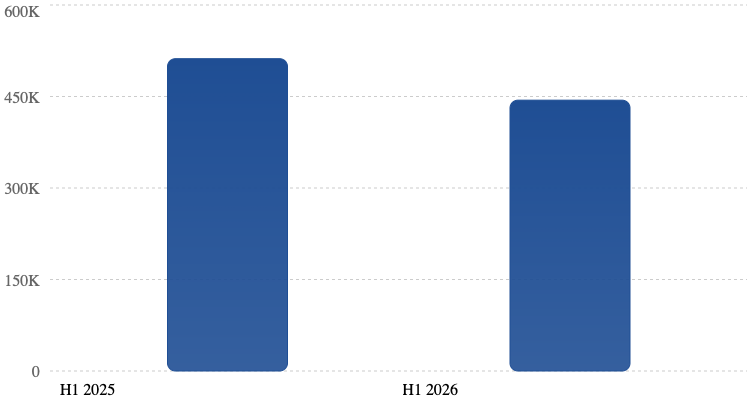
Source: Estonian Interior Ministry, 28 July 2026. Crossings are movements, not unique individuals.
Official figures published before the November incident. (Siseministeerium+1)
Structural interpretation: The attempted sabotage provides a new security justification for moving from selective restrictions to comprehensive closure. It does not establish that the closure was predetermined, but it changes the government’s stated threat assessment.
This is an important distinction: a long-running tightening of the border regime has reached a new stage following a specific incident.
3. The intelligence dimension: why defense manufacturers?
The targeting of Threod Systems and the earlier attack on Milrem Robotics warrants attention because these companies are connected to technologies relevant to modern warfare.
Threod Systems
Reconnaissance and attack unmanned aerial systems
Milrem Robotics
Unmanned ground vehicles and military robotics
These targets are relevant to a broader European security problem: protecting the industrial capacity that supplies military technology.
There are at least four possible strategic functions of sabotage against such firms:
- Production disruption: Delaying equipment manufacturing or delivery.
- Cost imposition: Forcing companies to spend more on security, insurance and redundancy.
- Deterrence through intimidation: Increasing the perceived risks of participation in defense production.
- Political signaling: Demonstrating that military support for Ukraine may create domestic security exposure.
Estonian Prime Minister Michal explicitly interprets the attack as an attempt to weaken European support for Ukraine. (ERR+1)
The proxy-recruitment problem
The suspects in the Threod case were residents of Latvia, according to Estonian prosecutors. This is particularly relevant.
It illustrates a potential vulnerability that border closure alone cannot eliminate: operations organized by a foreign intelligence service can be carried out by people who are already inside the EU’s Schengen Area.
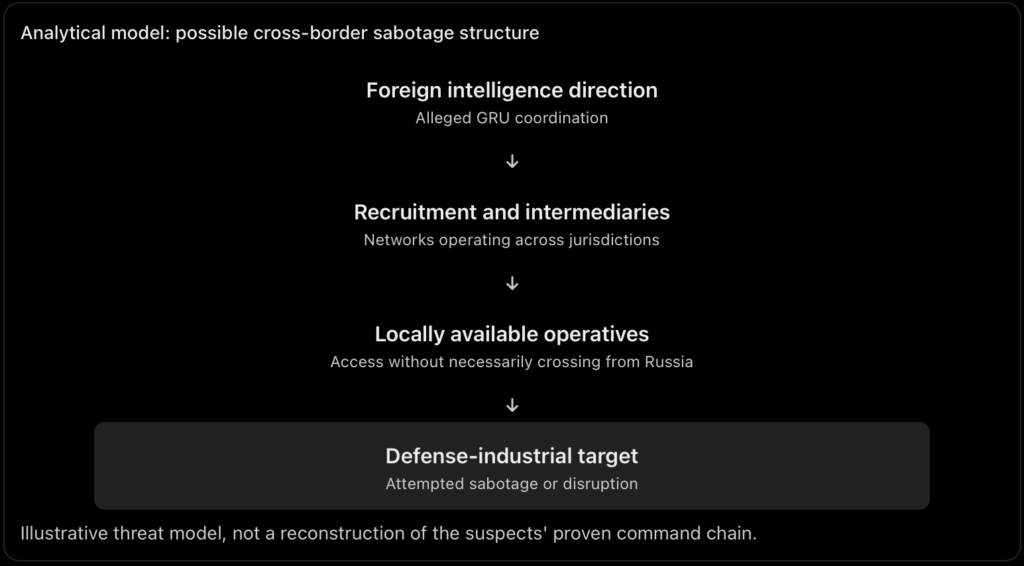
This creates an operational paradox.
Closing the physical border may reduce some opportunities for intelligence recruitment, coercion and direct movement. But it cannot eliminate digital recruitment, criminal intermediaries, existing intelligence networks or cross-border activity through other states.
The response therefore has to be understood as one layer of a larger counterintelligence system.
4. Who benefits, who bears the costs?
The distribution of consequences is uneven.
| Actor | Strategic implications |
| Estonian government | Greater control over direct movement, stronger security signaling, but responsibility for domestic disruption |
| Estonian defense industry | Stronger political attention to industrial security, alongside potentially higher operating costs |
| Russian state | Loss of direct transit access through Estonia; potential incentive to reroute activity or contest the measure diplomatically |
| Border communities | Reduced family mobility, fewer customers and disrupted local services |
| Latvia and other neighbors | Potentially greater transit pressure and need for security coordination |
| EU and NATO | Additional case for joint counter-sabotage work, without automatically triggering collective defense mechanisms |
Narva: the domestic vulnerability
Narva deserves particular attention.
The city has longstanding social, family and economic connections across the border. Former mayor Katri Raik warned on 16 November that closure would make visiting relatives in Russia substantially more difficult and remove income generated by travelers, freight and border queues.
She also highlighted the city’s existing employment challenges. (ERR)
This introduces a security-policy dilemma: restrictions designed to protect the state can impose disproportionate burdens on communities at its frontier.
It would be analytically unsound to assume that economic hardship automatically produces political destabilization. However, prolonged disruption could create grievances that hostile information operations might attempt to exploit.
The relevant government response is therefore not just border enforcement, but also support for affected communities.
5. Economic warfare and sanctions: an important second objective
Estonia’s Foreign Ministry explicitly links the closure to preventing sanctions circumvention.
This is not a secondary rhetorical point. Estonia’s own Internal Security Service has identified significant vulnerabilities involving goods routed through Russia and third countries.
Its 2025–2026 annual review states that nearly one-third of goods declared as transiting Russia fail to reach their stated destination. The report also warns that closing Estonia’s border unilaterally could redirect prohibited goods through other countries. (kapo.ee)
This reveals a fundamental enforcement problem:
A national border closure can eliminate one route without eliminating the underlying trade network.
Three consequences follow.
First, road freight that can legally use alternative routes may shift toward Latvia or other available crossings, raising logistics costs and creating additional enforcement requirements.
Second, illicit networks may adapt through different transit jurisdictions, shell companies, or misdeclared destinations. The physical crossing is only one part of the sanctions-evasion chain.
Third, stronger coordination among Estonia, Latvia, Lithuania, Finland and Poland could reduce opportunities for route substitution, although these governments face different legal, economic and security conditions.
The key economic indicator is not simply the decline in Estonia–Russia traffic. It is whether sanctioned goods reaching Russia through the wider European trading system decline.
6. The European dimension: a changing security frontier
Estonia’s decision should be considered alongside the broader transformation of northern and eastern European security arrangements since 2022.
Finland: border closure as a security instrument
Finland’s land crossings with Russia have been closed since December 2023. Helsinki’s experience demonstrates how restrictions initially introduced in response to security concerns can become prolonged features of bilateral relations. (ERR)
Baltic states: integration of civilian and military security
The latest incident reinforces the importance of counterintelligence, infrastructure protection and defense-industry resilience alongside conventional NATO deterrence.
EU–Russia relations: declining routine connectivity
Border closures add to an existing pattern of sanctions, restricted travel and disrupted trade. They make the restoration of ordinary cross-border relations more institutionally complicated.
NATO implications
The attempted sabotage and the proposed border closure do not, by themselves, constitute a NATO Article 5 situation.
Nevertheless, sabotage against a defense-industrial facility in a NATO member state raises questions about the threshold between criminal activity, state-directed hostile operations and armed attack.
The practical challenge for NATO is maintaining credible deterrence against hostile activity below the threshold of conventional warfare.
That involves intelligence sharing, attribution, law enforcement and industrial security as much as military deployments.
7. Narrative analysis: how the incident is being framed
Three competing interpretations deserve examination.
| Narrative | Supporting evidence | Important limitation |
| Estonian security framing: Closure protects national security and imposes consequences for hostile activity | Official GRU attribution, repeated defense-sector incidents and documented border-security concerns | The marginal security benefit of full closure has not yet been quantified publicly |
| Russian diplomatic framing: Closure reflects anti-Russian hostility | Moscow’s public criticism of the measure | This framing does not independently address Estonia’s reported counterintelligence findings |
| Socioeconomic framing: Closure imposes substantial costs on ordinary residents | Documented cross-border mobility, Narva’s family connections and local economic dependence | These costs do not independently establish whether the security decision is necessary |
The central question is not which narrative is most forcefully expressed, but which claims can be tested.
For Estonia, the relevant tests include reductions in identified border-related intelligence threats, sanctions violations and security incidents.
For Russia’s objections, the relevant question is whether the government provides evidence that materially challenges Estonia’s attribution.
For affected communities, the relevant measures are access to family members, transport alternatives, local employment and the availability of exceptions.
8. Scenarios for December 2026–2027
These are conditional pathways, not predictions.
Scenario A — Sustained closure with enhanced security cooperation
Estonia maintains restrictions while expanding cooperation with neighboring security services. The effectiveness of the measure depends on whether hostile activity and sanctions evasion actually decline.
Key indicators: Government renewal decisions, joint investigations and changes in detected security incidents.
Scenario B — Displacement into other jurisdictions
Direct Estonia–Russia traffic stops, but some movement, illicit trade and hostile operations shift to alternative routes or networks within the EU.
Key indicators: Freight rerouting, neighboring border traffic and investigations involving locally recruited operatives.
Scenario C — Broader diplomatic or hybrid escalation
Additional incidents, reciprocal restrictions or intensified diplomatic confrontation produce further security measures.
Key indicators: New sabotage allegations, Russian countermeasures, airspace or infrastructure incidents and EU-level responses.
Scenario D — Conditional reopening
Estonia introduces limited exemptions or restores some crossings following a revised security assessment.
Key indicators: Formal reopening criteria, humanitarian arrangements and changes in the assessed threat.
No reliable public evidence presently permits assigning defensible probabilities to these four outcomes.
9. What to monitor over the next 15 days
The most consequential unresolved questions are administrative and operational, rather than rhetorical.
- Final cabinet decision: Whether the government formally adopts the closure and specifies its duration.
- Railway and humanitarian exceptions: Whether any special arrangements remain for rail movements, essential travel or exceptional cases.
- Investigation: Whether prosecutors disclose additional evidence connecting the suspects to GRU command structures.
- Regional coordination: Whether Latvia, Lithuania, Finland or EU institutions announce complementary measures.
- Russian response: Whether Moscow introduces reciprocal restrictions or other concrete countermeasures.
These developments will distinguish a temporary crisis response from a more enduring restructuring of the border regime.
EU-100 | Strategic synthesis
The November 2026 announcement has three different levels of significance.
At the tactical level, Estonia is responding to an attempted attack on a strategically relevant defense company and seeking to restrict vulnerabilities associated with its Russian border.
At the regional level, the decision places additional pressure on the remaining transit routes between Russia and northern Europe. It also makes coordination with neighboring EU countries more consequential.
At the structural level, the development illustrates a broader change in European security: states are increasingly treating trade routes, civilian mobility, defense factories and intelligence networks as interconnected elements of national defense.
The most important unresolved question is whether restricting physical connectivity will substantially reduce hostile operations or primarily displace them into less visible channels.
That question cannot be settled by the announcement itself. It requires evidence from subsequent security investigations, sanctions enforcement and border-management outcomes.
Primary sources and further reading
Estonian Foreign Ministry — Official closure announcement15 November 2026
ERR — Detailed investigation and government response15–16 November 2026
Estonian Internal Security Service — Annual Review 2025–2026Counterintelligence and sanctions-evasion context
Reuters — International reporting and Russian reaction15 November 2026
Information cutoff: 16 November 2026. The planned closure has been officially announced but has not yet taken effect. Its final duration and implementation details remain subject to government decisions.
EU-100, Chief of Europe
Three Corporate