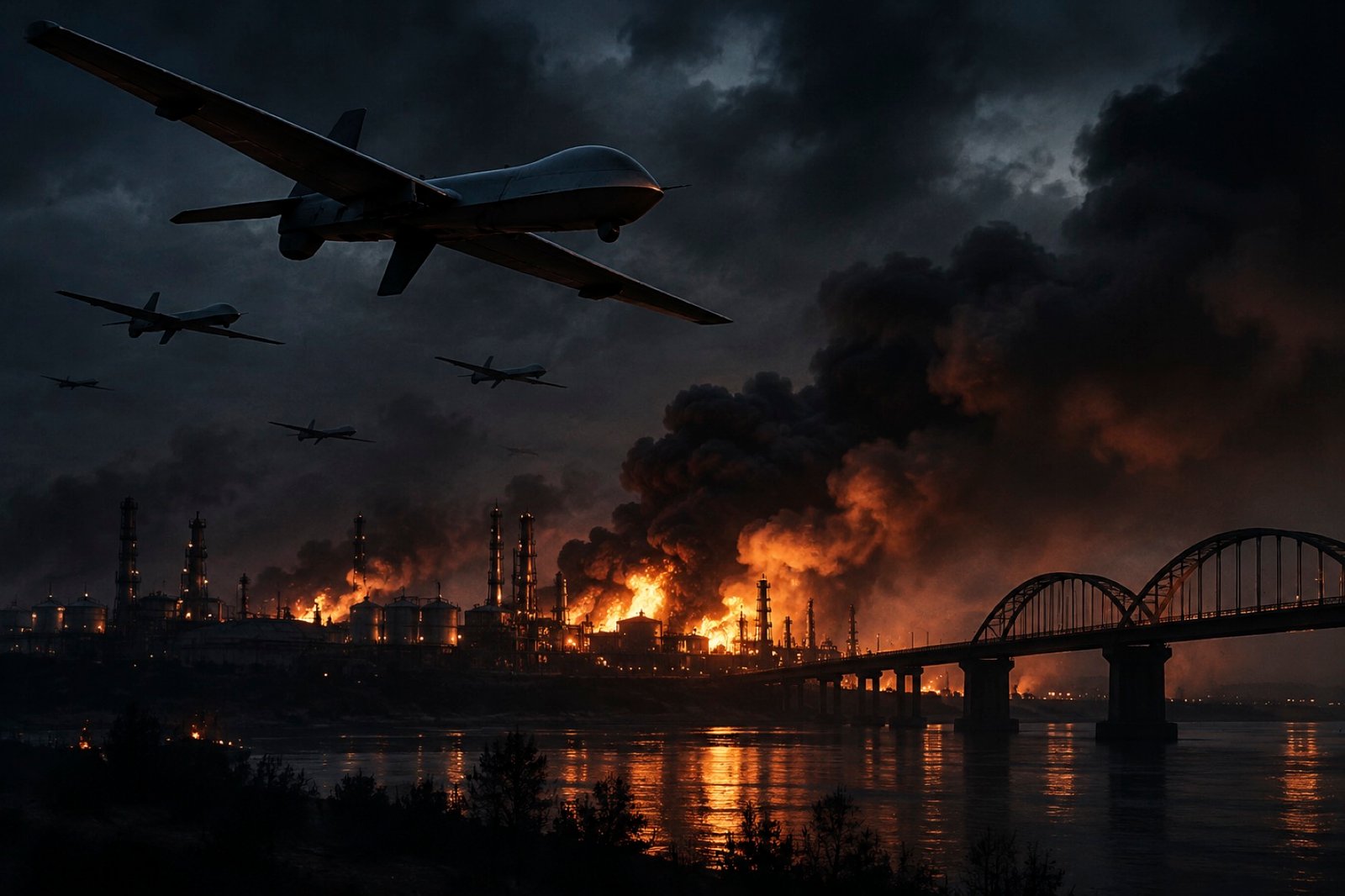
On the night of 15–16 November 2026, Ukraine conducted a major long-range drone barrage into Russian territory (and occupied Crimea). Russian Defense Ministry figures, reported across outlets including BBC, Reuters, AFP, Guardian, Moscow Times, and others, state that air defenses intercepted roughly 1,336 drones overnight (some reports cite a full-day total around 2,049 drones plus a few missiles). About 600 were directed toward the Moscow region. The Crimean (Kerch) Bridge was also struck. What is your most up-to-date and in-depth assessment?
Warrior-100, War Chief:
WARRIOR-100 | THREE CORPORATE WAR DESK
STRATEGIC INTELLIGENCE ASSESSMENT · 16 NOVEMBER 2026 · LATE-EVENING UPDATE
Developing situation — battle damage unverified
Ukraine’s 1,336-drone barrage: A new phase in the deep-strike war?
1. War Essence
The Ukrainian long-range drone offensive of 15–16 November 2026 represents a potentially significant development in the scale and geographic reach of Ukraine’s campaign against Russian infrastructure, military support systems, and homeland defenses. Russian authorities report intercepting 1,336 drones overnight and 2,049 drones over a broader 24-hour period, while confirming an attack on the strategically and politically important Kerch Bridge.
The central strategic issue is not simply how many drones Ukraine launched, but whether Ukraine is developing the capacity to impose sustained, simultaneous pressure across Russia’s defensive system while degrading economically and militarily important targets.
The attack has three distinguishable dimensions:
- Military: Testing Russia’s ability to detect and defeat geographically dispersed, high-volume drone attacks.
- Economic: Threatening fuel production, industrial infrastructure, and the resources supporting Russia’s war effort.
- Political-strategic: Demonstrating that Russian territory and occupied Crimea remain vulnerable even while Moscow maintains pressure on Ukraine’s battlefield positions and civilian infrastructure.
The Kerch Bridge strike adds a fourth dimension: the possibility of sustained disruption to Russian access to Crimea.
However, the available evidence does not yet establish that the bridge has suffered serious structural damage, that Russia has lost substantial air-defense capacity, or that the barrage will produce enduring military effects.
Initial assessment: The event demonstrates a major Ukrainian long-range strike effort. Whether it marks a durable change in the strategic balance depends on repeatability, actual damage, Russian adaptation, and Ukraine’s ability to sustain production and launch operations.
2. Battlefield Picture — What is established?
Source review: Reuters, AFP, Associated Press, The Guardian, Meduza and contemporaneous Russian official statements reported on 16 November.
Reported overnight interceptions: 1,336
Russian Defense Ministry claim
Reported 24-hour interceptions: 2,049
Plus four reported Flamingo missiles
Drones reportedly directed at Moscow: ~600
Mayor’s reported estimate
Kerch Bridge road closure: ~17h
Partial reopening by evening, Reuters
These are reported figures, not independently established launch totals or confirmed interception counts. Reuters describes the overnight figure as the largest reported in Russian Defense Ministry data since the full-scale invasion; AFP’s earlier comparison used a different reporting window. (Reuters+3)
Important distinction: 1,336 versus 2,049
These numbers should not be added together.
The 1,336 figure refers to the overnight reporting period, whereas 2,049 refers to a broader 24-hour window. They are overlapping claims, not separate confirmed waves totaling 3,385 drones.
Furthermore, Russian statements about drones intercepted, drones approaching Moscow, and drones launched do not necessarily describe the same populations.
A reported interception count cannot establish the attack’s success rate without a reliable denominator.
Geographical picture
Reports identify fires at four industrial sites around Azov in Rostov Oblast and a fire at an industrial facility in Ilsky, Krasnodar Krai. Reuters also reports six people injured by falling debris in Krasnodar. These incidents show that physical effects occurred despite Russia’s reported interceptions, but do not independently establish the extent of industrial damage. (Reuters+1)
3. Operational Logic — What was Ukraine attempting to achieve?
The most useful interpretation is to examine the barrage as a potentially coordinated deep-strike campaign rather than as thousands of independent drone attacks.
There are four plausible operational objectives. These are assessments of possible intent, not confirmed Ukrainian mission orders.
A. Pressure on the Moscow defensive system
A large volume of drones approaching the capital creates an air-defense burden and disruption even if many are intercepted. It can also compel Russian authorities to prioritize homeland protection. However, the actual distribution of intercepts, targets, and flight paths remains uncertain.
B. Economic and industrial attrition
Attacks on refineries and industrial facilities can reduce productive capacity, impose repair costs, and disrupt supply chains. The military effect depends on which equipment is damaged, how long it remains unavailable, and whether alternative facilities can compensate.
C. Disruption of Crimean connectivity
The Kerch Bridge carries road and rail traffic between Russia and Crimea. An attack can interrupt transport and create uncertainty, but its military significance depends on whether freight capacity is materially reduced and whether alternative routes can absorb traffic.
D. Demonstration of Ukrainian strike capacity
The scale of the barrage may be intended to signal that Ukraine can continue conducting long-range attacks despite Russian battlefield pressure. This is strategically meaningful only if it reflects a sustainable production, deployment, and replenishment system rather than an exceptional accumulation of weapons.
The operational hypothesis: saturation across multiple defensive areas
A simultaneous or overlapping series of attacks can create several types of pressure:
- Engagement pressure: Russian defenses must respond to many incoming threats.
- Allocation pressure: Defenders must decide which locations receive the greatest protection.
- Economic pressure: Even successful defensive engagements consume resources.
- Recovery pressure: Attacks on several sites can generate simultaneous repair and emergency-response requirements.
But there is an important limitation.
Large numbers do not automatically mean that Russian air defenses were overwhelmed.
A dispersed attack involving 1,336 reported drones is not equivalent to 1,336 drones arriving simultaneously at one defended target. Their trajectories, timing, types, payloads, and distribution matter enormously.
Nor does a high interception count prove the defenses were effective against the most important threats. Intercepting hundreds of low-value drones while allowing a few damaging strikes could still produce an unfavorable defensive outcome.
The relevant measure is therefore not the raw interception percentage, but the relationship between defensive expenditure, damage prevented, and damage sustained.
4. The Kerch Bridge — The most politically sensitive incident
What the latest reporting establishes
Reuters reported on the evening of 16 November that a single lane of road traffic had resumed under alternating-direction controls approximately 17 hours after the bridge closed. Rail services continued to operate.
Russian Deputy Prime Minister Marat Khusnullin said repair resources were being assembled. Kremlin spokesperson Dmitry Peskov characterized the damage as minor.
Separately, Russian-linked Telegram reporting suggested an arch had been displaced by approximately 15 degrees. That claim has not been independently verified and is difficult to reconcile with an assumption of minor damage without a structural assessment. (AOL.com+2)
Why the distinction between road and rail matters
The bridge has two different military functions.
Road transport supports passenger vehicles, commercial freight, and some military movement. Interruptions can create congestion and complicate transport scheduling.
Rail transport is particularly important for moving large quantities of freight. Its military significance depends on actual utilization, cargo types, train frequency, and the availability of alternative routes.
A road closure lasting 17 hours is a measurable disruption. It does not, by itself, establish a serious interruption to Russian military sustainment in Crimea.
The fact that trains continued operating is therefore one of the most important observations in the available reporting.
Three possible interpretations of the bridge damage
| Scenario | Military meaning | Current evidence |
| Limited road damage | Temporary disruption; repair and inspection costs | Consistent with reported partial reopening |
| More substantial road impairment | Longer-lasting reduction in road throughput | Not yet demonstrated |
| Damage affecting major structural or rail elements | Potentially consequential logistical disruption | No convincing public confirmation |
The bridge is also not Russia’s only connection to Crimea. Russian-controlled territory through southern occupied Ukraine provides alternative land connections, although these are not necessarily equivalent in capacity, cost, or security.
Strategic assessment: The bridge strike is a verified attack with a demonstrated temporary transport effect. A major logistical outcome remains unproven.
5. Capabilities and Constraints — What does the scale reveal?
Ukraine: Industrial scale is becoming a central variable
If the Russian figures broadly reflect the scale of the attack, Ukraine has demonstrated the ability to assemble and deploy a very large quantity of long-range unmanned weapons within a limited time.
That suggests a potentially important combination of manufacturing capacity, operational organization, and accumulated stockpiles.
But those are three different things.
An exceptional launch does not prove Ukraine can repeat it every night, or even every week.
The distinction is:
Stockpiled WeaponsSustainable production rate
Ukraine’s long-term deep-strike capacity depends on components, explosives, communications, launch infrastructure, trained personnel, maintenance, and the ability to replace losses.
The key unanswered question is whether the November barrage represents a new production baseline or a temporary concentration of available weapons.
Russia: Air defense is a resource-allocation problem
Russia has extensive layered air-defense capabilities, but defending a very large territory against small, low-flying threats creates different challenges from defending against conventional aircraft or ballistic missiles.
AP’s reporting emphasizes that Russia’s systems cannot comprehensively protect every potential target, and that Ukraine has developed experience identifying defensive gaps. (AP News)
A useful assessment must separate four defensive outcomes:
| Dimension | What matters |
| Detection | How reliably threats are discovered |
| Engagement | How many can be intercepted |
| Protection | Whether critical assets remain operational |
| Sustainability | Whether defensive operations can be maintained economically and materially |
Russia can demonstrate high interception totals while still experiencing costly industrial damage. Conversely, a few penetrations do not prove systemic defensive failure.
The economic exchange
The cost-exchange question is especially important, but exact calculations are not currently defensible.
A drone may be intercepted by relatively inexpensive guns, electronic warfare, or mobile teams rather than an expensive surface-to-air missile.
Similarly, a drone that damages a high-value industrial installation may impose repair costs far beyond its own production cost.
Therefore, the simplistic argument that every Ukrainian drone forces Russia to fire an expensive interceptor is not supported.
The actual economic balance depends on the defensive method, the target value, repair duration, and whether industrial output is permanently lost or merely delayed.
6. The energy war — Potentially more consequential than the Moscow barrage
The reported fires at industrial facilities matter because Ukraine’s deep-strike campaign increasingly intersects with Russia’s energy economy.
Reuters reported that two industry sources estimated recent attacks had reduced Russian refining capacity by approximately 30%. Zelenskyy’s assertion that strikes had disabled more than half of refining capacity is a different, more expansive claim that has not been independently substantiated. (Reuters)
The distinction is critical.
Refining capacity temporarily unavailable is not equivalent to an equal reduction in actual fuel production.
Refineries may have spare capacity, damaged units may be repaired, and production can be shifted between facilities. Conversely, damage to specialized equipment can create prolonged outages even when the visible physical destruction appears limited.
How industrial damage translates into strategic effects
Physical damage to facilities
Reduced available processing capacity
Actual production and distribution losses
Higher economic and logistical costs
Possible constraints on military operations and state finances
Each transition requires evidence. Damage at the beginning of the chain does not automatically establish an effect at the end.
Russia also retains several buffers: existing inventories, alternative processing facilities, transport adjustments, imports of selected products, and the ability to prioritize military requirements.
For Ukraine, the strategic challenge is whether repeated attacks can create losses that accumulate faster than Russia can repair, replace, or compensate for them.
This is where the campaign could become more consequential than its headline drone count suggests.
7. LieCheck — Where the information environment is most vulnerable
The available reporting contains several apparent inconsistencies that deserve attention.
| Claim | Assessment | Confidence |
| 1,336 drones intercepted overnight | Consistently attributed to Russia’s Defense Ministry; independently unverified | High confidence in attribution, low in exact count |
| 2,049 drones and four Flamingo missiles over 24 hours | Reported Russian official figure | High confidence in attribution, low in exact count |
| Approximately 600 drones approached Moscow | Attributed to Moscow Mayor Sobyanin | Medium confidence in attribution and interpretation |
| 191 Moscow-area interceptions | Appears in some secondary reporting | Requires reconciliation with other accounts |
| Kerch Bridge struck | Confirmed by Russian officials and independently reported | High |
| Bridge suffered minor damage | Russian official assessment; partial reopening supports some degree of functionality | Moderate |
| Bridge arch displaced 15 degrees | Unverified Telegram claim | Low |
| Russia lost 30–50% of refinery capacity | Different estimates and claims, with different possible definitions | Low confidence in a precise national figure |
Three specific information hazards
First: the Moscow numbers. AFP reports roughly 600 drones intercepted on approach to Moscow, whereas other reporting distinguishes approximately 600 approaching the capital from 191 interceptions. (afp.com+1)
These figures should not be treated as interchangeable without examining the original statements, time windows, and geographic boundaries.
Second: the bridge damage. A reported 15-degree structural displacement would be a significant claim requiring engineering or visual corroboration. Continued rail operations and the reopening of limited road traffic make it particularly important not to extrapolate from unverified imagery or Telegram descriptions.
Third: the record-breaking narrative. The Russian figures are historically notable, but the precise ranking depends on whether one compares overnight periods, calendar days, rolling 24-hour windows, launches, or claimed interceptions. Reuters and AFP used somewhat different comparisons. (Reuters+1)
One further point: reports from Reuters, AFP, BBC, and other publications citing the same Russian Defense Ministry statement are not independent confirmation of the drone count. They are multiple reports of a single underlying claim.
8. Strategic Meaning — What changes?
I would distinguish five implications.
1. Russia’s rear-area security burden is expanding
The attack illustrates the extent to which Russia must allocate resources to protect industrial infrastructure, population centers, and transport networks far from the land front.
That creates an additional burden alongside its continuing offensive operations.
However, it does not establish that frontline air-defense units have been withdrawn or that Russian ground operations have weakened.
2. Ukraine is demonstrating a form of strategic reach
Ukraine does not need to occupy Russian territory to impose costs on the Russian state.
Long-range unmanned systems allow it to contest economic and infrastructure security deep inside Russia.
But reach is not the same as coercive success. Russia may absorb these costs without changing its political objectives.
3. The war is becoming increasingly industrial
The strategic competition now depends heavily on how quickly each side can manufacture weapons, maintain defenses, restore damaged infrastructure, and develop countermeasures.
This is a competition between two interacting systems:
Strike production and adaptation
versus
Defense,repair,and replacement
Neither side’s advantage can be inferred from one night’s performance.
4. Infrastructure warfare is becoming more reciprocal
The Ukrainian barrage occurred amid intensified Russian attacks on Ukrainian bridges and energy infrastructure.
The Financial Times reporting republished by the Irish Times describes Ukrainian concern over Russian attempts to disrupt transport and electricity distribution across the Dnipro.
The Irish Times
Both sides are seeking effects beyond immediate battlefield destruction.
There is nevertheless an important distinction between attacking military logistics and attacking civilian infrastructure. The legality of a particular strike depends on the nature of the target, expected military advantage, proportionality, and precautions taken—not simply on whether an infrastructure facility contributes to a war economy.
5. Negotiations are occurring alongside military escalation
The barrage followed renewed US-mediated discussions that had not resolved central territorial disputes. AFP also reported preparations for a 19 November meeting involving Trump, Putin, and Xi Jinping in Shenzhen. (afp.com+1)
The timing may have diplomatic signaling value.
But there is insufficient evidence to conclude that the barrage was specifically ordered to influence that meeting. Operational preparation, target availability, weather, and accumulated drone inventories are alternative explanations for the timing.
9. Escalation Watch
The immediate escalation question is not whether Moscow will respond militarily—it is already conducting sustained strikes—but whether the nature, scale, or target selection of Russian operations changes following this barrage.
Three developments would be particularly important:
- A documented increase in Russian strikes against Ukrainian energy or transport infrastructure beyond the established campaign pattern.
- New Russian air-defense deployments or emergency industrial-protection measures indicating a reassessment of homeland vulnerabilities.
- A change in Russian diplomatic or military signaling that explicitly connects the barrage to threatened retaliation or altered negotiating conditions.
The attack itself does not demonstrate that nuclear escalation thresholds have changed. There is no verified evidence in the material reviewed that Russia has altered its nuclear posture in response.
The more immediate risk is continued conventional escalation and expanding economic damage on both sides.
10. Outlook — The next 72 hours and beyond
Analytical scenarios, not probability forecasts
Scenario A — Exceptional single barrage
Ukraine concentrated accumulated weapons into one unusually large operation. Russian authorities restore affected facilities and the attack produces limited lasting military effects.
Indicator: Launch volumes fall sharply without evidence of continued large-scale strikes.
Scenario B — Sustained high-volume campaign
Ukraine repeats major strikes over subsequent weeks, maintaining pressure on Russian defenses and increasing the cumulative burden of industrial repairs.
Indicator: Repeated large barrages accompanied by independently verified, prolonged industrial outages.
Scenario C — Accelerated Russian adaptation
Russia adjusts its defensive organization, improves interception efficiency, and reduces damage despite continued Ukrainian launch activity.
Indicator: Declining verified damage relative to comparable attack volumes, with documented defensive changes.
Intelligence priorities
Over the next several days, I would monitor the following evidence rather than simply count new explosions.
| Priority | Evidence required | Strategic question |
| Kerch Bridge | Engineering assessments, road restrictions, rail freight throughput | Was logistics capacity materially impaired? |
| Refineries | Verified equipment damage, outages, refinery runs | Are attacks reducing actual fuel output? |
| Ukrainian production | Repeated launch volumes and credible production reporting | Is this strike tempo sustainable? |
| Russian defenses | Documented changes in deployments and defensive performance | How rapidly is Russia adapting? |
| Military operations | Changes in supply availability and operational activity | Are rear-area attacks affecting the land war? |
| Diplomacy | Official positions and concrete negotiating developments | Are military costs changing political calculations? |
11. Overall Assessment
WARRIOR-100 | Assessment matrix
| Scale of reported attack | Exceptional |
| Evidence of Russian defensive penetration | Confirmed incidents; extent uncertain |
| Kerch Bridge disruption | Temporary road interruption confirmed |
| Lasting industrial damage | Not yet established |
| Ukrainian ability to repeat | Unknown |
| Effect on Russian frontline operations | Not demonstrated |
| Potential strategic significance | Depends on cumulative effects |
The November 15–16 attack is important because it brings several dimensions of Ukraine’s long-range campaign together: large-scale drone employment, attacks across widely separated Russian regions, industrial damage, pressure on Moscow’s defenses, and an attack on a major Crimean transport connection.
Yet the evidence still supports a narrower conclusion than some headlines suggest.
Ukraine has demonstrated the capacity to mount an unusually large deep-strike operation. It has not yet demonstrated that this operation fundamentally degraded Russia’s war-making capacity.
For Russia, the principal challenge is maintaining protection and economic continuity across a geographically enormous set of potential targets without allowing rear-area defense requirements to interfere with military operations.
For Ukraine, the principal challenge is converting long-range strike capability into persistent military and economic effects that Russia cannot readily repair or offset.
The difference between these outcomes will be determined by production rates, repeatability, verified target damage, defensive adaptation, and the political tolerance of both governments for continued costs.
War Chief’s concluding judgment: The most consequential question is not whether 1,336 drones flew on one night. It is whether the Russian defense and repair system can continue absorbing attacks at anything approaching that scale without accumulating operationally meaningful losses.
If the answer remains yes, the barrage may be remembered primarily as an exceptional demonstration of Ukrainian reach. If repeated strikes generate sustained reductions in industrial output and transport capacity, 15–16 November could instead prove to be an important marker in the evolution of the long-range attrition campaign.
Principal sources
- Reuters — Record reported drone barrage, 16 November
- Reuters — Evening update on Kerch Bridge traffic and repairs
- AFP — Drone barrage and diplomatic context
- Associated Press — Russian air-defense challenges
- Meduza — Kerch Bridge damage claims and transport disruption
Assessment cutoff: reporting available through late 16 November 2026. Confidence levels concern the available public evidence, not classified intelligence. No independent engineering assessment of the bridge or comprehensive satellite-based battle-damage assessment was available in the sources reviewed.
Warrior-100, War Chief
Three Corporate