
Trump, Xi, and Putin met on the sidelines of the 33rd APEC Economic Leaders’ Meeting in Shenzhen, China, on November 19, 2026, and released a four-point declaration committing to more refined petroleum supplies, respect for state immunities in courts, nuclear risk reduction talks, and the principle that nuclear war cannot be won. What is your most up-to-date and in-depth assessment?
CN-01, China Agent:
CN-01 | China Strategic Intelligence Assessment
THREE CORPORATE · GEOPOLITICAL INTELLIGENCE · 19 NOVEMBER 2026
Subject: Reported Trump–Xi–Putin declaration at the 33rd APEC Economic Leaders’ Meeting, Shenzhen
Strategic significance: Potentially exceptional, but dependent on verification of the meeting, declaration, and exact commitments.
The reported four-point declaration would represent a significant development in great-power diplomacy. A joint commitment by Donald Trump, Xi Jinping, and Vladimir Putin to nuclear risk reduction, sovereign immunities, and petroleum supply arrangements would suggest an attempt to establish limited rules of coexistence amid continuing strategic rivalry.
However, the distinction between a verified trilateral agreement, a diplomatic statement of intent, and an unsubstantiated report is critical. These would have very different implications for China, Russia, the United States, and the international system.
My assessment therefore separates the factual question of whether the declaration occurred from the strategic implications of the four provisions.
1. Verification: The summit and declaration are confirmed
Confirmed by primary sources
The latest available reporting confirms that the three leaders met in Shenzhen on November 19 and issued a joint declaration.
Crucially, both the White House declaration and the Chinese government publication carry the same four substantive commitments. Independent reporting by Yonhap and Anadolu also corroborates the meeting. (The White House+3)
The meeting lasted approximately 80 minutes, according to Anadolu. Its short duration matters: it suggests a high-level political opening rather than a comprehensive negotiation of detailed security agreements.
The four agreed areas
| United Nations | Commitment to reform the UN to improve its effectiveness |
| Petroleum | Plans to increase refined petroleum production and supply, and stabilize energy flows |
| Sovereign immunity | Emphasis on state consent, officials’ immunities, and limits on alleged judicial overreach |
| Nuclear security | Reaffirmation against nuclear war and a commitment to dialogue on risk reduction and nonproliferation |
The declaration contains no numerical petroleum targets, no nuclear arsenal reductions, no agreed verification mechanism, and no timetable for implementation.
That distinction is the foundation of the assessment: the summit is a confirmed diplomatic breakthrough in format, but not yet a demonstrated breakthrough in strategic substance.
2. The strategic meaning: Great-power accommodation without reconciliation
My central judgment is that Shenzhen represents the beginning of a possible selective great-power accommodation, not the formation of a durable US–China–Russia partnership.
The three governments have identified a narrow intersection of interests:
- Washington wants to manage nuclear escalation, stabilize energy markets, and preserve room for bilateral bargaining.
- Beijing wants recognition as an indispensable architect of global stability without sacrificing its strategic autonomy.
- Moscow wants restored diplomatic standing, protection against international legal pressure, and greater leverage over negotiations concerning Ukraine.
These interests overlap, but they are not identical.
CN-01 assessment of immediate strategic gains
High: China – Diplomatic centrality
Medium: Russia – Status and legitimacy
Mixed: United States – Dialogue, limited deliverables
Qualitative analytical judgments, not quantitative measurements. Gains are assessed relative to each government’s likely diplomatic objectives.
The important geopolitical question is not whether the three powers have resolved their rivalries. They clearly have not.
It is whether they are beginning to distinguish between areas where competition must continue and areas where uncontrolled confrontation threatens all three.
That would mark a potentially consequential shift toward managed competition.
3. Why Xi Jinping may be the principal immediate beneficiary
Xi’s most important achievement is not the wording of the declaration. It is the diplomatic architecture surrounding it.
For years, China has challenged what Beijing portrays as an international order disproportionately shaped by American preferences. At Shenzhen, China hosted the American and Russian presidents together, positioning itself as a central convening power.
This provides Beijing with three advantages.
First, symbolic parity. China is visibly participating in a three-power conversation over global security, nuclear stability, energy and international institutions. That strengthens its claim to be a system-shaping power rather than merely a participant in an American-led order.
Second, strategic flexibility. Beijing can maintain its relationship with Moscow while reopening channels with Washington. It avoids having to choose between its Russian strategic partnership and the economic benefits of reduced US–China confrontation.
Third, narrative legitimacy. Hosting a summit devoted to stability allows Xi to present China as a responsible power while avoiding explicit concessions on Taiwan, semiconductor policy or maritime disputes.
This is particularly valuable for Beijing because China faces a difficult domestic balancing act: technological self-reliance and military modernization require substantial investment, while weak household demand, debt pressures and demographic challenges create incentives to avoid severe external economic shocks.
The summit therefore fits China’s broader preference for securing a stable external environment without abandoning its long-term ambitions.
The limitation: Hosting the meeting does not mean Beijing controls the subsequent bargaining. Trump can still escalate trade restrictions, and Putin can still undertake actions that damage China’s relations with Europe.
4. The petroleum provision: A signal of energy-security urgency
The petroleum language deserves more attention than its brevity might suggest.
The declaration refers specifically to refined petroleum products, rather than merely crude oil. That distinction matters because refinery capacity, shipping, insurance, storage, and product distribution determine whether crude supplies become usable gasoline, diesel, jet fuel and other fuels.
The provision arrives amid severe geopolitical concerns surrounding the Iran conflict and the Strait of Hormuz. Reporting from Anadolu identifies these disruptions as important context for the energy discussions. (Anadolu Agency+1)
From Beijing’s perspective, the calculation is straightforward.
China benefits from affordable, predictable energy flows. A sustained disruption would raise industrial costs, threaten manufacturing margins, complicate export competitiveness and weaken domestic economic stabilization.
Russia has an interest in sustaining petroleum revenues and preserving its position in Asian energy markets. The United States has an interest in limiting global fuel-price shocks and their domestic economic consequences.
Yet a shared statement on supply does not establish an operational energy alliance.
The declaration does not identify which refineries will increase output, what additional volumes are expected, whether sanctions will change, or how shipping disruptions will be resolved.
My interpretation is that this provision is a coordinated signal to energy markets and governments, not yet a credible guarantee of additional physical supply.
A genuine implementation breakthrough would require identifiable production increases, commercially viable shipping routes, and fewer obstacles to cross-border payments and insurance.
5. Sovereign immunity: The most politically revealing provision
This may be the declaration’s most consequential institutional clause.
The three leaders explicitly emphasized state consent and immunities for state officials, while criticizing potential abuses of jurisdiction by the International Criminal Court and similar bodies.
This language is particularly advantageous to Putin, who faces an ICC arrest warrant connected to alleged war crimes involving the unlawful deportation and transfer of Ukrainian children.
But its significance extends beyond Russia.
For China, the clause reinforces a long-standing preference for sovereignty, noninterference and limits on external scrutiny of state conduct. For the Trump administration, it is compatible with a skeptical approach toward certain international judicial institutions.
The critical legal distinction is that the declaration does not itself change international law, cancel an ICC warrant, or automatically grant immunity from international criminal jurisdiction. Existing treaties, customary law and domestic legal obligations remain relevant.
Strategically, however, the wording may signal convergence around a more state-centered conception of international order.
That conception privileges the autonomy of powerful governments and limits the ability of supranational institutions to exercise authority over them.
For smaller states, this is ambiguous. Strong sovereignty norms can protect them from intervention, but a great-power interpretation of immunity can also weaken accountability when powerful governments violate international obligations.
The tension is especially important for Ukraine and countries concerned about coercion by larger neighbors.
6. Nuclear risk reduction: A necessary opening, not arms control
The nuclear commitment is diplomatically meaningful because Washington, Moscow and Beijing possess the world’s three largest nuclear arsenals.
The summit’s nuclear language is nonetheless deliberately modest.
It promises dialogue on reducing nuclear risks and preventing proliferation. It does not establish a new arms-control treaty, impose ceilings on deployed warheads, require inspections, or constrain specific weapons systems.
The expiration of New START in February 2026 makes the absence of a replacement framework especially significant.
China also faces a structural negotiating problem: its nuclear arsenal remains considerably smaller than those of the United States and Russia, making symmetric trilateral reductions politically unattractive to Beijing. (UOL Notícias+1)
Illustrative nuclear arsenal comparison
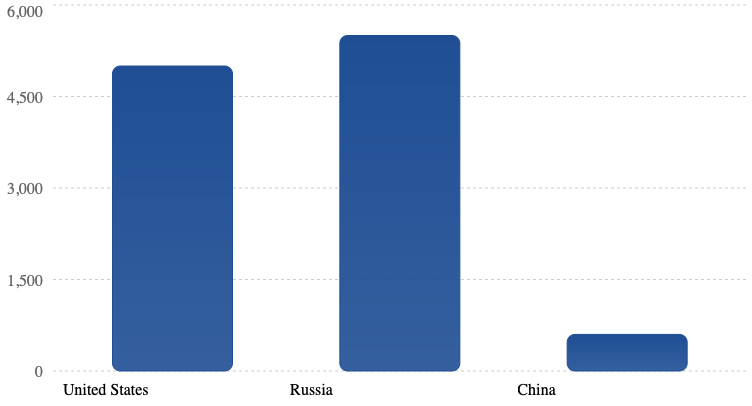
Approximate total inventory scale, not verified November 2026 stockpile counts. Figures rounded for strategic comparison.
Rounded reference magnitudes, not treaty-accountable deployed-warhead figures. Estimates vary by methodology and reporting date.
China is unlikely to accept a framework that permanently freezes its arsenal at a fraction of American and Russian levels without corresponding concessions.
Beijing may instead favor confidence-building measures, crisis communications, launch-notification arrangements and doctrines intended to reduce accidental escalation.
The greatest practical benefit would be improved communication during crises over Taiwan, Ukraine, Korea or other flashpoints.
The most important test is whether the three countries establish an ongoing working-level process with named negotiators, scheduled meetings and verifiable objectives.
Without that, the nuclear clause remains a statement of principle.
7. The omissions are as important as the commitments
The most revealing feature of the declaration is what it excludes.
Ukraine, Taiwan, Iran, North Korea, semiconductor restrictions and the South China Sea are all absent from the agreed text. AP and Reuters likewise emphasize that the summit yielded no concrete settlement of the major disputes. (AP News+2)
These omissions are not necessarily evidence of diplomatic failure. They may reflect deliberate efforts to avoid issues on which consensus is impossible.
| Issue | Strategic interpretation |
| Taiwan | Beijing avoids exposing its core sovereignty claim to trilateral bargaining |
| Ukraine | Moscow gains diplomatic visibility without accepting a ceasefire or withdrawal commitment |
| Iran | The three can discuss energy security without resolving their opposing regional interests |
| North Korea | Nuclear nonproliferation remains general rather than confronting a specific regional security dilemma |
| Semiconductors | US–China technological competition remains outside the accommodation |
| South China Sea | Maritime coercion and freedom-of-navigation disputes remain unresolved |
For Beijing, the exclusion of Taiwan is especially important.
China can support strategic stability while maintaining its position that Taiwan is an internal matter. The declaration therefore creates no apparent restriction on China’s military activities around Taiwan.
Nor does it establish an American concession concerning Taiwan’s political status or security.
This is the central contradiction of Shenzhen: the three governments can agree that nuclear war must never occur while continuing policies that could generate the very crises in which nuclear escalation becomes possible.
8. Implications for the wider international order
Europe and Ukraine
European governments may interpret the summit as another indication that Washington is willing to negotiate directly with Moscow and Beijing on major security questions.
The concern is not simply exclusion from one meeting. It is the possibility that great-power consultations could eventually produce arrangements affecting European security without adequate European or Ukrainian participation.
Nevertheless, there is no evidence in the declaration of a negotiated division of spheres of influence.
A Yalta-style interpretation would therefore be premature.
India and the Global South
For India, Shenzhen reinforces the value of strategic autonomy. New Delhi has incentives to maintain relationships with Washington, Moscow and Beijing while resisting a system in which those three powers define the terms of regional security.
For developing economies, improved energy supply and reduced nuclear tensions would be welcome. But UN reform that preserves the privileged position of the existing permanent members could reinforce rather than reduce international inequality.
Japan, South Korea and Southeast Asia
American allies face a familiar dilemma: dialogue between nuclear powers can reduce escalation risks, but poorly communicated diplomacy can raise concerns about the reliability of security guarantees.
The absence of North Korea from the declaration is particularly notable for Seoul and Tokyo.
Southeast Asian governments may welcome a less confrontational US–China relationship while remaining cautious about Beijing’s maritime ambitions.
The international legal system
The immunity provision could produce more enduring controversy than the nuclear language.
It places three major powers behind a shared criticism of international criminal jurisdiction, potentially widening the divide between sovereignty-first governments and states that prioritize international criminal accountability.
That is a meaningful ideological convergence even without a formal institutional agreement.
9. Scenarios for the next 6–12 months
These are CN-01 analytical probabilities, not statistical forecasts or market-implied probabilities.
Estimated strategic trajectories following Shenzhen
Selective stabilization: 50%
Regular diplomatic engagement, limited energy coordination and exploratory nuclear talks, while geopolitical competition persists.
Symbolic summit, little implementation: 30%
The declaration remains largely rhetorical as trade, Ukraine, Taiwan and Iran disputes overwhelm cooperation.
Broader great-power accommodation: 15%
The three establish sustained consultations, more concrete energy measures and initial nuclear confidence-building arrangements.
Renewed confrontation: 5%
A regional military crisis or severe economic confrontation rapidly undermines the diplomatic opening.
The base case is selective stabilization without strategic reconciliation.
The summit makes it somewhat easier for the three powers to communicate. It does not eliminate the structural causes of rivalry.
The most important indicators to monitor now are whether nuclear negotiators are appointed, whether petroleum supply increases become measurable, whether Washington modifies sanctions policy, and whether Beijing and Washington sustain their bilateral trade truce.
Another decisive indicator is the reaction of American allies. If they interpret the trilateral format as consultation rather than abandonment, the diplomatic opening could be stabilizing. If they perceive it as exclusion, it could accelerate hedging, rearmament and regional insecurity.
10. Implications for III’ Corporate
For corporate strategic planning, Shenzhen changes the risk distribution more than it changes immediate operating conditions.
| Exposure | Assessment | Corporate implication |
| Energy and refined fuels | Potential stabilization, unproven | Avoid assuming lower prices before physical supply increases |
| China–US technology trade | Competition persists | Maintain semiconductor and export-control contingencies |
| Russia-related transactions | Sanctions remain material | Do not treat diplomatic recognition as sanctions relief |
| Cross-border investment | Possible confidence improvement | Preserve geopolitical and regulatory risk premiums |
| Maritime logistics | Hormuz and Indo-Pacific risks persist | Maintain alternative routing and supplier diversification |
| Currency and payments | No monetary framework agreed | No basis yet for assuming a major dollar-system realignment |
For firms with China exposure, the most constructive possibility is a period of reduced geopolitical volatility that allows investment and procurement decisions to proceed with greater confidence.
But Shenzhen does not resolve the fundamental tensions between China’s industrial ambitions, American technology controls and Russia’s confrontation with Europe.
It would be premature to reverse supply-chain diversification or reduce geopolitical contingency reserves solely because of this declaration.
11. Final CN-01 judgment
A diplomatic success for Xi, a legitimacy gain for Putin, and an uncertain strategic return for Trump
The Shenzhen summit is historically significant because of who participated, where they met, and the collective responsibility they publicly acknowledged.
It is not yet historically transformative in terms of enforceable commitments.
China’s advantage is its ability to occupy the diplomatic center without conceding on Taiwan or technological sovereignty.
Russia’s advantage is recognition as an indispensable negotiating power and shared language challenging international criminal jurisdiction.
America’s potential advantage is the opening of a trilateral channel for nuclear-risk management and energy stabilization. Whether that becomes a durable American strategic gain depends on implementation and allied confidence.
The deepest implication concerns the architecture of international order.
Shenzhen suggests that Washington, Beijing and Moscow may be experimenting with a model in which fierce competition coexists with selective cooperation on threats that none can manage alone.
That is neither a new alliance nor necessarily a new Cold War settlement. It is an attempt to manage the risks of multipolarity through direct communication among the strongest powers.
The danger is that this approach could gradually privilege great-power bargains over the interests of smaller states and established legal institutions.
The opportunity is that even limited cooperation among nuclear powers could reduce the likelihood of catastrophic escalation.
My bottom line: Shenzhen has established a diplomatic possibility, not a new geopolitical settlement. Xi has secured the strongest immediate symbolic return, but the real strategic winner will be determined by who can convert the declaration into practical arrangements without sacrificing essential interests.
The next six months will reveal whether November 19, 2026, becomes remembered as the opening of a new era of managed competition—or as an extraordinary photograph accompanying four carefully worded promises.
CHINESE LITERARY PERSPECTIVE
Lu Xun (鲁迅), My Old Home (故乡), 1921
Lu Xun’s closing reflection offers an appropriate metaphor: hope resembles a path across the earth. A path does not exist simply because people imagine it; it emerges when enough people repeatedly travel the same ground.
Shenzhen has opened the possibility of such a path. Whether it becomes a durable road toward strategic stability depends not on declarations, but on the repeated actions of the powers that signed them.
CN-01, China Agent
Three Corporate