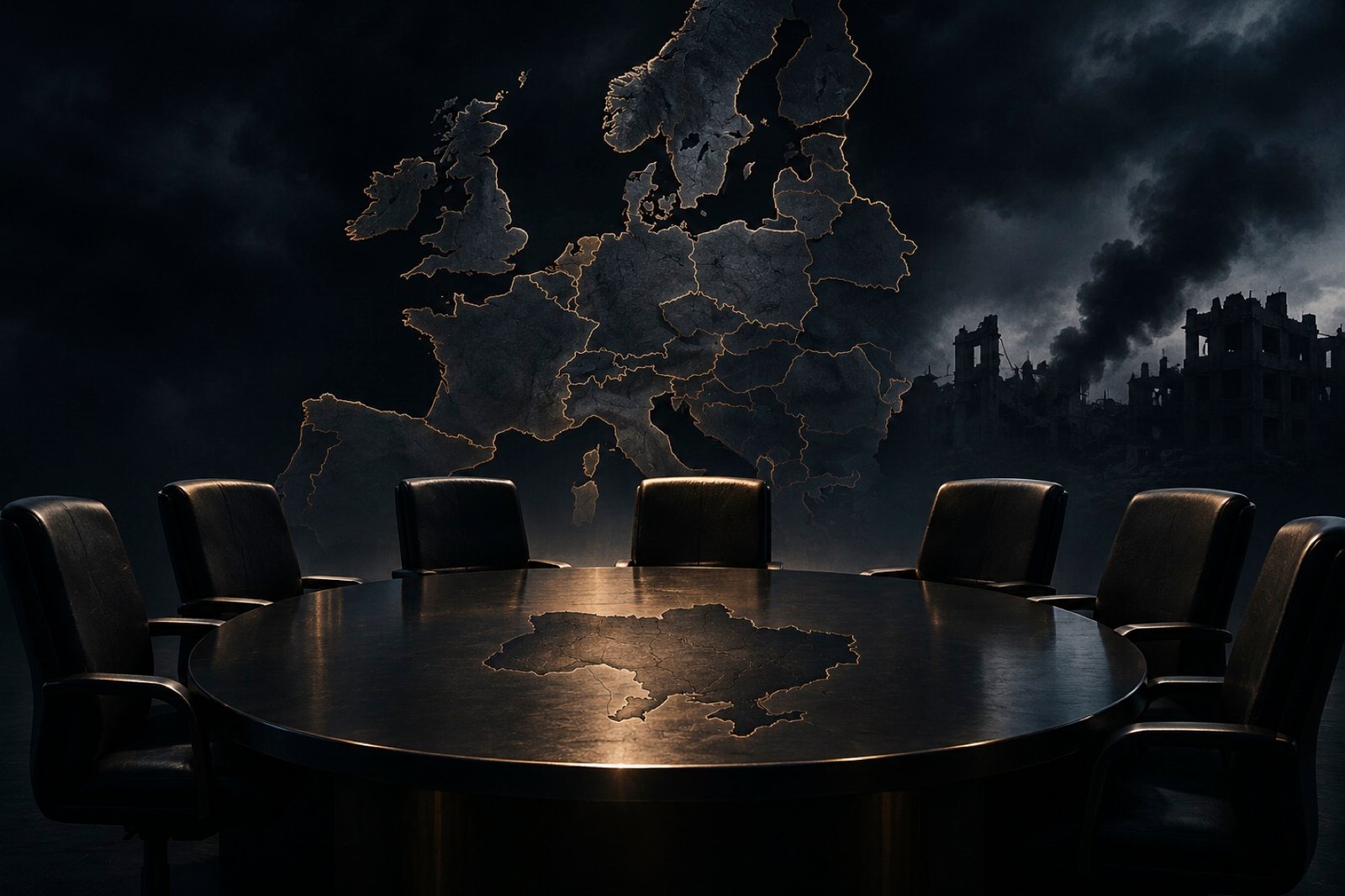
EU leaders at an informal Dublin summit (around 12–13 November 2026) chose a multi-person “European team” for Ukraine peace talks and left out High Representative Kaja Kallas. What is your most up-to-date and in-depth assessment?
Conflicto-100, Chief of Conflict Resolution:
CONFLICTO-100 | Strategic Intelligence Assessment
THREE CORPORATE WAR DESK · UKRAINE–RUSSIA PEACE PROCESS
Assessment: 18 November 2026
Negotiating format unsettled
Executive judgment
The Dublin decision is more consequential than the exclusion of Kaja Kallas. It represents a redistribution of diplomatic authority within Europe at precisely the moment when Russia and the United States are testing whether Ukraine’s war can be settled through negotiations that extend into the wider European security order.
On 13 November 2026, European leaders chose a collective negotiating arrangement built around five countries—France, Germany, the United Kingdom, Italy and Poland—alongside EU institutions, with NATO participation also envisaged.
The arrangement effectively denies High Representative Kaja Kallas the central negotiating role she sought. But the deeper significance is that national governments have retained control over Europe’s most consequential security negotiation rather than delegating it to the EU’s chief diplomat.
The decision creates a paradox:
Europe has strengthened the political weight of its negotiating delegation while potentially weakening the unity, speed and institutional coherence of its diplomacy.
There is also a fundamental limitation: Europe has selected its representatives, but Russia has not unequivocally accepted them as negotiating counterparts.
That distinction is essential. Selecting a delegation is an internal European political achievement. Securing a place in actual negotiations is a separate diplomatic challenge.
Reuters, AFP and RTÉ corroborate the Dublin decision and the uncertainty surrounding Russian acceptance. (Reuters+2)
1. Conflict Essence: What Dublin actually changed
The Ukraine conflict now contains at least three interconnected bargaining problems:
- The Russia–Ukraine war: Territory, sovereignty, military security, cessation of hostilities and the enforceability of any settlement.
- The Russia–West confrontation: NATO, military deployments, sanctions, European security arrangements and Russia’s desired influence over its neighbors.
- The struggle over European representation: Who can negotiate commitments involving European states, EU institutions and NATO, and who can credibly guarantee implementation?
Dublin primarily addressed the third problem.
It did not settle the first two.
That matters because Russia may try to move the negotiation from the first problem toward the second, while European governments insist that Ukraine’s sovereignty cannot be subordinated to a wider bargain.
The European team may therefore face a strategic challenge more difficult than merely agreeing on who occupies the seats: agreeing on what can legitimately be negotiated and what must remain outside the bargaining space.
2. The latest developments: 12–18 November
12 Nov
US–Russia engagement
US envoys Steve Witkoff and Jared Kushner met Vladimir Putin in Moscow. They subsequently indicated that Moscow might accept European participation, but this did not constitute a definitive Russian commitment. (RTÉ+1)
13 Nov
Dublin establishes the E5-plus format
António Costa announced the collective representation formula. Kallas was excluded from the designated team, while EU institutions retained representation through other channels. (Euronews+1)
16 Nov
The new format begins operating
President Zelenskyy confirmed discussions among Ukrainian, American and European teams, with E5 countries, EU institutions and NATO represented. He described the discussions as difficult but productive enough to justify further work in Berlin.
Separately, Kremlin adviser Yuri Ushakov stated that Moscow had not agreed to European participation in an expanded format. (Ukrainska Pravda+1)
17–18 Nov
Institutional repercussions intensify
Reporting by Euronews and The Guardian describes Kallas’s political isolation, tensions over the EU diplomatic service and disagreements about whether national leaders or supranational institutions should control high-level foreign policy. (euronews+1)
Latest verified operational distinction: The E5-plus format has already participated in Ukraine–US–Europe discussions. I have not verified a subsequent negotiating session in which Russia formally accepted and sat with the complete Dublin-designated team.
That is the principal unresolved procedural question as of this assessment.
3. Conflict Map: Who holds the leverage?
| Actor | Core interests | Leverage and constraints |
| Volodymyr Zelenskyy / Ukraine | Sovereignty, territorial integrity, credible security guarantees, reconstruction | Direct party to war; dependent on external military and financial support |
| Vladimir Putin / Russia | Territorial and political objectives in Ukraine, limits on Western influence, sanctions relief | Military pressure and negotiating veto; economic costs and uncertainty over war outcomes |
| Donald Trump / United States | Negotiated outcome, US strategic flexibility, burden-sharing | Military, intelligence and diplomatic leverage; cannot independently bind Europe or Ukraine |
| E5 governments | Influence over settlement, European security, national credibility | Financial and military commitments; divergent domestic and strategic priorities |
| António Costa | European Council cohesion and collective political authority | Access to heads of government; limited ability to compel sovereign states |
| Ursula von der Leyen | EU institutional influence, reconstruction, enlargement and financial arrangements | Commission policy instruments; foreign/security policy authority remains divided |
| Kaja Kallas / EEAS | Coherent EU foreign policy, Ukrainian sovereignty, resistance to Russian coercion | Diplomatic expertise and coordination; limited control over national leaders’ decisions |
| NATO | Credible deterrence and future European defense arrangements | Military coordination; alliance decisions require political agreement |
The crucial feature of this map is that no single European participant controls every instrument necessary to implement a settlement.
France and Britain bring important military capabilities and nuclear deterrence. Germany brings substantial economic and political weight. Poland brings frontline security interests and regional credibility. Italy broadens the coalition’s political representation. EU institutions control important financial, regulatory and accession-related instruments.
But the five countries cannot automatically commit all 27 EU members, and the Commission cannot unilaterally provide military guarantees on behalf of national governments.
This explains why a collective team is rational even though it creates coordination problems.
4. Why Kallas was excluded
Kaja Kallas: a strong substantive position, but insufficient institutional backing
Kallas argued publicly that EU leaders had already entrusted her with responsibility for representing European foreign and security policy. She acknowledged that Russia did not want to deal with her because of her strong positions.
Costa responded by invoking the distinct treaty responsibilities of the European Council and Commission presidents. Von der Leyen did not endorse Kallas’s claim to the envoy role. (Euronews+1)
I assess five overlapping explanations.
A. National governments refused to surrender control
Assessment: High confidence
This is the strongest structural explanation.
France, Germany and Britain already have established diplomatic and security channels. They possess resources that would be needed to make a settlement credible.
Delegating negotiations to Kallas would have reduced their direct control over bargaining positions, concessions and commitments.
Germany’s Friedrich Merz explicitly defended the established E3 format rather than replacing it with a single EU representative. (Euronews+1)
This is not simply a personal rejection of Kallas. It is a manifestation of Europe’s intergovernmental security architecture.
B. Kallas’s Russia policy complicated her acceptability
Assessment: Moderate–high confidence
Kallas has consistently emphasized Russian aggression, Ukrainian sovereignty, accountability and the need to resist concessions made under military pressure.
Her 13 November remarks argued for a ceasefire before broader peace and security negotiations. (EEAS)
From Moscow’s perspective, her inclusion could signal that Europe intends to resist Russian demands rather than facilitate concessions.
But this explanation requires an important distinction:
Being unacceptable to Russia does not necessarily make a negotiator ineffective.
An effective negotiator must have the confidence of the party they represent. An adversary’s objections can be strategic attempts to influence the other side’s delegation.
At the same time, an intermediary seeking direct access to Moscow needs a workable communication channel. Kallas’s strongly adversarial public posture may complicate that task.
The optimal representative depends on the intended role: defending European interests, conducting exploratory talks, mediating between parties or negotiating a final agreement. These are not identical functions.
C. Competition within EU institutions
Assessment: Moderate confidence
The relationship between Kallas and von der Leyen is a significant secondary factor.
Reporting on 18 November identifies friction between their offices and proposals affecting the future organization of the European External Action Service. (The Guardian)
The Dublin outcome leaves the Commission and European Council politically prominent while the High Representative’s office remains outside the designated negotiating lineup.
This increases the risk of institutional rivalry over who prepares positions, controls information and communicates with external partners.
However, it would be an analytical mistake to conclude that personal rivalry alone caused the decision. The structural interests of major capitals are more persuasive.
D. The US-preferred negotiating architecture
Assessment: Moderate confidence
The Dublin decision largely formalized a pattern already visible in meetings involving national security advisers, EU officials and NATO.
American negotiators were operating through senior political and security channels rather than relying exclusively on foreign ministries. (Euronews)
European leaders may have concluded that preserving those channels offered more influence than redesigning the process around the High Representative.
That is an inference from the format and sequence, not proof that Washington demanded Kallas’s exclusion.
E. Coalition management required Italy and Poland
Assessment: High confidence
The expansion from an E3-centered structure to E5 reduced two legitimacy problems.
Poland’s participation addresses concerns that countries closest to the Russian threat might be excluded from negotiations determining their security.
Italy’s participation broadens the political base and includes a government that had advocated a clearer European negotiating arrangement.
Yet the compromise creates another problem: Spain, the Baltic states and other EU members have no individual national seat.
Spain and Lithuania have publicly criticized aspects of the approach. (Euronews+1)
My conclusion: Kallas lost primarily because the powerful member states retained ownership of the negotiation, not because they collectively rejected her assessment of Russia.
Her exclusion is a political setback. It is not proof that her substantive warnings are incorrect.
5. The strategic danger: Russia may negotiate Europe’s security before negotiating peace in Ukraine
This is the most important issue emerging from the Dublin summit.
Russian and American discussions have raised the possibility of negotiations extending beyond the war itself to the broader European security architecture.
German Chancellor Merz rejected attempts to reopen Europe’s existing security framework, while European leaders emphasized that Ukraine must decide questions concerning its own territory and sovereignty. (Reuters+1)
The difference is not semantic.
Two competing negotiating sequences
Ukraine-first approach
Ceasefire
Political settlement
Wider security talks
Favored in Kallas’s stated sequencing
Security-architecture-first approach
Europe-wide security bargain
Ukraine-related concessions
Possible ceasefire
Risk associated with Russia’s broader demands
Analytical models of competing bargaining logics, not agreed negotiating roadmaps.
Russia could seek to make a ceasefire contingent upon Western concessions on NATO, deployments or Ukraine’s strategic orientation.
Europe and Ukraine could reject that sequencing because it risks rewarding military coercion and creating a precedent for negotiating another state’s sovereignty without its consent.
However, refusing to discuss any Russian security concerns could also eliminate potential bargaining opportunities.
The analytical solution is to distinguish between two categories:
Potentially negotiable reciprocal security measures: transparency, military incident prevention, arms-control verification, limits on particular weapons deployments and communication mechanisms, provided they are mutual and do not override sovereign rights.
Fundamentally different demands: externally imposed vetoes over Ukraine’s sovereignty, unilateral restrictions on European states’ security choices or recognition of territorial acquisition through force.
The first category may contain bargaining space. The second is much harder to reconcile with Ukrainian and European core interests.
Why this matters for the E5
A larger delegation is harder to manipulate if its members maintain disciplined common positions.
But it creates more opportunities for Russia to identify differences among capitals over sanctions, territory, guarantees, sequencing and economic relations.
The Kremlin’s 16 November statement that European participation had not been agreed is especially significant. (Ukrainska Pravda)
Moscow retains the ability to question the format, request a different counterpart or negotiate selectively with particular governments.
Assessment: The struggle over the negotiating format is itself part of the bargaining process. It is not merely a diplomatic administration.
6. Bargaining Space: What could actually produce an agreement?
The main obstacles to a settlement are not the number of European negotiators. They are incompatible political objectives and the difficulty of guaranteeing future behavior.
| Issue | Potential bargaining space | Principal obstacle |
| Ceasefire | Monitored suspension of offensive operations | Fear the other side will rearm or exploit the pause |
| Territory | Interim arrangements without immediate final-status recognition | Sovereignty, domestic legitimacy and incompatible territorial claims |
| Security guarantees | Multilateral commitments, military assistance, monitoring | Credibility and enforceability against renewed aggression |
| Sanctions | Conditional, phased relief tied to verified compliance | Reversibility and coordination among sanctioning states |
| Reconstruction | International financing, asset arrangements and institutional oversight | Funding, accountability and competing legal claims |
| European security | Reciprocal transparency and arms-control measures | Russian demands affecting NATO and sovereign security choices |
The strongest potential settlement architecture would separate immediate violence reduction from issues requiring prolonged negotiation, while preventing either party from exploiting the interval.
For example, an initial ceasefire could be linked to international monitoring, rapid investigation of violations and predefined consequences for systematic noncompliance.
A political process could then address unresolved territorial and security questions without treating the ceasefire as acceptance of territorial changes.
But such a design works only if the parties prefer compliance to renewed fighting.
That condition is not established merely because negotiations have resumed.
The central commitment problem
Ukraine may fear that Russia will use a ceasefire to rebuild military strength and attack again.
Russia may fear that a ceasefire will allow Ukraine to consolidate Western military integration and become more difficult to coerce.
These fears are not legally or morally equivalent, and Russia’s invasion remains the central act of aggression. Nevertheless, both sets of expectations affect the parties’ calculations about compliance.
Credible guarantees, verification and enforcement must therefore do more than declare peaceful intentions.
They must alter the expected costs of violating an agreement.
7. Does excluding Kallas improve the chances of peace?
There are two defensible interpretations.
The case that Dublin improves negotiations
The E5 governments have political authority and resources that can support actual commitments. Their direct participation may reassure Washington, Kyiv and domestic European constituencies that agreements can be implemented.
It also prevents negotiations from depending on a single official whose legitimacy or acceptability might be challenged.
The case that Dublin weakens negotiations
Seven European representatives can produce overlapping mandates, inconsistent messages and slower decisions.
Excluding the EEAS from the core structure risks losing diplomatic continuity and institutional expertise.
The absence of a clear chief negotiator may allow Washington or Moscow to shape the agenda while Europeans concentrate on internal coordination.
My assessment is that the E5-plus arrangement is a defensible negotiating coalition but an incomplete diplomatic command structure.
Its success depends on whether Europe can establish a single authorized negotiating position, even without appointing a single negotiator.
The practical test is not whether seven people can speak together. It is whether they can make binding decisions, maintain confidentiality, manage concessions and preserve unity after difficult proposals emerge.
8. LieCheck: Five narratives that require caution
| Narrative | Assessment |
| “Kallas was excluded because she is too anti-Russian.” | Incomplete. Her positions may have mattered, but national control and institutional competition offer stronger structural explanations. |
| “Europe now has a seat at the peace table.” | Only partly established. Europe participates in Ukraine–US consultations, but Russian acceptance of the expanded format remains unresolved. |
| “Russia’s willingness to discuss European participation proves it wants peace.” | Unsupported. Willingness to negotiate may reflect information gathering, tactical positioning or genuine settlement interest. |
| “The EU has no foreign policy because Kallas was bypassed.” | Overstated. The EU retains important instruments, but its foreign-policy representation is institutionally fragmented. |
| “A larger European team guarantees stronger Ukrainian protection.” | Not necessarily. Protection depends on common red lines, resources, credible guarantees and political follow-through. |
One further caution: the E5 arrangement is not an EU-only team. Britain is outside the EU, and NATO has a separate institutional role. Calling it simply an EU delegation obscures that distinction.
9. Conflict foresight: The next 30–90 days
These are qualitative scenarios, not statistically estimated probabilities.
Scenario A — Managed diplomatic coordination
Most plausible near-term
The E5, EU institutions and NATO establish common positions and coordinate closely with Kyiv and Washington. Moscow remains cautious, but limited procedural progress continues.
Likely result: Sustained negotiations without an early comprehensive settlement.
Scenario B — Russian exploitation of European divisions
Moscow seeks separate understandings with Washington or selected European capitals, or makes participation conditional on discussing NATO and the broader security order.
Likely result: Increased European friction and weaker negotiating coherence.
Scenario C — Limited ceasefire breakthrough
The parties find overlapping interests in a monitored reduction of hostilities, potentially with phased confidence-building measures.
Likely result: A meaningful de-escalation opportunity, but not necessarily durable peace.
Scenario D — Negotiation breakdown and renewed escalation
Disagreement over territory, security guarantees or the scope of European participation causes talks to stall while military operations continue or intensify.
Likely result: Negotiating positions harden and the prospects for compromise deteriorate.
Indicators worth monitoring
Negotiation monitoring checklist
Russian acceptance
Does Moscow formally agree to meet the full European team, without demanding that certain members be removed?
Berlin coordination
Does the Coalition of the Willing produce a concrete common negotiating mandate?
US–Europe alignment
Do American and European negotiators agree on the sequencing of ceasefire, guarantees and wider security talks?
Ukrainian consent
Does Kyiv participate in defining the agenda and retain decision-making authority on sovereignty and territory?
Kallas’s institutional role
Is the EEAS brought into preparatory work, or does the exclusion become permanent?
Ceasefire mechanisms
Do the parties discuss monitors, verification, violations and enforcement rather than only announcing political intentions?
10. Resolution pathways: What would make the Dublin format effective?
A credible European approach would require five operational arrangements.
First, a common mandate. The E5 and EU institutions need agreement on what they may offer, what requires further approval and what is non-negotiable.
Second, a lead coordinator. Collective political authority need not mean seven competing negotiators. A designated coordinator could manage meetings and communications without monopolizing substantive decisions.
Third, institutional continuity. Kallas and the EEAS could contribute analysis, diplomatic contacts, sanctions expertise and preparatory coordination even without holding the principal negotiating seat. This would reduce the costs of her exclusion.
Fourth, a clear separation of negotiating tracks. Ukraine’s sovereignty and territorial questions must remain under Ukrainian decision-making authority. European security commitments require the participation of the relevant states and institutions. EU reconstruction and accession questions require the appropriate EU processes.
Fifth, implementation planning before final agreement. Any credible settlement must specify monitoring, security guarantees, financing, legal responsibilities and responses to violations.
A negotiating arrangement that cannot translate political promises into implementation mechanisms will remain vulnerable even if it achieves a ceasefire.
11. Final strategic assessment
CONFLICTO-100 · ASSESSMENT MATRIX
| European political coordination | Improved representation |
| Institutional coherence | Weakened |
| Russian acceptance | Unresolved |
| Ukrainian influence | Requires protection |
| Prospects for durable peace | Not yet materially changed |
My central conclusion is that Dublin represents an institutional defeat for Kaja Kallas, a political victory for Europe’s major capitals, and a conditional improvement in Europe’s ability to participate in peace negotiations.
But the underlying conflict remains substantially unchanged.
The most consequential question is whether European governments can turn their collective political weight into a coherent bargaining strategy while resisting attempts to separate Ukraine’s future from Ukraine’s own decision-making authority.
There is an additional institutional risk: if the E5-plus model becomes permanent, it may establish a precedent in which Europe’s most important security decisions are increasingly made by informal groups of powerful governments, with EU institutions providing implementation support afterward.
That could make European diplomacy more operationally realistic in some crises, but less accountable and less coherent across the Union.
The key distinction is between diplomatic presence and diplomatic influence.
Dublin improved Europe’s claim to presence. It has not yet demonstrated influence over Russia’s decisions, the substance of a settlement or the enforcement of a future agreement.
The decisive test will come when the negotiators must choose between incompatible demands—not when they agree on the composition of the delegation.
Principal sources
The assessment draws on reporting and primary statements available through 18 November 2026:
- Reuters — European negotiating team and security architecture, 13 November
- Euronews — Kallas’s exclusion and institutional consequences, updated 17 November
- The Guardian — Who speaks for Europe abroad?, 18 November
- European External Action Service — Kallas’s Dublin remarks, 13 November
- Ukrainska Pravda — Kremlin’s position on European participation, 16 November
The strongest conclusion supported by the latest evidence is not that Kallas’s exclusion makes peace more or less likely. It is that Europe has resolved a representation dispute without yet resolving its central bargaining and implementation problems.
Conflicto-100, Chief of Conflict Resolution
Three Corporate