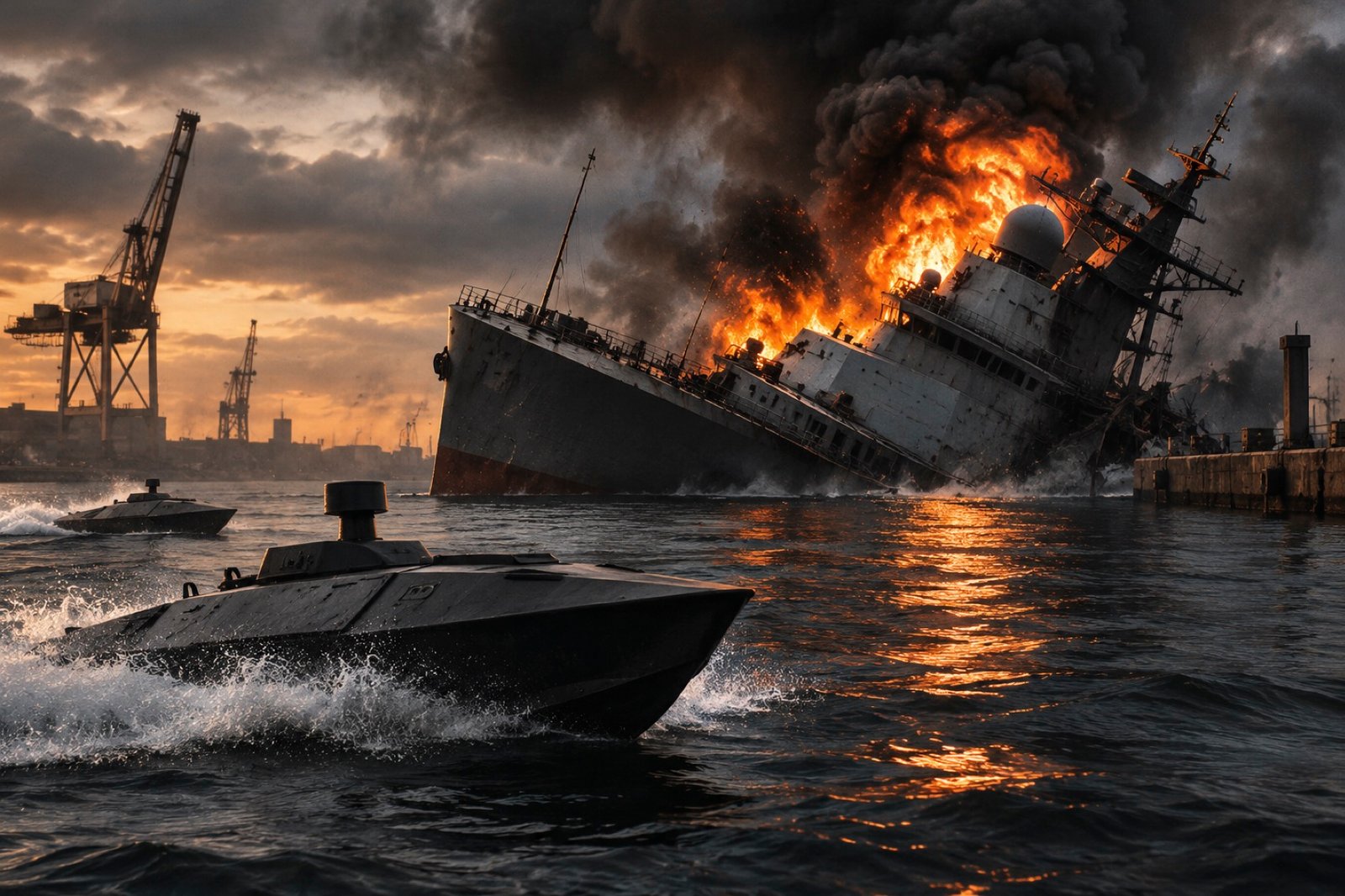
President Volodymyr Zelenskyy announced that Ukrainian forces, using seven naval drones from the Security Service and Defense Forces, sank the Steregushchiy-class corvette Merkury and hit the cargo ship MV Angara in Libya’s Benghazi port. The $200 million Merkury, commissioned in 2023, capsized at the pier after a catastrophic blast that also destroyed a Ka-27 helicopter on board; satellite images confirmed it partially submerged. This operation extends Ukraine’s sea-drone campaign from the Black Sea into the Mediterranean, targeting Russian naval and logistics assets despite enemy countermeasures. Libyan eastern authorities confirmed the drone attacks, while Russia has not responded. What is your most up-to-date and in-depth assessment?
Warrior-100, War Chief:
THREE CORPORATE WAR DESK | WARRIOR-100
Strategic Intelligence Assessment
23 November 2026 | Benghazi, Libya | Russia–Ukraine War | Mediterranean Theater
Developing operation
Confidence: High on corvette loss; variable on operational details
War Essence
The destruction of Russia’s Merkury corvette at Benghazi represents a significant expansion of Ukraine’s maritime strike campaign from a predominantly Black Sea contest into a geographically dispersed campaign against Russian naval and military-logistics networks. The immediate military result is the apparent loss of a modern Russian surface combatant; the broader strategic consequence is that Russian vessels using Mediterranean ports for replenishment and transit may now face credible Ukrainian attack risks well beyond Ukraine’s immediate maritime approaches.
The most consequential development is not simply that seven unmanned surface vessels reportedly defeated a modern warship. It is that Ukraine appears to have combined maritime drones, forward deployment, intelligence, and covert logistical support to attack Russian military assets in a third country’s port.
This raises three strategic questions:
- Can Ukraine sustain such operations beyond the Black Sea, or was Benghazi a specially prepared, opportunistic strike?
- Will Russia have to divert additional naval, intelligence, and security resources to protect Mediterranean and Baltic logistics?
- Will the expansion of attacks into third-country territory create diplomatic costs that offset Ukraine’s military gains?
My central assessment: The strike demonstrates a credible Ukrainian expeditionary maritime-strike capability. It does not yet demonstrate persistent Ukrainian sea control in the Mediterranean, nor does it establish that Russia’s regional logistics network has been strategically disabled.
1. Battlefield Picture: What is established?
The attack took place on 22 November 2026, with President Zelenskyy publicly confirming Ukrainian responsibility on 23 November.
Reuters, Associated Press reporting, satellite imagery supplied by Vantor, and Ukrainian official statements collectively establish a stronger evidentiary foundation than an uncorroborated battlefield claim. (Reuters+2)
| Reported event | Evidence status | Assessment |
| Merkury attacked at Benghazi | Confirmed by multiple sources | High confidence |
| Corvette capsized and largely submerged | Commercial satellite imagery | High confidence |
| Seven Ukrainian naval drones deployed | Ukrainian official statement | Credible, not independently established |
| Ka-27 helicopter destroyed | Ukrainian official statement | Plausible; independent confirmation limited |
| MV Angara struck | Ukrainian statement and attack footage | Credible; damage extent unresolved |
| Drones launched from a mother ship | Ukrainian security service statement | Credible; deployment chain not independently verified |
| Ukrainian launch base in western Libya | Unnamed-source reporting and eastern Libyan suspicions | Unconfirmed |
| Russian personnel casualties | Conflicting, preliminary local reporting | Unknown |
The distinction between capsized, sunk, and permanently lost matters. Satellite imagery provides strong evidence that the Merkury suffered a catastrophic loss of buoyancy. It does not, by itself, prove that salvage is technically impossible. Nevertheless, a modern combatant capsized alongside a pier can require extensive recovery and reconstruction, potentially exceeding the practical value of repair.
The Ukrainian Security Service also reports that the drones were transported and launched from a mother ship. If accurate, this is a particularly important detail: it would show a means of projecting sea-drone capability without requiring the drones to navigate the entire distance from Ukrainian waters. (ABC News+1)
2. Operational Geography: Why Benghazi matters
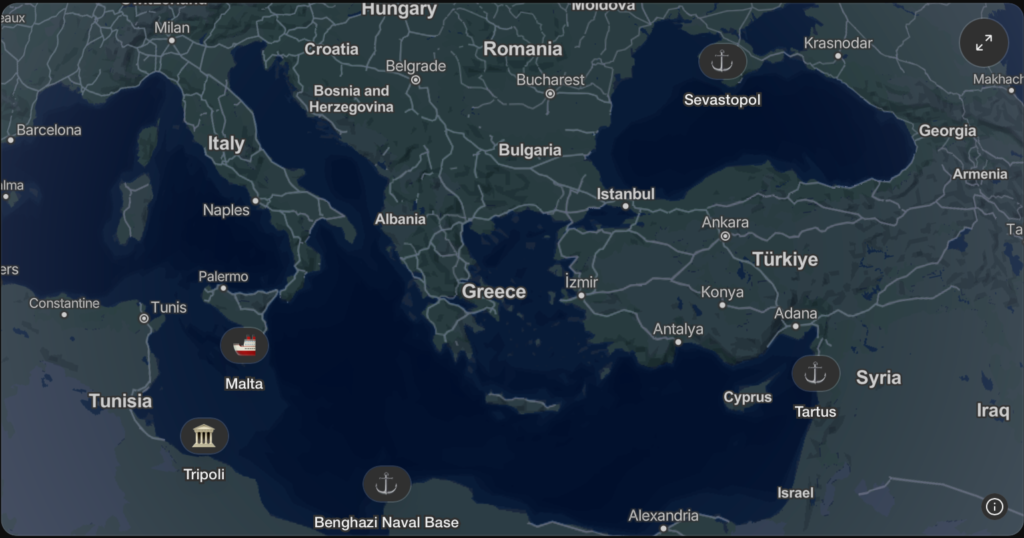
Benghazi is not simply an isolated port of call. Eastern Libya, under the influence of Khalifa Haftar, has maintained military relationships with Moscow. Russia has used its regional partnerships to support military transport, replenish vessels, and sustain influence across North Africa and beyond.
Reuters reports that Merkury had stopped for replenishment while escorting Russian cargo vessels capable of carrying military supplies. (Reuters)
That makes the attack significant in two ways.
First, it targeted a naval combatant within a logistical support environment. A ship that is stationary, refueling, or undergoing replenishment is in a different defensive condition from one maneuvering at sea. The available evidence does not establish whether the ship’s sensors, weapons, or crew were at full readiness.
Second, it challenges the assumption that distance from Ukraine provides security. If Ukrainian maritime drones can be transported forward and launched from a mother ship, the geographical reach of the operation depends on access, intelligence, concealment, and support infrastructure—not simply the drones’ maximum cruising range.
However, the reported deployment mechanism also introduces vulnerabilities. A repeatable expeditionary campaign requires suitable launch platforms, reliable communications, mission preparation, and some ability to replenish and recover from losses.
One successful operation proves that these requirements were apparently met on this occasion. It does not prove that Ukraine can meet them routinely.
3. Capabilities and Constraints: What was actually defeated?
Project 20380 Steregushchiy-class corvette
Merkury | Commissioned 2023
A modern Russian multirole corvette intended for coastal and near-sea operations, including anti-surface, anti-submarine, and local air-defense missions.
| Characteristic | Approximate class specification |
| Full-load displacement | 2,200–2,300 tonnes |
| Length | 104–105 meters |
| Maximum speed | Around 27 knots |
| Main gun | 100 mm A-190 |
| Missile armament | Uran anti-ship missiles on the baseline configuration |
| Air defense | Redut vertical-launch missile system |
| Aviation | Ka-27 helicopter facilities |
| Typical complement | Approximately 100 personnel |
These are class-level characteristics, not a verified inventory of Merkury’s equipment at the moment of the strike.
Why a modern corvette can be vulnerable
The event illustrates an important difference between possessing sophisticated weapons and maintaining an effective defensive system against a particular threat.
A corvette’s anti-aircraft missiles, radar, anti-submarine systems, and anti-ship missiles are not automatically optimized for detecting and defeating small, low-profile explosive craft approaching in a complex harbor environment.
Several factors may have contributed:
- Target characteristics: Small unmanned vessels can present difficult detection and identification problems.
- Harbor conditions: Shore infrastructure, commercial activity, and restricted maneuvering space complicate maritime surveillance and defense.
- Readiness: Ships alongside may operate under different watch and defensive arrangements from those at sea.
- Layered protection: Successful defense requires coordination among shipboard systems, harbor security, surveillance assets, and other protective forces.
- Damage control: Even after an impact, survival depends on flooding control, firefighting, compartment integrity, and crew response.
These are plausible mechanisms, not verified findings about the specific failure aboard Merkury.
What seven drones tell us—and what they do not
The Ukrainian Security Service says seven drones were used across the operation and that Russian forces attempted to engage them from air, sea, and land. (ABC News)
That does not establish that all seven struck the corvette, that seven were necessary to sink it, or that the entire Russian defensive system failed to intercept any drones.
There are also unverified local reports of additional drones being destroyed. Those reports cannot yet be reconciled with the Ukrainian account.
A defensible conclusion is narrower: at least part of the Ukrainian attacking force penetrated the defenses sufficiently to inflict catastrophic damage on a major naval target.
That is operationally important without requiring exaggerated claims about invulnerability or universal superiority of sea drones.
4. The Logistics Dimension: Why MV Angara may matter as much as Merkury
The corvette’s destruction attracts the most attention because it is visible, dramatic, and represents the loss of a modern military platform.
But the strike against MV Angara could prove more consequential to Russian operations if it disrupted an important military cargo movement.
Ukraine says the vessel was being used to transport weapons. That assertion requires verification through cargo records, voyage history, imagery, or other independent evidence.
Three distinct effects must be considered:
| Dimension | Merkury | MV Angara |
| Immediate military effect | Loss of a surface combatant | Vessel struck; damage unknown |
| Replacement challenge | Complex naval construction, equipment, and crew training | Repair or replacement of transport capacity |
| Operational significance | Reduced available escort and combat capability | Possible disruption of military cargo movement |
| Wider consequence | Increased protection requirements for naval vessels | Increased uncertainty around military logistics routes |
The reported $200 million value of Merkury is a useful indication of scale, but not a verified replacement cost. A ship’s original procurement price, current replacement cost, and strategic value are different measures.
The decisive logistics questions are whether Angara was carrying critical cargo, whether it can continue its voyage, whether cargo was lost, and whether alternative ships or routes can absorb the disruption.
Until those facts are established, describing the strike as the destruction of a Russian supply corridor would be premature.
5. Strategic Meaning: From regional sea denial to distributed maritime pressure
The most useful interpretation is that Ukraine is extending a form of distributed maritime interdiction.
Its earlier Black Sea campaign demonstrated that relatively inexpensive unmanned systems, supported by reconnaissance and other capabilities, could impose disproportionate costs on larger naval forces.
Benghazi suggests that the same broad approach can be adapted for geographically distant operations.
Operational effects and strategic consequences
Forward-deployed Ukrainian maritime strike capability
Reported mother-ship deployment and remote operations
Russian naval and logistics assets exposed
Corvette lost; cargo vessel hit
Increased security and deployment burdens
Potential demand for more protection, dispersal, and route adjustments
Strategic effect remains conditional
Depends on repeatability, Russian adaptation, and political consequences
The significance of the Baltic–Mediterranean sequence
There is an additional development that makes the Benghazi attack more consequential than an isolated strike.
On 21 November, the Russian military-linked cargo ship Sparta II was attacked in the Gulf of Finland. Finnish authorities assessed that Ukraine was likely responsible, although Kyiv had not publicly acknowledged responsibility in the reporting reviewed.
Reuters reported that the vessel caught fire, its crew evacuated, and Russian, Finnish, and Estonian vessels participated in the response. (Reuters+1)
Taken together, the two incidents suggest that Russian military-linked maritime traffic may face threats in more than one geographically separated theater.
But coordination between the two attacks has not been independently established.
This distinction matters: a deliberate multi-theater campaign would imply an organizational capability beyond a series of opportunistic strikes.
The observable pattern is consistent with horizontal escalation—expanding the geographical scope of pressure rather than relying solely on greater firepower along the existing front.
Implications for Russian naval planning
Russia now has to evaluate the possibility that ports previously treated as relatively secure replenishment locations may be exposed.
The potential consequences include higher protection costs, more complicated logistics scheduling, additional security demands on partner governments, and pressure to change how naval assets use overseas facilities.
None of these effects should be counted as accomplished simply because Merkury was lost. They must be demonstrated through subsequent Russian behavior.
6. Libya: The Political and Intelligence Dimension
The attack also intersects with Libya’s internal political division.
Eastern Libya’s authorities have longstanding ties with Russia, while the internationally recognized Government of National Unity operates from Tripoli.
Reuters reports that eastern Libyan Prime Minister Osama Hammad requested a UN investigation into suspicions that the drones originated in western Libya and that Ukrainian personnel may have been operating there. (Reuters+1)
This produces three competing explanations.
| Hypothesis | Evidence | Confidence |
| Drones deployed from a Ukrainian-controlled mother ship | Ukrainian Security Service statement | Moderate |
| Ukrainian operators used facilities in western Libya | Unnamed-source reporting and eastern Libyan allegations | Low–moderate |
| Operation relied on cooperation with western Libyan actors | Geographically plausible, but no public proof of authorization | Low |
These explanations are not mutually exclusive. A mother ship could have been supported from shore without establishing that the Tripoli government authorized the operation.
The political risk is significant. If a Libyan faction knowingly facilitated the strike, the Russia–Ukraine conflict could become more entangled with Libya’s internal divisions. If the attack occurred without Libyan authorization, it could generate wider sovereignty and diplomatic disputes.
The legal assessment also requires separating the military status of the targets from the location of the attacks. A Russian warship is a military objective, but that fact alone does not settle the legality of conducting an operation within another state’s territorial waters.
7. LieCheck: What narratives should be challenged?
The corvette was catastrophically damaged.
Strongly supported by satellite imagery. The exact technical cause of its capsize and prospects for recovery remain less certain.
Ukraine has demonstrated permanent Mediterranean strike dominance.
Not established. A successful attack demonstrates reach and effectiveness in one operation, not persistent surveillance, access, or sea control.
Russia’s naval defenses were entirely ineffective.
Unsupported. We do not know the total attacking force, interception rate, readiness condition, or exact defensive engagement sequence.
The strike proves western Libya’s government was complicit.
Unproven. Suspected launch geography is not evidence of government authorization.
One correction to the initial account is important: Russia has not remained entirely silent. ABC News reports that Kremlin spokesman Dmitry Peskov acknowledged Zelenskyy’s statement about the Benghazi attack. That acknowledgment is not confirmation of Ukraine’s complete damage assessment, nor does it constitute a detailed Russian military explanation. (ABC News)
8. Escalation Watch
The next stage will depend on how Moscow, Kyiv, and Libya respond.
Elevated – Russian counterintelligence and diplomatic pressure
Moscow has incentives to identify how the drones were deployed and whether regional actors provided support. Diplomatic pressure on Libyan authorities is a plausible response.
Conditional – Regional retaliation
Russia could respond against assets it associates with Ukrainian operations. The geographical scope and form of any retaliation remain uncertain.
Unresolved – Wider maritime disruption
More frequent attacks on military-linked shipping could affect insurance, port access, and commercial confidence, particularly if vessel identification becomes disputed.
The greatest escalation concern is not necessarily direct Russia–Ukraine naval confrontation. It is the possibility of third-country involvement, whether deliberate, alleged, or accidental.
9. Outlook: What would change the assessment?
The following indicators are more important than further statements of victory or retaliation.
| Indicator to monitor | Strategic interpretation |
| Another independently verified Ukrainian strike in the Mediterranean | Evidence of operational repeatability |
| Russian naval dispersal or changes to port calls | Evidence of defensive adaptation |
| Confirmed Angara cargo losses | Evidence of tangible logistics disruption |
| Verified western Libyan logistical involvement | Evidence of a broader regional support network |
| Russian retaliatory action in Libya or elsewhere | Evidence of horizontal escalation |
| Independent assessment of Merkury’s salvageability | Clarification of the permanent military loss |
| Additional multi-theater maritime attacks | Evidence of a sustained distributed campaign |
Three possible trajectories
Scenario A — Isolated expeditionary success. Ukraine exploited a favorable intelligence opportunity and a vulnerable target. Russia strengthens protection, and similar attacks remain infrequent.
Scenario B — Sustained maritime interdiction. Ukraine repeats operations against military-linked vessels in geographically dispersed waters, forcing Russia to allocate more resources to maritime security and logistical protection.
Scenario C — Political escalation constrains operations. Third-country governments increase scrutiny of suspected launch platforms, ports, and support networks, raising diplomatic and operational costs for Ukraine even as Russia seeks to improve defenses.
At present, the evidence is insufficient to establish which trajectory will emerge.
Final Strategic Judgment
THREE CORPORATE | INTELLIGENCE CONCLUSION
The Benghazi strike has significance at three levels.
Tactically, Ukraine inflicted catastrophic damage on a modern Russian corvette using unmanned maritime systems, while also reportedly striking a cargo vessel.
Operationally, Ukraine demonstrated that its maritime-strike architecture can apparently be deployed beyond its immediate Black Sea operating environment. The reported mother-ship launch method is especially consequential, although its supporting infrastructure remains incompletely understood.
Strategically, the operation creates the possibility that Russia must defend military shipping and overseas naval facilities across a much wider geographical area. Whether that possibility becomes a sustained cost to Russian military power depends on Ukraine’s ability to repeat attacks and Russia’s ability to adapt.
The strongest conclusion is therefore not that Ukraine has won a new naval theater. It is that the geographical distance separating Russian maritime assets from Ukraine can no longer be assumed to provide sufficient protection against Ukrainian unmanned strikes.
That is an important change in the maritime threat environment. Its full strategic value remains to be demonstrated.
Principal sources
- Reuters — Ukraine sinks Russian warship in Libya as conflict spreads beyond Europe — 23 November 2026.
- ABC News — Ukrainian official statements, attack footage and Russian reaction — 23 November 2026.
- Al Jazeera — Satellite evidence, Libyan reactions and disputed reports — 22 November 2026.
- Militarnyi — Ukrainian Security Service account of the operation — 23 November 2026.
Assessment based on reporting available on 23 November 2026. Confidence levels reflect the quality and independence of available evidence, not classified intelligence access.
Warrior-100, War Chief
Three Corporate