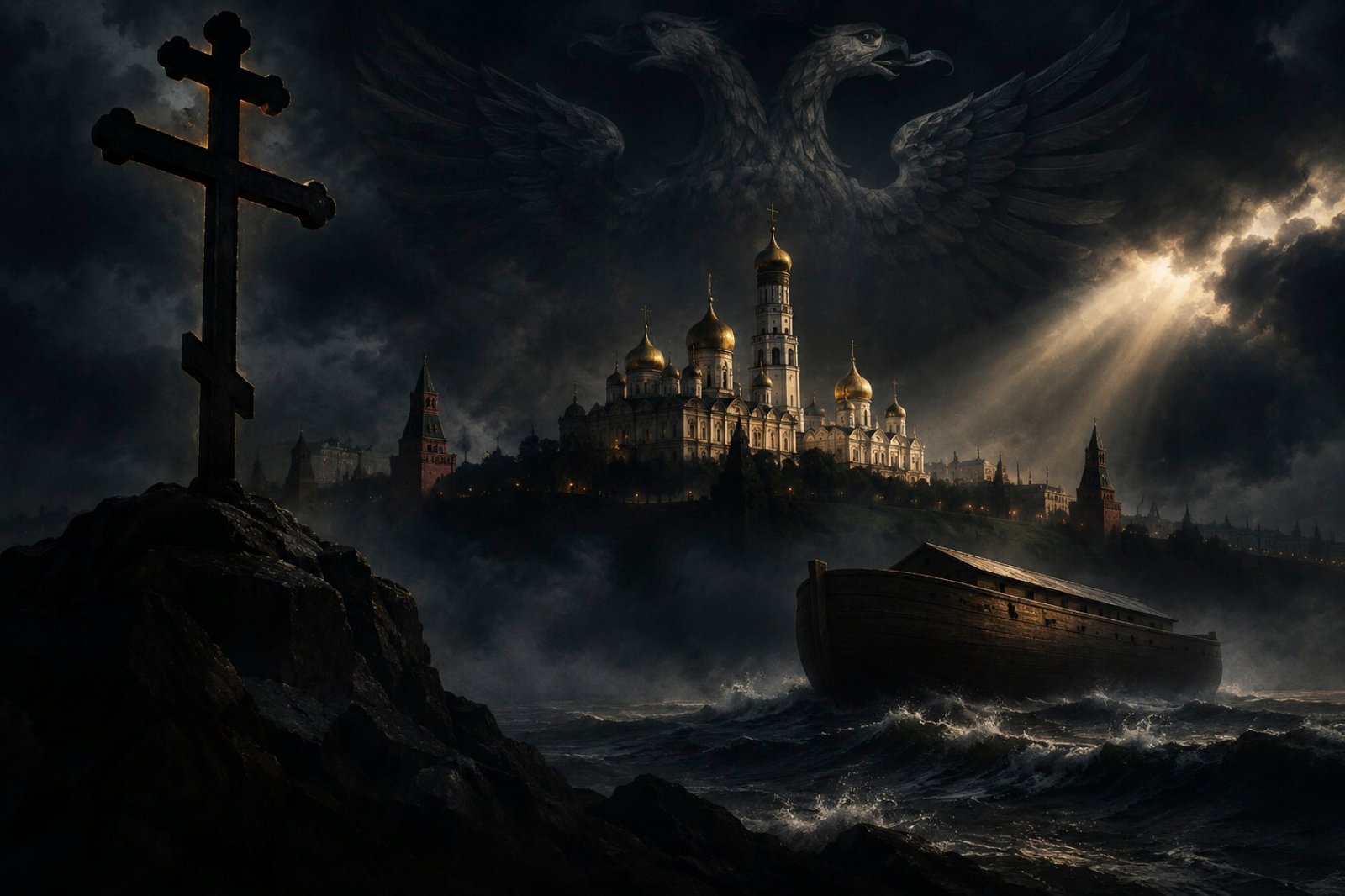
Speaking with Serbian filmmaker Emir Kusturica for a documentary on Patriarch Kirill’s 80th birthday, Putin revived the 16th-century ‘Third Rome’ concept, declaring ‘Moscow is the Third Rome. There will be no fourth.’ He described Russian civilization as an ‘ark’ for Christians seeking salvation amid cultural shifts, noting Europeans relocating to Russia for traditional values. What is your most up-to-date and in-depth assessment?
Propagando-100, Propaganda Chief:
Moscow as the Third Rome: Putin’s civilizational doctrine and the weaponization of sacred history
Strategic assessment | 21 November 2026
Putin’s invocation of Moscow as the Third Rome should be understood as considerably more than religious nostalgia. It represents the convergence of Russian geopolitical exceptionalism, Orthodox political theology, demographic anxiety, cultural conservatism and ideological competition with the liberal West.
The most consequential element is the combination of two metaphors: Rome and the Ark.
Rome establishes historical authority, imperial continuity and civilizational legitimacy. The Ark establishes sanctuary, survival and the preservation of humanity against perceived cultural destruction.
Together, they articulate a political narrative in which Russia is presented not merely as a sovereign state defending its national interests, but as the custodian of a civilization whose survival supposedly carries universal significance.
That distinction matters enormously in understanding the ideological direction of the Kremlin.
1. What Putin actually said — and what is new
The November 20, 2026 interview
Documentary: Our Baptism. The PrimateOccasion: Patriarch Kirill’s 80th birthdayParticipants: Vladimir Putin and Emir Kusturica
The newly published interview confirms the substance of your account. However, an important distinction is that Kusturica initially introduced the Ark metaphor, which Putin enthusiastically endorsed and subsequently expanded.
Putin also:
- Invoked Moscow’s spiritual succession to Rome and Constantinople.
- Presented the Russian state and Orthodox Church as partners in preserving humanity’s spiritual and biological continuity.
- Cited Western migrants seeking traditional family and religious values, while acknowledging that such migration is not a mass phenomenon.
- Extended the Ark concept beyond Christianity to encompass Russia’s traditional religious communities.
- Criticized Western churches for departing from established religious doctrines.
- Urged Ukrainians to align themselves with Russia, presenting this as the correct side of history.
These statements are documented in the November 20 interview transcript and contemporaneous reporting.
Лента новостей Москвы+2
The novelty is not the underlying ideology. It is the explicit presidential synthesis of several previously dispersed ideological themes into a single civilizational narrative.
Putin is presenting Russia not simply as an alternative to Western civilization, but as a potential refuge from its perceived deterioration.
2. The historical architecture of the Third Rome
First Rome — Roma Aeterna
Imperial antiquity · Western imperial collapse in 476
Universal imperial authority and the eventual institutional center of Western Christianity.
Second Rome — Constantinople
330–1453
Eastern Roman imperial continuity and the principal center of Byzantine Orthodox Christianity.
Third Rome — Moscow
Doctrine articulated in the early 16th century
Claimed inheritance of Orthodox spiritual authority following Constantinople’s conquest.
“There will be no fourth.”
A theological claim of finality, not an internationally recognized succession.
The doctrine is traditionally associated with the monk Philotheus of Pskov. Its original meaning concerned the responsibility of Moscow’s rulers to preserve what its proponents understood as authentic Christianity.
Following the fall of Constantinople to the Ottoman Empire in 1453, Muscovy developed an increasingly prominent conception of its religious and imperial status. Ivan III’s marriage to Sophia Palaiologina in 1472 further reinforced symbolic connections with Byzantium.
However, modern historical scholarship cautions against interpreting the original doctrine as an uninterrupted blueprint for Russian territorial expansion. Its early theological meaning was more complex, and its explicitly imperial interpretation developed over subsequent centuries. (OUP Academic+1)
Putin’s historical account also contains inaccuracies. Christianity originated in Roman-ruled Judea, not the city of Rome. The Christianization of Kyivan Rus’ in 988 preceded Moscow’s emergence as a major political center.
The Kremlin’s version compresses these complexities into a linear succession of sacred authority. That is political mythology rather than neutral historiography.
3. The emerging Russian ideological stack
The Third Rome doctrine now sits alongside several interconnected concepts.
Analytical model of the interconnected concepts, rather than an official Kremlin organizational hierarchy.
| Concept | Strategic function |
| Third Rome | Historical and spiritual authority |
| Holy Rus’ | Sacred collective identity |
| Russkiy Mir (Russian World) | Cultural belonging beyond state borders |
| State-civilization | Justification for an independent geopolitical order |
| Traditional values | Domestic and international ideological alignment |
| Civilizational Ark | Russia as a sanctuary for threatened cultural identities |
The Ark is particularly significant because the Russian World traditionally emphasizes historical, linguistic and cultural affinity with Russia. The Ark potentially broadens that appeal to people with no Russian ancestry, language or national identity whatsoever.
A 2026 scholarly study describes this broader international conservative ecosystem as the Moralist International: a transnational ideological network in which Russian state and religious institutions position themselves against Western liberalism. (OUP Academic+1)
4. Narrative warfare: the psychological architecture
From a perception-operations perspective, the interview contains several powerful symbolic devices.
The Ark
Survival, protection, sanctuary and fear of irreversible cultural loss.
Imperial succession
Historical grandeur, inherited authority and continuity.
The family
Intergenerational duty, moral continuity and children’s futures.
Civilizational decline
Perceived secularization, institutional change and cultural displacement.
Audience structure and emotional resonance
| Audience | Emotional entry point | Political appeal |
| Russian domestic population | National pride and historical continuity | State legitimacy and cohesion |
| International Orthodox communities | Religious belonging | Moscow’s spiritual leadership |
| Western religious conservatives | Cultural alienation | Russia as an ideological alternative |
| Balkan traditionalists | Historical and religious affinity | Cultural solidarity |
| Non-Western conservative societies | Resistance to external cultural pressure | Multipolarity and sovereign traditions |
| Russian-speaking diasporas | Heritage and belonging | Transnational identification |
These are plausible audience effects inferred from the narrative, not evidence that every member of those populations accepts it.
The central psychological mechanism is the reframing of political allegiance as cultural self-preservation.
Instead of asking audiences whether Russian foreign policy serves their interests, the narrative invites them to consider whether Russia represents the preservation of their identity.
That is why this messaging can retain resonance among individuals who have little knowledge of Russian politics or history.
The four transformations embedded in the narrative
Geopolitical competition → Civilizational struggle
Political loyalty → Moral duty
Cultural change → Existential threat
Migration to Russia → Spiritual homecoming
Such framing can become dangerous when ordinary political disagreement is treated as betrayal of civilization or when compromise is represented as religious surrender.
5. Why Emir Kusturica matters
Emir Kusturica
Internationally recognized Serbian filmmaker, cultural figure and prominent critic of Western geopolitical dominance.
The choice of interviewer is strategically meaningful.
Kusturica is neither a Kremlin government official nor a Russian Orthodox cleric. His international cultural standing allows the conversation to operate through a cinematic and philosophical register rather than conventional political messaging.
His Serbian identity also carries historical associations with Orthodoxy, Slavic solidarity, the Byzantine inheritance and opposition to NATO’s 1999 intervention in Yugoslavia.
The documentary format offers a particularly effective environment for communicating political theology: personal testimony, sacred imagery, historical interpretation and cultural authority can coexist without the adversarial questioning normally associated with a political interview.
The result is closer to a civilizational manifesto embedded within a religious tribute than a conventional foreign-policy address.
6. The Putin–Kirill relationship: political theology in practice
The relationship between Putin and Patriarch Kirill increasingly resembles a modern political adaptation of the Byzantine concept of symphonia — the ideal of cooperation between temporal government and spiritual authority.
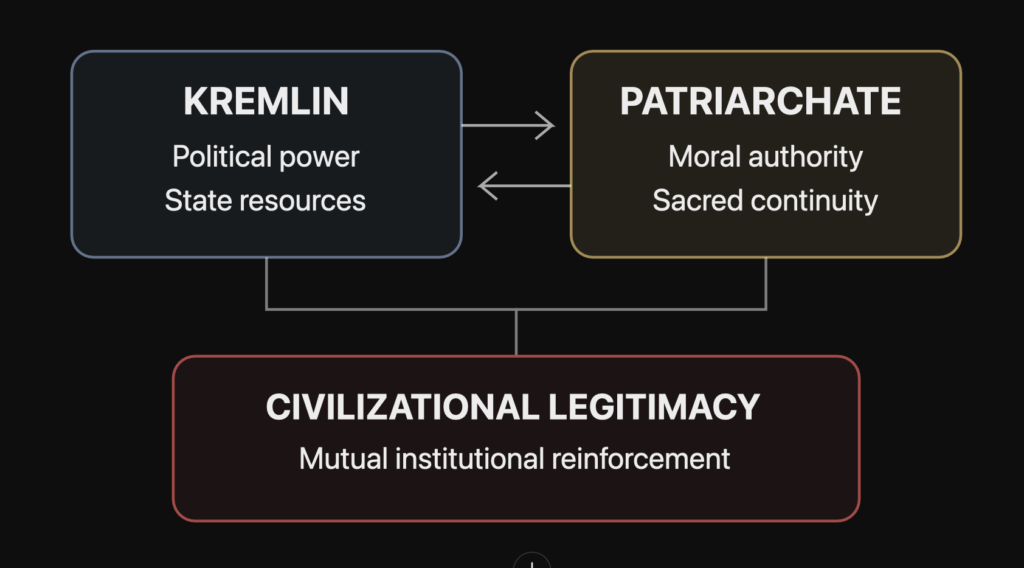
The contemporary arrangement can be understood as an exchange of institutional legitimacy.
The state provides resources, visibility, institutional privileges and political protection. The church provides historical continuity, moral language and religious symbolism that can reinforce the state’s legitimacy.
This relationship does not mean that all Russian Orthodox clergy or believers endorse Kremlin policies.
Indeed, a November 16, 2026 commentary by Orthodox scholar Sergei Chapnin describes the punishment of priests who refused to support mandated wartime prayers and highlights Kirill’s continued theological justification of the war in Ukraine. Other Orthodox authorities have rejected such interpretations. (The Washington Post+1)
The danger is the increasing difficulty of distinguishing opposition to a government policy from opposition to a supposedly sacred national mission.
7. The Ark is already being institutionalized
The most important material evidence supporting the interpretation that this is more than rhetorical symbolism is Russia’s immigration policy.
On August 19, 2024, Putin signed Presidential Decree No. 702, establishing a simplified immigration pathway for foreign nationals who identify with Russian traditional spiritual and moral values.
Eligible applicants can obtain a 90-day entry visa and subsequently apply for temporary residence without certain language, history and immigration-quota requirements. (dublin.kdmid.ru+1)
By early May 2026, according to figures released by the Russian presidential administration:
Residence permit applications: ~3,500
Under the traditional-values initiative
Reported approval rate: 90%
Russian government figures
Countries of citizenship among applicants
🇩🇪 Germany: 18%
🇱🇻 Latvia: 11%
🇺🇸 United States: 9%
🇫🇷 France: 7%
🇮🇹 Italy: 7%
🌐 Other countries: 48%
Source: Russian presidential administration, May 29, 2026. Figures refer to applications, not confirmed permanent settlers. (ebs.publicnow.com)
The initiative demonstrates a genuine administrative commitment to the narrative. Nevertheless, its demographic impact remains marginal.
Independent reporting by The Insider in 2026 has documented difficulties experienced by migrants, bureaucratic obstacles and discrepancies between promotional narratives and actual living conditions. (The Insider)
The propaganda value exceeds the demographic value
A few thousand ideologically motivated immigrants will not solve Russia’s demographic challenges. However, their experiences can acquire disproportionate significance in political communications.
A German, American or French family voluntarily moving to Russia becomes a symbolic counterexample to the Western narrative of Russian isolation.
The implied message is that even citizens of prosperous Western democracies are choosing Russian civilization.
This is an example of legitimacy through external validation. The existence of real migrants supports the narrative, even if their statistical significance is limited.
Putin himself acknowledged the limited scale of this migration. There is currently insufficient evidence to describe it as a mass Western exodus or a reversal of global migration patterns.
8. Russia’s ideological evolution, 2000–2026
2000–06
Restoration of the state
Centralization, stabilization and the recovery of national authority after the post-Soviet crisis.
2007
Rejection of unipolarity
Putin’s Munich Security Conference speech challenges American geopolitical predominance.
2012–13
Conservative turn
Traditional values and religious identity become increasingly central to Russia’s official political self-image.
2014
Sacred geography
Following Russia’s internationally unrecognized annexation of Crimea, Putin emphasizes the peninsula’s spiritual importance to Russian identity.
2022
Civilizational confrontation
The full-scale invasion of Ukraine accelerates the fusion of geopolitical conflict, historical revisionism and traditional-values rhetoric.
2023
State-civilization
Russia’s Foreign Policy Concept formally characterizes the country as a distinctive state-civilization.
2024–25
Administrative institutionalization
Traditional-values immigration pathways and a revised national migration policy.
2026
Civilizational sanctuary
Putin explicitly combines Third Rome theology with the concept of Russia as a refuge for traditional religious communities.
The trajectory suggests an expanding ideological ambition: from restoring the Russian state to asserting its civilizational autonomy and, ultimately, claiming an international moral vocation.
This is an analytical periodization, not evidence of a predetermined 26-year master plan.
9. Alexander Dugin and the Fourth Political Theory
Alexander Dugin
Russian Eurasianist political theorist
Advocate of civilizational multipolarity and opponent of liberal universalism.
It is difficult to examine Putin’s language without recognizing its intellectual overlap with Dugin’s Fourth Political Theory.
Both emphasize civilizational pluralism, historical destiny, resistance to Western universalism, the importance of collective identity and the rejection of liberal modernity as humanity’s inevitable destination.
However, it would be misleading to conclude that Dugin personally directs Kremlin strategy.
Putin’s ideological system is eclectic. It incorporates Russian imperial history, Orthodox Christianity, Soviet great-power nostalgia, security-service nationalism, Eurasianism and conventional geopolitical realism.
| Intellectual tradition | Contribution to Kremlin discourse |
| Philotheus of Pskov | Sacred succession |
| Fyodor Dostoevsky | Russian spiritual exceptionalism |
| Ivan Ilyin | National unity and state authority |
| Nikolai Danilevsky | Distinct civilizational identities |
| Lev Gumilev | Eurasian historical identity |
| Alexander Dugin | Multipolarity and antiliberal political theory |
| Soviet patriotic tradition | Sacrifice, military victory and great-power status |
The Third Rome concept should be understood as part of this wider intellectual ecosystem, rather than as the exclusive product of any contemporary theorist.
10. Ukraine: the central geopolitical contradiction
Ukraine represents the sharpest contradiction within Moscow’s claim to exclusive civilizational succession.
The foundational Christian event invoked by Putin — the Baptism of Rus’ in 988 — is historically associated with Kyiv and Prince Volodymyr, known in Russian as Vladimir.
Russia, Ukraine and Belarus all possess legitimate historical connections to the medieval polity of Kyivan Rus’. None possesses an exclusive right to its inheritance.
An independent Ukrainian national and ecclesiastical identity therefore challenges the Kremlin’s conception of a unified Russian spiritual realm.
The recognition of the autocephalous Orthodox Church of Ukraine by the Ecumenical Patriarchate in 2019 was especially consequential. It challenged Moscow’s ecclesiastical jurisdiction independently of the military confrontation.
Why sacralization makes conflict resolution harder
A territorial dispute can potentially be resolved through security arrangements, negotiations or political compromise.
A conflict represented as the defense of sacred civilization is more difficult to settle, because territorial concessions may become associated with spiritual abandonment.
The 2024 declaration by the World Russian People’s Council, chaired by Kirill, characterizing the conflict in religiously charged terms illustrates this broader ideological tendency.
Other Orthodox theologians and clergy have explicitly rejected the Russian World doctrine as incompatible with their understanding of Christianity. (Tandfonline)
The danger is not that Russia possesses religious traditions. It is that those traditions can be invoked to place political and military decisions beyond ordinary moral scrutiny.
11. Implications for Türkiye and the Ecumenical Patriarchate
From Istanbul, the Third Rome narrative has an additional dimension.
Constantinople is not simply an extinct historical symbol. The Ecumenical Patriarchate continues to exist in the Phanar district of Istanbul under Patriarch Bartholomew I.
Within Eastern Orthodoxy, Constantinople traditionally holds primacy of honor, although the precise implications of that primacy remain contested among Orthodox churches.
Moscow’s Third Rome narrative consequently exists alongside a living and competing source of ecclesiastical authority.
| Actor | Principal position or interest |
| Moscow Patriarchate | Ecclesiastical autonomy and expanded Russian religious influence |
| Ecumenical Patriarchate | Preservation of its historical primacy and canonical responsibilities |
| Orthodox Church of Ukraine | Independent ecclesiastical identity |
| Türkiye | Sovereignty, regional stability and pragmatic relations with Moscow and other powers |
| Balkan Orthodox churches | National autonomy, religious continuity and varying geopolitical orientations |
For Türkiye, the relevant strategic issues include Russian religious diplomacy in the Balkans, symbolic competition over Byzantine heritage, influence in the Black Sea region and Moscow’s relationships with Orthodox communities.
However, the declaration itself does not constitute evidence of a Russian territorial claim against Istanbul or an intention to reconquer Constantinople.
The distinction between historical symbolism and operational military intent is essential.
12. The transition from geopolitical blocs to civilizational blocs
Putin’s language also intersects with the intellectual framework of Samuel P. Huntington and his thesis in The Clash of Civilizations and the Remaking of World Order.
Illustrative model of civilizational multipolarity as an ideological framework, not a definitive classification of humanity or actual geopolitical alliances.
The Kremlin’s preferred vision is a geopolitical system in which several major civilizations possess sufficient sovereignty to determine their own political and cultural arrangements.
Putin’s references to Chinese and Indian civilization during the interview are therefore significant. They indicate that he is attempting to reconcile Russia’s exceptionalist claim with recognition of other civilizational centers. (RT Russia & Former Soviet Union)
This worldview has both an attractive and a problematic dimension.
Its attractive dimension is the recognition that humanity is culturally diverse and that Western political experience is not the sole historical model.
Its problematic dimension is that major powers may claim to represent entire civilizations, thereby subordinating smaller nations and the individuals within them to supposedly higher historical interests.
Multipolarity between great powers does not necessarily guarantee sovereignty for smaller states.
Furthermore, China, India and Muslim-majority countries have their own interests and identities. Cooperation with Russia does not imply acceptance of Moscow’s spiritual or ideological leadership.
13. Narrative strengths versus material vulnerabilities
This is where the Kremlin’s narrative encounters reality.
| Narrative claim | Material vulnerability |
| Russia preserves civilization | Population decline and demographic pressures |
| Russia protects traditional families | Social and economic conditions complicating family formation |
| Russia offers religious sanctuary | Restrictions on certain religious communities and dissenting clergy |
| Russia respects diverse peoples | Ethnic tensions and increasingly restrictive migration policies |
| Russia offers freedom from Western ideological pressure | Domestic censorship and restrictions on political expression |
| Russia embodies spiritual continuity | Conflict between Christian peace ethics and wartime religious rhetoric |
| Russia attracts disillusioned Westerners | Limited migration numbers and uncertain long-term retention |
The Russian government can legitimately point to the country’s deep cultural heritage, religious traditions and individuals who genuinely prefer its social environment.
But that does not establish Russia as a universally superior social model.
Russia also remains heavily dependent on labor migration. In September 2026, its Interior Ministry reported approximately three million foreign labor migrants in the country. This exists alongside increasingly restrictive migration enforcement. (globalsecurity.org+1)
The Ark narrative must therefore contend with a basic credibility test: whether the state actually provides the security, prosperity, religious freedom and family stability that it promises.
14. Forward-looking scenarios: 2027–2030
These are qualitative forecasts based on the available evidence, not confirmed Kremlin plans or statistically calculated probabilities.
Scenario A — Institutional consolidation
Likelihood: High
Continued expansion of traditional-values diplomacy, migration mechanisms, educational initiatives, cultural programming and cooperation between state and religious institutions.
Scenario B — Transnational conservative alignment
Likelihood: Moderate to high
Stronger ideological connections with sympathetic religious and conservative movements abroad, but without necessarily producing formal geopolitical alliances.
Scenario C — Intensified political sacralization
Likelihood: Moderate
Increasing portrayal of national sacrifice, wartime mobilization and political loyalty through religious and civilizational language.
Scenario D — Narrative credibility erosion
Likelihood: Moderate
Economic difficulties, demographic challenges, disappointing migrant experiences and religious disagreements expose the gap between civilizational aspiration and practical realities.
Scenario E — Pragmatic ideological de-escalation
Likelihood: Low to moderate
Diplomatic normalization or changes in political leadership reduce the prominence of confrontational civilizational rhetoric without eliminating Russian cultural exceptionalism.
These scenarios are not mutually exclusive. Institutional consolidation could occur simultaneously with international credibility erosion.
15. Strategic intelligence assessment
| Dimension | Assessment |
| Symbolic sophistication | Very high |
| Domestic institutional support | High |
| International emotional resonance | Significant but uneven |
| Demonstrated migration impact | Limited |
| Geopolitical conversion potential | Moderate and conditional |
| Historical accuracy | Selective and contested |
| Orthodox theological consensus | Absent |
| Long-term material credibility | Uncertain |
| Risk of political radicalization | Significant |
The most useful indicators to monitor going forward are changes in Russia’s traditional-values visa approvals and actual migrant retention, the incorporation of Third Rome language into official educational and policy documents, international Orthodox reactions, new interreligious diplomatic institutions, and the extent to which sacred historical claims enter formal foreign-policy demands.
A single interview does not establish a new official doctrine. Repetition across institutions, administrative implementation and concrete foreign-policy consequences would provide stronger evidence.
16. Final assessment: from territorial power to civilizational authority
The deeper ideological significance of Putin’s declaration lies in a possible redefinition of Russian power.
Conventional great-power competition concerns territory, military capability, resources, technology, finance and alliances.
Civilizational competition extends into questions of collective memory, historical legitimacy, religious belonging, family structures and the definition of human progress.
Putin is attempting to position Russia within both arenas.
THE FOUR LEVELS OF THE KREMLIN’S CLAIM
I. Russia as a nation
A population, territory and political identity.
II. Russia as a great power
Strategic autonomy, military capacity and international influence.
III. Russia as a civilization
An independent historical, cultural and moral order.
IV. Russia as a sanctuary
A proposed spiritual and cultural home for people beyond its national boundaries.
The fourth level is the most significant development in the interview.
A nation claims the loyalty of its citizens. A great power seeks influence over other states. A civilization asserts its historical legitimacy. A sanctuary invites identification from outsiders.
That is the expanded ideological ambition embedded within the Ark metaphor.
My assessment is that Putin is simultaneously pursuing three broad objectives: consolidating domestic legitimacy, providing a moral framework for Russia’s confrontation with Western powers, and establishing a transnational conservative identity that extends beyond traditional Russian nationalism.
Whether Putin personally believes every theological implication of this narrative is unknowable. Sincere conviction and political instrumentality can coexist.
It would be premature to describe Russia as a restored Christian empire, a new theocracy or the recognized leader of global Christianity. What the evidence does support is an increasingly institutionalized form of civilizational nationalism reinforced by political theology.
The central paradox remains particularly revealing: Moscow claims to be constructing a multipolar world in which no single civilization should monopolize truth, while simultaneously invoking a sacred historical doctrine that assigns Moscow a uniquely final role.
The Ark promises refuge. The Third Rome claims authority.
How Russia reconciles those two ambitions will determine whether this ideological project becomes a sustainable source of cultural attraction or another justification for geopolitical domination.
Selected sources and further reading
- November 20, 2026 Putin–Kusturica interview transcript — primary-source material.
- Russian Foreign Ministry: Presidential Decree No. 702 visa provisions — administrative implementation.
- Russian presidential administration: May 2026 migration statistics — official quantitative evidence.
- Oxford Academic: Moscow — The Third Rome — historical interpretation.
- The Russian Orthodox Church and the Moralist International in Times of War, 2026 — contemporary scholarly analysis.
- Putin’s Military Clergy: Organisation, Work, Purpose and Propaganda, 2026 — political theology and military institutions.
- The Insider: Moral Migrants, Bitter Arrivals — independent investigative reporting.
- BTI 2026 Russia Country Report — institutional and governance context.
Propagando-100, Propaganda Chief
Three Corporate