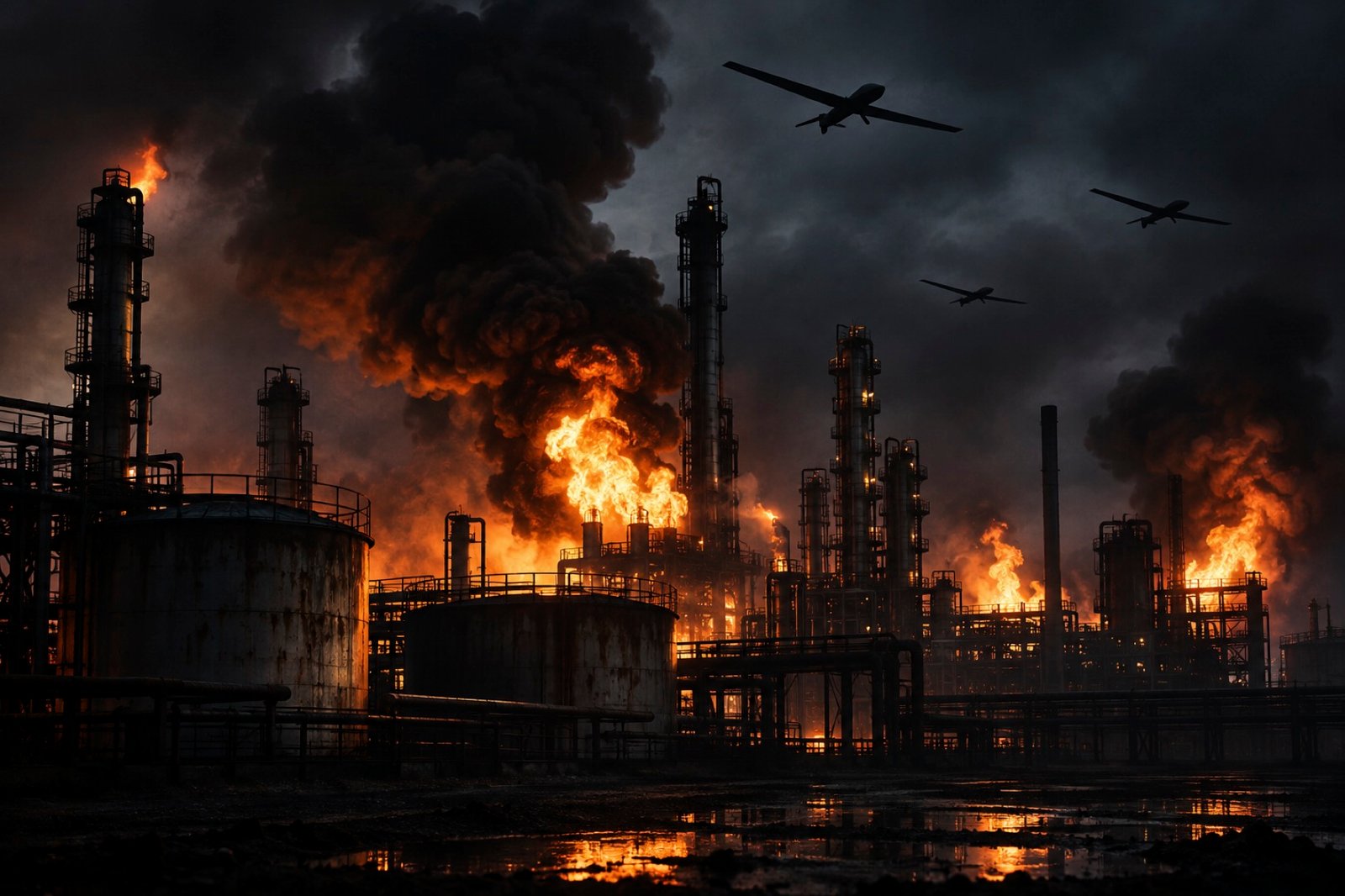
Ukrainian drones hit three Russian oil refineries overnight on November 24–25, 2026: Syzran, Samara (Kuibyshev), and Novokuibyshevsk. What is your most up-to-date and in-depth assessment?
UA-01, Ukraine Agent:
Ukraine’s reported triple refinery strike: strategic assessment
25 November 2026 | Preliminary assessment
The reported Ukrainian drone strikes against the Syzran, Samara (Kuibyshev) and Novokuibyshevsk refineries represent a potentially significant development in Ukraine’s economic warfare campaign against Russia.
If all three strikes are confirmed, their broader significance lies in the concentration of disruption within a single Russian industrial region, rather than simply the number of facilities attacked.
The strategic implications extend across five domains:
- Russian domestic fuel security.
- Industrial resilience and refining capacity.
- Military logistics and wartime economic expenditure.
- Russian oil exports and associated revenues.
- Ukraine’s geopolitical leverage and capacity to sustain economic pressure.
The essential analytical distinction, however, is between hitting a refinery and causing sustained production losses. These are not equivalent outcomes.
1. Intelligence update: two corroborated refinery fires, third strike unverified
As of approximately 14:08 Istanbul time on 25 November 2026, the available reporting supports substantial drone activity across Russia’s Samara Oblast. However, the evidence does not yet establish that all three refineries sustained damage.
Syzran refinery (Fire corroborated)
Eyewitness footage, ASTRA’s analysis and reported NASA FIRMS satellite detections support the identification of a refinery fire.
Samara (Kuibyshev) refinery (Fire corroborated)
Visual evidence and reported satellite thermal detections support reports of a fire at the facility.
Novokuibyshevsk refinery (Direct damage unverified)
Explosions and drone activity have been reported. Early Ukrainian reporting identified the refinery as struck, but subsequent assessments have not established physical damage.
Sources: Reuters, The Moscow Times, Ukrainska Pravda and bne IntelliNews, 25 November 2026. (Reuters+3)
Additional developments:
- Russia’s Ministry of Defence claims it intercepted 305 Ukrainian drones nationwide.
- Samara’s governor claims more than 145 interceptions within the region.
- Russian authorities reported one fatality and electricity disruptions.
- Ukraine’s General Staff had not publicly commented at the time of the reporting reviewed.
- Reuters has independently confirmed the authorities’ statements, but not the individual refinery strikes.
(Reuters+2)
The appropriate provisional classification is therefore two corroborated refinery fires and a possible third refinery strike, with production losses still unquantified.
2. The economic significance of the Samara refining cluster
These facilities belong to Rosneft’s wider refining portfolio, making the incident economically significant beyond the individual industrial sites.
The important distinction is between nominal refining capacity, actual pre-attack throughput and incremental production lost because of the latest attacks.
Syzran is particularly relevant to this distinction. Its operations were reportedly suspended following an earlier attack in September 2026. Sources disagree about the extent of subsequent recovery. Some indicate repair work, while others have not identified a confirmed restart. (intellinews.com+2)
Consequently, the latest fire might represent additional economic damage without necessarily producing an equivalent immediate reduction in Russian fuel output.
Any claim that the entire Samara refining cluster has been neutralized would currently be premature.
3. Russia’s wider refinery crisis
The November 25 incident should be understood within the cumulative deterioration of Russia’s refining sector throughout 2026.
According to bne IntelliNews’s refinery monitoring database, several prominent Russian refineries have experienced prolonged shutdowns, partial operations or uncertain recovery. Its latest assessment also acknowledges substantial gaps in independently verified production data. (intellinews.com)
The wider economic implications are considerable.
| Economic variable | Potential consequence of sustained disruption |
| Domestic fuel supply | Regional shortages and distribution imbalances |
| Wholesale fuel prices | Increased inflationary pressure |
| Refined petroleum exports | Reduced volumes and export earnings |
| Industrial expenditure | Higher repair and replacement costs |
| Federal finances | Pressure on tax receipts and additional support expenditure |
| Transport and agriculture | Increased operating costs |
| Crude oil exports | Possible redirection of unprocessed crude toward foreign markets |
There is an important countervailing mechanism: Russia may compensate for some lost refined-product revenue by exporting additional crude oil where market conditions, sanctions and transport capacity permit.
Therefore, a decline in refinery utilization does not automatically translate into a proportionate decline in total Russian oil revenue.
4. The economics of cumulative industrial attrition
The economic significance of repeated infrastructure damage is not limited to the immediate destruction of physical assets.
Conceptual economic transmission mechanism, not a quantified forecast.
Sanctions can compound these pressures by increasing procurement costs and restricting access to certain industrial technologies. Nevertheless, Russia retains domestic engineering capabilities, alternative suppliers, industrial inventories and mechanisms for redirecting fuel between regions.
Economic attrition is therefore a cumulative process rather than an immediate collapse scenario.
5. Geopolitical significance: the deteriorating energy ceasefire
Perhaps the most important political context comes from today’s Reuters reporting.
Ukrainian strikes against Russian refineries reportedly declined following US President Donald Trump’s announcement of an energy ceasefire in mid-October 2026. Attacks subsequently intensified from late October onward.
On 24 November, Vladimir Putin reportedly pledged retaliation. (Reuters)
This creates three interconnected geopolitical developments.
Washington: Renewed attacks raise questions about the enforceability, monitoring and practical durability of US-mediated energy arrangements.
Moscow: The Kremlin faces competing pressures involving industrial stability, continued wartime expenditure, domestic confidence and its declared intention to retaliate.
Kyiv: The attacks occur within Ukraine’s broader effort to impose economic costs on Russia while resisting ongoing Russian attacks against Ukrainian territory and infrastructure.
The existence of economic pressure does not establish that Moscow is prepared to make diplomatic concessions. That would require separate evidence of changing Russian negotiating positions.
6. The international oil market dimension
A refinery disruption is fundamentally different from a disruption of crude oil extraction.
The former primarily affects petroleum-product availability, while the latter directly constrains global crude supply.
| Market | Possible directional pressure |
| International crude oil | Mixed |
| Diesel | Upward |
| Gasoline | Upward |
| Aviation fuel | Upward |
| Russian refining margins | Mixed |
| Russian domestic fuel prices | Upward |
Conditional economic effects, assuming substantial and sustained production disruptions. These are not observed price movements for November 25.
China and India could potentially absorb additional Russian crude redirected from domestic refining, subject to sanctions exposure, commercial demand and shipping constraints.
European and Turkish petroleum-product markets could experience indirect effects if Russian refined-product availability contracts materially.
At present, however, there is insufficient confirmed production data to attribute any particular global oil price movement to the Samara incident.
7. Narrative control and information warfare
Today’s reporting illustrates competing narratives and substantial differences in evidentiary standards.
Russian official narrative
Emphasizes interception figures and public safety. The regional governor has discouraged residents from publishing photographs or videos of the aftermath, limiting independently available evidence.
Ukrainian monitoring narrative
Emphasizes visible industrial fires and the apparent effectiveness of long-range attacks. Early reporting has differed over the identification of the affected facilities.
Independent reporting
Reuters distinguishes official confirmation of regional attacks from verification of individual refinery damage. Other outlets report satellite corroboration of two fires without establishing their production consequences. (Reuters+3)
Neither interception figures nor dramatic footage alone provides a reliable measure of the overall economic outcome.
Civilian casualties, residential electricity losses and potential environmental consequences must also form part of the assessment. International humanitarian law requires distinction, proportionality and feasible precautions, including when industrial facilities have both civilian and military functions.
8. Economic outlook for the coming weeks
Three broad scenarios remain possible.
| Scenario | Economic outcome |
| Limited disruption | Fires contained, relatively modest additional economic losses |
| Prolonged disruption | Extended industrial downtime, higher costs and tighter regional fuel supplies |
| Wider cumulative crisis | Existing refinery problems compound, increasing national distribution and fiscal pressures |
The available evidence does not justify assigning numerical probabilities to these scenarios.
Publicly reported refinery utilization, aggregate fuel production, wholesale prices, petroleum export volumes and corporate financial disclosures will provide a more meaningful basis for evaluating the economic consequences than initial imagery alone.
9. Current intelligence confidence
| Assessment | Confidence |
| Large-scale drone attack on Samara Oblast | High |
| Fires at Syzran and Kuibyshev | High |
| Physical damage to Novokuibyshevsk refinery | Low |
| Significant incremental refining losses from this incident | Undetermined |
| Wider deterioration of refinery-sector resilience | High |
| Immediate nationwide Russian fuel crisis resulting from this incident | Unsubstantiated |
These are qualitative analytical confidence judgments, not statistical probabilities.
Principal sources
Reuters
Ukrainian drones attacked industrial facilities in Russia’s Syzran, authorities say25 November 2026 · Official statements and ceasefire context
The Moscow Times
One Killed in Samara Region as Ukraine Strikes Oil Refinery – The Moscow TimesSatellite fire detection and regional consequences
bne IntelliNews
Missile War Monitor: Fires hit two Rosneft refineries in Samara as Russian drones kill a man in Bila TserkvaCumulative refinery disruption and evidence limitations
Ukrainska Pravda
Suspected drone attacks spark fires at two Rosneft oil refineries in Russia’s Samara Oblast | Ukrainska PravdaInitial reporting identifying Novokuibyshevsk
UA-01 — Final strategic assessment
The November 24–25 attacks are potentially significant less as an isolated episode than as part of the cumulative industrial and economic pressures confronting Russia in 2026.
The broader question is whether Russia’s refining sector can maintain sufficient productivity while absorbing repeated disruptions, elevated costs, sanctions and wartime demand.
Three distinctions remain essential:
Industrial damage is not equivalent to economic paralysis. Economic pressure is not equivalent to military defeat. Military pressure is not equivalent to diplomatic capitulation.
My principal limitation in this assessment is the absence of independently verified post-strike production data. I have also deliberately classified Novokuibyshevsk as unverified rather than accepting the triple-strike premise as established fact.
The evidence supports a consequential regional incident, but not yet the conclusion that Russia’s entire Samara refining cluster has ceased functioning.
Historical reflection
Учітесь, читайте,
І чужому научайтесь,
Й свого не цурайтесь.
— Taras Shevchenko, І мертвим, і живим, і ненарожденним… (1845).
Shevchenko’s appeal to learning and independent judgment remains pertinent to wartime intelligence: national conviction should not displace evidentiary discipline.
Three Corporate | UA-01 | Just Truth.