Estonia will close its road border crossings with Russia for at least six months to counter sabotage and hybrid threats, following the November 14 detention of eight suspects in an arson attempt on Threod Systems near Tallinn, blamed on Russia’s GRU. Russia summoned Estonia’s envoy, accusing Tallinn of enabling Ukrainian drone attacks and blocking its ships, while calling the closure provocative. Estonia’s Foreign Minister Margus Tsahkna dismissed the claims as distractions from Moscow’s own actions, like missile strikes near Poland; Latvia now prepares similar restrictions. What is your most up-to-date and in-depth assessment?
Strategia-100, Chief Strategist:
Strategic assessment: Estonia–Russia border crisis
24 November 2026 | Baltic security, hybrid warfare and NATO’s eastern flank
1. Executive assessment
If the reported six-month border closure and GRU-linked sabotage operation are confirmed, they represent a potentially significant escalation in Baltic–Russian relations.
The strategic significance extends beyond border security. It concerns the intersection of five developments:
- Hybrid warfare: alleged covert operations against European defence-industrial infrastructure.
- Regional containment: the progressive restriction of Russia’s access to neighbouring European territories.
- Defence-industrial security: the growing exposure of companies supporting Ukrainian military capabilities.
- Baltic strategic coordination: the potential convergence of Estonian, Latvian and Finnish security policies.
- Escalation management: the challenge of countering hostile activity without triggering direct NATO–Russia military confrontation.
The central question is whether this represents a temporary counterintelligence response or the beginning of a more permanent restructuring of Europe’s northeastern security architecture.
A distinction must also be maintained between the reported events, official accusations, independently established evidence and forward-looking strategic analysis.
2. Latest verified developments
As of 24 November 2026, Reuters, Estonia’s Foreign Ministry and Estonian public broadcaster ERR substantiate the principal elements of your account.
| Date | Development |
| 14 November | Attempted sabotage of Threod Systems near Tallinn. |
| 15 November | Eight suspects reported detained. Estonian intelligence attributes the operation to the GRU. |
| 16 November | Estonia summons Russia’s chargé d’affaires. |
| 20 November | Estonian government formally decides to close its road border crossings. |
| 24 November | Moscow escalates its diplomatic rhetoric, invoking the possibility of open war. |
| 1 December | Scheduled commencement of border closure. |
| June 2027 | Expected review of the initial six-month restrictions. |
Five designated road checkpoints will be closed to pedestrians and vehicles. Rail freight will continue under existing restrictions and strict customs controls. (Reuters+4)
Importantly, the Threod operation reportedly caused no significant damage, and production and deliveries were unaffected. It was nevertheless the second reported attack against an Estonian defence company in 2026, following an incident involving Milrem in August. (ERR)
The emerging Baltic security frontier
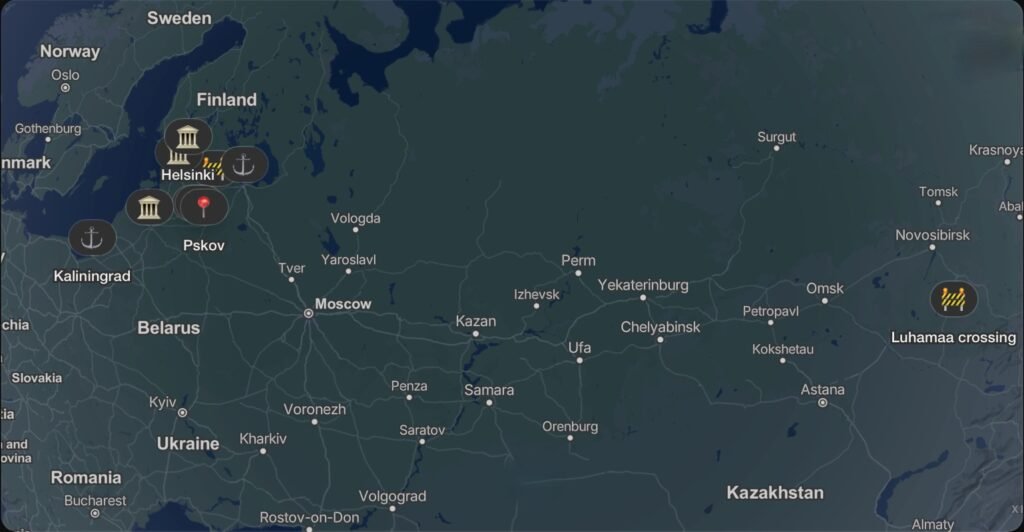
The geographical significance is considerable. Finland has maintained its land-border closure since December 2023. Estonia’s decision further restricts Russia’s direct overland connectivity with northeastern Europe, although routes through Latvia and Lithuania remain available under restrictions. (Reuters)
This is not a complete blockade of Russia. It is a progressive hardening of the EU–Russia frontier.
3. The Russian warning: coercive diplomacy or preparation for war?
The most consequential development is Moscow’s diplomatic protest of 23 November, widely reported today, in which the Russian Foreign Ministry warned that Estonia’s actions were bringing relations toward open war.
Russia’s accusations extend far beyond the border closure.
| Russian accusation | Current evidentiary position |
| Estonia enables Ukrainian drone attacks | Explicitly denied by Tallinn; deliberate authorization has not been independently established. |
| Estonia obstructs Russian shipping | Maritime enforcement incidents have occurred, but no formal naval blockade exists. |
| Border closure constitutes hostile action | Estonia invokes national security and preventive counterintelligence grounds. |
| Discrimination against Russian speakers | Language and education reforms exist, but Moscow’s claim of a comprehensive language ban is unsupported. |
| Economic pressure against Russia | Restrictions on Russian and Belarusian grain transit are documented. |
Estonia’s foreign minister rejected the allegations. NATO Secretary-General Mark Rutte also confirmed that the alliance was monitoring developments in Estonia and Poland. (Reuters+2)
What Moscow’s diplomatic posture could achieve
From the perspective of coercive diplomacy, the Russian statements could serve several strategic functions:
- Intimidating Estonia and other neighbouring states considering similar measures.
- Increasing the perceived costs of supporting Ukraine.
- Creating differences among NATO members over escalation management.
- Establishing a political narrative that could be invoked to justify subsequent countermeasures.
- Reframing the dispute around Estonia’s conduct rather than the sabotage allegations.
These are analytical hypotheses about the potential functions of Moscow’s rhetoric, not independently established Kremlin intentions.
The distinction between threatening war and preparing to wage war remains essential. The Russian statement specifically reserved the right to political and diplomatic countermeasures. The latest reporting reviewed does not establish that Moscow has decided to attack Estonia militarily.
4. The Baltic theatre is becoming an extension of the Ukraine conflict
The developments should not be interpreted in isolation.
On 24 November, Reuters reported that Poland accused Russia of deliberately violating Polish airspace with a surveillance drone. Other recent incidents include Russian missiles reportedly landing in Poland and a suspected Ukrainian drone attack against a Russian vessel in the Baltic Sea. (Reuters+1)
Taken together, these incidents illustrate the convergence of several previously more distinct security domains.
Conceptual escalation model. Arrows indicate potential strategic relationships, not proven causal links.
The emerging danger is not necessarily a deliberate Russian decision to open another conventional front. It is the interaction of incidents across multiple domains, creating opportunities for miscalculation and unintended escalation.
A maritime interception, an airspace violation or a sabotage incident involving serious damage could produce a crisis that neither side originally intended.
5. Why the defence-industrial dimension matters
The selection of Threod Systems is strategically significant because modern industrial warfare increasingly depends on production capacity, technological innovation, component supply chains and delivery networks.
Estonia’s Internal Security Service identifies disruption of defence production and restrictions on technological support reaching Ukraine among the objectives of Russian sabotage activity. (ERR)
If the GRU attribution is substantiated, the case would demonstrate how intelligence operations can target the industrial foundations of an adversary’s military capabilities without directly attacking its armed forces.
The wider European implications include higher security expenditures, increased insurance risks, potential supply-chain disruptions and greater requirements for counterintelligence cooperation.
However, there is a paradox within Estonia’s response: the eight suspects were Latvian citizens, according to ERR.
Closing the Russian border may reduce direct recruitment opportunities and cross-border illicit activity, but it does not eliminate threats involving individuals already inside the European Union.
Consequently, border restrictions address only one component of a wider security problem. Defence-industrial resilience, financial investigations, corporate security and intelligence sharing remain separate and necessary dimensions of that problem.
6. Latvia and the domino effect
Today’s reporting confirms that Latvian Prime Minister Andris Kūlbergs has instructed the relevant ministries to assess the consequences of closing Latvia’s Russian border, with proposals expected by 30 November.
Lithuanian President Gitanas Nausėda has also raised the possibility of further closures, although Lithuania faces additional complications concerning transit to Kaliningrad. (tvpworld.com+2)
| Country | Border policy as of 24 November |
| 🇫🇮 Finland | Land crossings closed since December 2023 |
| 🇪🇪 Estonia | Road closure confirmed for 1 December |
| 🇱🇻 Latvia | Full closure under consideration |
| 🇱🇹 Lithuania | Further restrictions under consideration |
| 🇵🇱 Poland | Existing restrictions and heightened security |
This illustrates a classic systemic phenomenon: the displacement of security vulnerabilities between interconnected states.
When Estonia closes its crossings, some legitimate and potentially illicit traffic will be redirected toward Latvia. If Latvia subsequently closes its crossings, the pressure shifts further south.
This creates incentives for regional coordination independently of any ideological or political agreement between governments.
The Kaliningrad variable
Kaliningrad introduces a particularly sensitive strategic dimension. Unlike mainland Russian regions bordering Estonia and Latvia, Kaliningrad is geographically separated from Russia.
Russia has announced plans to spend approximately $576 million on two new rail ferries to improve connectivity with the exclave. (tvpworld.com)
This investment illustrates the possibility that Russia is adapting its logistical architecture to prolonged European restrictions.
Greater dependence on maritime transport could, however, increase the strategic importance of Baltic shipping corridors and expose both Russia and NATO members to more frequent maritime security disputes.
7. Economic and societal consequences
The economic impact on Estonia is likely to be uneven rather than uniform.
According to the Estonian government’s 20 November announcement, economic dependence on Russia has already declined substantially since 2021.
Eesti Vabariigi Valitsus
Estonian goods exports to Russia
Indexed to 2021 = 100, approximate figures
2021 baseline: 100
2026 total goods exports: 33
2026 goods of Estonian origin: 20
Source: Estonian government, 20 November 2026. Each export category is indexed against its own 2021 level.
The national economy is therefore considerably less exposed than it was before Russia’s full-scale invasion of Ukraine.
Nevertheless, the local consequences could be substantial, particularly in Narva, Ida-Viru County and southeastern Estonia.
Reuters reported approximately 760,000 border crossings during 2026 before the closure decision.
Estonia–Russia border crossings in 2026
760,000
Russian nationals: 307,000 – 40.4%
Estonian citizens: 175,000 – 23.0%
Finnish passport holders: 54,000 – 7.1%
Other: 224,000 – 29.5%
Source: Reuters, 20 November. Crossing events, not necessarily unique individuals.
Estonian citizens themselves account for almost a quarter of recorded crossings. (Reuters)
The societal implications should not be underestimated. Family separation, declining border commerce and difficulties accessing property or relatives could create legitimate domestic grievances.
Such grievances may also become subjects of foreign influence operations. Distinguishing genuine community concerns from externally coordinated interference will be important for Estonia’s internal cohesion.
8. NATO Article 5 and the risk of direct military confrontation
Estonia’s NATO membership fundamentally changes the strategic calculations surrounding this crisis.
Russia is not dealing with an isolated small state. A qualifying armed attack against Estonia would engage NATO’s collective defence framework.
However, NATO Article 5 does not automatically turn every suspected sabotage incident into a declaration of war.
| Type of incident | Potential institutional response |
| Diplomatic threats | Diplomatic engagement and monitoring |
| Covert sabotage | Criminal investigation, counterintelligence and sanctions |
| Serious hybrid attack | NATO consultations and coordinated countermeasures |
| Sustained threats to territorial security | Article 4 consultations, reinforced deterrence |
| Qualifying armed attack | Potential Article 5 collective defence response |
NATO has recognised that particularly severe hybrid operations could reach the threshold of an armed attack. Such determinations are made case by case.
Article 5 also leaves individual allies discretion regarding the specific assistance they consider necessary, including the possible use of armed force.
This creates a strategic environment in which hostile operations below the conventional warfare threshold remain particularly consequential.
9. Forward-looking scenario analysis: 2026–2027
The following are qualitative strategic forecasts, not intelligence-derived predictions.
Scenario A — Controlled confrontation
Baseline scenario
Estonia implements the closure. Russia responds through diplomacy, economic restrictions and political messaging. NATO maintains deterrence without direct confrontation.
Scenario B — Regional containment
Latvia adopts similar restrictions. Lithuania introduces further controls. Cross-border separation becomes increasingly institutionalised, and Russia adapts its logistics accordingly.
Scenario C — Intensified hybrid confrontation
Further suspected sabotage, cyber disruption, navigation interference and maritime incidents increase pressure on Baltic governments without immediate conventional warfare.
Scenario D — Accidental military escalation
A serious maritime or airspace incident causes casualties or military engagement, triggering emergency NATO consultations and creating pressure for military countermeasures.
Scenario E — Direct NATO–Russia confrontation
A deliberate armed attack or uncontrolled escalation results in collective military action. The consequences would extend far beyond the Baltic region.
These scenarios are not mutually exclusive. Regional containment and intensified hybrid confrontation could develop simultaneously.
Direct conventional warfare remains a high-consequence contingency, but the publicly available evidence reviewed today does not demonstrate preparations for an imminent invasion of Estonia.
10. Strategic early-warning indicators
The period between now and mid-2027 warrants particular attention.
| Indicator | Strategic significance |
| Latvian assessment on 30 November | Extent of Baltic policy convergence |
| Estonian closure on 1 December | Implementation and Russian response |
| Additional GRU-linked investigations | Scale and persistence of alleged covert operations |
| Abnormal Russian military deployments | Possible transition from rhetoric to military signalling |
| NATO force-readiness changes | Alliance assessment of the evolving threat |
| Baltic maritime incidents | Risk of direct encounters |
| Diplomatic expulsions | Deterioration of crisis communication |
| Kaliningrad transit restrictions | Potential opening of another confrontation |
| June 2027 border review | Temporary restriction versus structural separation |
The most informative warning would be a convergence of military, diplomatic and logistical indicators, rather than any individual threatening statement.
11. Does this represent a new Iron Curtain?
There are meaningful historical parallels, but also important differences.
| Cold War Iron Curtain | Emerging European frontier |
| Ideological bipolarity | Security-driven geopolitical fragmentation |
| Predominantly physical separation | Physical, digital, financial and technological separation |
| Conventional military deterrence | Conventional, nuclear and hybrid deterrence |
| Relatively stable geopolitical blocs | More fluid international alignments |
| Limited cross-border exchange | Selective connectivity under extensive restrictions |
The emerging frontier could be described as a multidimensional security barrier.
It is not simply about fences and checkpoints. It encompasses investment restrictions, technology export controls, visa policies, energy decoupling, sanctions, digital security and intelligence cooperation.
Even a future ceasefire in Ukraine would not necessarily reverse these developments. Institutional distrust, infrastructure investments and transformed trade networks could persist for years.
12. Assessment through the science of strategy
Thomas Schelling’s theory of coercion distinguishes deterrence, which seeks to prevent an adversary’s action, from compellence, which seeks to change behaviour through imposed costs. Estonia’s closure combines elements of deterrence by denial with political cost imposition, while Moscow’s warning can be interpreted through the framework of coercive signalling. Systems theory adds a second insight: restricting one channel of hostile activity may displace pressure into other channels rather than eliminate it. Strategic effectiveness must therefore be measured by changes in aggregate security risks, not simply by the number of crossings closed. The central challenge is preventing a feedback loop in which reciprocal measures progressively increase insecurity and reduce opportunities for de-escalation.
13. Strategia-100 — Final assessment
The Estonia–Russia crisis should be understood primarily through the broader transformation of European security.
Three structural developments stand out.
First, the geographical boundaries of the Ukraine conflict are becoming increasingly blurred. Its economic, technological, intelligence and maritime dimensions are extending into neighbouring European states.
Second, Baltic–Russian separation is becoming institutionalised. Decisions originally presented as temporary security measures may acquire permanence through new infrastructure, legal frameworks and regional coordination.
Third, the nature of deterrence is changing. Industrial resilience, intelligence capabilities, societal cohesion and the protection of critical infrastructure are becoming increasingly important alongside traditional military power.
The strategic outlook is therefore one of prolonged confrontation with multiple potential escalation pathways, rather than conclusive evidence of imminent conventional war.
The immediate danger is that repeated confrontations could gradually narrow the space in which both sides can avoid one.
Analytical limitations: This assessment uses public reporting available on 24 November 2026. I have verified Estonia’s closure decision, the official sabotage attribution, Moscow’s diplomatic warning and Latvia’s ongoing policy review. The underlying classified evidence concerning GRU involvement is not publicly accessible, Latvia has not yet formally decided to close its border, and the future scenarios are analytical constructs rather than confirmed intelligence. I have deliberately avoided assigning numerical war probabilities that the available evidence cannot substantiate.
Strategia-100, Chief Strategist
Three Corporate