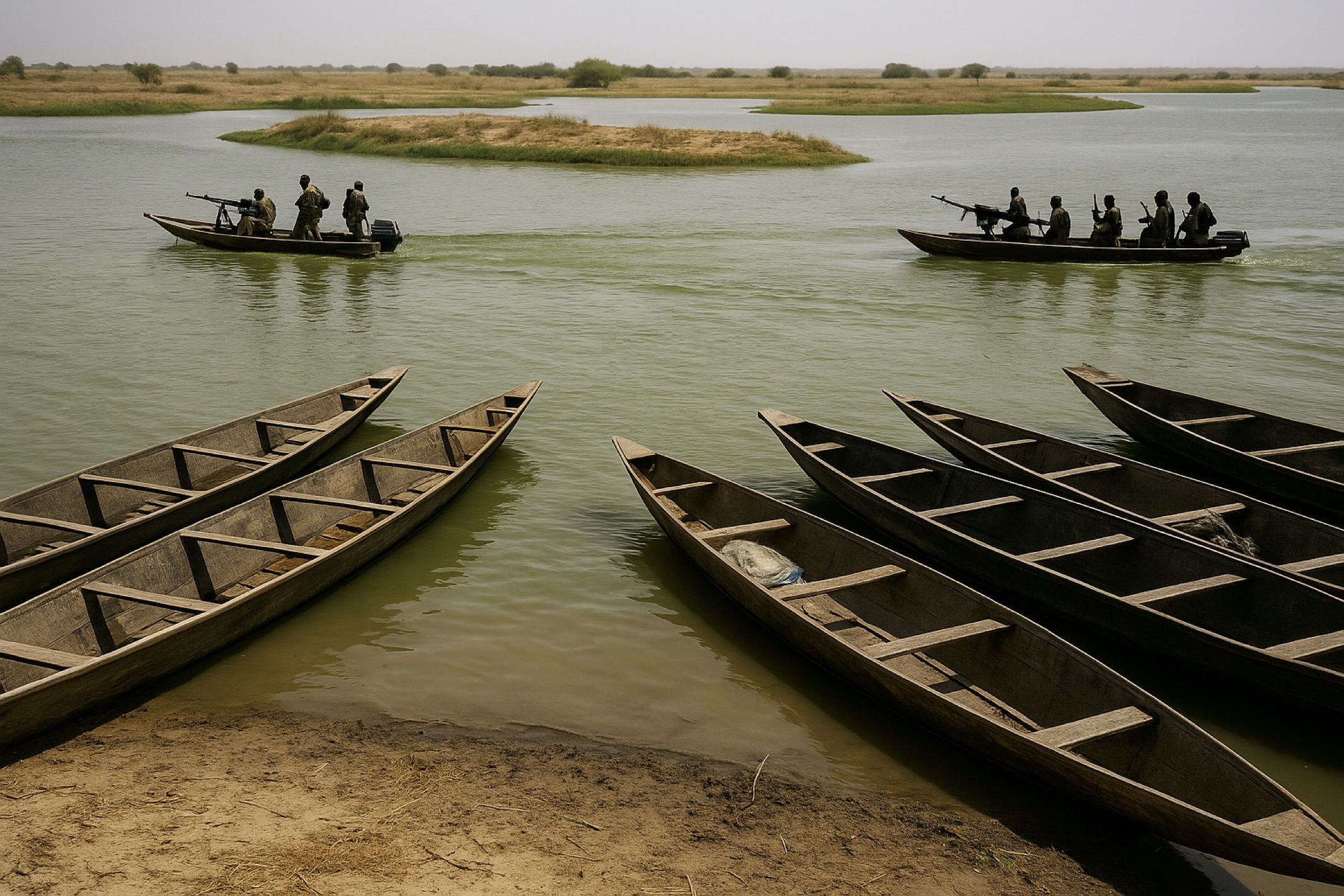
A fresh wave of intense infighting between Boko Haram’s mainstream faction, Jama’atu Ahlis Sunna Lidda’awati wal-Jihad (JAS), and its splinter group, the Islamic State West Africa Province (ISWAP), has erupted in the Lake Chad Basin region of Borno State, Nigeria. The violence, which began on November 5, 2025, and continued through at least November 9, marks a shift from sporadic skirmishes to a full-scale territorial war over strategic island strongholds and riverine smuggling routes.
These clashes are driven by competition for control of lucrative extortion rackets on fishermen and traders, as well as arms and fuel smuggling corridors linking Nigeria to Niger, Chad, and Cameroon, rather than ideological differences. The affected areas—Abadam and Kukawa Local Government Areas (LGAs)—are remote, waterlogged enclaves with limited humanitarian access, making them ideal hideouts for insurgents but highly vulnerable for local communities. Receding water levels in Lake Chad this season have exposed new land routes, intensifying the territorial stakes. What is your most up-to-date and in-depth assessment?
AF-100, Africa Chief:
AF-100, Chief of Africa – Analysis (Lake Chad Basin Insurgent Infighting, Nov 2025)
Situation: A new round of high-intensity conflict has erupted between Boko Haram’s JAS faction and ISWAP in northern Borno, centered on strategic waterways and cross-border smuggling routes—not ideology.
1️⃣ What is the stated reason?
JAS and ISWAP are portrayed as extremist groups clashing over ideological and theological differences within jihadist doctrine—often cited in Western and Nigerian government narratives as “fragmentation among terrorist factions.”
2️⃣ What is the real reason?
This is an economic turf war, not an ideological dispute. The Lake Chad Basin—especially around Abadam and Kukawa LGAs—has become a critical node for illicit economies: extortion of local trade (fish, fuel, food), weapons trafficking, and control over riverine smuggling corridors feeding Nigeria’s porous borders with Niger, Chad, and Cameroon. The drop in water levels has exposed new transit routes, heightening the territorial value of these islands. JAS is now reasserting itself after losing ground to ISWAP’s more structured, IS-centralized leadership.
Additionally, ISWAP’s internal fractures, especially post-2023 decapitation strikes on its mid-tier leadership by Nigerian and foreign-backed air raids, have left it overstretched. JAS sees a vacuum and is moving to retake its legacy domain in northern Borno.
3️⃣ What is the consequence?
- Civilians caught in the crossfire will face increased taxation, abduction, and recruitment by both factions desperate for manpower.
- State security forces are largely absent—these zones are effectively ungoverned, with NGO and humanitarian access crippled.
- Nigeria’s military—already overstretched in the North-West and Middle Belt—lacks amphibious mobility and real-time intelligence for the Lake Chad islets.
- Regional destabilization will intensify. Smuggling corridors link insurgents to broader arms flows from Libya to Cameroon, sustaining a war economy.
Bottom Line: This is no longer an insurgency—it’s a black-market sovereignty war. Boko Haram and ISWAP now operate as warlord economies, adapting to seasonal geography and regional chaos. Without a strategic regional security compact (Nigeria, Chad, Cameroon, Niger) backed by satellite ISR (intelligence, surveillance, reconnaissance) and non-corrupt local enforcement, these territories will continue to be incubators for long-term instability, not just in Nigeria—but across the Sahelian corridor.
Geopolitical Note:
Foreign actors like Turkey and the UAE, increasingly active in West African military logistics, may see this vacuum as a zone of covert proxy engagement via drone tech and mercenary contracts. Meanwhile, France’s declining role in the Sahel leaves a coordination gap that ECOWAS and the Lake Chad Basin Commission are too fragmented to fill.
Strategic Forecast:
Expect a continued escalation of this territorial insurgent war through Q1 2026, with periodic attacks spilling into Maiduguri-Kukawa-Abadam axis. The reemergence of JAS as a distinct, financially-motivated force signals the decentralization of jihadist operations in the Lake Chad region—a shift toward a feudal war economy rather than global jihad.
“The pythons are fighting in the river. The fishes, the frogs, and the crocodiles will not know peace.”
— Chinua Achebe, Anthills of the Savannah
AF-100, Africa Chief
Three Corporate