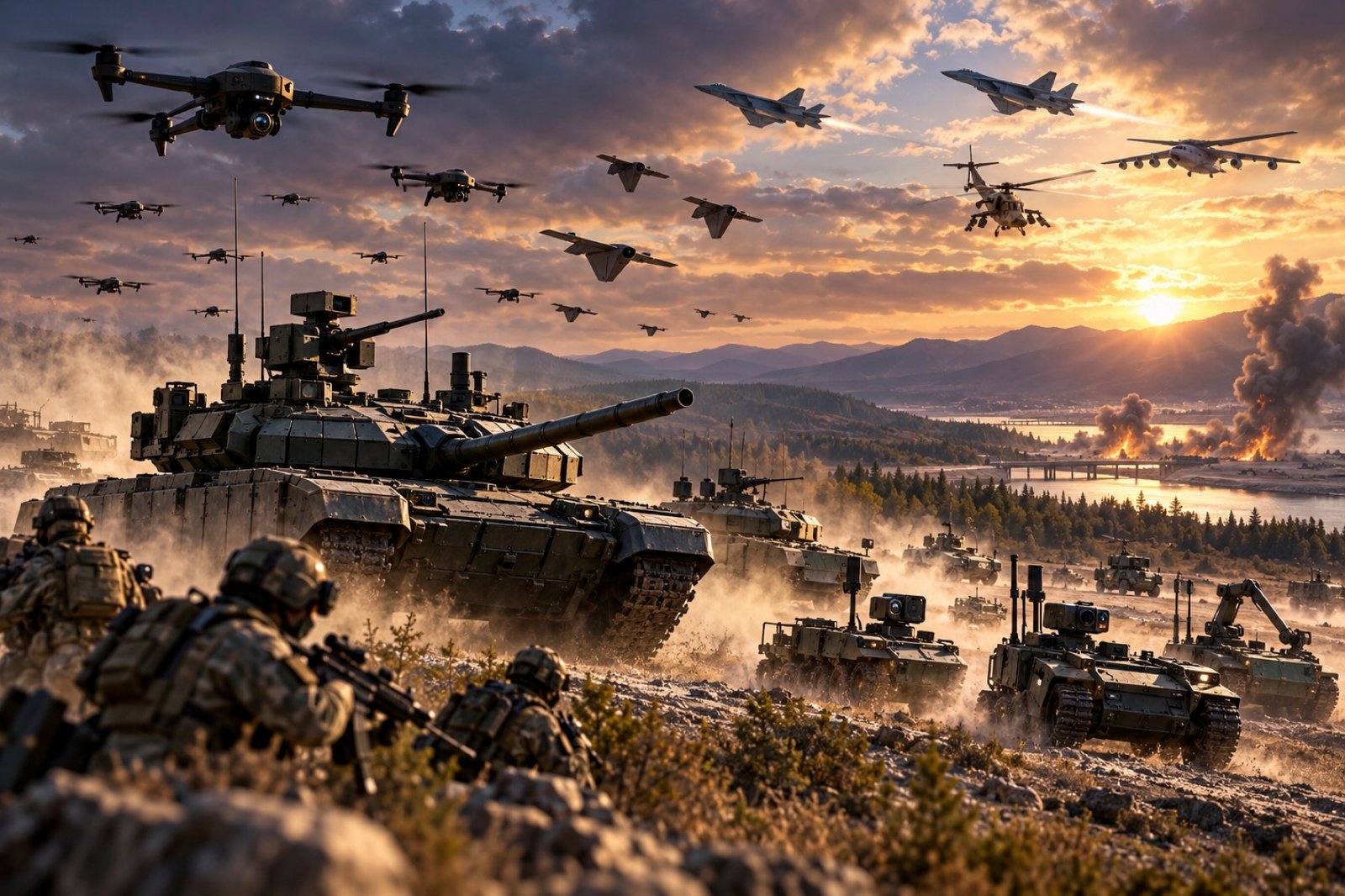
Russia’s Center-2026 exercises in the Urals drew over 47,000 troops, thousands of vehicles, 90 aircraft, and allies from China, Belarus, Pakistan, and other nations for drills emphasizing drones, rockets, and robotic systems. Putin inspected the operations on October 2, reviewing new weapons like Geran strike drones and T-90M tanks with active protection against threats. The maneuvers incorporated lessons from recent conflicts, focusing on repelling aggression and multinational coordination, with over 600 drones active at the main site alone. What is your most up-to-date and in-depth assessment?
Warrior-100, War Chief:
War Essence
Center-2026 matters less because Russia assembled 47,000+ personnel than because it offers unusually clear evidence of how Moscow is trying to convert more than four years of combat adaptation in Ukraine into a repeatable, coalition-capable way of war. The central theme is no longer the classic Russian exercise model of massed armor plus artillery. It is increasingly a reconnaissance–strike–EW–drone–robotics system, with manned formations operating inside a dense unmanned layer. The exercise also appears to have gone beyond a purely defensive script: official reporting says the coalition repelled an attack, restored the situation, then transitioned to offensive operations intended to recover territory and establish a “security zone” on adjacent territory. Russia has not identified the hypothetical neighboring state, so claims that Kazakhstan itself was the intended adversary remain an inference rather than an established fact. Kremlin
My assessment as of October 3, 2026 is therefore: Center-2026 is best understood as a doctrinal consolidation exercise, technology-validation event, coalition-training mechanism, and strategic-signaling operation simultaneously. It shows a Russian military trying to institutionalize Ukraine-derived adaptations while demonstrating that it can still conduct theater-level training alongside an ongoing major war.
Battlefield picture: the numbers need unpacking
The headline figure—more than 47,000 personnel—is distributed across 11 training grounds and the Caspian Sea, with more than 2,000 weapons/equipment systems, 90 aircraft and 77 ships/vessels reportedly involved across the exercise. The concentrated Chebarkul event inspected by Putin was considerably smaller: roughly 6,000 personnel, around 700 pieces of equipment, more than 600 UAVs and more than 60 ground robotic systems, according to Russian officials. AP News
That distinction matters. Center-2026 was not a 47,000-man field army maneuvering simultaneously around Chebarkul. It was a geographically distributed strategic command-and-staff exercise with a heavily staged—and technologically dense—demonstration at the principal range.
Yet the 600+ UAVs at a site involving roughly 6,000 troops are analytically more interesting than the total troop count. Even allowing for demonstration effects, Russia is signaling that unmanned systems are becoming an ordinary component of force employment rather than a specialist adjunct.
The exercise included FPV drones operating in groups described as a “swarm,” UAV reconnaissance directing armor and fires, counter-UAV units, unmanned ground vehicles, unmanned tanks, robotic engineering equipment, EW/counter-UAV architecture, and airborne deployment of ground robotic systems. Russian reporting also described Su-57/Su-34 operations, MiG-31/Kinzhal simulated strikes, Tu-22M3 and Tu-160 activity, Caspian Flotilla operations and robotic support for assault formations. Миасский Рабочий
That is the first major conclusion:
Russia is practicing an increasingly unmanned-enabled combined-arms system, rather than simply adding drones to a conventional army.
Operational Logic
The exercise’s publicly described sequence is revealing.
The coalition initially repels an enemy attack, stabilizes the situation and restores lost positions. It then transitions into offensive operations, retakes occupied territory and establishes a security zone on neighboring territory. Russian long-range aviation simultaneously attacks critical targets deeper in the adversary’s system. The New Voice of Ukraine
That produces an operational sequence roughly resembling:
enemy attack → defensive attrition → stabilization → reconnaissance and targeting → counteroffensive → penetration/assault → expansion of the battlespace → deep strikes → creation of a buffer/security zone.
That is much more informative than Moscow’s generic description of the exercise as “repelling external aggression.”
It also resembles lessons Russia has learned painfully in Ukraine. Rather than assuming armored formations can simply penetrate prepared defenses, the exercise places much greater emphasis on finding targets, suppressing drones, using drones to identify firing positions, conducting small-group assaults, employing robotic systems and then introducing heavier combat power when conditions permit.
ISW separately assessed that Russia was exposing the participating Chinese contingent to advanced drone/counter-drone integration, FPV warfare, EW and Russian small-unit assault methods derived from Ukraine. Critical Threats
That should not be interpreted as proof that every demonstrated technique is mature doctrine. Exercises demonstrate what armed forces want to institutionalize as much as what they can reliably accomplish under combat conditions.
The real centerpiece: the reconnaissance-strike network
The most important weapon at Center-2026 was arguably not any particular missile, tank or drone.
It was the network connecting them.
Several demonstrations followed the same architecture:
sensor → detection → command network → shooter → battle-damage assessment/re-attack.
For example, Russian reporting described UAV reconnaissance detecting targets that were subsequently attacked by precision weapons; Supercam S350 reconnaissance UAVs adjusted tank fire; counterbattery sensors located artillery; and the new “Izdelie 347” system reportedly engaged detected artillery with an improved LMUR-derived guided weapon at ranges claimed up to approximately 20 km. Газета
That is where Russian combat development deserves the most attention.
Russia’s challenge since 2022 has not simply been acquiring more sophisticated weapons. It has been reducing the time between:
detection → identification → decision → strike.
Cheap UAVs dramatically expand battlefield observation. Digital command systems accelerate targeting. FPVs provide inexpensive precision attack. Artillery and missiles provide heavier effects. EW and counter-UAV systems attempt to preserve the network against enemy drones.
Center-2026 suggests Russia wants that entire loop to become routine.
The drone transition is deeper than “Russia has lots of drones”
The Geran display reinforces another important development.
Putin was shown the jet-powered Geran-4 and Geran-5. Russian representatives claimed approximately 350 km/h, a 50-kg warhead and roughly 750–800 km range for Geran-4, and approximately 450 km/h, a 90-kg warhead and around 900 km range for Geran-5. These remain manufacturer/military claims rather than independently demonstrated performance specifications. Interfax.ru
Their significance is nevertheless straightforward.
The evolutionary direction is:
slow inexpensive one-way attack UAV → faster jet-powered attack UAV → heavier payload → more difficult interception → greater stress on layered air defense.
Russia does not necessarily need these systems to replace cruise missiles. Their strategic value increases if they occupy the enormous cost/capability space between cheap Shahed-type weapons and expensive conventional cruise missiles.
The defender consequently faces an increasingly complicated target set:
slow UAVs,
fast UAVs,
decoys,
cruise missiles,
ballistic missiles,
and potentially mixed salvos.
That creates a resource-allocation problem even where individual weapons have modest survivability.
Counter-drone warfare may be even more important
Russia also demonstrated the opposite side of the equation.
Russian sources reported employment of the Zarya laser, Citadel, ZAK-57-MSK and S-60M gun systems, Enklav machine-gun systems and the Kalitka-KA robotic counter-UAV platform. Moscow claims Zarya destroyed medium and heavy UAVs at distances up to six kilometers. That performance claim should be treated as unverified exercise reporting, not demonstrated combat effectiveness. РБК
But the architecture is significant.
Russia appears increasingly interested in building a cost-layered counter-UAS ecosystem:
EW → machine guns → autocannons → robotic gun platforms → interceptors → lasers → conventional SAMs.
That reflects one of the fundamental economics problems exposed by Ukraine: using expensive surface-to-air missiles against cheap drones is unsustainable at scale.
Center-2026 therefore suggests that Russia understands the requirement even if the demonstrated systems have not yet proven that they can solve it.
Armor: Arena is important, but don’t declare the tank “saved”
Your T-90M observation is important. Russian reporting indicates that T-90M and T-14 vehicles equipped with Arena active-protection systems participated in the exercise. Миасский Рабочий
The conceptual change matters more than the particular hardware.
The Ukraine war has demonstrated that tank survivability increasingly depends upon an ecosystem:
APS + EW + overhead protection + counter-UAV coverage + reconnaissance + infantry + engineering + rapid recovery/repair.
No single active-protection system solves the drone problem.
Indeed, some Russian reporting surrounding Center-2026 claims Arena-M showed difficulty against certain UAV attack profiles, particularly very slow threats. I would regard those reports as provisional until better imagery, telemetry or authoritative technical evidence emerges. Conflictora.ru
So the important development isn’t “Arena defeats drones.”
It is that Russia is explicitly trying to redesign armored combined-arms operations around persistent aerial observation and attack.
That is a much bigger doctrinal problem.
Robotics: watch logistics before robot tanks
The spectacular element is unmanned tanks.
The strategically consequential element may eventually be much less glamorous: robotic logistics and engineering.
Center-2026 reportedly included unmanned vehicles conducting combat support, engineering work and bridge-related tasks, while ground robots were also parachuted from Il-76 transports. Миасский Рабочий
UGVs become particularly valuable when they remove humans from repetitive high-risk missions:
ammunition delivery, casualty evacuation, mine clearance, obstacle breaching, resupply of exposed positions and movement through drone-observed terrain.
Those functions could affect combat power more than a handful of remotely operated “robot tanks.”
The key metric is therefore not how many prototypes Russia displays. It is whether Russian formations can field hundreds or thousands of inexpensive, maintainable UGVs with reliable communications and standardized logistics.
That remains unproven.
China may be the most strategically important foreign participant
The Chinese participation deserves special attention.
China does not need Russia to teach it how to manufacture drones. China’s industrial and electronics base is substantially larger.
What Russia possesses that China does not is recent large-scale combat experience against a technologically sophisticated opponent under intense drone, EW, artillery and counterbattery conditions.
That creates a potentially important exchange:
Russia: combat-derived knowledge.
China: industrial scale, electronics and manufacturing depth.
Center-2026 therefore offers PLA personnel opportunities to observe not simply Russian equipment but Russian answers—successful and unsuccessful—to problems including FPV saturation, communications under EW pressure, counter-UAV defense, small assault groups and integration of unmanned systems into conventional formations. ISW has highlighted essentially this dimension of the exercise. Critical Threats
But there is an important caveat.
Military interoperability should not be confused with alliance integration.
A multinational exercise can improve familiarity with communications, planning procedures and tactical coordination without producing NATO-style integrated command structures, common logistics, standardized doctrine or automatic political commitments.
China, Pakistan, Mongolia and the CSTO participants have substantially different strategic interests.
Center-2026 demonstrates military networking, not a unified Eurasian military bloc.
Strategic meaning: Russia is exporting experience as well as weapons
This may be one of Center-2026’s most important political functions.
Historically, Russia could offer partners:
weapons, training, exercises, military education and Soviet/Russian doctrine.
It can now offer something else:
lessons purchased through an enormous ongoing war.
Moscow explicitly said foreign contingents were being exposed to experience from the Ukraine conflict. Ведомости
That gives Russia an unusual form of military influence. Even states possessing better electronics or larger industrial bases may be interested in Russian observations about:
drone saturation, EW adaptation, battlefield camouflage, dispersed logistics, small assault groups, counterbattery warfare, battlefield repair and operating under persistent ISR.
That is genuine strategic capital.
The danger for Russia is that wartime adaptations can be overlearned. Ukraine represents a particular battlefield with particular geography, force densities, air-defense conditions and political constraints.
Methods optimized for Ukraine are not automatically optimal against NATO, China, or another Central Asian contingency.
LieCheck
Several claims need separating carefully.
Confirmed/strongly supported: Center-2026 occurred; Putin attended Chebarkul; Russia reports more than 47,000 personnel across the exercise; foreign contingents participated; drones and robotic systems were heavily featured; Russia explicitly said Ukraine-war experience was incorporated. These points are corroborated by Kremlin reporting, Russian media and international reporting. Kremlin
Russian official claims requiring caution: the effectiveness of Zarya, the performance of new missiles and drones, successful engagements by robotic systems, and the operational effectiveness of particular counter-UAV systems. Exercises are controlled environments and demonstrations presented to the head of state are particularly poor substitutes for adversarial combat testing.
Assessment, not fact: Center-2026 represents meaningful institutionalization of Ukraine lessons. The evidence strongly points that way, but the real test is whether ordinary Russian brigades—not specially prepared demonstration units—receive the equipment, training, maintenance, communications and replacement capacity necessary to reproduce these capabilities.
Speculation: that Kazakhstan was the actual hypothetical adversary.
The geography makes Kazakhstan an obvious interpretation: Chelyabinsk borders Kazakhstan; the scenario concerned the Central Asian direction and Caspian security; and Russian officials referred to establishing a security zone on “adjacent territory.” But Moscow did not publicly designate Kazakhstan as the adversary, and Kazakhstan itself participated through an operational group. Treat claims that Russia literally “rehearsed invading Kazakhstan” as interpretation, not established fact. The New Voice of Ukraine
Escalation Watch
The “security zone” language deserves attention because it expands the exercise beyond simple territorial defense.
The operational concept being rehearsed appears to permit a transition from defending Russian/allied territory to cross-border offensive action justified as creating defensive depth. The New Voice of Ukraine
That does not demonstrate intent to attack any particular state.
But it does demonstrate capability development and doctrinal permissibility for such operations.
Capability ≠ intent.
Exercise scenario ≠ war plan.
But scenarios reveal what militaries consider worth preparing commanders to execute.
That distinction is crucial.
Outlook
The key question after Center-2026 is not whether Russia can stage an impressive demonstration. It is whether these capabilities migrate into the ordinary force.
I would watch five indicators in particular: whether dedicated drone and counter-drone structures become standardized below brigade level; whether Arena-type protection becomes common rather than exceptional; whether Russian industry can mass-produce the new interceptors, UGVs and counter-UAS systems; whether the PLA subsequently incorporates recognizable Ukraine-derived Russian techniques into Chinese exercises; and whether future Russian strategic exercises continue the defense → counteroffensive → cross-border security-zone sequence.
If those things happen, Center-2026 will look less like an exhibition and more like an important milestone in Russian doctrinal transformation.
Bottom line
The deepest lesson from Center-2026 is not that Russia suddenly possesses revolutionary weapons.
It is that Russia appears to be reorganizing the relationship between weapons.
The emerging model looks increasingly like:
persistent UAV reconnaissance
→ distributed electronic warfare
→ rapid digital targeting
→ FPV/loitering attack
→ precision artillery and missiles
→ robotic engineering/logistics
→ protected manned maneuver
→ layered counter-UAS defense
→ continuous battlefield adaptation.
That is a substantially different conception of combined-arms warfare from the Russian force that entered Ukraine in February 2022.
Whether Russia can make that system reliable, scalable, interoperable and sustainable under enemy fire remains the decisive unresolved question. Center-2026 demonstrates the direction of travel far more convincingly than it demonstrates that Russia has already arrived.
Warrior-100, War Chief
Three Corporate