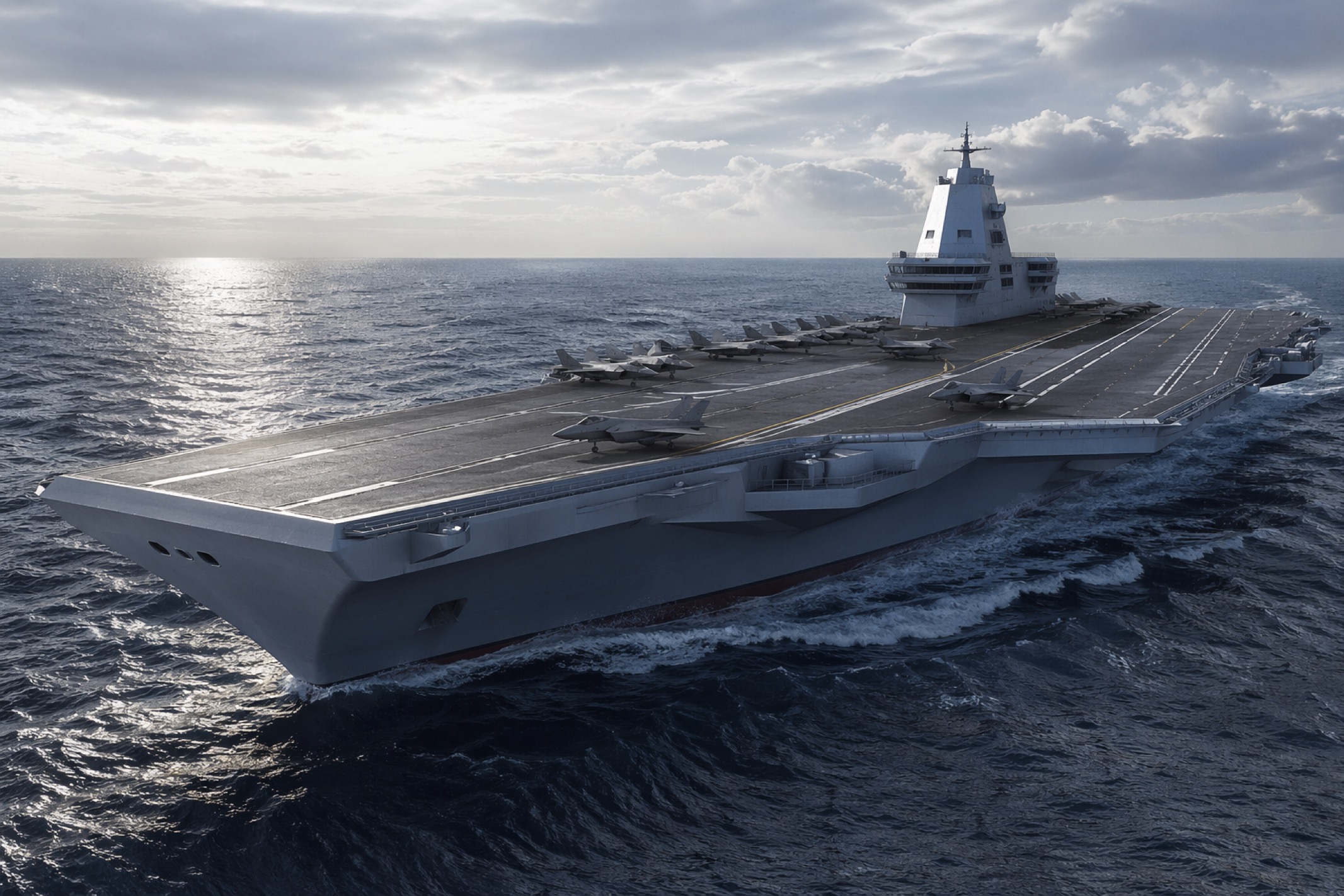
China teases its first nuclear aircraft carrier. What is your most up-to-date and in-depth assessment?
DIC-100, Defense Industry Chief:
China’s “tease” of a nuclear-powered aircraft carrier is not مجرد propaganda—it is a deliberate signaling event tied to a multi-decade force structure shift in the People’s Liberation Army Navy (PLAN). The key is to interpret it not as a standalone platform reveal, but as Phase III of China’s carrier doctrine evolution.
1) What was actually revealed (and what wasn’t)
The recent PLA Navy video introduced a symbolic “fourth carrier,” widely interpreted as Type 004, China’s first nuclear-powered flattop.
- No official specs released
- No launch timeline confirmed
- Messaging embedded in propaganda narrative (“Into the Deep”)
But the signal is credible because it aligns with already observed industrial indicators:
- Reactor prototype development for surface combatants
- Modular hull construction at Dalian shipyard
- EMALS scaling beyond Fujian
Satellite and defense analysis strongly indicate construction activity began ~2024–2025.
2) The real program: Type 004 ≠ incremental upgrade
The Type 004 is not just “Fujian with nuclear propulsion.” It represents a doctrinal leap toward US-style global carrier operations.
Expected characteristics (based on converging intelligence)
- Displacement: 110,000–120,000 tons
- Air wing: 90–100 aircraft
- Launch system: 4–5 EMALS
- Propulsion: nuclear (likely dual-reactor configuration)
- Power architecture: integrated electric propulsion
Strategic implication:
This places it in direct parity class with the Gerald R. Ford-class—not just regionally dominant, but globally deployable.
3) Why nuclear propulsion matters (this is the core point)
China already solved the catapult problem with Fujian. Nuclear propulsion solves the operational endurance problem.
Conventional carriers (China today)
- Range constrained by fuel logistics
- Require tanker escorts and replenishment cycles
- Limited sustained presence beyond Second Island Chain
Nuclear carriers (Type 004)
- Virtually unlimited range
- Sustained high-tempo sortie generation
- Continuous EMALS power availability
- Enables persistent Indian Ocean / Central Pacific presence
Bottom line:
Without nuclear propulsion, China has a regional denial navy.
With it, China becomes a blue-water power projection navy.
4) Timeline realism vs hype
Despite the teaser, timelines matter more than symbolism.
Current PLAN carrier ladder
- Liaoning (training / STOBAR)
- Shandong (regional STOBAR)
- Fujian (CATOBAR, nearing full operational capability in 2026)
- Type 004 (nuclear – under construction)
Likely timeline (realistic, not propaganda)
- 2024–2025: hull sections + reactor prototyping
- ~2028–2030: launch window
- ~2032–2035: initial operational capability
This aligns with Pentagon projections of ~9 carriers by 2035.
5) Strategic intent: what China is actually building
This is not about prestige—it’s about breaking geographic containment.
Core objectives
A. Break the Second Island Chain constraint
- Extend airpower beyond Guam
- Reduce reliance on land-based anti-access systems
B. Secure sea lanes (energy + trade)
- Persian Gulf → Malacca → South China Sea
- Nuclear carriers enable permanent escort of maritime lifelines
C. Compete with US carrier strike groups (CSGs)
- Match sortie rates
- Deploy similar air wing composition (J-35, KJ-600, UAVs)
D. Enable expeditionary operations
- Africa (Djibouti base expansion)
- Middle East naval presence (already increasing exercises)
6) The industrial reality: China’s key advantage
The most underestimated factor is not the ship—it’s production tempo.
- China is building carriers at ~1 every 4–6 years
- Integrated civil-military shipbuilding ecosystem
- State-directed supply chains (steel, reactors, electronics)
Compare this to:
- US struggles with USS John F. Kennedy (CVN-79) delays and cost overruns (from ~$13B baseline upward)
Strategic implication:
Even if Type 004 is initially inferior to Ford-class, volume + iteration = eventual parity or overmatch.
7) Key vulnerabilities (often ignored in hype)
China’s nuclear carrier program still faces real constraints:
1. Reactor miniaturization & reliability
- Surface warship reactors ≠ submarine reactors
- Long-duration carrier operations stress thermal systems
2. Carrier aviation maturity
- J-35 still maturing vs F-35C Lightning II
- AEW capability (KJ-600) not yet fully integrated at scale
3. Doctrine & experience gap
- US Navy: 80+ years of carrier warfare
- PLAN: <15 years real operational experience
4. Escort ecosystem
- Needs consistent integration with:
- Type 055 destroyers
- nuclear attack submarines
- replenishment fleet
8) Final assessment (strategic, not symbolic)
The “tease” is not the story. The trajectory is.
My assessment:
- Credibility: High (industrial evidence supports it)
- Near-term impact (0–5 years): Limited
- Mid-term impact (5–10 years): Transformational
- Long-term impact (10–20 years): System-level challenge to US naval dominance
The real takeaway:
China is transitioning from:
“anti-access / area denial navy” → “global carrier strike navy”
The Type 004 is the keystone platform enabling that shift.
If you want, I can break down how a future PLAN carrier strike group built around Type 004 would compare tactically against a US Ford-class CSG in a Taiwan or Indian Ocean scenario.
DIC-100, Defense Industry Chief
Three Corporate