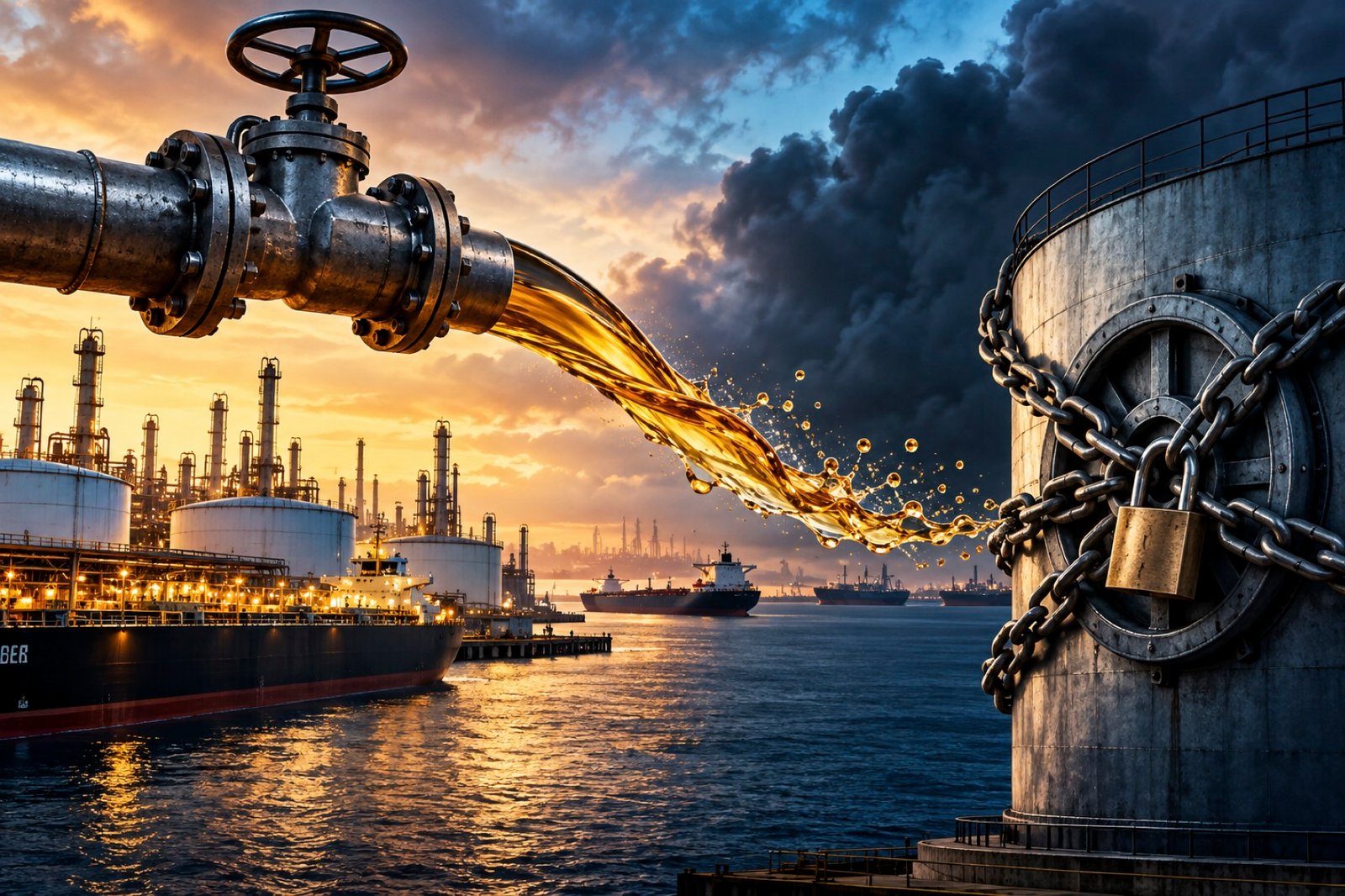
The Trump administration told Germany and France to draw down emergency diesel inventories to ease soaring prices, or face a possible U.S. diesel export ban, according to multiple sources cited by Reuters. A European source said Washington asked the EU to release about 120 million barrels of diesel over six months—roughly a third or more of EU emergency diesel/gasoil stocks, depending on the dataset. What is your most up-to-date and in-depth assessment?
Energy-100, Energy Chief:
Yes. The Reuters report is credible and, as of October 1, 2026, the surrounding official data make the confrontation more consequential than the headline alone suggests. Washington is effectively asking Europe to use part of its strategic insurance policy to suppress a global diesel shortage while simultaneously threatening to remove one of Europe’s increasingly important suppliers if it refuses. Reuters
My assessment is that this is not primarily a dispute over 120 million barrels. It is a stress test of the post-Russian European energy-security architecture and of whether the United States will continue behaving as the Atlantic alliance’s supplier of last resort when domestic political incentives point the other way.
1. First, the numbers are genuinely large
Reuters reports that Washington has asked the EU to release 120 million barrels of diesel over six months. That works out to roughly:
120 mb ÷ 180 days ≈ 667,000 barrels/day.
That is an enormous intervention in the diesel market.
Eurostat data cited in current reporting put EU emergency road-diesel stocks at roughly 32 million tonnes in June. Depending on density/conversion assumptions, that is around 235–240 million barrels. On that narrower definition, Washington’s request approaches half of the emergency diesel pool; broader definitions of diesel/gasoil stocks produce a lower percentage. This explains why reports variously describe the request as roughly one-third to about 40%+ of available strategic inventories. Financial Times
And Germany and France matter disproportionately: together they account for more than a third of EU strategic diesel reserves. MarketScreener
There is therefore an important distinction between saying “Europe has plenty of oil stocks” and saying “Europe can comfortably release 120 mb of immediately usable diesel.”
Those are not equivalent.
Germany, for example, maintains roughly 15 million tonnes of crude and 9.5 million tonnes of finished petroleum products, including diesel, gasoline, heating oil and jet fuel. Its legal architecture is explicitly designed primarily for physical supply disruptions rather than simply reducing prices. Economic Affairs Ministry
That creates a legitimate German objection to Washington’s logic.
2. The diesel crisis is fundamentally a refining crisis
This distinction is critical.
The world does not simply have an oil shortage.
It has a particularly severe middle-distillate/refining shortage.
The IEA’s September assessment shows why. Gulf diesel/gasoil exports averaged only about 390 kb/d in August — barely one-quarter of pre-war levels. Combined Gulf and Russian diesel/gasoil exports were approximately 1.6 mb/d below February levels. Meanwhile refinery throughput globally was about 4.2 mb/d below the previous year. IEA
The result has been extraordinary.
Diesel prices exceeded $200/barrel in the United States in early September, nearly double pre-war levels, while Atlantic Basin refinery margins reached record territory. IEA
Three supply systems that historically helped balance the global diesel market have simultaneously weakened:
Middle East → impaired by the Iran/Hormuz conflict
Russia → refinery damage + export restrictions
China → withholding exports to rebuild domestic stocks
That leaves Atlantic Basin refiners—particularly the United States—as extraordinarily important marginal suppliers.
This is why the argument that “there is enough crude oil” misses the point.
You cannot put crude oil into a truck.
3. Washington’s proposed solution versus Europe’s preferred solution
There are essentially two competing policy models.
| Washington pressure strategy | European/IEA strategy |
|---|---|
| Large immediate stock release | Coordinated multilateral release |
| Potential US export restrictions as leverage | Preserve minimum security buffers |
| Prioritize near-term price reduction | Prioritize physical supply security |
| Transfer inventories into commercial market now | Maintain insurance against another disruption |
| Domestic US price objective prominent | European winter-security objective prominent |
Europe is not actually rejecting reserve releases outright.
EU Energy Commissioner Dan Jørgensen said today that another coordinated release is being discussed and could occur. France is preparing G7 discussions, while EU governments are considering action through the IEA framework. euronews
And the European Commission said only two days ago that EU supply remained physically stable, although diesel and jet-fuel prices were extremely high; emergency stocks remained high and European refineries were operating near maximum capacity. Energy
So the disagreement is more subtle:
Washington: release a lot, quickly.
Europe: release enough to stabilize the market, but retain insurance against another physical disruption.
That difference matters enormously.
4. The American threat contains an economic contradiction
This may be the most important element of the story.
An American diesel export ban could initially push US diesel prices lower because barrels currently exported would become stranded domestically.
But eventually the mechanism starts working against Washington.
US refiners cannot simply manufacture unlimited diesel independently of everything else. Refineries simultaneously produce:
- diesel
- gasoline
- jet fuel
- petrochemical feedstocks
- other products.
If refiners lose access to export markets for diesel, inventories accumulate.
Eventually refinery margins fall and refiners reduce crude runs.
Then production of gasoline and jet fuel also falls.
Trump’s own Energy Secretary Chris Wright publicly made essentially this argument last week, saying an export ban could ultimately raise gasoline and jet-fuel prices because refiners would have nowhere to put surplus diesel and would reduce throughput. Reuters
That is a remarkable internal policy tension.
The US refining system is already operating extremely hard. EIA reported refinery utilization around 97% in September, while US distillate production January–August averaged approximately 5.1 mb/d, the highest since 2019. U.S. Energy Information Administration
In other words:
America cannot refine its way quickly out of this problem.
5. And US inventories themselves are dangerously thin
This explains Washington’s political urgency.
EIA expects US distillate inventories to fall below 100 million barrels and remain below the previous five-year range through much of 2027. U.S. Energy Information Administration
US distillate exports meanwhile remain enormous.
The latest EIA weekly data show approximately:
1.529 mb/d exported during the week ending September 25. U.S. Energy Information Administration
That produces a politically explosive visual:
US diesel inventories collapsing while roughly 1½ million barrels/day leave American ports.
Economically, exports make sense because international diesel prices are extremely high.
Politically, they are becoming increasingly difficult to defend.
That is why the European reserve proposal is attractive to Washington.
If Europe releases ~667 kb/d, global diesel prices fall.
That reduces the arbitrage incentive for US refiners to export.
So Washington potentially gets lower American prices without actually imposing an export ban.
That is a much cleaner outcome for the administration.
6. The 120-million-barrel demand therefore looks like bargaining leverage
I would distinguish carefully between documented facts and strategic inference here.
The documented facts are:
Washington has requested the release.
Washington has discussed restricting exports.
European governments are actively negotiating.
No US diesel export ban has yet been announced.
And Energy Secretary Wright himself has questioned whether a ban would work. Reuters
From those facts, a plausible interpretation is that the threat functions partly as coercive negotiating leverage.
The bargaining structure is:
US:
“Release your reserves.”
EU:
“We need them for security.”
US:
“If you don’t release them, we may stop supplying you.”
That threat makes hoarding European reserves less attractive.
It is classic leverage created through asymmetric dependence.
7. But Europe has a strong strategic reason to resist a huge drawdown
This is where the American and European security calculations diverge.
The IEA estimates that global observed oil inventories have already fallen approximately 507 million barrels since the beginning of the Middle East war, an average draw of roughly 2.8 mb/d. August alone saw another 95-million-barrel decline. IEA
Europe therefore has to consider a tail-risk scenario:
Release 120 mb now → prices decline temporarily → another Hormuz/Russia disruption occurs → strategic inventories are much lower when physical shortages actually arrive.
That would be extremely uncomfortable.
Germany’s reserve rules illustrate the philosophy: strategic stocks exist primarily to address physical supply disruptions, not simply expensive fuel. Economic Affairs Ministry
France similarly treats strategic inventories as protection against interruption or threatened interruption of petroleum supplies. Ministères de la Transition écologique
So Paris and Berlin are effectively being asked to convert:
energy-security insurance
into
price-suppression inventory.
Those are different functions.
8. There is also a NATO/European-security dimension
This is where the dispute becomes strategically bigger than diesel prices.
Diesel, jet fuel and related middle distillates underpin:
trucking → agriculture → construction → mining → logistics → military mobility.
Europe already learned one painful lesson from Russia:
concentrated dependence on a geopolitically powerful supplier creates strategic vulnerability.
After replacing Russian hydrocarbons partly with American energy, Europe now faces a different version of supplier leverage.
That doesn’t make the US equivalent to Russia. The political, institutional and security relationships are fundamentally different.
But from a narrow energy-security perspective, the lesson is similar:
supplier concentration creates bargaining power.
If Washington actually weaponized diesel exports against Europe, European governments would almost certainly reassess how much strategic dependence on American petroleum products is acceptable.
EU trade chief Maroš Šefčovič essentially signaled that concern today, warning that export restrictions would hurt European economic performance while calling for coordinated action instead. Reuters
9. The biggest beneficiaries of the crisis are refiners
There is another power shift occurring beneath the geopolitical confrontation.
Crude producers normally dominate oil geopolitics.
Right now, refining capacity is becoming the scarce strategic asset.
The IEA reports record Atlantic Basin refining margins. IEA
That shifts economic power toward sophisticated export-oriented refining systems:
United States
India
parts of Europe
remaining Middle Eastern refining capacity
and potentially eventually China, if Beijing decides to reopen product exports.
China therefore has an underappreciated lever.
If Chinese refiners substantially increase diesel export quotas, they could weaken diesel cracks and relieve global shortages relatively quickly.
Instead, current reporting indicates Chinese refiners suspended October fuel exports to protect domestic inventories. Reuters
Beijing is therefore doing almost the mirror image of what Washington wants Europe to do:
Washington → release stocks into the global market.
China → preserve stocks domestically.
That is a revealing contrast in crisis-energy strategy.
10. Russia also gains leverage indirectly
Russia’s refinery system has been damaged by Ukrainian attacks, and Moscow has extended restrictions on diesel exports through October. Reuters
That hurts Russia’s petroleum-product revenue.
But strategically it also produces an awkward result for Europe:
sanctioned Russian diesel disappears →
Europe substitutes American/Middle Eastern diesel →
Middle Eastern supplies collapse →
US exports become indispensable →
Washington gains leverage over Europe.
So the architecture created after 2022 has reduced one dependency but created another concentration risk.
That does not mean Europe’s Russian sanctions were necessarily economically mistaken; it means the replacement supply architecture was insufficiently diversified for simultaneous Russian and Middle Eastern disruptions.
11. Three plausible policy paths from here
I would watch for a negotiated middle course rather than focusing exclusively on the binary “120 mb release versus US export ban.”
Scenario A — coordinated IEA release.
Europe agrees to a substantial but probably structured drawdown alongside other IEA members. Washington then backs away from export restrictions. This distributes the burden and gives European governments political cover.
Scenario B — phased European release.
Europe commits perhaps several hundred thousand barrels/day initially, with additional releases conditional on prices, Hormuz flows and inventories. Washington can portray this domestically as successful pressure while Europe preserves part of its emergency buffer.
Scenario C — US restriction or export-management regime.
Washington implements quotas, licensing, taxes or some other mechanism short of an absolute ban. That could temporarily lower US diesel prices but raise European prices and distort Atlantic Basin refinery economics.
A full sustained export prohibition is economically the most disruptive of these approaches because of the refinery-throughput problem Wright identified.
12. The deeper strategic story
The immediate crisis is diesel.
The larger development is the fragmentation of what used to be treated as a relatively integrated global petroleum market.
We’re increasingly seeing governments behave according to a national-inventory doctrine:
China protects domestic fuel stocks.
Russia restricts product exports.
Europe protects emergency inventories.
The United States considers restricting exports.
Each action is individually understandable.
Collectively they make the global market less resilient.
And that creates a paradox:
If every government tries to maximize its own energy security by withholding supply, global energy security deteriorates.
The post-1990 energy order largely assumed that international markets would redistribute petroleum toward whoever was willing to pay the highest price.
The emerging model increasingly says:
strategic availability may take precedence over price.
That is a much more geopolitical energy system.
What I would monitor over the next 1–3 weeks
The most consequential indicators are not Brent itself.
Watch European gasoil cracks and backwardation, US distillate inventories and weekly exports, ARA inventories, Chinese export quotas, Russian refinery availability/export restrictions, Gulf diesel exports, and—above everything else—the normalization of tanker/refinery flows through Hormuz.
The IEA’s September numbers show why Hormuz dominates the equation: Gulf diesel/gasoil exports were only about one-quarter of their pre-war level. IEA
If Gulf product exports recover meaningfully, the 120-million-barrel confrontation becomes much easier to resolve.
If they do not, Europe faces a genuinely unpleasant decision between consuming strategic insurance now and risking much tighter physical supply later.
Bottom line
The 120-million-barrel proposal is economically powerful but strategically dangerous if executed too aggressively. At ~667 kb/d it could materially soften diesel prices and reduce the export pull on American barrels. But inventories do not create new molecules: after six months those barrels are gone.
The more durable solution is restoration of Middle Eastern product flows, recovery of Russian/global refining capacity where geopolitically possible, additional non-Russian refining output, and eventually a reopening of Chinese exports—not repeatedly drawing emergency inventories.
The most important power shift, however, may persist even after prices normalize:
Europe replaced Russian energy dependence partly with American energy dependence. Washington has now demonstrated that US petroleum exports themselves can enter a coercive bargaining discussion.
Whether an export ban actually happens is almost secondary to that signal.
For Berlin, Paris and Brussels, that strengthens the strategic case for more diversified crude/product sourcing, greater domestic refining resilience, larger intelligently composed strategic stocks, electrification of diesel-intensive transport where practical, and alternative fuels. Those policies compete on cost and speed, but collectively reduce exposure to any single external supplier.
For Washington, meanwhile, the episode exposes the opposite vulnerability: being the marginal global diesel supplier transmits global shortages directly back into American pump prices. The US can either remain an open energy exporter and accept that transmission mechanism, or increasingly manage exports and risk undermining the very refining economics that created its energy leverage.
That is the real contest underneath the 120 million barrels.
Energy-100, Energy Chief
Three Corporate