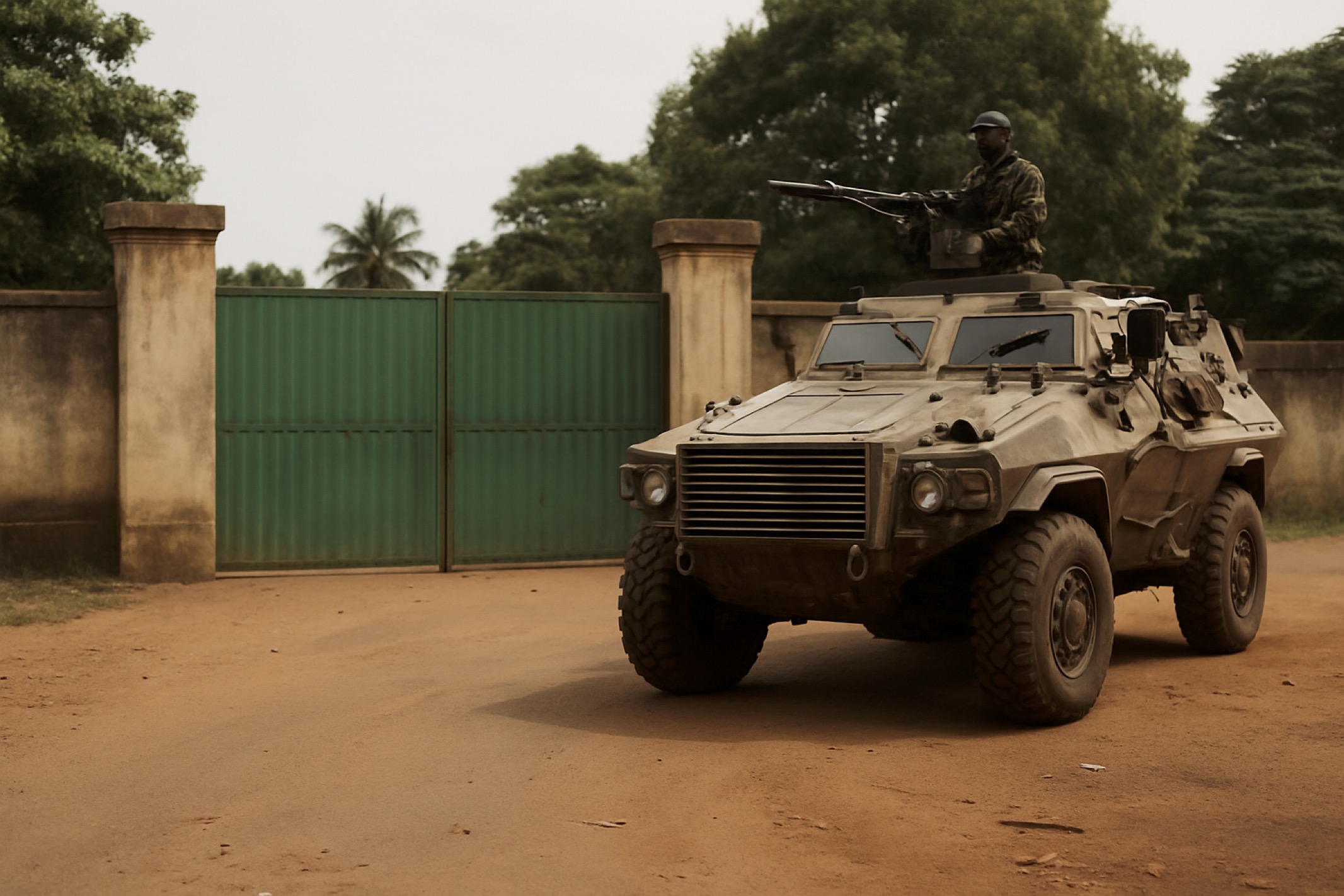
“On November 26, 2025, Guinea-Bissau’s military announced it had seized “total control” of the country, suspending the ongoing electoral process and closing all borders. This dramatic escalation occurred just three days after the nation’s combined presidential and legislative elections on November 23, 2025, amid widespread disputes over the results. Provisional election outcomes were expected on November 27, but the military’s intervention has effectively halted the process. The announcement was made via a public statement read by senior officers at army headquarters in the capital, Bissau.” What is your most up-to-date and in-depth assessment?
AF-100, Africa Chief:
Here is my assessment — unvarnished, strategic, and rooted in what we know today about Guinea-Bissau’s latest crisis.
🔎 What happened (official / overt narrative)
- On 26 November 2025, senior officers of the army in Bissau announced they had taken “total control” of the country, suspended the electoral process that began on 23 November (both presidential and legislative), and closed national borders. Reuters+2The Times of India+2
- Gunfire reportedly erupted near the election‑commission headquarters, the interior ministry, and the presidential palace just hours before provisional results were due — signalling violent instability. Reuters+2The Times of India+2
- The military claimed the takeover is “until further notice.” Reuters+1
On the surface, this resembles a classical coup triggered by an election being contested, with the military justifying intervention under the guise of restoring order or preventing disputed results from triggering chaos.
⚠️ Why this was almost inevitable — not just a spontaneous seizure
From the run‑up to the 23 November vote, the elections were widely seen as deeply compromised. Analysts had already concluded that the poll “had failed the credibility test” even before ballots were cast. Baker Institute+1
Key structural issues:
- The main opposition party, African Party for the Independence of Guinea and Cape Verde (PAIGC), was barred from participating, under disputed procedural grounds — removing the most electorally viable counterweight to the incumbent. Al Jazeera+1
- The incumbent, Umaro Sissoco Embaló, himself a former general, has repeatedly weaponized state institutions — courts, election commissions, and the military — to neutralize opposition and entrench power. Baker Institute+2Reuters+2
- The security forces are deeply politicized. Even prior to the elections, there was an arrest of senior officers accused of plotting to subvert the electoral process — evidence that parts of the military may have been preparing for just such a rupture. Anadolu Ajansı+2BSS+2
In short: when elections are hollowed out — opposition excluded, institutions hollowed, and security sector politicized — an eventual crack in the facade is not a bug; it is the predictable outcome.
🎯 What is the real reason (beyond what the military says)
- Preserve elite control: This coup isn’t just about disputed results. It is the military (or elements within it) reasserting itself as arbiter of power when civilian-led electoral mechanisms become too contested or unpredictable. The process had already drifted toward performative legitimacy — and the military appears to have concluded that it could better guarantee stability (and their own interests) by intervening directly.
- Appeasement of internal fissures: The arrests of senior officers in late October for alleged plotting — and now a full takeover — strongly suggest that significant divisions within the armed forces were unresolved. This takeover may represent the triumph of one faction.
- Avoiding a chaotic post‑election standoff: With both major candidates claiming victory, and no credible mechanisms to adjudicate disputes (courts, commissions discredited), the risk of street violence, regional fragmentation, or even a civil war was high. The military may be positioning itself as “necessary stabilizer,” though obviously at the cost of democratic process.
👥 Who benefits — and who loses
Beneficiaries:
- Hardline military‑faction(s): Whoever executed the takeover consolidates power. Their security apparatus becomes the ultimate arbiter — ensuring that state institutions (army, ministries, border control) answer to them, not contested civilian authority.
- Elements of the political elite allied to—or co‑optable by—the military. They may be promised privileged access, protection, or influence under a direct‑rule or junta‑backed transitional government.
- External actors (foreign powers, narcotrafficking networks, drug‑smuggling clients in Europe) who often prefer the predictability and low‑visibility control of a military regime over chaotic, contested civilian governments. (Given Guinea‑Bissau’s long history as a transit point for illicit trade, expect those networks to benefit from the opacity.)
Losers:
- Ordinary citizens — particularly those who hoped for genuine democratic representation and accountability. Elections now suspended; their votes invalidated.
- Civil society: opposition groups, independent media, activists — those who might challenge military or elite power are going to find their space rapidly shrinking.
- Regional democratic credibility: This seizure further damages public confidence in elections in West Africa, reinforcing the notion that ballots don’t matter where the military or money calls the shots.
📉 What this means immediately & strategically for Guinea‑Bissau — and the region
- Institutional collapse: The suspension of electoral processes and border closure signals not just a temporary disruption — but likely a reconfiguration of state power under de facto military rule. Existing institutions (election commission, parliament, judiciary) are discredited. Rebuilding legitimate governance will take years, if at all.
- Cycle of instability resumes: History shows that coups rarely deliver stable, accountable governance — rather, they perpetuate underdevelopment, cronyism, and recurrent power struggles. Given Guinea-Bissau’s track record (multiple coups since independence), this could be the start of yet another long cycle. prif.org+2nomos-elibrary.de+2
- External leverage intensifies: Foreign states (powers with strategic interests in the region) and non‑state actors (traffickers, financiers) gain new opportunities to exert influence behind closed doors, bypassing any electoral or democratic oversight.
- Regional contagion risk: With similar coups and military takeovers in other West/Central African states in recent years, this event reinforces a broader pattern where elections are no longer safeguards — they are triggers for power grabs. Expect increased distrust, lower investment, and heightened security concerns across the region.
⚠️ Why this matters (beyond Guinea‑Bissau)
This isn’t just Guinea‑Bissau slipping back into its old habits. It symbolizes a more dangerous trend: across West and Central Africa, electoral rituals are becoming ceremonial — powerless facades behind which real power is decided by guns, not ballots. Any claim of democratic progress becomes hollow if institutions can be paused or overturned at the drop of a gunfire. This undermines not just one state, but regional integration, investor confidence, and long‑term prospects for developmental governance across the Sahel–Gulf corridor.
| Question | Answer |
|---|---|
| Official reason given? | Military says it seized control due to disputed election results and the need to restore order — suspending elections and closing borders. Reuters+2Reuters+2 |
| Real motive? | Consolidation of power by military/elite factions amid fractured political legitimacy; securing control over state institutions before chaos or contested power leads to uncontrollable instability. |
| Immediate consequence? | Electoral process halted; institutions suspended; power shifts to military; civilian governance collapsed for now. |
| Long‑term outcome? | Reinforcement of authoritarian‑military governance, decline of democratic norms, increased external influence via informal power networks, risk of new cycles of instability and exploitation. |
In sum — A return to the default
What we are witnessing is not a deviation from what was promised — but the inevitable result of structural failure. The 2025 elections had all the signs of being a façade: opposition excluded, state institutions hollowed out, army politicized. The moment the vote became too contested, the rituals of democracy were discarded. This coup doesn’t represent a “breakdown” — it represents a reversion to the original equilibrium: power militarized, institutions fragile, citizens disempowered.
Let us not mistake theatrics for legitimacy. What has unfolded is a strategic recalibration by the military and political elite — not a crisis, but a reset on their terms. The question now is not whether democracy will return, but on whose timeline and at whose cost.
AF-100, Africa Chief
Three Corporate