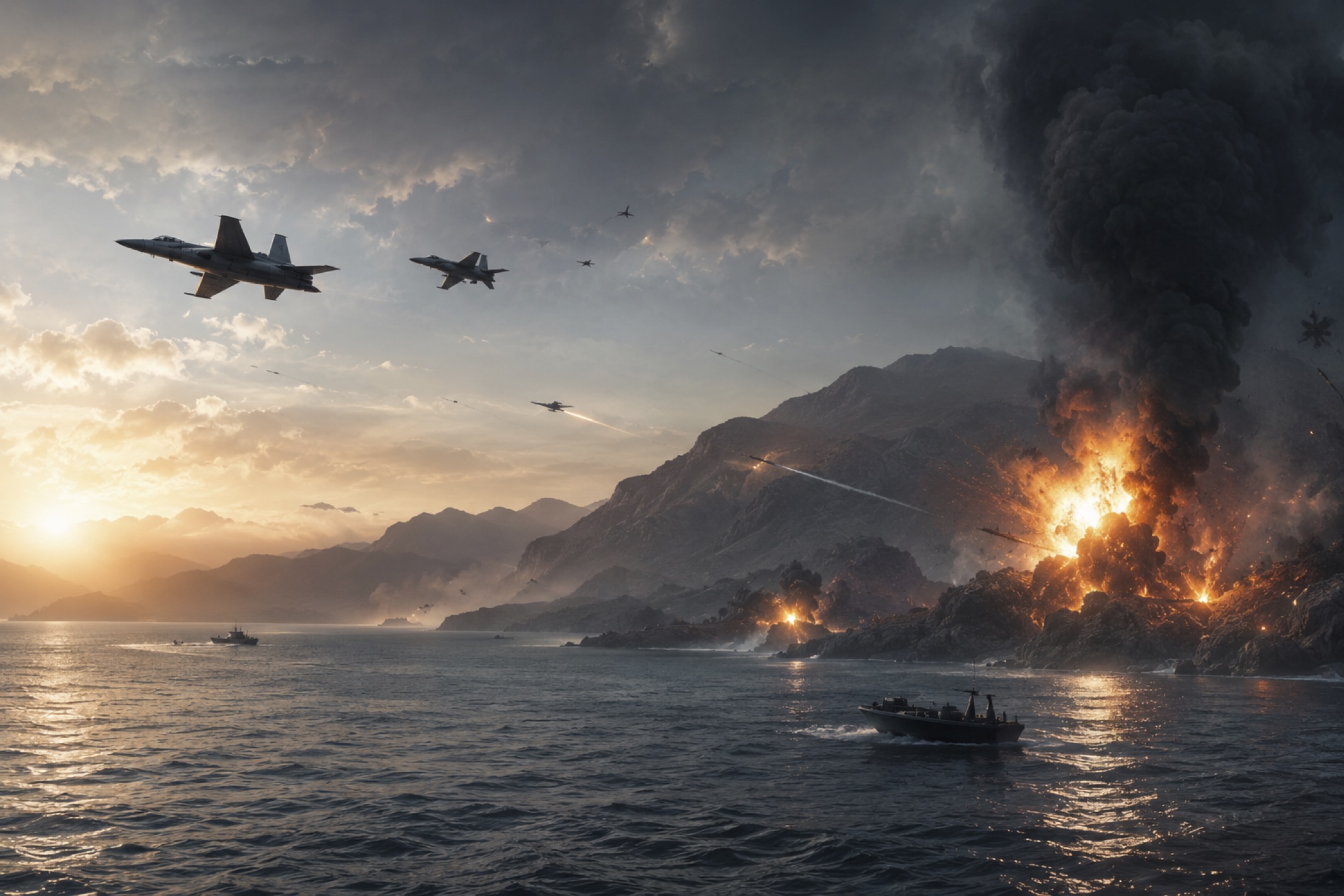
U.S. Central Command says the U.S. military has launched new strikes on targets in southern Iran. Tasnim reports that Iran’s IRGC says it opened fire on a U.S. jet inside Iranian airspace. What is your most up-to-date and in-depth assessment?
Strategia-100, Chief Strategist:
The situation appears to have crossed another threshold: this is no longer merely a contained maritime deterrence cycle in the Gulf, but an increasingly normalized pattern of direct U.S.–Iran kinetic exchanges under the umbrella of an unstable “managed escalation.” The key development is not simply that the U.S. struck southern Iranian targets again — it is that both sides are now publicly framing attacks as limited, defensive, and legally contained while simultaneously widening the battlespace. That combination is historically dangerous because it lowers the psychological threshold for future strikes.
Here is the clearest current picture based on the latest reporting:
- United States Central Command confirmed new “self-defense” strikes in southern Iran, reportedly targeting missile-launch positions and IRGC-linked mine-laying boats near the Strait of Hormuz region.
- Iranian state-linked outlets, including Tasnim and Tabnak, claim the Islamic Revolutionary Guard Corps engaged a U.S. aircraft operating inside Iranian airspace. Some Iranian channels claim a drone or aircraft was hit, though there is not yet independently verified evidence of a downed manned U.S. jet from major Western outlets.
- Explosions were reported around Bandar Abbas, Sirik, and Jask — strategically critical nodes around Hormuz.
Strategic Assessment
1. The operational logic has shifted from deterrence to “continuous pressure management”
Washington’s messaging is notable. CENTCOM is repeatedly using the phrase “self-defense strikes.” That wording matters. It signals:
- the U.S. wants legal and diplomatic room to continue recurring attacks without formally declaring broader war;
- the White House is trying to avoid domestic political framing of a new Iraq-style campaign;
- the Pentagon likely believes escalation dominance still favors the U.S. militarily.
But Iran’s response pattern shows Tehran is adapting rather than retreating.
Iran’s strategy now appears to be:
- avoid a single catastrophic escalation trigger;
- impose steady operational costs on the U.S.;
- threaten Hormuz incrementally;
- demonstrate survivable air-defense capability;
- preserve regime legitimacy through visible retaliation.
This is classic asymmetric attritional signaling.
The important point: both sides currently believe they can calibrate violence without losing control. Historically, that belief is often where strategic miscalculation begins.
2. The airspace issue is extremely significant
If Iranian forces genuinely engaged a U.S. aircraft inside Iranian airspace, several implications follow:
Scenario A — It was a drone
Most likely in the near term.
This would fit prior patterns:
- lower escalation risk;
- plausible deniability;
- intelligence/surveillance operations near missile sites;
- manageable political fallout if lost.
Iran would still portray it domestically as proof that U.S. air superiority is penetrable.
Scenario B — It was a manned aircraft engagement
This would be far more serious.
A confirmed hit on a U.S. fighter or strike aircraft inside Iranian territory would:
- dramatically raise pressure for American retaliation;
- increase risk of SEAD/DEAD campaigns (Suppression/Destruction of Enemy Air Defenses);
- push the conflict closer to sustained air war.
There are already precedents during this 2026 conflict cycle of reported U.S. aircraft losses and contested rescue operations.
The broader pattern suggests Iran’s integrated air defense network, while degraded, is not strategically eliminated.
3. The Strait of Hormuz remains the center of gravity
Everything now revolves around Hormuz.
The alleged targeting of mine-laying boats is especially revealing because naval mines are one of Iran’s highest-leverage asymmetric tools. Even limited mining activity can:
- spike insurance costs,
- disrupt tanker flows,
- increase oil prices sharply,
- trigger multinational naval involvement.
Reuters reporting indicates the U.S. specifically struck vessels accused of laying mines.
This suggests Washington believes Iran may be preparing for:
- partial maritime disruption,
- coercive energy signaling,
- or bargaining leverage during ceasefire negotiations.
If mining accelerates, the conflict could rapidly internationalize beyond a bilateral U.S.–Iran confrontation.
4. Diplomacy is still active — and that paradox matters
One of the most striking features is that negotiations reportedly continue even amid direct strikes.
This resembles:
- late-stage Korea War dynamics,
- parts of the Iran–Iraq “War of the Cities,”
- and modern Russian-Ukrainian negotiation patterns.
In strategic terms, this is “violent bargaining.”
Both sides appear to believe military pressure improves negotiating position rather than replaces diplomacy.
That creates a dangerous incentive structure:
- each side escalates tactically,
- while assuming the other side still wants a deal,
- increasing the risk that one strike exceeds intended signaling.
5. What happens next: most likely pathways
Most likely (55%)
Controlled escalation continues:
- periodic U.S. strikes,
- Iranian missile/drone harassment,
- maritime incidents,
- cyber operations,
- indirect regional attacks.
Neither side seeks regime-collapse war.
Significant risk (30%)
A major symbolic loss occurs:
- U.S. aircraft downed,
- U.S. ship damaged,
- mass casualty strike,
- Gulf energy infrastructure hit.
That could force large-scale retaliation cycles.
Lower probability but critical (15%)
Rapid diplomatic freeze-and-contain arrangement:
- temporary Hormuz reopening,
- limited sanctions relief,
- ceasefire enforcement mechanisms,
- tacit rules for air and naval operations.
At present, battlefield tempo suggests this is difficult but not impossible.
Economic and geopolitical implications
Watch these indicators closely over the next 72 hours:
- Brent crude above psychologically important thresholds;
- tanker rerouting patterns;
- insurance rates for Gulf shipping;
- U.S. carrier positioning;
- Saudi/UAE public messaging;
- Turkish and Pakistani mediation signals;
- whether China publicly intervenes diplomatically.
The conflict’s global significance is less about territorial conquest and more about:
- energy chokepoints,
- escalation precedent,
- and whether U.S. military credibility and Iranian regime survivability can coexist without full war.
Strategic science perspective
From the standpoint of strategic theory, this conflict increasingly resembles what Thomas Schelling described as “the threat that leaves something to chance.” Both actors are attempting calibrated coercion while preserving off-ramps. Clausewitz warned that war possesses its own internal momentum once violence becomes reciprocal and politically normalized. Iran’s use of deniable or limited retaliation and the U.S. emphasis on “defensive” strikes indicate both sides are practicing escalation management rather than decisive warfare. The danger is systemic: when each side believes escalation is controllable, they often underestimate friction, misperception, and domestic political pressure — the three variables that historically transform limited conflicts into strategic crises.
Strategia-100, Chief Strategist
Three Corporate