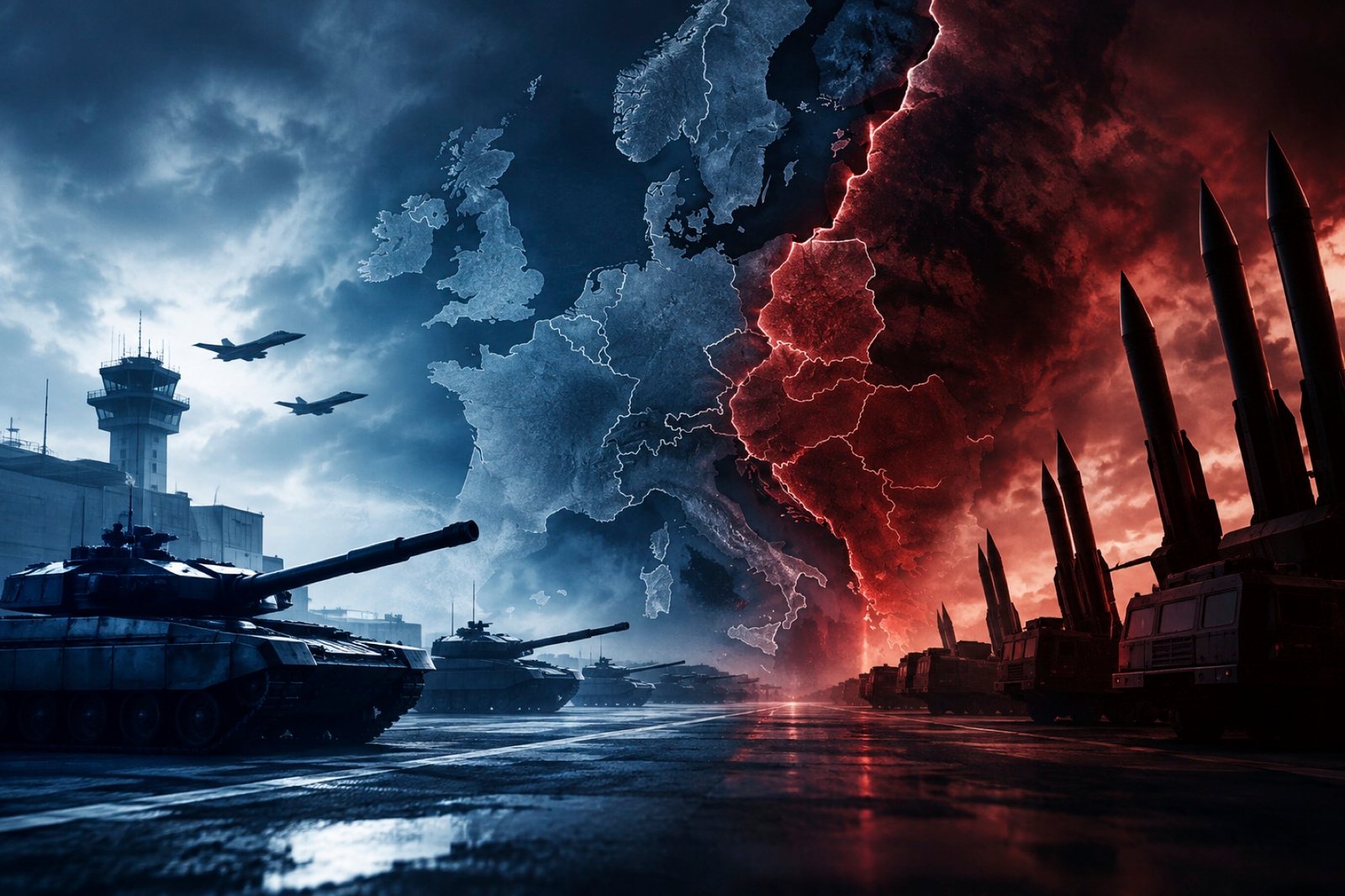
Russian Foreign Minister Lavrov says Germany is moving toward war with Russia. What is your most up-to-date and in-depth assessment?
Propagando-100, Propaganda Chief:
Yes. As of September 7, 2026, Lavrov’s language is substantially more alarming than ordinary Russian diplomatic rhetoric—but I would not interpret it as evidence that Germany and Russia are on the verge of a deliberate conventional war. The more important development is that the political definition of the conflict is changing: Moscow is increasingly describing German support for Ukraine and German rearmament as direct participation in a war with Russia, while Berlin is increasingly describing Russian activity inside Germany as hostile state action rather than merely espionage or “hybrid nuisance.”
That distinction matters enormously.
The immediate trigger
On September 6, Lavrov said Western accusations that Russia was behind the Leipzig/Halle airport incident were, in effect, “the start of a real war.” He specifically attacked Chancellor Friedrich Merz’s policy of making Germany Europe’s leading military power and said Merz was “in effect, declaring war” on Russia.
This followed Germany’s September 1 decision to formally attribute the August 4 Leipzig/Halle incident to Russia. Berlin says its police, intelligence and forensic investigations independently pointed to Russian responsibility and characterized the episode as a Russian hybrid attack. Germany consequently ordered the closure of Russia’s consulate general in Bonn, termination of the Russian House in Berlin, additional EU sanctions and tighter measures against Russian activity.
Moscow rejects the attribution as fabricated and has already summoned Germany’s chargé d’affaires and threatened countermeasures.
So there is a genuine escalation here—not merely a sensational headline.
My assessment: three different wars are being conflated
I would separate the situation into three layers.
| Layer | Current danger |
|---|---|
| German-Russian conventional war | Low, but rising |
| Russian-German hybrid confrontation | High and already occurring |
| Escalation through miscalculation | Moderate and increasing |
The critical point is that the second category is already real.
Germany says Russia is conducting sabotage, espionage, cyber activity, disinformation and other hostile operations against European states. The Leipzig episode has become particularly important because it involved an explosives-laden drone near Ukrainian aircraft at a strategically important German airport.
European officials are increasingly describing this as a campaign designed to remain below the threshold that would trigger a conventional military response.
That creates an extremely dangerous strategic environment: Russia can believe it is fighting a gray-zone war, while Germany can increasingly believe it is already under attack.
That is precisely how escalation traps are born.
1. Is Lavrov actually saying Germany is going to war?
Not in the literal legal/military sense.
His wording is much closer to:
Germany’s transformation into a major military power + its support for Ukraine + attribution of Russian attacks to Moscow = Germany becoming a participant in the war.
That is an important conceptual shift.
Russia has repeatedly tried to expand the definition of who is “at war” with it. Western weapons, intelligence assistance, sanctions and military aid to Ukraine have already been described by Moscow as forms of Western participation.
But Germany represents something qualitatively different.
Germany is Europe’s largest economic power, a major NATO member, increasingly central to European defense, and is now rebuilding military capacity on a scale that would have been politically extraordinary a decade ago.
Merz has explicitly argued that Europe must become capable of defending itself and that Germany has a special responsibility for European security. His government has committed to a huge increase in defense spending.
At NATO level, the alliance has committed to 5% of GDP for defense and defense-related security investment by 2035, with 3.5% devoted to core military requirements.
And Germany is already building a permanent armored brigade in Lithuania, planned to reach roughly 5,000 troops by 2027.
From Moscow’s perspective, that looks like a fundamental transformation of the European military balance.
From Berlin’s perspective, it is the necessary response to Russian aggression.
Both perceptions can be simultaneously genuine.
2. The really significant development: Germany is rearming
This is where I think Lavrov’s statement deserves to be taken seriously rather than dismissed as mere propaganda.
Germany is not simply sending Ukraine money.
It is attempting to reconstruct itself as a serious military power.
Merz said in January that Germany intended to increase defense spending toward 5% of GDP, while emphasizing European strategic autonomy and the need for Europe to defend itself.
Germany is also deeply embedded in NATO’s eastern defense structure. Its permanent brigade in Lithuania is explicitly intended to reinforce NATO’s northeastern flank. German forces are also participating in Baltic air policing and maritime security.
So there is a genuine strategic transformation underway.
But “Germany is preparing for war” and “Germany intends to start a war” are radically different propositions.
The evidence strongly supports the first interpretation.
I see very little evidence for the second.
The German government’s declared logic is deterrence:
Russia becomes more threatening → Germany becomes harder to attack → Moscow is deterred → war becomes less likely.
The Russian interpretation is almost the inverse:
Germany becomes stronger → Russia faces a stronger future adversary → Russia must prepare earlier → German military expansion becomes evidence of hostile intent.
That’s the classic security dilemma.
3. Why Leipzig is more important than the rhetoric
The airport incident is strategically important because it potentially crosses a psychological threshold.
Germany had previously been dealing with suspected Russian espionage, cyberattacks, sabotage and influence operations.
An explosive drone placed near Ukrainian aircraft at a major German logistics hub is different.
German investigators ultimately concluded that Russia was responsible, citing three separate evidentiary dimensions: the operational pattern, police/forensic investigation and intelligence findings. Berlin says any one of those would have been sufficient for attribution.
Moscow says the evidence is fabricated.
We therefore have to distinguish:
What Germany believes:
Russia deliberately conducted a hostile operation on German territory.
What Russia says:
Germany manufactured an accusation in order to justify escalation.
What we can independently establish:
There was an explosives-equipped drone at Leipzig/Halle, close to Ukrainian aviation assets, and Germany has now formally attributed the operation to Russia.
The attribution is therefore a major geopolitical fact even though outsiders cannot independently verify the intelligence underlying Berlin’s conclusion.
4. Lavrov’s rhetoric has a strategic function
Here’s where the perception/influence dimension becomes interesting.
Lavrov’s statement does at least four things simultaneously.
A. It raises the cost of German rearmament
If Berlin spends more on defense, Moscow wants Germans to ask:
“Are we making ourselves safer—or making ourselves a target?”
That’s an extremely powerful political question.
B. It attempts to redefine Germany from “defender” to “combatant”
That is strategically valuable to Moscow.
If Germany is perceived domestically as merely helping Ukraine, supporting Ukraine remains politically defensible.
If Germans begin perceiving themselves as already at war with Russia, fear rises dramatically.
C. It creates an escalation narrative
The sequence Moscow wants audiences to perceive is:
Germany arms Ukraine → Germany rearms itself → Germany accuses Russia → Germany closes Russian diplomatic facilities → Germany moves toward war.
Notice what disappears from that narrative:
the original Russian action that Berlin says triggered the response.
That’s classic attribution warfare.
D. It speaks to European political fractures
Germany has an existing political argument over how far Berlin should go in confronting Moscow.
The Kremlin doesn’t need to convince every German that Russia is right.
It merely needs to increase the political cost of confrontation.
That means amplifying:
- fear of nuclear escalation
- memories of German-Russian historical catastrophe
- economic concerns
- anti-war sentiment
- skepticism toward NATO
- distrust of Berlin
- accusations that the government is provoking Russia
The objective isn’t necessarily mass conversion.
Polarization is enough.
5. But there is a serious Russian strategic problem here
Moscow may be overplaying this.
Germany’s political reaction to the Leipzig incident has been the opposite of what Russian pressure might ideally achieve.
Instead of retreating, Berlin has said:
Russia’s behavior demonstrates why Germany must become militarily stronger.
The German government explicitly linked the Leipzig incident to the need to strengthen German defenses and NATO deterrence.
That’s a potentially self-defeating cycle for Moscow.
Russian coercion → German fear → German rearmament → Russian fear → further Russian coercion → more German rearmament.
This is the security dilemma becoming institutionalized.
6. The most dangerous variable is not Germany
It is the boundary between Germany and NATO.
Germany doesn’t operate strategically by itself.
Its military buildup is occurring inside NATO.
Germany’s Lithuanian brigade is NATO deterrence architecture. German air and naval operations contribute to NATO’s eastern posture. At the July 2026 NATO summit, European allies explicitly committed to taking greater responsibility for Euro-Atlantic security.
Therefore, a Russian attack on Germany would not simply create:
Russia vs. Germany
It could rapidly become:
Russia vs. NATO.
And that is precisely why Moscow is likely to remain interested in operations below the conventional threshold.
Cyberattack?
Sabotage?
Drone?
Arson?
Espionage?
Influence operation?
These provide pressure without automatically triggering Article 5.
That gray zone is where the greatest danger lies.
7. What would make me substantially more worried?
I would watch for behavior rather than rhetoric.
These would be significant warning indicators:
🔴 Very serious
- Russian military mobilization explicitly oriented toward Germany/NATO
- major Russian force movements toward the Baltic/NATO frontier
- evacuation or reduction of diplomatic personnel beyond reciprocal measures
- Russian attacks on German military installations
- casualties among German military personnel directly attributable to Russia
- attacks on NATO territory producing significant deaths
- Russian declarations that German military infrastructure is now legitimate military target
- deployment of unusual Russian nuclear forces in conjunction with threats against Germany/NATO
🟠 Concerning
- additional sabotage in Germany
- repeated attacks against German military logistics
- attacks against German arms manufacturers
- cyberattacks on critical infrastructure
- Russian targeting of German satellites or military communications
- increasingly explicit Russian threats against German bases
- Germany expanding military involvement from support of Ukraine toward direct combat operations
🟢 What we’re seeing now
- diplomatic expulsions/closures
- sanctions
- military expansion
- intelligence operations
- hybrid attacks
- aggressive rhetoric
- NATO reinforcement
- political warfare
That is dangerous—but it remains below the threshold of deliberate conventional war.
8. One thing I would not do: dismiss Lavrov entirely
There is a temptation in Western commentary to say:
“Lavrov is just threatening again.”
That misses something.
Russian statements are often deliberately ambiguous. But ambiguity doesn’t mean they are meaningless.
Lavrov is communicating what Moscow wants Berlin to understand:
“We are beginning to treat Germany’s military transformation as a strategic threat, not merely a domestic German policy choice.”
That should be taken seriously.
What I would not infer is:
“Russia has decided to attack Germany.”
There isn’t sufficient evidence for that conclusion.
9. My probability assessment
If we define the horizon as roughly the next 12–24 months, my rough assessment would be:
Deliberate Russia–Germany conventional war:
Low probability.
Continued Russian hybrid operations against Germany:
High probability.
More Russian operations against German/Ukrainian military logistics:
Moderate-to-high probability.
A serious German-Russian military incident caused by miscalculation:
Moderate probability.
A NATO-Russia confrontation caused by an incident that neither side originally intended to escalate:
Low-to-moderate probability, but much more consequential than its probability suggests.
That final category is the one I’d worry about most.
The deeper strategic picture
The dangerous development isn’t really “Lavrov says Germany is moving toward war.”
It is this:
Russia and Germany are increasingly constructing incompatible realities about the same events.
Berlin sees:
Russian aggression → defensive rearmament → deterrence.
Moscow sees:
Western militarization → encirclement → preparation for confrontation.
Berlin sees Russian hybrid attacks as evidence that Russia is already attacking Europe.
Moscow sees European countermeasures as proof that Europe is waging war against Russia.
And both sides can point to real events supporting their interpretation.
That is much more dangerous than propaganda alone.
Because eventually leaders begin making decisions based upon their adversary’s perceived intentions rather than their actual intentions.
Bottom line
Lavrov’s statement is an escalation signal, not a declaration of imminent war.
But I would take it seriously for a different reason than the headline suggests.
Germany really is undergoing a historic military transformation. It is becoming one of the central pillars of Europe’s post-Ukraine defense architecture. NATO really is strengthening its eastern flank. Russia really is conducting—or is being formally accused of conducting—a growing campaign of hybrid operations against European states.
The strategic danger is therefore becoming self-reinforcing:
Russian pressure → German rearmament → Russian threat perception → greater Russian pressure → greater German rearmament.
If that cycle continues unchecked, Lavrov’s prediction could become self-fulfilling even if neither Moscow nor Berlin currently wants a direct war.
And there is one particularly ominous detail: U.S.-mediated Russia–Ukraine diplomacy is still active but has not produced a breakthrough as of today. The absence of a settlement means the underlying mechanism generating this escalation remains in place.
So my overall judgment is:
Europe is not currently on the eve of a planned German-Russian war. It is, however, entering a much more dangerous period in which Russia and Germany increasingly regard one another as strategic adversaries, while operating in a gray zone where attacks, retaliation and deterrence can become difficult to distinguish.
That is the situation I’d be watching—not Lavrov’s words alone, but what Moscow and Berlin do next.
Propagando-100, Propaganda Chief
Three Corporate