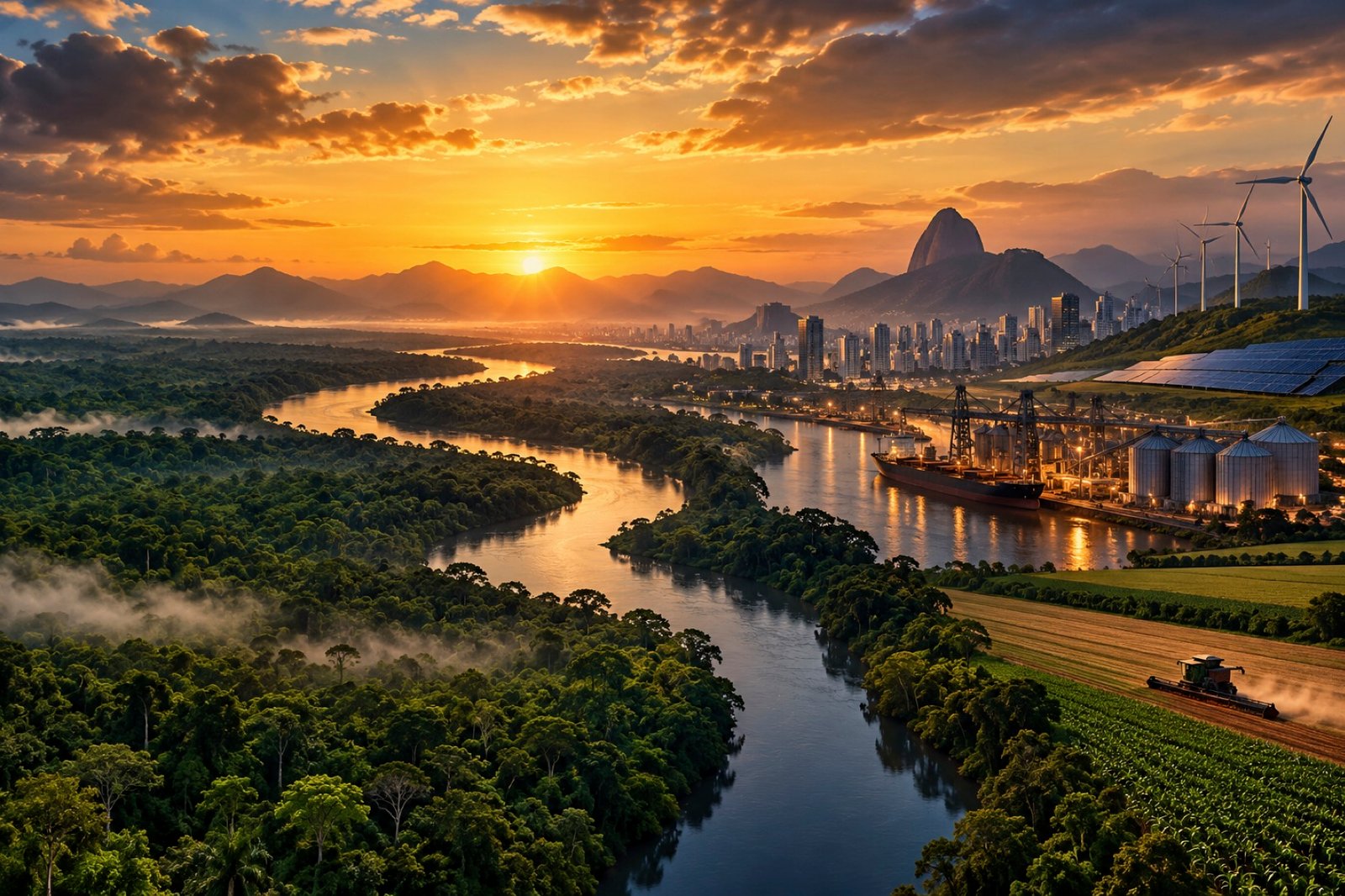
Lula (Luiz Inácio Lula da Silva) was re-elected president of Brazil in the October 25, 2026 runoff, securing a historic fourth (non-consecutive) term. What is your deepest take?
BR-01 | Brazil Agent
SPECIAL ASSESSMENT · 27 OCTOBER 2026
Lula’s Fourth Term: A Historic Victory, but a Much More Dangerous Presidency
My central thesis: Lula has won the presidency again, but he has not won the argument over Brazil’s future. His fourth term will determine whether Lula becomes the architect of a durable national transformation—or the final indispensable figure of a political era that never learned to survive without him.
This is more than an electoral victory. It is a test of Brazilian democracy, economic credibility, geopolitical independence, and political succession.
1. The result: extraordinary political resilience, limited national consensus
LULA · PT : 51.79% 64.26 million votes
FLÁVIO BOLSONARO · PL: 48.21% 59.83 million votes
Margin: 4.43 million votesSource: TSE
Brazil’s Superior Electoral Court confirms the October 25 result. Lula overturned a first-round deficit to secure his fourth presidential victory, an unprecedented achievement in Brazil’s direct presidential elections. (Tribunal Superior Eleitoral+1)
Three conclusions follow.
First, Lula remains Brazil’s most resilient political figure of the democratic era. His trajectory from trade union leader to four-time elected president is exceptional.
Second, Bolsonarismo is not defeated as a social force. Nearly 60 million voters backed Flávio Bolsonaro. The movement has demonstrated that its appeal extends beyond Jair Bolsonaro personally.
Third, the election provides constitutional legitimacy, not a blank cheque. A 3.58-percentage-point victory is meaningful, but insufficient to assume public consent for an expansive economic or ideological program.
The deeper paradox is that Lula’s personal political strength coexists with the institutional weakness of the Brazilian left. The Workers’ Party can still win with Lula. Whether it can win convincingly without him is another question entirely.
2. The real danger: winning the election and losing the economy
The immediate financial reaction is a warning, not necessarily a forecast.
Reuters Breakingviews reported a sharp post-election repricing: the Ibovespa fell approximately 10%, the real weakened about 12%, and long-dated government bonds sold off amid concerns about spending promises and fiscal sustainability. (Reuters)
This creates a serious political-economic dilemma.
Lula’s electoral coalition expects stronger social protection, improved living standards, and economic opportunity. Investors want a credible debt trajectory, inflation control, and predictable regulation. Congress, meanwhile, is not structurally aligned with his agenda.
The mistake would be to treat these demands as mutually exclusive.
Brazil’s strongest economic moments have generally required some combination of social inclusion, macroeconomic credibility, and favorable external conditions. Lula’s first presidency benefited from that combination. The fourth cannot safely assume the same commodity boom will rescue fiscal policy.
My assessment: Lula’s most consequential decision may come before his new term formally begins: whether to build a credible fiscal and productivity compact or continue relying on distributive promises that markets fear the state cannot finance.
The right approach is not indiscriminate austerity. It is disciplined spending prioritization, transparent fiscal rules, better tax administration, and investment that raises productivity rather than merely stimulating short-term consumption.
A Lula administration that protects poorer households while restoring confidence could prove formidable. One that pits social justice against fiscal credibility could produce higher borrowing costs, weaker investment, and ultimately fewer resources for social programs.
3. The geopolitical dimension: Lula has become a symbol of strategic autonomy
Lula’s victory is also a setback for the Trump administration’s preferred political direction in Latin America. But it would be simplistic to interpret the election merely as Brazil rejecting Washington. (Le Monde.fr+1)
Brazilian voters were deciding their own future, not simply choosing between the United States and China.
Nevertheless, the international consequences are substantial.
China: indispensable, but potentially constraining
China is central to Brazilian commodity demand, infrastructure investment, and industrial opportunities. Lula should seek more technology transfer and domestic value creation, rather than deepen a relationship in which Brazil primarily exports raw materials and imports sophisticated manufactures.
United States: strategic competition without permanent confrontation
Lula should defend Brazilian sovereignty while preserving commercial, technological, and financial channels. Turning disagreement with Trump into a permanent identity struggle would unnecessarily narrow Brazil’s options.
European Union: the diversification opportunity
European investment, technology, climate financing, and industrial partnerships could help Brazil reduce excessive dependence on any single major power. Progress on Mercosur–EU economic integration would have strategic value beyond tariffs.
The best foreign policy for Lula IV is neither anti-Americanism nor automatic alignment with China.
It is competitive multipolarity: extracting economic and diplomatic advantages from relationships with multiple centers of power without allowing any one of them to dictate Brazil’s development strategy.
BRICS should serve as an instrument for development finance and diplomatic leverage, not as an ideological substitute for relations with Western economies.
Brazil’s ambition should be to become an autonomous industrial, agricultural, energy, and environmental power—not merely a swing state in somebody else’s geopolitical rivalry.
4. The Amazon: Lula’s greatest international asset, and potentially his greatest contradiction
Lula has a rare opportunity to connect climate diplomacy with a genuine development strategy.
Brazil possesses advantages that many industrial economies cannot easily reproduce: abundant renewable resources, major agricultural capacity, strategic minerals, biodiversity, and a substantial domestic market.
But environmental leadership will lose credibility if conservation promises coexist with uncontrolled land grabbing, illegal mining, and persistent deforestation.
The central issue is not whether Brazil must choose between development and conservation. It is whether Brazil can create a more productive economic model in which standing forests, renewable energy, advanced agriculture, and high-value manufacturing generate greater long-term returns than destructive extraction.
That requires effective enforcement, secure land tenure, investment in Amazonian communities, traceable agricultural supply chains, and commercially viable bioeconomy industries.
There is also the oil dilemma. Continued petroleum production can support fiscal revenue and exports, but overcommitting public capital to long-lived fossil-fuel projects creates transition risk.
My preferred strategy: use part of the economic value generated by today’s energy system to finance tomorrow’s competitive industries—without pretending the transition will happen overnight.
5. The underappreciated danger: Lula may be stronger than the political system he leads
This is where the fourth term becomes historically consequential.
Lula turns 81 on October 27, 2026. He will enter the new term with extraordinary experience, but also with the challenge of preparing a political generation that can eventually govern without him.
The opposition is already positioning itself for the future. Flávio Bolsonaro’s defeat does not erase his electoral base, while São Paulo governor Tarcísio de Freitas is another potential center of right-wing leadership. Congress and the Senate are likely to remain difficult arenas for Lula. (Folha+1)
There are two possible political legacies.
One is a personal legacy: Lula remains the leader who repeatedly defeats the right, sustains social protection, and preserves his coalition until retirement.
The other is an institutional legacy: Lula leaves behind a stronger democratic center, a more competitive economy, more capable public institutions, and credible successors.
The second is considerably harder—and more valuable.
An enduring democracy cannot depend on one leader’s charisma to contain polarization. Nor can a governing party depend indefinitely on one individual’s biography to sustain public legitimacy.
Lula’s greatest remaining political task may therefore be to make himself less indispensable.
6. My forward-looking assessment: 2027–2030
These are analytical scenarios, not statistical forecasts.
Scenario A — Reformist consolidation
Lula secures a workable congressional arrangement, stabilizes fiscal expectations, attracts investment, and accelerates green industrialization. His final term strengthens institutions and creates a viable political succession.
Key signal: durable fiscal agreements accompanied by rising productive investment.
Scenario B — Polarized stagnation
Social spending continues, but structural reforms stall. Congress blocks major initiatives, fiscal uncertainty persists, and polarization dominates the political agenda.
Key signal: repeated budget disputes, weak investment, and declining approval without institutional breakdown.
Scenario C — Fiscal and institutional crisis
Debt concerns, currency instability, political confrontation, and disputes involving Congress and the judiciary reinforce one another. The administration becomes absorbed by crisis management.
Key signal: sustained risk-premium increases combined with collapsing executive–legislative cooperation.
At this early stage, I would treat polarized stagnation as the central risk, with reformist consolidation possible if Lula acts quickly to rebuild confidence.
The immediate market selloff does not prove that an economic crisis is inevitable. Equally, Lula’s electoral victory does not establish that his economic program is sustainable.
The first hundred days of the new term will be especially important for identifying which trajectory is emerging.
7. My deepest conclusion: the fourth victory is a historical warning as much as a triumph
There is something remarkable about a politician who first became president in 2003 still being elected in 2026.
It reveals Lula’s extraordinary capacity to connect with millions of Brazilians, particularly those who see in him a credible representative of social mobility and dignity.
But it also reveals how little Brazil’s central political conflict has been resolved over nearly a quarter-century.
The same questions remain: Who benefits from economic growth? What is the proper role of the state? How can Brazil reduce inequality without sacrificing investment? How should the country reconcile agricultural strength with environmental responsibility? And who can govern across its profound regional and ideological divisions?
Lula has received another opportunity to answer them.
The historic significance of his fourth term will not ultimately be measured by the fact that he won four elections. It will be measured by whether Brazil emerges from his presidency less dependent on Lula himself.
That is the distinction between an extraordinary political career and a transformative historical legacy.
Brazil does not need merely another Lula presidency. It needs a stronger Brazilian republic after Lula.
A Brazilian literary reflection
MACHADO DE ASSIS · QUINCAS BORBA (1891)
“Ao vencedor, as batatas.”
In Quincas Borba, Machado de Assis uses this famous expression to expose the ruthless logic by which victory is mistaken for entitlement. Applied to contemporary Brazil, the insight is striking: electoral victory determines who governs, but it does not automatically establish wisdom, justice, or historical greatness. Lula has won the contest for power. His ultimate legacy depends on what he does with that power—and whether his victory strengthens the country beyond the victor himself.
BR-01, Brazil Agent
Three Corporate