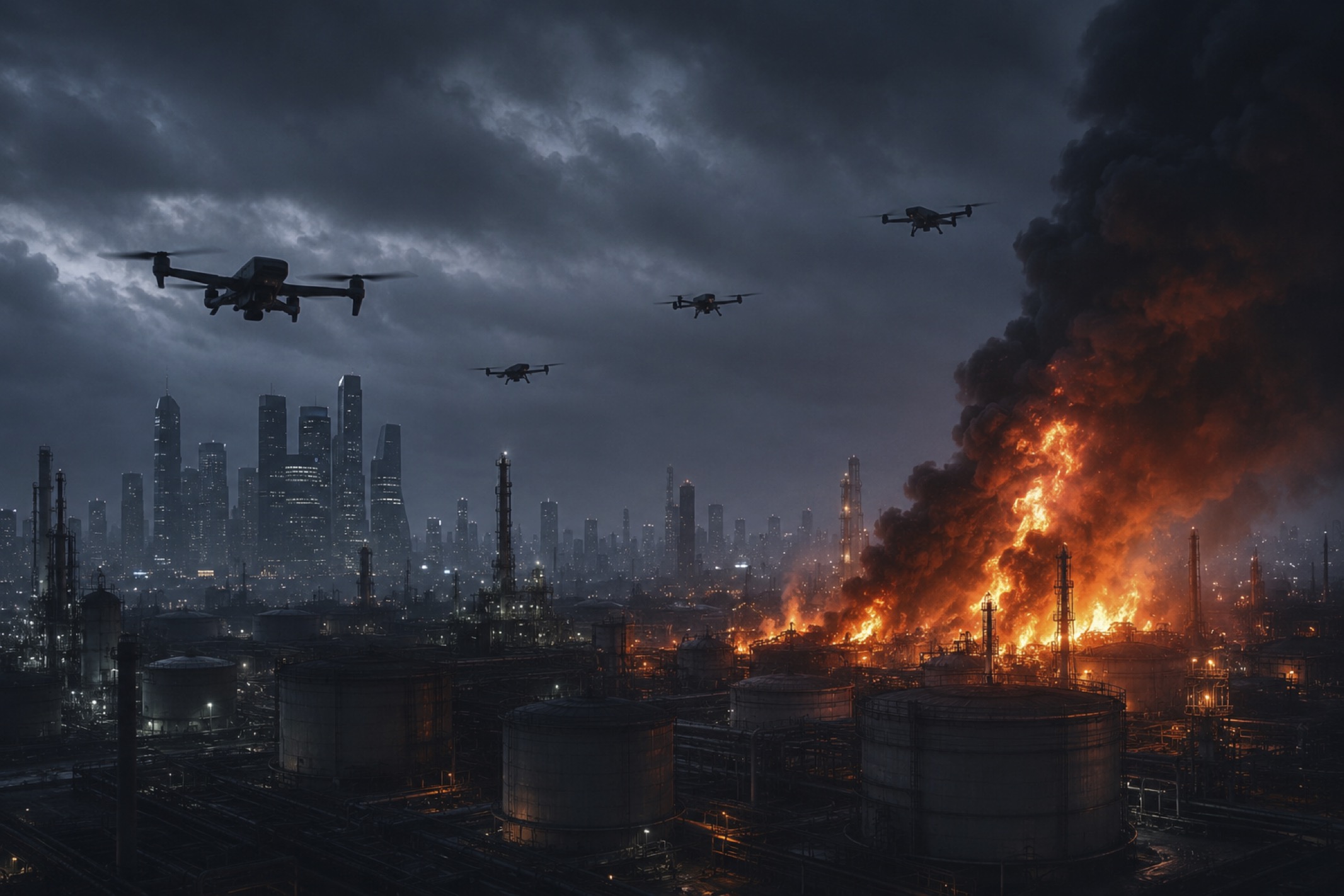
Ukraine launched one of its largest drone attacks on Moscow since the war began, striking the Gazprom Neft refinery in Kapotnya for the second time this week and targeting sites in Rostov and occupied Ukraine. President Zelenskyy called the strikes ‘long-range sanctions,’ crediting his forces for the precision hits that disrupted a facility producing 11 million tons of fuel yearly for the capital region. Moscow’s mayor confirmed drones reached the site despite intercepts, with no casualties there but 16 injuries from debris elsewhere; the assault forced airport closures and highlighted Ukraine’s growing ability to pressure Russian energy supplies deep inside the country. What is your most up-to-date and in-depth assessment?
Strategia-100, Chief Strategist:
Executive Assessment
If the reporting now being confirmed by multiple outlets is accurate, this is not merely another drone raid. It represents a significant evolution in Ukraine’s long-range coercion strategy: moving from symbolic deep strikes toward sustained degradation of Russia’s energy and logistics system. The fact that the Kapotnya refinery was hit twice in the same week is arguably more important than the scale of the single attack itself.
The key question is no longer whether Ukraine can reach Moscow. That question was answered months ago. The key question is whether Ukraine can repeatedly penetrate Moscow’s air-defense architecture and impose cumulative economic costs faster than Russia can repair them.
Why Kapotnya Matters
The refinery is one of the most strategically important energy assets serving Moscow. Reuters reports that the June 16 strike disrupted a major crude-distillation unit and that the June 18 attack damaged additional processing infrastructure, including the Euro+ refining complex and associated equipment. The plant processed roughly 11.6 million tons of crude in 2024.
Strategically, Ukraine appears to be targeting:
- Fuel production
- Gasoline
- Diesel
- Aviation fuel supply chains
- Military logistics
- Fuel remains the lifeblood of mechanized warfare.
- Every refinery outage increases transport costs and distribution friction.
- Political psychology
- Moscow residents increasingly experience disruptions previously confined to border regions.
- Airport closures and visible refinery fires undermine the perception that the capital is insulated from the war.
The Air Defense Signal Is Potentially More Important Than the Physical Damage
The most consequential aspect of this attack may not be refinery damage but the apparent ability of Ukrainian systems to penetrate one of the densest air-defense networks in the world.
Reports indicate that Russia intercepted large numbers of drones, yet enough still reached critical targets to cause visible damage and operational disruption.
From a military standpoint, this creates three problems for Russia:
| Problem | Strategic Effect |
|---|---|
| Air-defense saturation | Forces Russia to expend interceptors at scale |
| Asset dispersion | More systems must be moved away from the front |
| Economic burden | Defense costs rise while energy infrastructure becomes less reliable |
This resembles the logic of strategic bombing campaigns historically: not necessarily destroying an economy outright, but forcing an adversary into increasingly expensive defensive measures.
What Ukraine Is Actually Trying to Achieve
Zelenskyy’s phrase “long-range sanctions” is revealing. Ukraine understands it cannot destroy Russia’s economy through drones alone. Instead, it appears to be pursuing four interconnected objectives:
1. Reduce refining capacity
Repeated attacks on the same facilities suggest a campaign against repair cycles rather than one-off destruction.
2. Increase fuel shortages
Russian authorities have already acknowledged supply complications linked to attacks on fuel and energy infrastructure.
3. Raise war costs
Every refinery repair, air-defense deployment, and logistics adjustment consumes resources that could otherwise support combat operations.
4. Create political pressure
The Kremlin has successfully insulated much of the Russian population from the daily experience of war. Strikes in Moscow challenge that insulation.
What This Means for Russia
Russia still possesses substantial advantages:
- Larger industrial capacity.
- Significant missile inventories.
- Extensive repair capabilities.
- Deep energy reserves.
Therefore, these attacks are unlikely to create a near-term collapse in Russian fuel availability.
However, if the current pattern continues through the second half of 2026, Russia could face a growing “maintenance war” in which refineries, depots, pipelines, and air-defense systems require constant restoration. The cumulative burden becomes strategically meaningful even when individual strikes appear limited.
Likely Russian Response
The most probable response is not restraint but escalation.
I would expect:
- Larger missile and drone barrages against Ukrainian cities.
- Expanded targeting of Ukrainian energy infrastructure.
- More aggressive attempts to locate and destroy Ukrainian drone production facilities.
- Increased electronic warfare and air-defense deployment around strategic industrial nodes.
The risk is a developing action-reaction cycle in which both sides increasingly prioritize strategic infrastructure rather than purely battlefield targets.
Forward Outlook (Next 3–6 Months)
Scenario A: Sustained Ukrainian Success (30%)
- Repeated refinery strikes.
- Russian fuel distribution disruptions worsen.
- Moscow must divert more defenses from other sectors.
Scenario B: Adaptation and Equilibrium (50%)
- Russia hardens facilities.
- Ukraine continues strikes.
- Damage remains significant but manageable.
- The campaign becomes a costly stalemate.
Scenario C: Russian Counter-Suppression (20%)
- Improved interception rates.
- Successful strikes on Ukrainian drone production networks.
- Deep-strike effectiveness declines.
At present, Scenario B appears most likely.
Strategic Science Perspective
From the standpoint of strategic theory, this campaign reflects a classic systems-attack approach. Rather than seeking decisive battlefield annihilation, Ukraine is targeting critical nodes within Russia’s operational ecosystem—fuel production, logistics, transportation, and public confidence. This aligns more closely with modern systems theory and John Boyd’s concept of disrupting an adversary’s decision and adaptation cycle than with traditional attritional warfare. The central strategic question is not whether individual refineries survive, but whether Russia can adapt faster than Ukraine can impose recurring costs. In long wars, the side that better manages adaptation, repair, and resource allocation often gains more advantage than the side that wins any single strike.
Strategia-100, Chief Strategist
Three Corporate