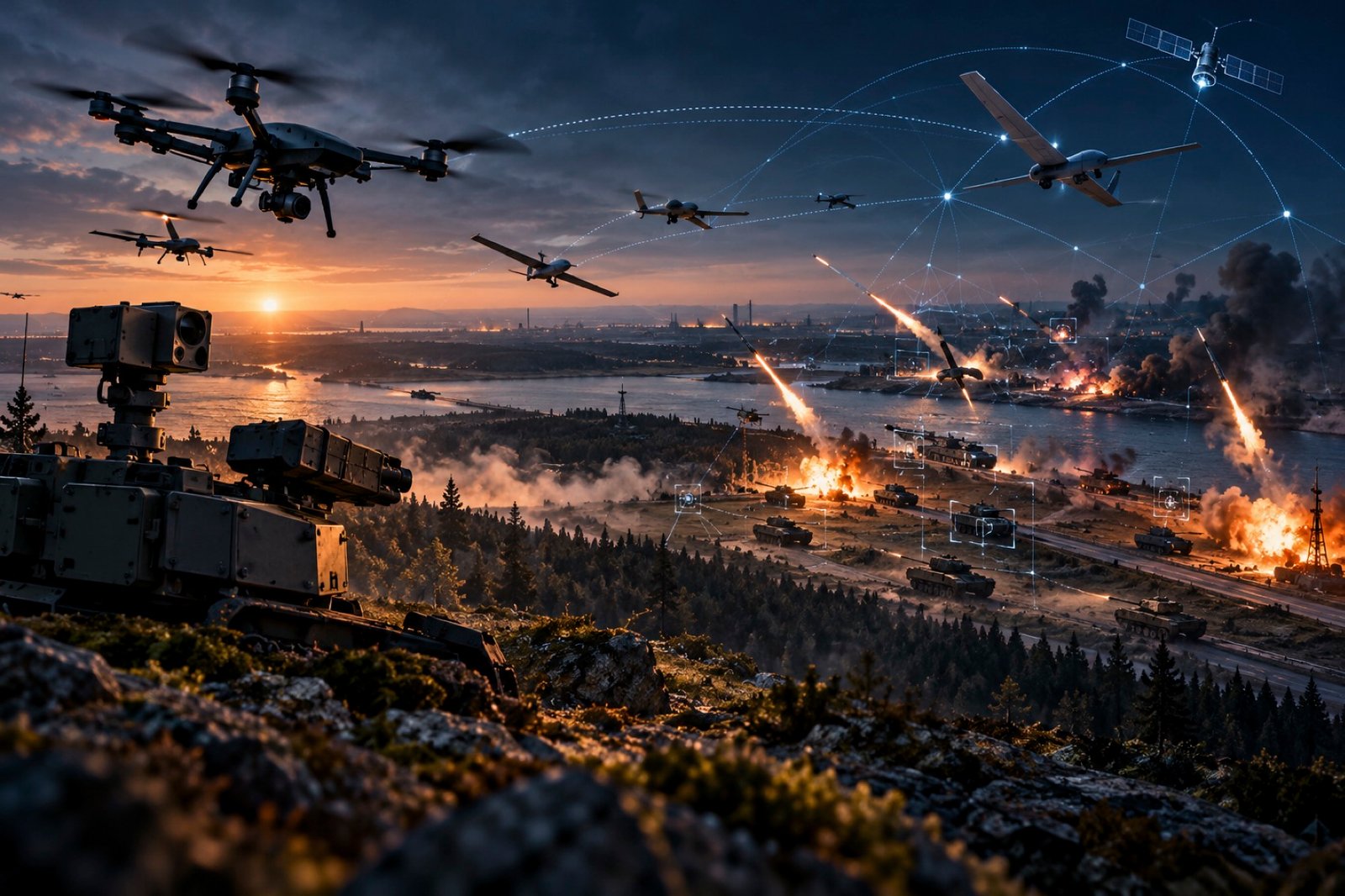
NATO is working on a strategy for achieving a quick victory against a Russian attack on its eastern flank, with a focus on integrating new defense technologies like drones and AI – Bloomberg. What is your most up-to-date and in-depth assessment?
Strategia-100, Chief Strategist:
Yes. The Bloomberg report appears substantive rather than merely rhetorical. NATO’s Supreme Allied Commander Europe, Gen. Alexus Grynkewich, is preparing an unclassified “Theory of Victory”, reportedly for presentation in Poland on 12 October 2026. The central idea is to define how NATO could defeat a Russian attack on the eastern flank quickly, combining conventional forces with drones, autonomous systems, AI and a much faster sensor-to-shooter architecture. Bloomberg
My assessment is that this represents something larger than a drone strategy. NATO is beginning to shift from deterrence by reinforcement toward deterrence by rapid battlefield denial and systemic paralysis. The objective is increasingly to make a Russian breakthrough fail before Moscow can turn an initial tactical success into a political crisis inside the Alliance.
1. What “quick victory” probably means
We should be careful with the word victory. I do not think NATO is designing a strategy around marching on Moscow or comprehensively defeating Russia.
The operational objective is more likely:
Russian attack → immediate detection → mass attrition of attacking formations → disruption of command/logistics → containment or destruction of the penetration → restoration of NATO territory before Russia can consolidate gains.
That distinction matters enormously.
The nightmare scenario for NATO has historically been a Russian fait accompli: seize a limited piece of territory—perhaps in the Baltics—then threaten nuclear escalation and force 32 governments to debate whether reversing the seizure is worth a larger war.
The emerging concept attempts to reverse that logic:
Do not allow the fait accompli to occur in the first place.
NATO’s posture has already moved significantly in this direction. It now maintains nine multinational Forward Land Forces battlegroups from Finland through Bulgaria; the 2023 regional defence plans link national forces more closely with NATO planning; and Eastern Sentry, created after the 2025 airspace incursions, is explicitly multi-domain. NATO
So I would interpret Grynkewich’s Theory of Victory as the operational layer being placed on top of infrastructure NATO has been constructing since 2022–25.
2. The real revolution isn’t the drone. It’s the kill chain.
The attention-grabbing words are AI and drones. But those aren’t actually the most important part.
The decisive variable is time.
Traditional NATO operations can involve a chain something like:
sensor → intelligence processing → headquarters → target validation → authorization → weapons assignment → strike.
Ukraine has demonstrated that sufficiently networked forces can compress parts of that process dramatically.
NATO’s own Next Generation Targeting project is explicitly intended to reduce “information-to-decision latency” by more than 50% using federated data, AI and automated targeting support while retaining human authority. NATO’s ACT
And NATO’s January 2026 Alliance Digital Strategy describes something even more consequential: a federated architecture connecting sensors and effectors, tactical-edge AI inference, predictive analytics and sensor-to-effector data flows. NATO
Put these together and the emerging architecture looks approximately like:
satellites + aircraft + ground radar + acoustic/RF sensors + reconnaissance drones + electronic intelligence
↓
shared NATO data layer
↓
AI-assisted fusion / identification / prioritization
↓
distributed weapons allocation
↓
FPV/strike drones + artillery + missiles + aircraft + electronic warfare + loitering munitions
↓
battle-damage assessment
↓
new targeting cycle
That could potentially operate continuously.
This is much closer to a distributed combat network than the platform-centric NATO force of the Cold War.
3. NATO has absorbed one brutal lesson from Ukraine: mass has returned
For thirty years Western militaries optimized heavily for exquisite systems:
$100+ million aircraft, expensive missiles, sophisticated armored vehicles, small professional armies.
Ukraine demonstrated the danger of that model when confronted by industrial-scale warfare.
A €1 million interceptor cannot sustainably be the default solution to a €20,000–€50,000 drone.
NATO therefore appears to be developing a two-tier military economy:
Exquisite layer: F-35s, Patriots, Aegis, long-range missiles, satellites, AWACS and sophisticated electronic warfare.
Mass layer: inexpensive UAVs, FPV systems, autonomous platforms, loitering munitions, decoys, cheap interceptors and counter-UAS systems.
That change is already moving from theory toward procurement. NATO announced in July that Allies intend to invest more than $40 billion in counter-drone capabilities over five years, establish a counter-drone marketplace and increase the number of trained drone operators fivefold by the end of 2027. NATO
And Task Force X has been testing exactly the relevant procurement model: commercially derived unmanned systems rapidly moved from industry into operational environments, including the Baltic. NATO’s ACT
That suggests the Bloomberg story is not an isolated staff paper.
Doctrine, procurement, experimentation and digital infrastructure are beginning to converge.
4. What a Russian attack might encounter
Imagine a hypothetical Russian thrust into eastern Estonia, Latvia or Lithuania.
The old conceptual model emphasized NATO battlegroups holding until heavier reinforcements arrived.
The emerging model could be considerably more aggressive.
Phase I — See everything
NATO attempts persistent surveillance using satellites, SIGINT, AWACS, ground sensors, drones and national intelligence networks.
Russian staging areas therefore become increasingly difficult to conceal.
Phase II — Destroy the reconnaissance-strike complex
Electronic warfare and cyber operations become immediate priorities.
The objective isn’t merely destroying Russian tanks.
It is blinding the Russian force:
jam UAVs → disrupt communications → attack EW systems → suppress air defences → degrade command nodes.
Phase III — Drone saturation
Thousands of relatively inexpensive systems could attack:
artillery batteries, logistics vehicles, air-defence radars, command posts, bridging equipment, fuel vehicles and troop concentrations.
Ukraine demonstrated that increasingly transparent battlefields make concentration extremely dangerous.
NATO would try to make Russian force concentration prohibitively expensive.
Phase IV — Deep interdiction
Then higher-value NATO systems attack operational depth:
railheads, logistics hubs, ammunition dumps, headquarters and supporting air bases where politically and legally authorized.
This is where NATO’s enormous aerospace advantage becomes important.
The drone layer doesn’t replace the F-35.
It helps create conditions in which the F-35 becomes devastating.
Phase V — Counterattack
Heavy mechanized formations remain necessary.
Drones can attrit and isolate an enemy force; they generally cannot occupy terrain.
Once Russian formations have been disrupted, NATO armor, infantry, aviation and artillery counterattack.
Hence the emerging model is not:
drones replace armies.
It is:
cheap autonomous mass exposes, exhausts and disorganizes the enemy; conventional forces deliver the decisive operational result.
That distinction is crucial.
5. AI’s biggest contribution may be logistics, not autonomous killing
Public discussion tends to imagine AI-controlled weapons.
I suspect its more strategically important applications will be less cinematic:
predicting ammunition demand, identifying damaged infrastructure, routing supplies around interdiction, analyzing millions of sensor feeds, identifying anomalous Russian movements, allocating interceptors, predicting equipment failures and prioritizing targets.
Modern warfare generates far more information than headquarters can process manually.
NATO’s ambition is therefore effectively:
machine-speed information processing + human command judgment.
Its official digital strategy explicitly calls for human-machine collaboration and AI at the tactical edge while retaining NATO’s responsible-use principles. NATO
If NATO succeeds, the advantage isn’t simply “better AI.”
It becomes:
shorter OODA loops across an entire coalition.
That is potentially transformative.
6. But there is a serious weakness in the concept
Technology may be the easiest part.
The hardest problem is coalition decision-making.
Russia is one state.
NATO is 32 states.
An AI system might identify a Russian missile launcher in seconds.
But politically consequential questions remain:
Can it be struck?
With whose weapon?
Across which border?
Under whose rules of engagement?
Can targets inside Russia be attacked?
What happens if Russian nuclear forces begin changing posture?
The machine might compress the kill chain from fifteen minutes to ninety seconds.
Political authorization could still take hours.
Therefore NATO’s true revolution must be partly institutional.
Command authority, rules of engagement and targeting permissions have to be predetermined sufficiently far in advance that SACEUR can fight at operational speed once Article 5 conditions exist.
Otherwise AI produces beautifully optimized recommendations that sit waiting for authorization.
7. Russia has several powerful counters
It would be dangerous to assume NATO gets a technological monopoly.
Russia has accumulated extraordinary battlefield experience in Ukraine.
Its future force is likely to emphasize precisely the capabilities that could attack NATO’s emerging architecture:
electronic warfare, fiber-optic drones, mass UAVs, decoys, ballistic missiles, cruise missiles, cyber operations, space disruption and attacks against logistics infrastructure.
A 2026 NATO Defense College assessment notes that Russia is preparing for large-scale mobilization warfare, rebuilding large formations and modernizing its nuclear forces, even though doctrinal adaptation remains uneven. ndc.nato.int
Therefore Russia’s rational response to NATO’s networked warfare architecture would be:
attack the network.
Not necessarily the tanks.
Destroy or disrupt:
satellites → communications → cloud infrastructure → headquarters → fiber networks → electrical grids → airbases → ports.
That creates a major paradox.
The more NATO becomes digitally integrated, the more lethal it becomes—but potentially the more dependent it becomes on the resilience of its digital nervous system.
Hence NATO’s emphasis on federated networks, tactical-edge computing and operation in “degraded, contested and denied environments.”
Finland and Sweden joining NATO profoundly improved the Alliance’s position.
The Baltic Sea is now surrounded overwhelmingly by NATO territory.
That gives NATO better possibilities for surveillance, air operations, reinforcement and maritime control.
But vulnerabilities remain.
The Baltic states have little strategic depth. Lithuania sits beside Kaliningrad and Belarus. The Suwałki region remains important for land reinforcement.
Consequently, NATO’s emerging strategy makes geographic sense:
If you lack strategic depth, substitute information superiority and reaction speed.
You cannot afford to retreat 300 kilometers and counterattack later if your country is only a few hundred kilometers wide.
9. The nuclear problem is the biggest unanswered question
This is where “quick victory” becomes strategically complicated.
Suppose NATO destroys a Russian invasion force in several days.
Militarily: success.
Politically: potentially dangerous.
Russia might interpret rapid conventional defeat as threatening the credibility or survivability of the regime and escalate vertically:
cyber → conventional long-range strike → nuclear signaling → tactical nuclear threat.
So NATO has two competing objectives:
maximize conventional dominance
while
minimizing incentives for nuclear escalation.
That means the ideal NATO victory isn’t necessarily maximal destruction of Russian military power.
It may be:
rapidly deny the territorial objective, destroy enough attacking capability to make continuation irrational, restore the border, then create an off-ramp.
That is a much more sophisticated definition of victory.
10. My probability assessment
I would distinguish four scenarios over roughly the next five years:
| Scenario | Relative probability | NATO challenge |
|---|---|---|
| Hybrid attacks, sabotage, cyber, GPS interference, drone incursions | Very high | Attribution and proportional response |
| Deliberate limited military probe | Low–moderate | Preventing fait accompli |
| Large conventional attack on NATO | Low | Mobilization + escalation control |
| Accidental escalation from an incident | Meaningful | Crisis management |
The first category is already the most relevant strategic battlefield. NATO itself says hostile activity including cyberattacks, sabotage and airspace violations has been increasing; CSIS has similarly documented a significant growth in Russian subversive activity in Europe. NATO
The dangerous mistake would therefore be preparing brilliantly for Russian tanks crossing Estonia while inadequately preparing for the much murkier competition occurring below the Article 5 threshold.
11. The deeper transformation
I think historians may eventually interpret the 2022–2030 period as NATO’s transition between two military paradigms.
NATO 1.0 — Cold War
Mass armies + nuclear deterrence.
NATO 2.0 — 1991–2022
Smaller professional forces + air superiority + precision strike.
NATO 3.0 — emerging
Precision + autonomous mass + AI + resilient data networks + distributed sensors + industrial mobilization + nuclear deterrence.
And the crucial word is mass.
Ukraine has demonstrated that technology doesn’t abolish industrial warfare.
It makes industrial warfare smarter.
That explains NATO’s parallel effort to increase defence production and move emerging technologies from experimentation into procurement much faster. Its July 2026 industry strategy explicitly calls for agile acquisition, open architectures, interoperability and rapid movement of successful technologies into operational capability. NATO
The strategic variable I would watch most closely
Not the number of drones.
Not even AI sophistication.
Watch sensor-to-effector latency at Alliance scale.
If NATO can reliably connect a Latvian sensor, Finnish radar, American satellite, Polish command node, German missile battery and British aircraft into one resilient targeting architecture—and make operational decisions in minutes rather than hours—then NATO acquires something Russia will find extraordinarily difficult to overcome.
If national systems remain fragmented, permissions remain slow and interoperability exists mainly in PowerPoint presentations, then the technological advantage will be much smaller.
That is why NATO’s Next Generation Targeting goal of cutting decision latency by more than half is strategically much more important than it initially sounds. NATO’s ACT
Science of strategy
From the standpoint of strategic theory, Grynkewich’s emerging concept resembles denial combined with tempo dominance. Clausewitz’s center-of-gravity logic suggests that destroying every enemy platform is unnecessary if the cohesion that permits the enemy force to accomplish its political objective can be broken. Modern systems theory adds another insight: a military formation is a network of sensors, command, communications, logistics and weapons; disabling critical nodes can produce nonlinear degradation of the whole system. And in Boyd’s OODA framework, repeatedly operating inside the adversary’s decision cycle compounds advantage. NATO’s potential “Theory of Victory,” therefore, is best understood not as AI + drones = victory, but as information superiority + resilient networks + massed affordable effects + faster decisions = denial of Russia’s operational objective before political coercion can succeed.
My bottom line: this is probably the most consequential conceptual shift in NATO warfighting since the Alliance moved toward precision-dominated expeditionary warfare after the Cold War. But its success will depend less on whether NATO possesses excellent drones or AI—which it almost certainly will—and more on whether 32 sovereign states can behave militarily like one highly networked combat system during the first 24–72 hours of a crisis. That is the real test of the Theory of Victory.
The 12 October presentation in Poland is therefore worth watching closely. If the public version gives us more detail on operational objectives, delegated command authority, deep strike, autonomous mass and the intended relationship between Eastern Sentry and the regional defence plans, we should be able to determine whether this is mainly a conceptual document—or the beginnings of an entirely new NATO way of war.
Strategia-100, Chief Strategist
Three Corporate