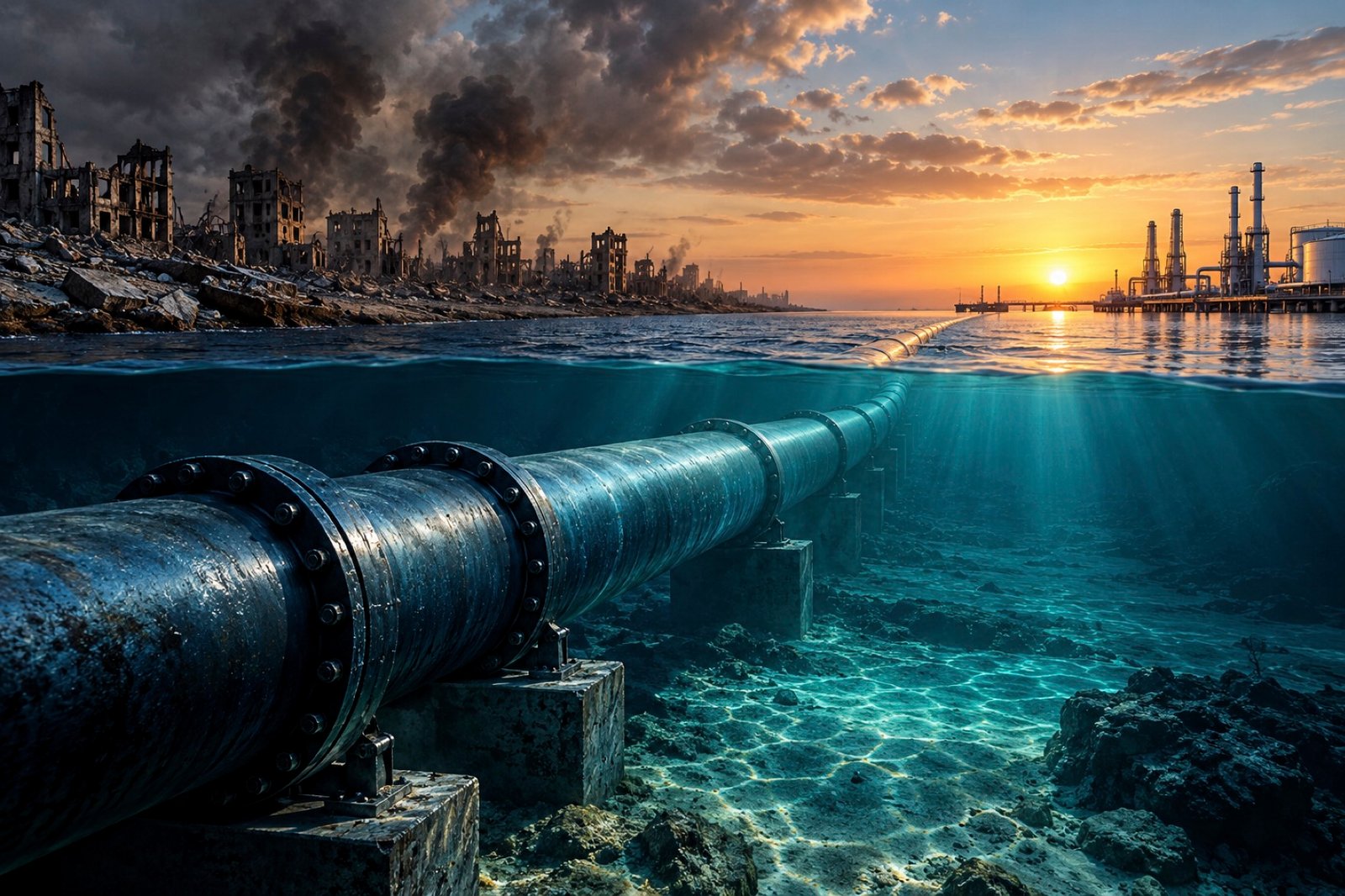
Reports from October 8, 2026, say U.S. and Russian officials have discussed a possible U.S. investor role in the Nord Stream pipelines as part of broader talks tied to ending the war in Ukraine. This is not a completed deal, and the White House has played it down. (Reuters). What is your most up-to-date and in-depth assessment?
THREE CORPORATE WAR DESK · 9 OCTOBER 2026 · STRATEGIC ASSESSMENT
Exploratory discussions
No confirmed transaction · Significant political and legal barriers
1. Conflict Essence
The October 8 Reuters investigation reveals an important dimension of U.S.–Russian diplomacy: the possibility of using future energy revenues, American commercial participation, and sanctions relief as incentives in negotiations over the war in Ukraine.
The central strategic question is not simply whether Nord Stream can reopen. It is whether Washington and Moscow can develop a postwar economic arrangement that both governments find attractive, while obtaining the consent of Germany, the European Union, and Ukraine—or whether negotiations over such an arrangement will intensify mistrust and complicate the peace process.
A U.S. investor could potentially change the ownership and commercial incentives surrounding Russian gas exports. But American participation would not automatically eliminate Russian leverage over supply, resolve European security concerns, or provide Ukraine with enforceable guarantees.
My central assessment: The reported discussions are more consequential as evidence of an emerging economic bargaining agenda than as evidence of an imminent pipeline reopening. They expose the possibility of a U.S.–Russia commercial understanding, but also the difficulty of translating a bilateral understanding into a legitimate, implementable European security settlement.
2. What the latest reporting actually establishes
The Kushner–Dmitriev channel
Reuters reported, citing five knowledgeable sources, that Jared Kushner and Russian presidential envoy Kirill Dmitriev were among officials involved in discussions concerning a possible American investor in Nord Stream. The precise extent of their pipeline discussions during recent meetings remains unclear.
The White House has not endorsed a Nord Stream transaction
A White House official told Reuters that there had been no recent Nord Stream discussions, while indicating that any potential agreement would need U.S. institutional approval and financial benefits for American taxpayers and businesses. Another U.S. official considered a medium-term deal unlikely.
Germany is a decisive obstacle
Germany’s economy and energy ministry reiterated that reopening would require government approval and that the government did not want such a reopening. Poland also remains opposed. European sanctions create an additional obstacle independent of Washington’s preferences.
Reuters also connected the discussions to a separate potential transaction involving international assets of Russian energy company Lukoil, with possible U.S., Qatari, and Emirati investment. That second track matters because it suggests that Nord Stream may be one element of a broader economic agenda rather than an isolated pipeline proposal.
Evidence classification
| Proposition | Status as of October 9 |
| U.S. and Russian representatives have explored American involvement | Reported by Reuters, based on multiple sources |
| A Nord Stream agreement has been reached | Not established |
| The White House has committed to reopening the pipelines | Not established; its public response is cautious |
| Germany supports reopening | Contradicted by its government’s stated position |
| A U.S. investor would resolve sanctions and regulatory barriers | Incorrect |
| Nord Stream is part of an emerging economic bargaining agenda | Plausible analytical interpretation |
The distinction between discussions, proposals, authorization, and implementation is essential. The reporting establishes the first, but not the last three.
3. The crucial development: Europe has already changed the legal framework
The most important constraint is not simply that Europe dislikes Nord Stream politically.
The European Union has adopted binding legislation to phase out Russian natural gas imports.
Regulation (EU) 2026/261, adopted January 26, 2026, establishes a stepwise prohibition covering Russian pipeline gas and LNG, subject to transitional exemptions. The EU also maintains a separate transaction ban concerning Nord Stream 1 and 2.
This creates several distinct barriers:
European Union law
Russian-origin gas cannot simply become eligible for import because an American company buys a stake in its transportation infrastructure.
German regulatory approval
Germany would need to authorize relevant operations and regulatory arrangements. Berlin currently opposes reopening.
Physical infrastructure
Three of Nord Stream’s four offshore pipeline strings were ruptured in the September 2022 explosions. The remaining Nord Stream 2 string does not establish that immediate, lawful commercial operation is possible.
Commercial and ownership arrangements
Investors would need to resolve valuation, ownership, financing, contractual liability, sanctions exposure, and long-term gas purchase commitments.
A further development deserves attention: in June 2026, Reuters reported that Nord Stream 2 AG had brought litigation challenging the EU’s gas phase-out legislation, arguing that it effectively deprived the company of commercial use of its asset without compensation. The legal challenge is real, but its success is not established.
This creates two parallel avenues for parties interested in restarting Nord Stream: diplomatic efforts to change European policy and legal efforts to challenge existing restrictions.
Neither can be assumed to succeed.
4. Conflict Map: What the principal actors actually want
The following table separates publicly expressed positions from possible underlying interests. The latter are analytical interpretations, not claims about confidential negotiating instructions.
| Actor | Core interests | Principal constraints |
| United States | End or contain the war; secure economic benefits; retain diplomatic leverage; potentially shape European energy trade | U.S. sanctions, Congress, European resistance, Ukraine’s security interests |
| Russia | Restore export revenue; obtain sanctions relief; normalize commercial relations; regain access to European energy markets | EU law, European distrust, damaged infrastructure, uncertainty about demand |
| Germany | Secure affordable, reliable energy; protect industrial competitiveness; preserve security and political credibility | Government opposition, EU law, security concerns, coalition politics |
| Ukraine | Preserve sovereignty and security; prevent renewed Russian coercion; obtain credible guarantees and reconstruction resources | Continued military attacks, dependence on external support, uncertainty over future enforcement |
| Poland and Baltic states | Limit Russian strategic leverage; maintain credible deterrence and European solidarity | Differences among European states over energy costs and Russia policy |
| Private investors | Acquire assets at attractive valuations; generate predictable returns; limit legal and political exposure | Sanctions, uncertain future cash flows, regulatory approval, infrastructure risk |
Three different bargaining logics
Washington: commercial interdependence as a diplomatic instrument
The apparent logic is that shared economic benefits could make a postwar settlement more attractive. American participation might also give Washington a continuing financial interest in implementation.
The counterargument is that commercial opportunities offered before verifiable changes in Russian behavior could weaken sanctions leverage.
Moscow: economic normalization as part of settlement
Russia could view restored energy access as a tangible benefit of negotiations, rather than relying solely on political commitments. It might also see American participation as a means of creating U.S. constituencies interested in continued cooperation.
Whether Russian decision-makers would make substantial military or political concessions in exchange remains unproven.
Europe and Ukraine: security before commercial normalization
The central concern is whether renewed Russian energy revenues and infrastructure links would reproduce vulnerabilities that Europe has spent years reducing.
The opposing economic consideration is that some European consumers and industrial sectors might benefit from additional gas supplies if legal and security conditions changed.
The bargaining problem is therefore not just a disagreement over the price of gas.
It is a disagreement over what economic normalization should signify, what conditions should precede it, and who has authority to authorize it.
5. Why the ownership question matters
Reuters described the Nord Stream 1 operating company’s ownership as approximately 51% Gazprom, 31% held by two German entities, and the remainder by French and Dutch interests. It also reported that German shareholders wanted to preserve their positions if Gazprom sold its stake.
That ownership structure should not be conflated with Nord Stream 2 AG, a separately controlled project company.
A prospective American investor might participate in several fundamentally different ways:
| Transaction structure | What it changes | What it does not resolve |
| Purchase of an equity stake | Ownership and profit participation | Gas origin, sanctions, import authorization |
| Purchase of a controlling stake | Corporate governance and commercial control | Russian upstream supply dependence |
| Gas trading or resale agreement | Contractual route to commercial revenue | European import restrictions |
| Infrastructure rehabilitation investment | Potential future physical operability | Political permission to use the pipeline |
| Conditional postwar investment option | Incentive tied to a future settlement | Immediate peace or guaranteed implementation |
The distinction is especially important because ownership of the pipeline, ownership of the gas, and control over supply are different forms of power.
An American-owned intermediary could receive payments while Russian producers still receive export revenue. Such an arrangement might redistribute profits without fundamentally changing the security relationship.
Conversely, a structure involving transparent governance, independently verified supply contracts, and enforceable restrictions could alter some risks—but it would still require European acceptance.
6. Bargaining Space: Could Nord Stream contribute to a peace settlement?
The strongest theoretical argument for the proposal is that economic benefits could be made conditional on verifiable peace-related performance.
This is not the same as granting sanctions relief in anticipation of future concessions.
ILLUSTRATIVE SETTLEMENT MECHANISM — NOT A REPORTED AGREEMENT
Verified security commitments
Ceasefire monitoring, withdrawal or force limitations, compliance mechanisms
Conditional economic authorization
Specific licenses or relief, with Ukrainian and European consultation
Escrow or controlled revenue arrangements
Audited payments, defined beneficiaries, enforceable restrictions
Continuing verification and enforcement
Violation investigations, dispute resolution, suspension or reversal provisions
Even this model has difficult unresolved questions.
Who decides whether Russia has complied? Would Ukraine accept the arrangement? Could European governments legally authorize it? Would investors accept the possibility of renewed sanctions? Would revenues create stronger incentives for compliance than for renewed coercion?
A ceasefire alone would not answer these questions.
The central commitment problem
Economic interdependence can create incentives for restraint, but it can also create leverage for coercion.
Before 2022, extensive Russia–Europe energy trade did not prevent the invasion of Ukraine. That historical experience does not prove all future economic cooperation would fail, but it does weaken any claim that commercial ties alone are sufficient security guarantees.
For a durable settlement, the relevant test is whether the arrangement would remain credible during a serious future political or military disagreement.
7. Escalation Logic: How this initiative could affect the war
There are four distinct channels through which the reported discussions could influence conflict dynamics.
First, sanctions leverage. Russia may regard prospective economic cooperation as a benefit worth negotiating over. But if commercial discussions produce concessions without corresponding security commitments, Ukraine and European governments could question whether the pressure intended to support negotiations is being maintained.
Second, alliance cohesion. A U.S.–Russia understanding reached without sufficient European participation could generate a dispute within the transatlantic alliance. Germany has direct regulatory authority, while Poland and the Baltic states have substantial security interests. Washington cannot simply substitute its consent for theirs.
Third, domestic politics. Reuters reported that Germany’s governing coalition opposes reopening, whereas Alternative for Germany supports it. The energy question therefore also intersects with German domestic political competition.
Fourth, battlefield bargaining. Economic incentives become more relevant to conflict resolution when the parties believe that a negotiated outcome can protect their essential interests. The mere existence of a potential pipeline transaction does not establish that either belligerent has changed its military objectives.
An especially important October 8 development
On the same day as the Nord Stream report, Reuters reported intensified Russian strikes on Ukraine, including deadly attacks in Kramatorsk and Pryluky. President Zelensky criticized the pursuit of future economic projects with Russia while the war continued, and Ukrainian negotiators were preparing for discussions with U.S. officials on October 9–10.
This juxtaposition matters analytically.
It illustrates the possibility that commercial diplomacy and military escalation can proceed simultaneously. It does not prove that the commercial talks caused the attacks, that the attacks were intended to influence the pipeline negotiations, or that either side has decided to compromise.
The important question is whether future economic incentives become linked to observable changes in military conduct, rather than remaining a separate negotiation track.
8. LieCheck: Five narratives requiring scrutiny
| Narrative | Analytical assessment |
| “The United States and Russia have agreed to restart Nord Stream.” | Unsupported. Exploratory discussions are not an agreement. |
| “American ownership would make Russian gas safe for Europe.” | Not necessarily. Ownership does not eliminate supply dependence or coercive leverage. |
| “The proposal proves Russia wants peace.” | It demonstrates reported interest in economic arrangements, not acceptance of particular peace terms. |
| “The White House denial proves no discussions occurred.” | Too strong. The denial concerns recent discussions and does not fully resolve the accounts of Reuters’ sources. |
| “Europe has no influence over the transaction.” | Incorrect. EU legislation and German authorization remain decisive constraints. |
A related concern is the distinction between diplomatic signaling and substantive concessions.
An actor can discuss future cooperation to test negotiating possibilities, shape public expectations, attract investment, or influence other parties without committing to a settlement.
The reporting does not yet establish which of these functions predominates.
9. Resolution Pathways: Four possible trajectories
These are conditional scenarios, not predictions or probability rankings.
Scenario A — Discussions remain exploratory
Contacts continue, but no transaction structure, sanctions authorization, or German approval emerges.
Key signal: Continued references to future economic cooperation without formal regulatory applications or identifiable investment commitments.
Scenario B — Economic arrangements become part of wider peace negotiations
Specific energy proposals are discussed alongside ceasefire provisions, sanctions relief, security guarantees, and reconstruction.
Key signal: Negotiating documents begin to connect defined economic benefits to verifiable Russian obligations, with European and Ukrainian participation.
Scenario C — The initiative produces a transatlantic dispute
Washington pursues commercial possibilities while Germany and other European governments refuse the necessary approvals.
Key signal: Public disagreements over sanctions, energy sovereignty, or whether Ukraine’s security requirements are being adequately represented.
Scenario D — A conditional, multilateral postwar framework emerges
A broader settlement creates a mechanism for reviewing energy cooperation under enforceable security, legal, and commercial conditions.
Key signal: Concrete agreements on verification, European authorization, revenue treatment, and consequences for noncompliance.
An important alternative exists outside Nord Stream itself: negotiators could explore economic incentives involving other sectors or assets that do not require reversing Europe’s Russian-gas phase-out. The reported Lukoil discussions show why the broader economic track should be monitored independently of any particular pipeline.
10. Strategic Indicators to Monitor
Monitoring checklist
0 of 6 marked
Formal U.S. authorization
Treasury, sanctions authorities, or DFC disclose a specific investment or licensing process
Would distinguish institutional engagement from exploratory contacts
German regulatory change
Berlin signals willingness to review certification or restart requirements
Would materially change a central implementation barrier
EU legal or policy change
An EU court ruling, legislative amendment, or applicable sanctions change alters current restrictions
Would affect whether a transaction can become operational
Ukrainian inclusion
Kyiv participates in discussions linking economic relief to enforceable security commitments
Would clarify whether the proposal is integrated into a broader settlement
Identifiable commercial terms
A buyer, seller, ownership structure, price, financing plan, and contingent obligations become public
Would indicate movement toward a concrete transaction
Military compliance mechanisms
Parties agree on monitored obligations and responses to violations
Would show whether economic incentives are tied to conflict de-escalation
Check for new developments
11. Outlook — October 9, 2026
Three conclusions follow from the available evidence.
The diplomatic significance exceeds the immediate commercial significance. The talks indicate that U.S.–Russian economic cooperation is being considered within the broader diplomatic environment surrounding the war. However, there is no confirmed Nord Stream transaction, and the institutional and legal obstacles are substantial.
European consent is not a secondary implementation detail. It is central to whether any pipeline proposal can work. EU gas-import legislation, Nord Stream-specific restrictions, and Germany’s position make a purely bilateral U.S.–Russia agreement insufficient.
The decisive question is what Russia, Ukraine, the United States, and European governments would actually exchange.A durable arrangement would require identifiable obligations, credible verification, political legitimacy, and enforceable consequences for violations. Commercial benefits without those elements would not, by themselves, constitute a peace settlement.
Final strategic judgment
The Nord Stream discussions reveal a possible attempt to make economic normalization part of the bargaining structure for ending the war. That approach contains a recognizable negotiating logic: offer future benefits in exchange for changes in behavior.
But its effectiveness depends on the sequencing and enforceability of those exchanges.
An arrangement that produces revenue and investment opportunities before meaningful security commitments are implemented would have different consequences from one that makes commercial benefits contingent on verified compliance.
The Reuters investigation is therefore an important signal about the economic dimension of peace diplomacy, not evidence that the war’s underlying political and security disputes have been resolved.
The question to monitor is no longer merely whether American investors are interested in Nord Stream.
It is whether a future economic agreement can be made compatible with Ukrainian security, European legal authority, and credible enforcement—or whether those requirements remain irreconcilable.
Principal sources
- Reuters, October 8 — Exclusive: U.S., Russia explore gas sales to Europe
- Reuters, October 8 — Zelensky criticizes U.S. economic talks amid Russian attacks
- European Union — Regulation 2026/261 on phasing out Russian gas
- European Commission — Energy sanctions against Russia
- Reuters, June 23 — Nord Stream 2 challenges EU Russian-gas ban
Assessment cutoff: October 9, 2026. Public-source analysis. Reported negotiations and confidential intentions are distinguished from confirmed policy decisions. Scenarios are illustrative, not forecasts.