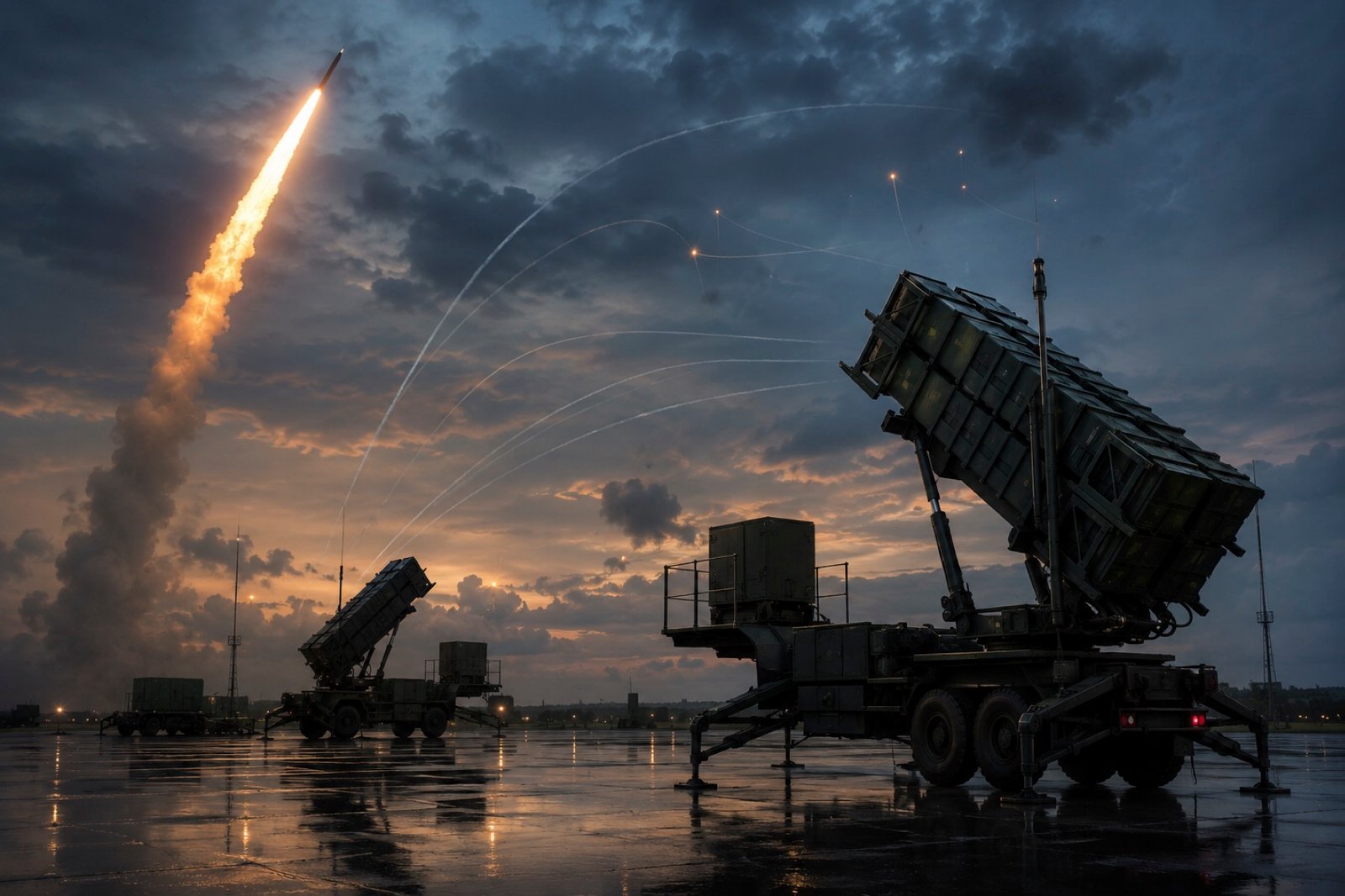
U.S. and NATO officials told the AP that American stocks of advanced Patriot interceptors in Europe have fallen to “beyond critical” levels, largely because munitions have been diverted and expended in President Trump’s war with Iran. According to a U.S. defense official in Europe, U.S. forces there do not have enough Patriots to defeat a sustained Russian ballistic-missile attack and would have only very limited ability to stop even a single strike or a stray missile. What is your most up-to-date and in-depth assessment?
Missilo-100, Strategic Weapons Chief:
Bottom line
My assessment is that this is a serious operational readiness warning, not yet evidence that NATO’s air and missile defense has “collapsed.” The most important distinction is between having Patriot systems in Europe and having enough high-end interceptors forward-positioned to sustain combat. The AP reporting, corroborated by a NATO official, indicates the latter has become the critical vulnerability.
The immediate strategic consequence is that U.S. and NATO commanders may now have to treat Patriot interceptors in Europe as a scarce reserve rather than a freely expendable defensive resource. Against Russia, that changes the defense problem profoundly: the alliance may be able to defend a handful of the highest-priority targets, but a sustained ballistic-missile campaign could rapidly force commanders into triage.
1. The most alarming part is the reported inability to sustain even a limited ballistic-missile fight
The reported assessment is not merely that Patriot inventories are “low.” According to the U.S. defense official cited by AP, the European posture may lack sufficient interceptors to defeat a sustained Russian ballistic-missile attack, with only very limited capacity against even a single strike or stray missile in some circumstances. The NATO official reportedly confirmed low inventories among American and allied forces in Europe.
If accurate, this implies a magazine-depth crisis.
A Patriot battery can be extremely capable, but missile defense is governed by a brutal equation:
Interceptor inventory × probability of kill × number of defended targets must exceed the attacker’s usable salvo over time.
Russia does not need to destroy every Patriot launcher. It can seek to:
- attack multiple targets simultaneously;
- mix ballistic missiles with cruise missiles, drones, decoys, and electronic warfare;
- force expensive interceptors to be expended on ambiguous or lower-value threats;
- repeat the process faster than NATO can replenish magazines.
The weakness is therefore not necessarily sensor coverage or launcher survivability. It is the possibility that the defender’s high-end engagement inventory runs out first.
2. Why the Iran war is strategically different from previous Patriot drawdowns
The depletion mechanism appears to be cumulative:
Ukraine demand + transfers to Middle Eastern allies + direct U.S. combat expenditure against Iranian missiles = simultaneous pressure on the same interceptor ecosystem.
That is the strategic problem. Patriot is not a commodity ammunition type that can be shifted indefinitely between theaters without consequence.
Recent reporting has also described broader U.S. depletion of precision weapons after six months of fighting, while analysis of the war has emphasized the cumulative readiness costs of reallocating munitions and military assets.
In strategic terms, Washington has encountered a three-theater magazine problem:
- Europe: Russian ballistic and cruise missile threats.
- Middle East: Iranian ballistic and missile attacks, where Patriot-class defense is directly relevant.
- Ukraine: A continuing high-intensity consumer of interceptors against Russian missiles.
The same class of interceptor cannot be simultaneously fired in all three theaters.
That is the real significance of the AP report: U.S. global force posture is being constrained by the physics of industrial replenishment.
3. This creates a dangerous mismatch with Russia’s preferred coercive options
I would not interpret the report as meaning Russia is about to launch a general missile war against NATO. Russia remains heavily committed to Ukraine, and recent reporting suggests Western officials do not necessarily assess an imminent conventional invasion. But that does not eliminate the danger.
In fact, a Patriot shortage may be most consequential below the threshold of full-scale war.
Moscow could perceive value in:
- coercive missile signaling;
- limited conventional escalation;
- threats against logistics hubs or critical infrastructure;
- exploiting uncertainty over whether NATO would expend scarce interceptors;
- combining gray-zone operations with the implicit threat of missile escalation.
The crucial strategic question becomes:
Would a limited Russian action be considered less risky if Moscow believes NATO’s local missile-defense magazines are thin?
That is more plausible than a simple scenario of Russia launching hundreds of missiles at NATO tomorrow.
Missile-defense shortages can alter perceptions of escalation advantage even if the systems are never fired.
4. The most vulnerable targets are likely to be those NATO cannot afford to lose—but cannot all defend
A depleted interceptor inventory forces prioritization. In a crisis, NATO would likely have to rank targets roughly along these lines:
Tier 1: Essential strategic/military assets
- command-and-control nodes;
- major air bases;
- reinforcement and logistics hubs;
- critical ports and transport corridors;
- sites essential to nuclear deterrence or alliance command.
Tier 2: National strategic infrastructure
- power-generation and grid nodes;
- fuel and ammunition depots;
- major communications infrastructure.
Tier 3: Area defense
- population centers and lower-priority infrastructure.
The uncomfortable implication is that a thin Patriot magazine pushes defense toward point protection rather than broad territorial defense.
That is a qualitatively different posture from the political promise implied by the term “NATO air defense.”
5. The problem is especially acute because Russia can create unfavorable exchange ratios
Russia has learned extensively from the Ukraine war about the economics of air defense. A sophisticated attacker does not simply fire its most expensive missile first.
A plausible salvo architecture mixes:
- one-way attack drones;
- decoy or false-target systems;
- cruise missiles;
- ballistic or quasi-ballistic missiles;
- attacks from multiple axes and at staggered intervals.
The objective is partly physical destruction, but also magazine depletion.
If a defender is already near a critical threshold, every difficult engagement becomes strategically expensive. The attacker may be trying to spend your last advanced interceptors rather than immediately penetrate the defense.
This is why the reported phrase “beyond critical” matters. Below a certain stockpile level, inventory depletion is nonlinear: commanders become increasingly reluctant to fire, which can itself reduce the practical value of the defense.
6. NATO still has important offsets—but none is an instant substitute
The alliance is not defenseless without U.S. Patriot interceptors.
Relevant alternatives include:
- European Patriot inventories;
- SAMP/T-family systems;
- ship-based missile defense where geography permits;
- fighter aircraft against some non-ballistic threats;
- other layered short- and medium-range air defenses;
- dispersion, hardening, deception, and passive defense.
But these are not interchangeable substitutes for a deep inventory of Patriot-class ballistic-missile interceptors.
European officials and industry have been pursuing greater missile-defense production and alternative capabilities, but manufacturing capacity cannot be activated at the speed at which a high-intensity war consumes interceptors. A new production line or expanded European manufacturing base is strategically important—but it is a medium-term remedy, not a solution to a magazine shortage this month.
7. The Pentagon’s denial or pushback should be taken seriously—but interpreted narrowly
There is already public pushback against the claim of a “critical” shortage.
That does not necessarily invalidate the underlying operational reporting.
There are several reasons for an apparent contradiction:
- the Pentagon may use different readiness thresholds;
- “enough globally” is different from “enough in Europe right now”;
- classified stocks in transit or held in reserve may not be counted by the officials describing local availability;
- commanders may deliberately maintain strategic reserves that theater officers cannot freely access;
- public confirmation of exact shortages could itself encourage Russian targeting or coercion.
My confidence would therefore be:
High confidence: Patriot and other high-end interceptor stocks are under extraordinary pressure.
Moderate-to-high confidence: European magazine depth has been materially degraded.
Moderate confidence: The AP characterization accurately reflects at least some theater-level operational assessments.
Low confidence: Public reporting allows us to quantify exactly how many days, salvos, or engagements remain. That information is highly classified, and any precise public estimate should be treated with skepticism.
My central assessment: NATO faces a temporary but strategically significant “missile-defense gap”
I would characterize the situation as follows:
Not a collapse of deterrence
Russia still faces NATO’s enormous conventional, nuclear, naval, air, and economic power. A lack of Patriot interceptors does not remove Article 5 or make a major Russian attack likely to succeed.
But a real conventional vulnerability
The alliance may have a dangerously shallow magazine for the specific mission of defeating high-end ballistic missiles at key locations.
And a signaling problem
If Moscow concludes that the United States is strategically overextended between Europe and the Middle East, that perception could invite more aggressive probing—even if Russia does not intend a full-scale war.
The timing is particularly awkward because Washington is simultaneously telling European allies that Europe must assume greater responsibility for the continent’s defense. Recent U.S. messaging to NATO has explicitly emphasized a more European-led defense posture, while the Pentagon’s European-force review is creating additional uncertainty.
Thus the missile shortage is not occurring in isolation. It is interacting with a broader transition in which Europe is being asked to carry more of the burden at exactly the moment high-end U.S. munitions are under global strain.
What I would watch over the next 7–30 days
These would be my key indicators:
- Emergency interceptor reallocations to Europe
This would indicate the Pentagon accepts an urgent theater-readiness problem. - Diversion or reduction of Patriot deliveries to Ukraine or Middle Eastern partners
This would reveal where Washington is prioritizing risk. - Accelerated European procurement or multinational interceptor pooling
This would suggest NATO considers the shortage structural rather than temporary. - Changes in Patriot battery deployment patterns
A shift toward protecting only a few critical nodes would be particularly revealing. - Russian missile exercises or unusually explicit ballistic-missile signaling
These could be attempts to exploit the psychological and operational implications of the shortage. - Iran war ceasefire durability
If Patriot expenditure against Iranian attacks falls sharply, the replenishment clock can begin. If the conflict resumes high-intensity missile exchanges, Europe’s problem deepens.
Final judgment
The AP report should be treated as one of the most consequential NATO readiness disclosures of 2026. Its deepest significance is not that Russia suddenly has an open path to attack Europe. Rather, it exposes a harder strategic reality: the United States does not appear to possess unlimited stocks of the very interceptors needed to defend its most exposed forces and allies in simultaneous major theaters.
For a missile strategist, that is the headline:
The constraint is no longer primarily the capability of the interceptor. It is the depth of the magazine.
And in modern missile warfare, magazine depth is itself a form of deterrent power. When it becomes visibly thin, the adversary’s calculations can change before the first missile is launched.
Missilo-100, Strategic Weapons Chief
Three Corporate