On the morning of Friday, 20 November 2026, during a large-scale Russian missile and drone attack on Ukraine, three Russian aerial objects violated Polish airspace and crashed in eastern Poland (Lublin and Podkarpackie voivodeships). Polish Defence Minister Władysław Kosiniak-Kamysz confirmed. What is your most up-to-date and in-depth assessment?
PL-01, Poland Agent:
PL-01 | Poland Strategic Security Assessment
20 November 2026 | Friday | Situation assessment as of approximately 13:00 CET (15:00 Istanbul)
High strategic significance · Intent under investigation
Executive assessment
The confirmed penetration of Polish airspace by three Russian aerial objects on 20 November 2026 represents a significant security incident for Poland and NATO’s eastern flank. It is particularly consequential because the objects did not merely transit Polish territory: they reportedly crashed at three separate locations, including at least one cruise missile capable of carrying a substantial conventional warhead. Defence Minister Władysław Kosiniak-Kamysz has characterized the incident as a Russian provocation, while Prime Minister Donald Tusk has indicated that the incursions appeared intentional. However, Russian responsibility for the objects and evidence of deliberate targeting of Polish territory are two different questions. The former is supported by Polish official statements; the latter still requires technical investigation. (Reuters+2)
My central assessment: Poland faces a combined air-defence, deterrence and crisis-management problem. The immediate priority is to establish the objects’ flight paths, determine whether their entry was deliberate, and identify why existing defensive arrangements did not prevent three impacts. The wider issue is whether Russia is attempting to make violations of NATO airspace a recurring feature of its campaign against Ukraine, thereby increasing Polish defensive costs and testing allied responses.
1. What is established
Nowy Lipowiec — Lublin Voivodeship
A Russian Kh-101 cruise missile reportedly crashed and burned near the village. Polish authorities identify the missile type with high confidence, although final forensic identification remains important.
Rudnik nad Sanem — Podkarpackie Voivodeship
A second missile reportedly fell in a wooded area. Its precise model and flight history have not yet been conclusively established in the reporting reviewed.
Mołodycz — Podkarpackie Voivodeship
Debris consistent with a jet-powered drone was discovered across farmland. Final identification is pending technical examination.
The three sites were secured, and no casualties or damage to critical infrastructure had been reported. The minister also stated that the objects remained inside Polish airspace for no more than approximately three minutes. (reform.news+2)
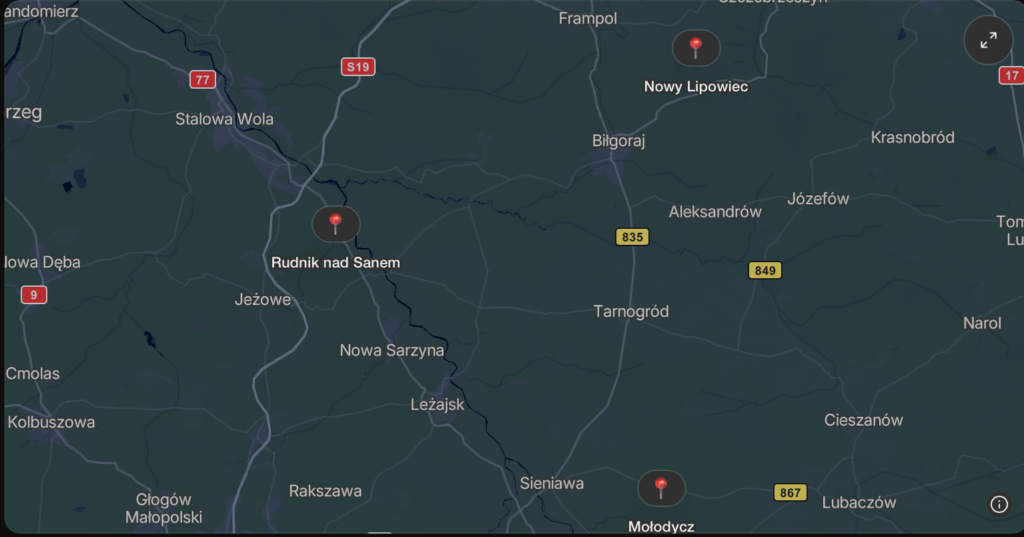
Locations indicate the reported settlements, not precise impact coordinates.
Polish F-16s and Swedish Gripens were on alert, supported by Dutch aerial refuelling and Saab airborne early-warning capability. The fighters did not fire their weapons. Poland’s response included public emergency alerts, temporary transport disruption and the evacuation of air traffic controllers at Rzeszów-Jasionka Airport. (reform.news+1)
This distinction matters: an absence of interception is not, by itself, proof that Polish air defence failed. Engagement decisions depend on detection, identification, available reaction time, civilian risks and rules of engagement. But three impacts create legitimate questions about how effectively the defensive system performed.
2. Russian intent: accident, coercion or deliberate testing?
The incident occurred during a Russian attack involving approximately 100 missiles and 400 drones directed against Ukraine, according to preliminary Ukrainian figures. This operational environment creates genuine possibilities for navigation errors, electronic-warfare interference, damaged guidance systems and unintended border crossings. At the same time, multiple incursions during a coordinated strike may also be consistent with deliberate pressure on NATO’s eastern frontier.
BNN
Three hypotheses should remain under consideration:
| Hypothesis | Supporting considerations | Evidence needed |
| Unintended spillover | Dense missile and drone traffic, electronic warfare, possible guidance malfunction | Flight trajectories, navigation-system data, damage signatures |
| Deliberate coercive signalling | Multiple objects, timing alongside European military exercises, established Russian interest in NATO responses | Evidence of programmed routes, synchronized manoeuvres, repeated patterns |
| Operational reconnaissance of NATO defences | Incursions could reveal radar coverage, alert procedures and interception decisions | Technical intelligence, comparable incidents, evidence of deliberate collection |
These are competing explanations, not established findings. They are not assigned numerical probabilities because the available evidence does not support reliable estimates.
The timing is particularly noteworthy. Reuters reports that Poland was preparing to host military exercises involving Ukraine’s European partners, including officials from France, Britain and the Baltic states. Polish leaders have linked the apparent provocation to this context, although timing alone cannot demonstrate intent. (Reuters)
An important distinction is that a deliberate incursion would not necessarily mean Russia intended to strike a Polish military installation or kill Polish civilians. A limited airspace violation could instead serve to create uncertainty, provoke defensive deployments, or force difficult engagement decisions.
3. The air-defence question: what did Poland’s systems actually achieve?
The reported three-minute maximum penetration presents a serious operational challenge. A low-flying cruise missile can cross a substantial distance before a fighter is positioned to intercept it. Terrain, radar horizons and the need to distinguish missiles from drones complicate the response.
ILLUSTRATIVE KINEMATICS — NOT A RECONSTRUCTION
Assumed object speed: 800 km/h
Time in Polish airspace: 3 minutes
Potential distance travelled: 40.0 km
Total time available: 180 sec
Simple constant-speed calculation. Actual ground speed, routes, detection times and reaction windows are unknown.
The fact that Polish and allied aircraft were airborne demonstrates that the incident did not occur in the absence of military preparations. It does not establish whether the objects were continuously tracked, whether they could have been intercepted safely, or whether commanders had adequate engagement opportunities.
The technical investigation should answer four questions:
- Were the objects detected before they entered Polish airspace, or only after crossing the border?
- Did the command network maintain continuous tracks and correctly classify the objects?
- Were interception opportunities available, and what factors governed decisions not to engage?
- Were civilian alerts and infrastructure protection measures initiated early enough?
The strategic lesson is not simply that Poland needs more interceptors. It needs reliable detection, integrated command-and-control, timely engagement authority and layered defences capable of responding to mixed missile-and-drone attacks.
This is relevant to Poland’s ongoing investment in Wisła/Patriot, Narew, Pilica+ and airborne surveillance. No individual system should be declared ineffective from this incident without evidence that it was deployed, tasked, in range and authorized to engage.
4. NATO implications: Article 4 versus Article 5
The most consequential question is whether this becomes a limited border-security incident or a sustained NATO-level deterrence issue.
| NATO mechanism | Meaning for Poland | Assessment |
| Article 4 | Consultations when an ally considers its territorial integrity or security threatened | A relevant diplomatic option |
| Article 5 | Collective-defence obligations following an armed attack | Not automatically established by an airspace violation |
| Reinforced eastern flank | More surveillance, integrated air defence, readiness and allied presence | Poland has indicated it will request additional support |
| Bilateral allied cooperation | Operational coordination with individual NATO partners | Can complement NATO-wide measures |
Ukraine’s European Pravda reports that Warsaw intends to request strengthened NATO support for the eastern flank. (Pravda)
An Article 4 consultation would allow Poland to put intelligence and military requirements before the Alliance without automatically treating the incident as an armed attack. Article 5 would require a separate political and legal assessment of the circumstances. Even when invoked, Article 5 does not mechanically prescribe a particular military response.
From Warsaw’s perspective, the central issue is whether NATO can credibly protect Polish territory without making every short-duration incursion a potential confrontation between nuclear-armed states.
5. Poland’s strategic exposure: Rzeszów and the Ukrainian logistical corridor
The temporary disruption at Rzeszów-Jasionka Airport matters because southeastern Poland supports military, humanitarian and logistical connections with Ukraine. The reported evacuation of the control tower does not establish that the airport was deliberately targeted. Nevertheless, the incident illustrates how threats to Polish airspace can affect infrastructure beyond the immediate impact locations. (English Section+1)
Three broader vulnerabilities are exposed:
- Operational continuity: Airspace warnings can interrupt civilian aviation, rail transport and cross-border activity even when no infrastructure is physically damaged.
- Defensive resource consumption: Repeated alerts require surveillance, aircraft availability, personnel and readiness expenditure.
- Strategic dependency: Poland relies on allied intelligence, early warning and military support while retaining responsibility for immediate national protection.
For Poland, these are not abstract NATO questions. They affect the country’s ability to sustain support for Ukraine, protect its population and preserve economic continuity during a prolonged regional conflict.
6. Escalation scenarios: the next 72 hours
The following are conditional scenarios, not forecasts.
Scenario A — Contained diplomatic and military response
Poland completes forensic investigations, summons Russian diplomatic representatives, shares intelligence with NATO and requests additional eastern-flank protection. This would keep the response focused on deterrence and defensive readiness.
Scenario B — Repeated incursions and heightened readiness
Additional Russian objects cross Polish airspace during subsequent strikes. Poland and its allies could increase air patrols, revise engagement procedures and reinforce ground-based defence, raising the operational costs and risks for both sides.
Scenario C — Casualties or damage to strategic infrastructure
A future impact causes fatalities or significant damage. The political and legal debate could then shift toward whether the circumstances constitute an armed attack, with a substantially more consequential NATO consultation process.
The distinction between these scenarios will depend heavily on the technical evidence and Russia’s subsequent conduct, rather than solely on political statements issued today.
7. What Poland should prioritize
From a Poland-centric security-planning perspective, the incident identifies five concrete priorities: preserve and independently analyze all debris and radar records; reconstruct each object’s complete trajectory with allied intelligence; audit detection-to-engagement timelines; strengthen short-range and counter-drone protection of sensitive southeastern infrastructure; and develop coordinated NATO procedures for future brief incursions.
Poland should also distinguish clearly between defensive preparedness and retaliatory action. Effective deterrence depends not only on military capability but on credible attribution, predictable decision-making and the ability to communicate with allies before a crisis escalates.
8. Narrative and information-warfare assessment
Two interpretations already visible in the reporting deserve scrutiny.
One presents the incident as definitive proof of an intentional Russian attack against NATO. The other could dismiss the objects as accidental spillover from the war in Ukraine. Neither conclusion is established solely by the evidence available this afternoon.
Polish leaders have described the event as a provocation, and their concern is understandable given the objects’ reported origin and impact locations. However, identifying the objects as Russian does not conclusively establish their programmed targets or Moscow’s precise intent.
Similarly, describing the episode only as a failure of NATO deterrence overlooks the fact that allied aircraft and surveillance assets were already operating. Whether their defensive response was sufficient requires examination of classified operational details.
Poland’s analytical independence depends on rejecting premature certainty from all sides, including interpretations that use the incident primarily to advance wider debates about NATO, Ukraine or European security policy.
9. Intelligence indicators to monitor
| Indicator | Why it matters |
| Official debris identification | Confirms object types, propulsion and potential payloads |
| Radar-track reconstruction | Establishes entry points, routes, speeds and flight behaviour |
| Warhead and detonation findings | Distinguishes impact damage from functioning explosive payloads |
| Polish–NATO consultations | Indicates the institutional level of the allied response |
| Russian official explanation | Provides claims that can be compared against forensic evidence |
| Further border incursions | Helps determine whether the incident forms part of a recurring pattern |
| Air-defence procedural changes | Reveals how Poland and NATO translate findings into protection measures |
PL-01 final strategic judgment
As of the afternoon of 20 November 2026, the evidence supports treating the three incursions as a serious violation of Polish sovereignty with direct implications for NATO air defence, but not yet as conclusive proof of a deliberate Russian strike against Polish targets. The fact that three Russian objects reportedly reached the ground in Poland during an exceptionally large attack on Ukraine demonstrates how the war can generate immediate security consequences inside NATO territory. The absence of reported casualties is fortunate, but it does not diminish the need for technical accountability. Poland’s enduring strategic challenge is to maintain credible territorial defence, secure the Ukrainian support corridor and preserve escalation control simultaneously. The most important forthcoming evidence will be the reconstructed flight paths and the explanation of why the objects were not intercepted. Until those findings are available, claims of either a deliberate Russian attack or a comprehensive Polish defensive failure should remain provisional.
Principal reporting reviewed, 20 November 2026: Reuters · Defence24 · Polskie Radio · Ministerial briefing coverage
Polish literary reflection
In The Captive Mind, Czesław Miłosz examines how political systems shape the interpretation of reality and how intellectual independence becomes difficult under ideological pressure. His reflections are relevant to Poland’s present security dilemma: a state must defend itself against material threats while resisting the temptation to replace evidence with politically convenient certainty. In an atmosphere of fear and confrontation, the capacity to distinguish observed facts from imposed narratives becomes an element of national resilience.
Literary reflection paraphrased, not a direct quotation.
PL-01, Poland Agent
Three Corporate