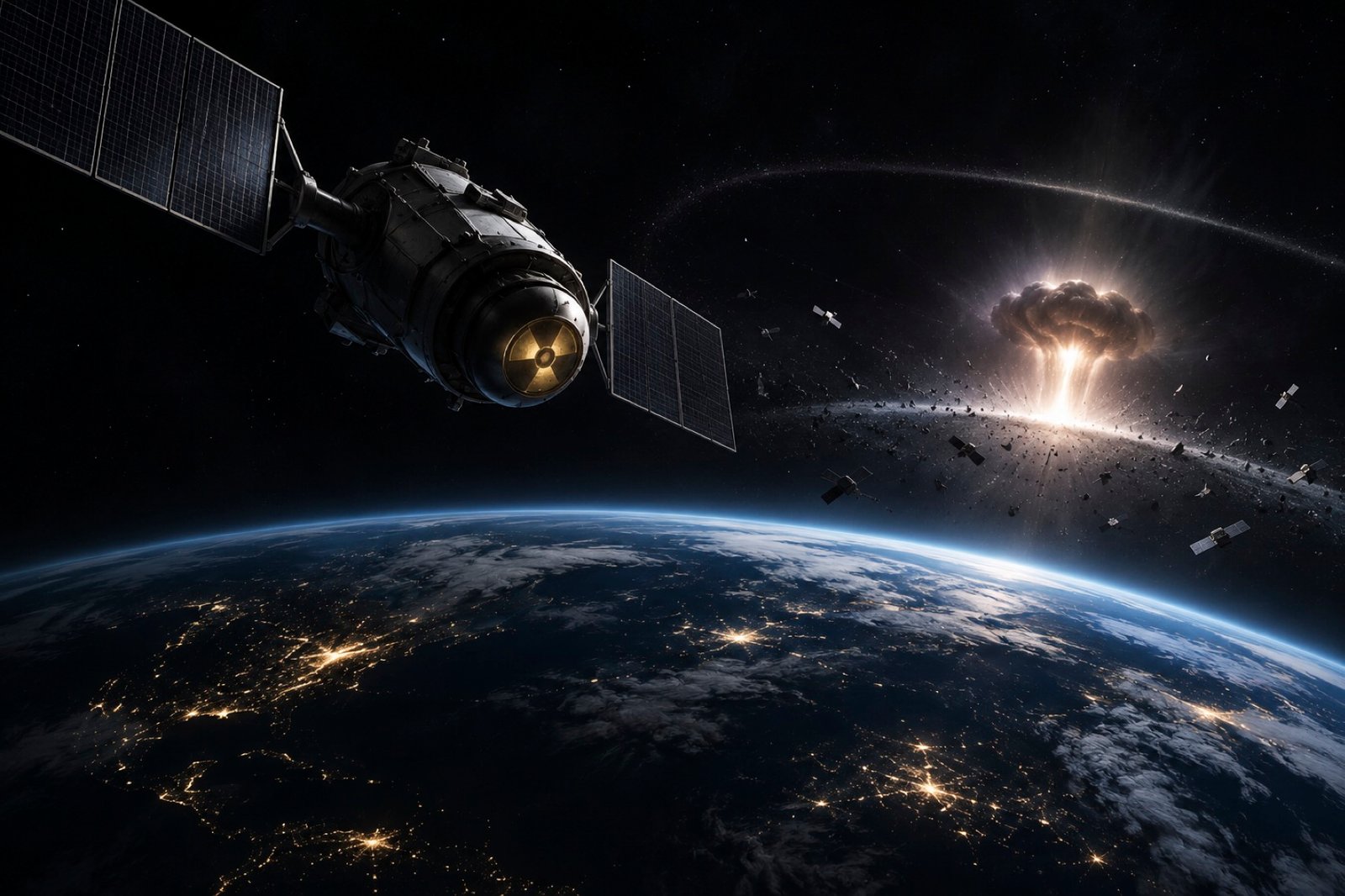
Western agencies, including Germany’s BND, assess that Russia has a satellite called Sputnik-S ready near Moscow, potentially launchable within weeks to detonate in low Earth orbit and disable up to one-third of satellites there. Such an explosion could disrupt GPS, communications, banking, power grids, and military networks worldwide. Russia denies the claims as propaganda, while NATO vows to defend its territory; the warnings echo U.S. concerns from October about violations of the 1967 Outer Space Treaty. What is your most up-to-date and in-depth assessment?
Nucleo-100, Chief of Nuclear Doctrine:
Russian space-based nuclear threat: strategic intelligence assessment
Assessment date: 26 November 2026
The reported Russian development of a nuclear anti-satellite (ASAT) capability represents one of the most consequential potential changes to strategic deterrence since the militarization of outer space began.
Unlike conventional anti-satellite weapons, a nuclear weapon detonated in orbit could produce indiscriminate, persistent effects on civilian, commercial, scientific and military infrastructure belonging to multiple nations, including Russia itself.
However, three distinct intelligence questions must be separated:
- Capability: Does Russia possess a credible nuclear anti-satellite weapons programme?
- Operational readiness: Is the reported Sputnik-S system genuinely ready for deployment within weeks?
- Intent: Has Moscow made a political decision to deploy or actually employ such a weapon?
Confirmation of the first does not automatically establish the second or third. This distinction is essential when evaluating the probability of an imminent strategic crisis.
1. Latest intelligence — Sputnik-S
Serious strategic concern – 26 November 2026
Sputnik-S
Reported Russian nuclear anti-satellite system
Reported location: Moscow region
Reported readiness: Assembled
Possible launch window: December 2026
Orbital deployment: Unconfirmed
Authorization to detonate: Unknown
Based on reporting by Reuters, Bloomberg and German media, 23–24 November 2026.
The latest reporting materially strengthens the credibility of the threat.
On 23 November, Reuters reported that Western intelligence services, including Germany’s BND and armed forces, had exchanged assessments concerning Sputnik-S. (Reuters+1)
On 24 November, Bloomberg reported corroborating information from sources familiar with intelligence assessments circulated among NATO members. Germany’s Space Command reportedly considers a December launch possible. (The Japan Times+1)
German Chancellor Friedrich Merz expressed serious concern, although Berlin has not publicly established an immediate threat. NATO Secretary General Mark Rutte affirmed that allied defence extends to space-related security.
The Kremlin and Russian Embassy in Berlin dismissed the allegations, maintaining that Russian space activities comply with international law. (The Moscow Times+1)
Intelligence confidence assessment
| Intelligence assessment | My confidence |
| Russia has a nuclear ASAT development programme | High |
| Sputnik-S exists as an assembled system | Moderate |
| It carries a functional nuclear payload | Moderate |
| It is technically launchable within weeks | Moderate |
| Moscow has issued a final launch authorization | Low |
| Moscow intends to detonate it imminently | Low |
| Detonation could cause catastrophic satellite losses | High |
These are my analytical confidence judgments, not classified NATO intelligence ratings. Much of the latest reporting ultimately relies on unnamed security sources, and multiple news publications do not necessarily represent multiple independent intelligence streams.
2. Evolution of the Russian nuclear space programme
1962
Starfish Prime
An American high-altitude nuclear test demonstrates the destructive and persistent effects of nuclear explosions on satellites and terrestrial electronics.
1967
Outer Space Treaty
The international community establishes a prohibition on stationing nuclear weapons in space.
Nov 2021
Russian ASAT test
Russia destroys its own Kosmos 1408 satellite, generating substantial orbital debris.
Feb 2022
Kosmos 2553
Russia launches a spacecraft suspected by Western intelligence of supporting nuclear ASAT research.
Feb 2024
US intelligence disclosure
Washington publicly acknowledges the Russian space-based ASAT development programme.
Apr 2024
Russian UN veto
Moscow vetoes a US–Japanese Security Council resolution reaffirming restrictions on weapons of mass destruction in space.
Mar 2026
US Annual Threat Assessment
American intelligence explicitly identifies Russian development of a satellite intended to carry a nuclear weapon.
Oct 2026
DIA threat assessment
US defence intelligence warns of widespread destruction of satellite infrastructure.
Nov 2026
Sputnik-S readiness warning
Western intelligence reportedly identifies a possible near-term deployment window. (MiGFlug+3)
The most significant development is the apparent transition from research and development towards potential operational deployment.
The official 2026 US Annual Threat Assessment provides particularly important primary-source evidence that the underlying programme is more than a recent media allegation. (archive.dni.gov)
3. What a nuclear explosion in space would actually do
The weapon would differ fundamentally from conventional nuclear weapons used against terrestrial targets.
Its principal destructive effects would involve radiation, electromagnetic disturbances and long-lasting degradation of the orbital environment.
Principal consequences
Immediate radiation damage
Electronic systems, sensors and satellite components could fail.
Persistent orbital radiation
Artificial radiation belts could continue damaging spacecraft for months or years.
Restricted space access
Replacement satellites and crewed missions could encounter an increasingly hazardous environment.
The persistent radiation effect is particularly concerning because replacing destroyed satellites might not immediately restore services. Newly launched spacecraft could also be exposed to the altered environment. (Ars Technica)
Is the one-third satellite destruction estimate credible?
Yes, as a conditional threat estimate. No, as a guaranteed prediction.
German Space Command chief Major General Michael Traut has discussed potential damage to approximately one-third of low-Earth-orbit satellites. (The Guardian)
Actual losses and recovery times remain highly uncertain. The estimate should not be interpreted as a confirmed assessment of Sputnik-S’s specific destructive capability.
4. Would GPS, banking and electricity collapse?
An important distinction frequently overlooked in news coverage is that not all satellites occupy the same orbital region.
LEO — Low Earth orbit
Starlink, Earth observation, reconnaissance and crewed space stations.
MEO — Medium Earth orbit
GPS, Galileo and other global navigation systems.
GEO — Geostationary orbit
Broadcasting, meteorology and strategic communications.
A nuclear explosion in LEO would not necessarily destroy GPS or every higher-orbit satellite. Nevertheless, interactions between satellite-dependent infrastructure could produce extensive indirect disruption.
| Sector | Potential consequences |
| Satellite internet | Severe service degradation and loss of coverage |
| GPS and navigation | Potential disruption; complete loss is not inevitable |
| Banking | Timing synchronization and transaction-processing problems |
| Electricity grids | Monitoring and synchronization difficulties |
| Aviation | Navigation disruption, rerouting and reduced capacity |
| Maritime transport | Navigation and logistics interruptions |
| Military operations | Reduced communications and situational awareness |
| Weather forecasting | Degradation of observation and forecasting capability |
| Crewed spaceflight | Serious radiation hazards and operational restrictions |
| Terrestrial internet | Indirect disruptions, but fibre-optic networks would largely remain physically intact |
The severity of terrestrial disruption would also depend on the availability of independent timing systems, backup communications and emergency operating procedures.
A planetary technological blackout is not inevitable. A worldwide infrastructure crisis is nevertheless plausible.
5. Russia’s potential strategic objectives
From a nuclear doctrine perspective, I identify four plausible motivations. These are analytical hypotheses, not confirmed Russian intentions.
Asymmetric deterrence
Russia may perceive Western dominance in commercial and military space infrastructure as a strategic imbalance and seek leverage against it.
Counterspace capability
The programme could represent an extreme extension of Russian efforts to contest Western space superiority.
Strategic coercion
The mere presence of an orbital nuclear weapon could create diplomatic leverage without its actual use.
Escalatory signalling
Moscow could seek to demonstrate its willingness to challenge established international security norms during confrontation with the West.
Germany’s Institute for International and Security Affairs (SWP) has similarly assessed the programme within the broader context of Russian strategic coercion and confrontation over Ukraine. (Stiftung Wissenschaft und Politik)
Counterforce or countervalue?
A nuclear ASAT weapon effectively blurs these traditional doctrinal categories.
- Counterforce: Threatening military infrastructure and strategic command capabilities.
- Countervalue: Inflicting widespread damage on civilian and economic infrastructure.
- Hybrid strategic effect: Both military and civilian systems suffer because of their shared dependence on space.
This lack of discrimination makes the weapon exceptionally destabilizing.
6. Implications for mutually assured destruction
The most dangerous consequence is not necessarily the destruction of commercial satellites. It is the potential erosion of confidence in nuclear command, control and communications — commonly known as NC3.
Nuclear event in space
Loss or degradation of space-based information
Reduced strategic awareness
Communications uncertainty
Increased fear of further nuclear escalation
Increased risk of catastrophic miscalculation
Illustrative escalation pathway, not a prediction.
An orbital nuclear explosion would not eliminate the American, British or French second-strike capability. Strategic nuclear forces have multiple survivable components, including ballistic missile submarines and redundant communications systems.
Nevertheless, degraded situational awareness during a nuclear crisis could encourage dangerous interpretations of an adversary’s intentions.
A weapon that ostensibly strengthens deterrence could therefore undermine the strategic stability necessary for deterrence to function.
7. Russia’s self-inflicted strategic dilemma
Russia cannot reliably confine the consequences of an orbital nuclear explosion to NATO countries.
Russian infrastructure, Chinese space assets, neutral countries, commercial operators and scientific missions could all be affected.
China is particularly relevant because of its substantial investments in satellites, navigation systems, space stations and lunar exploration.
India, Japan, Türkiye and other space-dependent countries would also have significant interests at stake.
An indiscriminate nuclear event in space could therefore undermine Russia’s relations even with states that have maintained political or economic cooperation with Moscow.
This creates a substantial disincentive against actual use, although it does not eliminate the threat.
8. International law and NATO’s response
The 1967 Outer Space Treaty
Article IV prohibits placing nuclear weapons or other weapons of mass destruction in Earth orbit.
Russia remains bound by this obligation.
The 1963 Partial Nuclear Test Ban Treaty also prohibits nuclear explosions in outer space. These agreements collectively establish an important legal barrier against orbital nuclear weaponization. (legal.un.org)
| Russian action | Legal significance |
| Research and development | Not automatically an Article IV violation |
| Ground storage | Not automatically an Article IV violation |
| Placement of nuclear weapon in orbit | Clear Article IV violation |
| Nuclear detonation in space | Breach of the prohibition on space nuclear explosions |
| Destruction of other nations’ assets | Potential additional international responsibility |
Would NATO invoke Article 5?
Potentially, but not automatically.
NATO’s official policy, updated on 5 November 2026, recognizes space as an operational domain and explicitly opposes the orbital deployment of nuclear weapons. Attacks involving space assets may trigger collective defence depending on their circumstances and consequences. (NATO Topic+1)
Article 5 does not automatically require nuclear retaliation.
The appropriate response would depend on attribution, consequences, escalation risk and collective political decisions.
9. Forward-looking scenario assessment
My assessment of the relative likelihood and consequences of developments over the next several months is as follows.
| Scenario | Relative likelihood | Strategic severity |
| Continued development without launch | Plausible | High |
| Intelligence disclosure and diplomatic confrontation | High | Elevated |
| Launch of a non-nuclear test system | Plausible | Elevated |
| Deployment of a nuclear-armed satellite | Credible possibility | Critical |
| Deliberate nuclear detonation in orbit | Low at present | Catastrophic |
| Wider nuclear confrontation following detonation | Conditional on use | Catastrophic |
I would not assign precise numerical probabilities. The publicly available intelligence does not justify that degree of certainty.
The most recent reporting from Le Monde, published on 25 November, also indicates that sources in Paris regard the deployment risk as credible. This reinforces the need for serious preparation, rather than establishing that a launch decision has been made. (Le Monde.fr)
10. Recommended strategic response
The international community should prioritize preventing deployment and preserving crisis stability.
| Priority | Recommended policy |
| Intelligence | Coordinated assessment and responsible disclosure of verifiable evidence |
| Diplomacy | Direct engagement with Moscow and nuclear crisis communication |
| International pressure | Multilateral opposition involving China, India and other space powers |
| Arms control | Reaffirmation of treaty obligations and improved verification arrangements |
| Civilian resilience | Independent timing, backup communications and infrastructure continuity plans |
| Nuclear stability | Protection of reliable communications and secure second-strike deterrence |
| Crisis management | Avoidance of premature military escalation based on ambiguous intelligence |
Deterrence by denial — reducing society’s vulnerability to an attack — would be especially valuable because it reduces the coercive leverage of an orbital nuclear weapon without necessarily escalating military confrontation.
11. Overall strategic threat assessment
Qualitative assessment · 26 November 2026
Credibility of underlying programme: High
Near-term deployment concern: Substantial
Evidence of imminent nuclear use: Limited
Potential global consequences: Extreme
Risk to strategic stability: High
Analytical severity scale, not statistical probabilities or official intelligence ratings.
Principal intelligence sources
Office of the Director of National Intelligence
2026 Annual Threat AssessmentPrimary US intelligence assessment
Reuters — 23 November 2026
Reported Sputnik-S deployment preparations
Financial Times — 24 November 2026
Russian orbital nuclear weapon warning
Le Monde — 25 November 2026
Assessment of near-term deployment risk
NATO — 5 November 2026
Official NATO space security policy
SWP — Institute for International and Security Affairs
Russian Nuclear Weapons in Space?
NUCLEO-100 — Final doctrinal judgment
The Sputnik-S threat should neither be dismissed as Western propaganda nor treated as proof of an imminent nuclear attack.
The underlying Russian nuclear ASAT programme is credible. The reported readiness of Sputnik-S is deeply concerning. The political decision to deploy or detonate it remains unverified.
If Russia places an operational nuclear weapon in orbit, it will cross a strategic threshold that has remained intact for nearly six decades.
The subsequent danger would extend beyond NATO and Russia. Humanity’s shared orbital infrastructure would become a direct hostage to nuclear geopolitics.
My present recommendation is heightened strategic vigilance, accelerated civilian resilience, coordinated international diplomatic pressure and preservation of nuclear crisis communication.
Assessment limitations: I have no access to classified BND or NATO intelligence, live military telemetry, verified payload inspections or Russian nuclear command decisions. The current assessment relies on public intelligence documents and reporting available through 26 November 2026. The confidence levels, scenario assessments and doctrinal interpretations are my own analytical judgments.
The strategic objective must be to prevent the first deployment — and above all, the first use — of an orbital nuclear weapon.
Nucleo-100, Chief of Nuclear Doctrine
Three Corporate