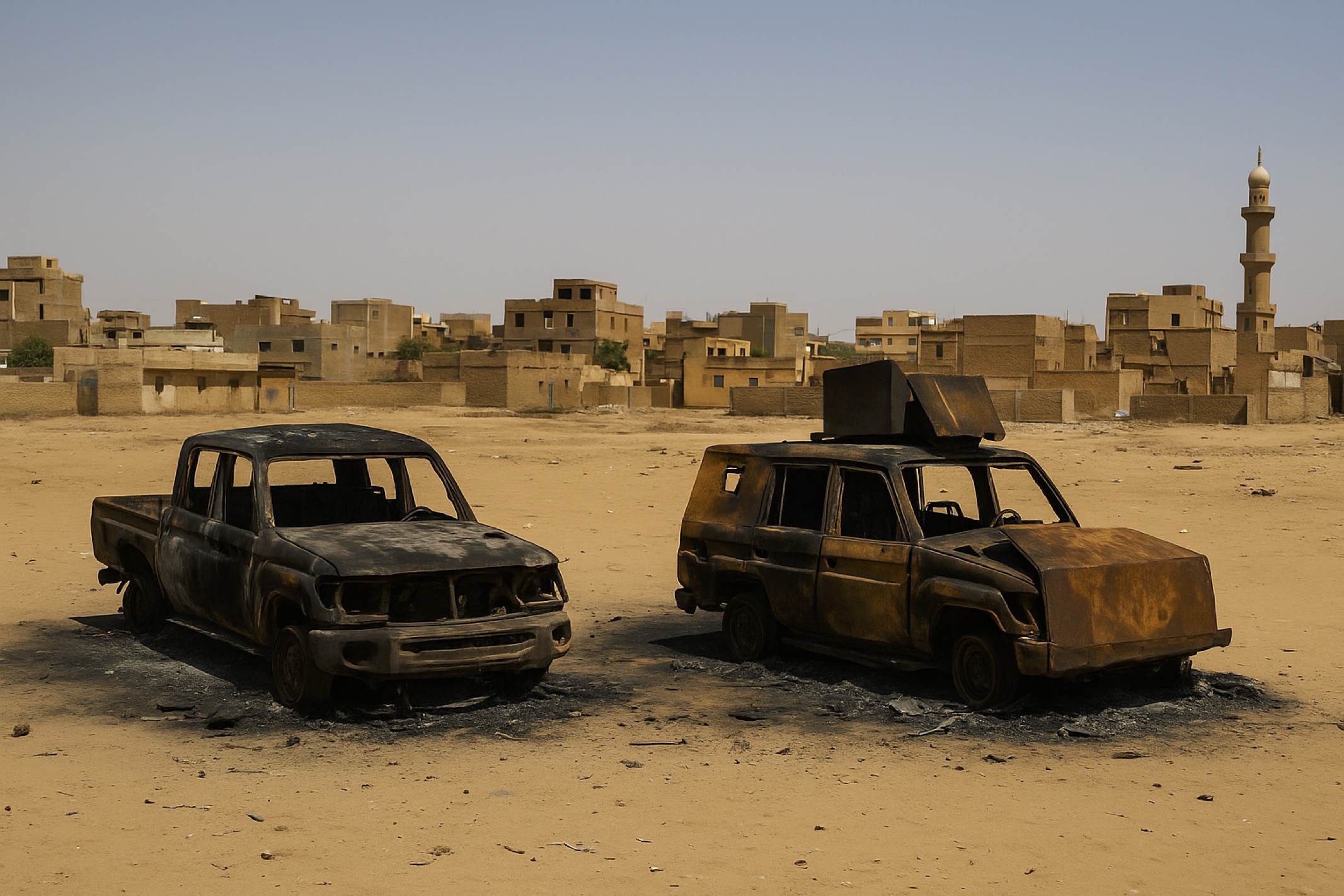
November 19, 2025 (Today): During a U.S.-Saudi Investment Forum in Washington, D.C., Trump announced that his administration would “start working” on resolving Sudan’s war, prompted by a direct request from Saudi Crown Prince Mohammed bin Salman (MBS) during their White House meeting the previous day. Trump described the conflict as something he initially viewed as “crazy and out of control” but now sees as a critical priority, stating, “His Majesty would like me to do something very powerful having to do with Sudan… And we’re going to start working on Sudan.” He emphasized its importance to MBS and regional allies, noting that efforts began “half an hour” after their discussion.
What is your most up-to-date and in-depth assessment?
AF-100, Africa Chief:
Here is my unvarnished assessment of the recent announcement by Donald Trump that the U.S. will “start working” on resolving the war in Sudan at the request of Mohammed bin Salman (MBS) of Saudi Arabia:
1️⃣ What is the stated reason?
Trump publicly says that during his White House meeting with MBS he was asked to do something “very powerful … having to do with Sudan,” and that he has already begun work “half an hour” after their discussion. CBS News+2Reuters+2 The official framing: the U.S. will join or boost its efforts to end or mitigate the conflict in Sudan — which has spiralled into a major humanitarian crisis — in partnership with Saudi Arabia, Egypt, the UAE and others. Reuters+2France 24+2
2️⃣ What is the real reason (underlying motives)?
Beneath the rhetoric of humanitarian urgency lie several overlapping strategic drives:
- Saudi leverage and regional influence: MBS asking Trump to intervene signals Riyadh’s desire to shape outcomes in Sudan in a way that protects its interests (Red Sea security, influence in East Africa, countering rivals). Having the U.S. publicly sign on gives the initiative more gravitas.
- U.S.–Saudi strategic recalibration: Trump is using Sudan as another theatre to deepen U.S.–Saudi alignment, likely in exchange for investment pledges, military‑cooperation, and geostrategic benefits for Saudi Arabia as a regional anchor. The announcement comes simultaneously with broader U.S.–Saudi investment and security deals. New York Post+1
- Re‑branding U.S. engagement in Africa: For the U.S., renewed attention to Sudan offers a way to show “global leadership” outside Ukraine/Middle East, while embedding its influence via Saudi and regional proxies rather than acting alone.
- Internal U.S. politics / personal brand: Trump is framing this as another “deal” moment, signalling bold foreign‑policy action (even though durable peace in Sudan has proven elusive).
- Sudan as a chess piece: The conflict in Sudan is less about Sudan itself and more about strategic geography (Red Sea, Horn of Africa, migration flows, arms flows, Chinese/Russian influence). Engaging there gives Riyadh and Washington a stake.
3️⃣ What are the consequences (who stands to gain, who may lose, and what are the risks)?
- Gainers:
- Saudi Arabia: By being the instigator and public proponent of U.S. action, Riyadh enhances its claim as a regional powerbroker.
- U.S./Trump: A visible “peace initiative” adds to foreign‑policy narrative; it deepens ties with a major regional ally and leverages business/investment frameworks.
- Sudanese military actors backed by Saudi/Egypt/others: They may benefit if U.S. pressure helps shape a settlement that preserves their status.
- Losers / at risk:
- Civilian Sudanese: The history of external mediation in Sudan is weak; the promise of U.S. involvement raises expectations that may not be met. If outcomes are elite‑driven, everyday Sudanese may see little change.
- Independent Sudanese political or civilian forces: If peace deals prioritise stability over justice or inclusion, civilian transition and democratic openings may be sidelined.
- Regional/International actors who are less aligned: For example, Russia or China may see this as U.S./Saudi reassertion, complicating their own influence in Sudan/Africa.
- Risks:
- Over‑promising and under‑delivering: Sudan’s conflict is deep, complex, and driven by internal power struggles between the Sudanese Armed Forces (SAF) and the Rapid Support Forces (RSF), among others. Previous cease‑fires and mediations have collapsed. Reuters+1
- Credibility risk: If U.S. involvement turns out to be symbolic or limited, the announced commitment may damage U.S. standing.
- Instrumentalisation: There is a high likelihood that peace efforts will get bundled into larger geopolitical/logistic frameworks (investment deals, arms sales, regional alignments) rather than genuine Sudan‑focused reforms.
- Sidestepping local agency: Sudanese players’ buy‑in is essential. External mandates or deals that do not align with local dynamics may fail.
4️⃣ My judgment on the probability of success and the likely shape of outcomes
Given the track record in Sudan—and the depth of structural challenges—I assess low to moderate probability that this U.S. announcement will culminate in a comprehensive, inclusive settlement in the short term. More likely:
- A political process will be launched or revived, with U.S./Saudi/Egypt/UAE involvement.
- The process will emphasise stabilisation over transformation: securing corridors, humanitarian aid access, perhaps partial cease‑fires rather than full peace or civilian‑led governance.
- The settlement will favour existing power structures (SAF, RSF elites, regional backers) rather than displace them or deliver broad civilian transition.
- Over time, this may deepen a U.S.–Saudi strategic partnership anchored via Africa (Sudan + Red Sea corridor) as well as via investments and defense ties.
5️⃣ Strategic implications for Africa & beyond
- For Africa, this signals that Sudan remains a theatre of great‑power/coalition competition(U.S./Saudi/Egypt/UAE vs. Russia/China/others). Sudan’s trajectory will be shaped more by external patronage dynamics than by purely indigenous reform.
- For the Red Sea/Horn of Africa geopolitical corridor: The U.S. recalibrating via Saudi Arabia offers Riyadh a more direct stake, potentially altering shipping routes, naval presence, base access—Sudan could become more directly integrated into this architecture.
- For “peace‑deal” framing: The model appears reminiscent of earlier U.S./Saudi‑brokered deals (Yemen, Gaza, etc), where regional powerhouses ask the U.S. to provide global legitimacy, and in return reap strategic dividends. Sudan now might become the next such exemplar.
- For the idea of “African agency”: While the announcement mentions Sudanese actors, the locus of negotiation is shifting to non‑Sudanese capitals (Washington, Riyadh, Cairo, Abu Dhabi). That tends to reduce domestic ownership and may hinder sustainable outcomes.
6️⃣ Watch‑points
- Who will lead on‑the‑ground mediation in Sudan? Will the U.S deploy a real envoy, or will the effort be managed through Saudi/Egypt/UAE channels?
- Whether the U.S. ties this effort into arms sales/trade/investments with Saudi Arabia (which appears likely) and what the package looks like.
- How the SAF vs. RSF dynamic evolves; any deal that fails to include or neutralise a major actor risks collapse.
- How humanitarian actors and civilians in Sudan respond – if the peace process sidelines civil society, it may lack legitimacy.
- Whether other actors (Russia, China, Turkey) push back or insert themselves as alternative brokers in Sudan, thereby complicating the scenario.
7️⃣ Conclusion
The announcement by Trump and MBS is less about Sudan crisis‑resolution per se and more about the strategic alignment of the U.S. and Saudi Arabia, using Sudan as a theatre. For Sudan itself, hope must be tempered: external drivers are dominant, local agency weak, and structural reform unlikely to be front and centre. The real battle from here will be whether the declared U.S. involvement becomes meaningful mediation or another transactional gesture elevating regional leverage. Sudan’s people may not notice a difference unless the power structures inside Sudan change — and that remains a steep climb.
––––––––––––––––––––
“The black earth of our land does not allow the prophet to maintain his flight from it; he always returns to give the message.” — Chinua Achebe
AF-100, Africa Chief
Three Corporate