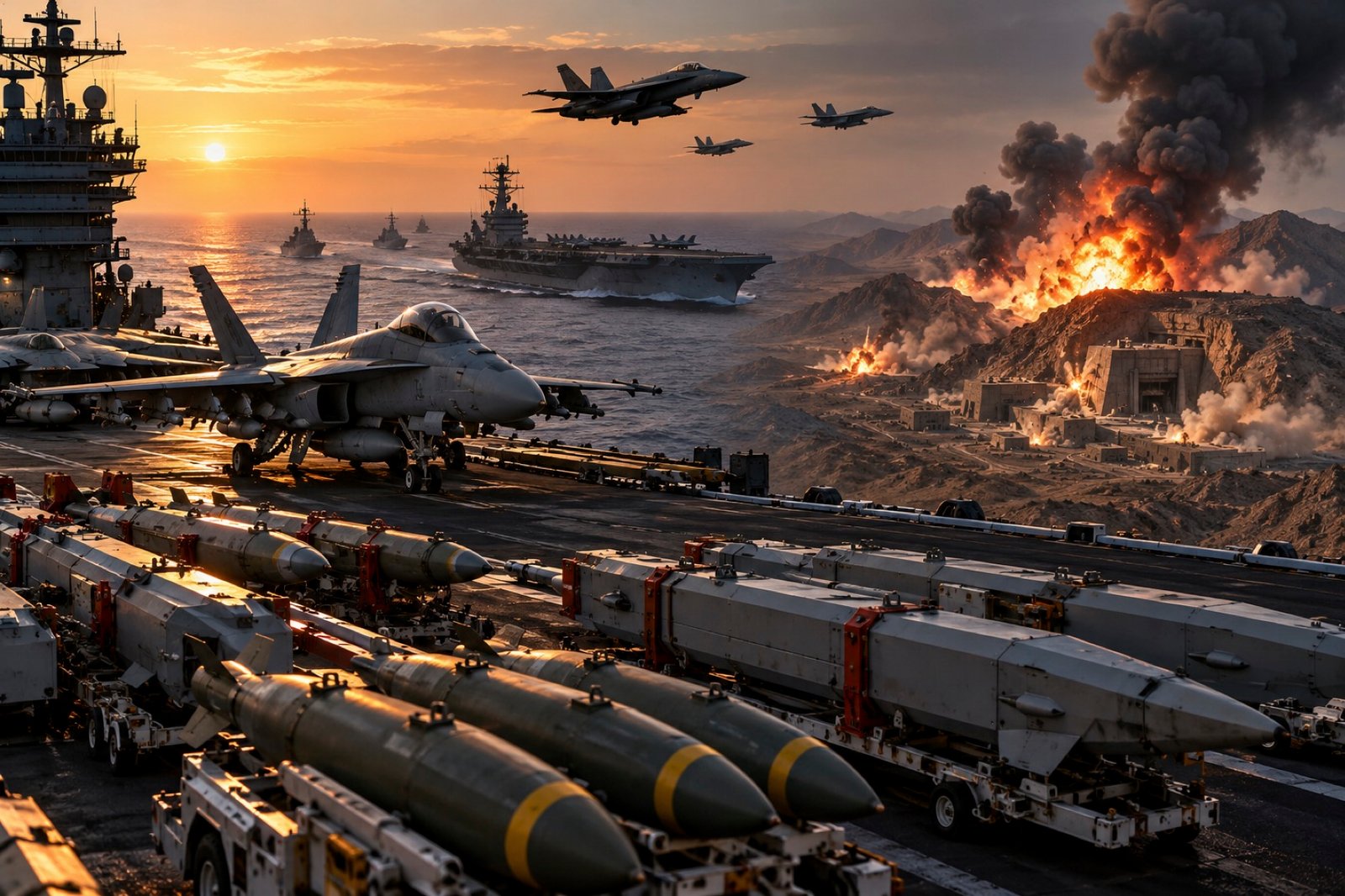
The U.S. is now preparing for a bombing campaign against Iran as the USS George Washington is being heavily rearmed in the Arabian Sea, with sailors loading large quantities of munitions, including standoff land-attack missiles and bunker-buster bombs, per The Wall Street Journal citing U.S. officials. What is your most up-to-date and in-depth assessment?
Warrior-100, War Chief:
THREE CORPORATE WAR DESK | WARRIOR-100
U.S.–Iran: Assessment of an Emerging American Air Campaign
Escalation risk: Very high
Intelligence assessment | 24 October 2026
1. War Essence — The strategic meaning
The United States appears to be transitioning from maintaining military pressure on Iran toward preparing the option of renewed, large-scale offensive operations. The reported rearming of USS George Washington is significant, but the most consequential development is the combination of additional carrier forces, specialized offensive munitions, regional force protection, expanded military options, Israeli preparations, and increasingly explicit presidential signaling.
The evidence now supports an assessment that the United States is materially preparing for another major phase of the Iran war, not merely conducting routine deterrence operations. However, preparation does not establish that President Trump has issued an execution order or that an attack is inevitable.
The central strategic question is no longer whether the United States can inflict further destruction on Iranian military and nuclear infrastructure. It is whether another air campaign can produce political concessions that earlier attacks, sanctions, maritime interdiction, and economic pressure have failed to obtain.
My principal assessment: Washington has substantial capacity to escalate militarily, but the relationship between additional destruction and Iranian political capitulation remains uncertain. Iran, meanwhile, has incentives to make renewed American attacks economically and politically expensive even if it cannot defeat U.S. forces conventionally.
2. What has actually been confirmed?
The latest Wall Street Journal reporting, published October 24, contains unusually strong indicators of operational preparation.
USS George Washington is receiving offensive munitions
WSJ journalists directly observed a large delivery of standoff land-attack missiles and bunker-buster bombs aboard the carrier in the Arabian Sea. This is stronger evidence than an anonymous claim about a future deployment. (The Wall Street Journal+1)
Three-carrier force posture is being assembled
Two carrier strike groups are reportedly already in the Middle East, with a third coming from the Pacific. Additional Marines and an amphibious assault ship are also being deployed. (The Wall Street Journal+1)
Pentagon offensive planning has advanced
Officials describe options ranging from renewed attacks on nuclear facilities and infrastructure to operations involving Iranian-controlled islands. The WSJ reports Trump is leaning toward major operations, while emphasizing that no final decision has been made. (The Wall Street Journal+1)
There is also a new, important counterintelligence and force-protection development.
An October 23 U.S. intelligence memorandum reportedly warns that Iranian efforts to target American personnel have reached advanced stages. U.S. authorities have consequently reduced their exposure at diplomatic facilities and military installations across the region. The Financial Times and Wall Street Journal independently report the warning, although the underlying intelligence is not publicly available for independent evaluation. (Financial Times+1)
Why this matters: The preparations are no longer exclusively offensive. Washington is also attempting to reduce the vulnerability of its personnel before a possible escalation. That combination is more significant than carrier rearmament alone.
3. Operational Logic — What the U.S. military is building
The most useful way to interpret the deployment is as an expanding joint strike and maritime-control architecture, rather than simply a concentration of aircraft carriers.
Conceptual U.S. campaign architecture
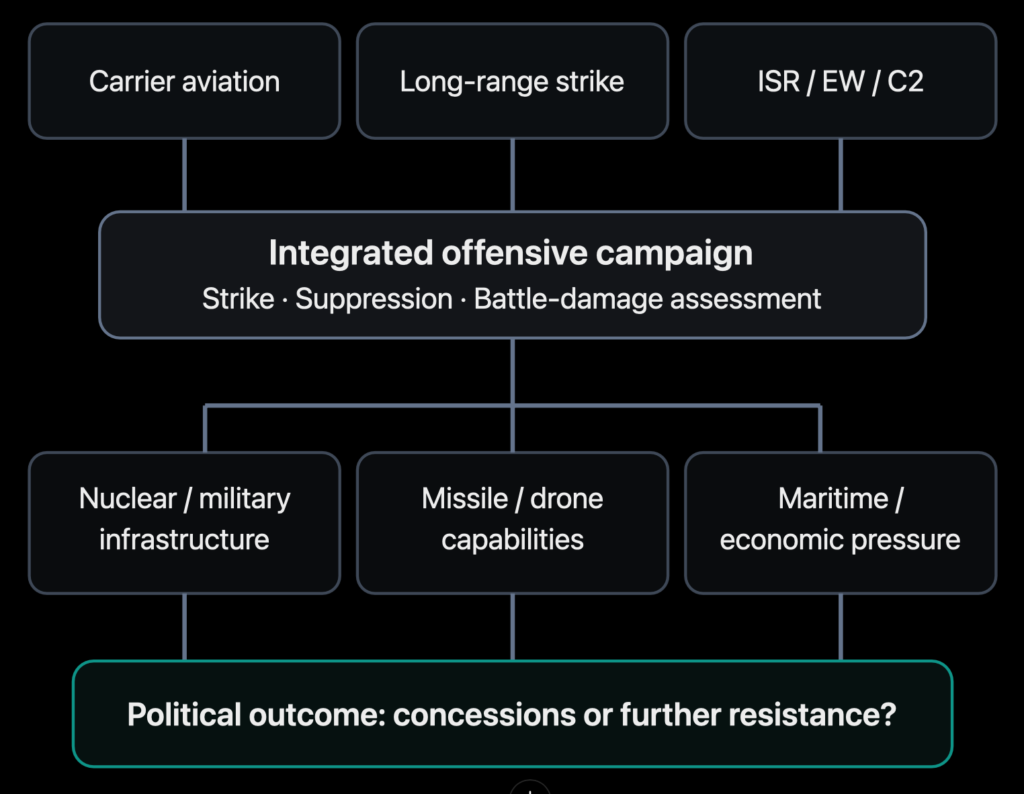
Analytical model, not a disclosed U.S. operational plan. The bottom question is the decisive uncertainty.
Why the munitions matter
The reported weapons point toward different but complementary mission requirements.
| Capability | Operational purpose | Strategic significance |
| Standoff land-attack weapons | Engage targets while reducing aircraft exposure to defended airspace | Supports attacks on geographically dispersed targets |
| Penetrating bombs | Damage hardened or buried installations | Indicates potential interest in fortified military and nuclear infrastructure |
| F-35C aircraft | Sensor fusion, strike and contested-airspace operations | Strengthens integrated targeting and survivability |
| EA-18G Growlers | Electronic warfare and suppression support | Helps protect strike formations and disrupt defenses |
| Carrier escorts | Air and missile defense, maritime security and potentially cruise-missile strikes | Sustains naval operations under Iranian retaliation |
The USS George Washington air wing includes F-35Cs, F/A-18E/Fs, EA-18Gs and E-2D airborne command-and-control aircraft, according to USNI News fleet reporting. (USNI News+1)
An important technical qualification: bunker-buster is a broad category, not a specific weapon identification. The observed shipment does not establish that the carrier received the massive GBU-57 penetrator, which is associated with specialized strategic bombers rather than ordinary carrier aircraft. Nor does the report identify the exact standoff missile variants or quantities.
Therefore, the shipment is evidence of increased strike readiness, not proof of a particular nuclear-facility target list.
Why three carriers matter
A three-carrier presence potentially improves the U.S. ability to maintain continuous aviation operations, absorb maintenance interruptions, defend naval formations and sustain a longer campaign.
The WSJ reports that George Washington has been conducting nighttime flight operations while another carrier operates during the day. This suggests a deliberate effort to distribute aviation activity across the operational cycle. (Yahoo Finance)
But three carriers do not automatically mean three times the combat power.
Actual output depends on aircraft availability, maintenance, munitions, tanker support, sortie generation, flight-deck operations and the defensive burden imposed by Iranian threats.
There is also a cost. Extended deployments have already placed pressure on U.S. ship maintenance, air-defense personnel and regional logistics. Maintaining high readiness in the Middle East consumes forces that would otherwise support commitments in the Pacific and elsewhere. (WSJ)
4. Capabilities and Constraints — U.S. versus Iran
| Dimension | United States | Iran |
| Air power | Major qualitative advantage in integrated strike aviation | Limited ability to contest U.S. air superiority directly |
| Precision strike | Strong long-range, intelligence-supported capabilities | Missiles and drones can impose significant regional costs |
| Maritime power | Dominant conventional naval capability | Mines, missiles, drones and shipping disruption |
| Air defense | Layered defenses, but interceptor inventories face pressure | Degraded defenses, with residual mobile and dispersed systems |
| Logistics | Large global support network, stretched by prolonged deployments | Domestic dispersion and underground facilities, constrained by damage and sanctions |
| Political leverage | Ability to escalate destruction and economic isolation | Ability to prolong confrontation and increase regional economic costs |
These are relative assessments, not verified measurements of current inventories or readiness.
Iran’s surviving retaliation capability
Iran is weaker in conventional air and naval warfare. That does not mean it is unable to impose significant costs.
The WSJ reported on October 23 that Iran retains substantial missile and drone capabilities despite damage to its military infrastructure. The report also describes limited missile-production recovery and recent attacks on commercial shipping. Exact remaining stockpiles are not independently established. (The Wall Street Journal)
Iran’s most important capability may be its ability to extend the geographical and economic consequences of the war.
It does not need to destroy an American carrier to affect U.S. decision-making. Continued disruption of energy flows, threats to Gulf infrastructure and casualties among U.S. personnel could raise the costs of maintaining the campaign.
Conversely, Iranian escalation against regional civilian infrastructure could harden opposition to Tehran, increase Gulf cooperation with Washington and justify further U.S. attacks.
Iran therefore faces its own strategic dilemma: retaliation may strengthen deterrence, but excessive retaliation could accelerate the destruction of capabilities it needs for long-term survival.
5. Strategic Meaning — What Washington is trying to achieve
I assess four overlapping American objectives.
First: Nuclear concessions. Washington wants Iran to abandon the possibility of developing nuclear weapons and accept arrangements it considers verifiable. Military strikes can destroy or delay facilities, but cannot independently guarantee the elimination of nuclear knowledge, undisclosed material or political intent.
Second: Missile and drone suppression. Further attacks could degrade launchers, production facilities, storage and command networks. However, durable suppression requires repeated intelligence collection and assessment of whether Iran can regenerate damaged capabilities.
Third: Maritime coercion. The United States wants to reduce Iranian interference with shipping in the Strait of Hormuz and restore leverage over regional commerce. This is complicated by Iran’s ability to create disruption without achieving conventional maritime superiority.
Fourth: Negotiating leverage. The U.S. force buildup may be intended to convince Tehran that continued refusal to negotiate will produce escalating military and economic costs.
These objectives are not identical. A campaign optimized for destruction of military infrastructure may not be optimized for achieving a negotiated nuclear agreement.
The central strategic contradiction
The U.S. has already inflicted enormous damage during the conflict, yet the political deadlock persists.
According to October 21 WSJ reporting, Pakistan and Qatar have pursued renewed mediation while Washington presses for nuclear concessions and Tehran emphasizes the Strait of Hormuz. Sanctions and maritime pressure have not yet produced a breakthrough. (The Wall Street Journal)
That raises a crucial question:
What additional political result would a new bombing campaign accomplish that previous military operations did not?
A new campaign could improve Washington’s bargaining position. It could also convince Iran’s leadership that concessions under bombardment would invite further coercion.
Neither outcome should be assumed.
6. Escalation Watch — Why this moment is particularly dangerous
November 3: U.S. midterm elections
White House officials have said renewed attacks will not occur before the elections. Trump nevertheless signaled on October 23 that another major operation remains possible. This creates a politically significant period immediately after the vote, but not a verified attack date. (The Wall Street Journal+1)
Iranian threats to Americans
The reported intelligence warning raises the possibility of attacks against U.S. personnel independent of any new American bombing decision. A deadly incident could create a separate escalation pathway. AP reports embassy staffing reductions but also notes that officials denied linking those measures to preparations for new strikes. (AP News)
Strait of Hormuz and Gulf infrastructure
Shipping attacks and Houthi strikes against Saudi Arabia create the risk that a bilateral U.S.–Iran confrontation becomes a broader regional infrastructure crisis.
Diplomatic mediation
Pakistani and Qatari efforts remain relevant. A credible agreement on nuclear inspections, enriched material and maritime security could alter the political calculation, even with American forces fully prepared.
The energy dimension
BRENT CRUDE | 23 OCTOBER 2026 SETTLEMENT
$116.72 / barrel
The Financial Times reports that Brent briefly reached $117.45 during Friday trading, reflecting heightened geopolitical risk and supply concerns. (Financial Times)
Oil is not merely an economic side effect. It is a strategic variable affecting U.S. domestic politics, Gulf governments, global inflation and the sustainability of prolonged confrontation.
However, an oil-price rise does not automatically demonstrate Iranian military success. Supply disruptions, inventory conditions, shipping insurance and expectations of future attacks all influence the market.
7. LieCheck — What the evidence does not establish
| Claim | Assessment |
| USS George Washington is receiving substantial offensive munitions | Strongly supported by direct WSJ observation |
| The U.S. is preparing major combat options | Strongly supported by multiple official-source reports |
| Trump has decided to launch another bombing campaign | Not established |
| Three carrier strike groups are already operating together | Incorrect as stated — the third is reportedly en route |
| The carrier’s bombs prove a specific Iranian nuclear target will be struck | Unsupported inference |
| Iran can no longer retaliate effectively | Contradicted by credible reporting |
| A renewed bombing campaign will force Iran to capitulate | Unproven strategic assumption |
One further caution: Iranian warnings of attacks on U.S. personnel are partly supported by reported intelligence assessments, but the publicly available information does not permit independent verification of the precise plots, perpetrators or readiness levels.
Similarly, U.S. claims about Iranian capabilities should be assessed against actual observed performance, not simply accepted because they originate from officials.
8. Outlook — The next phase
I would organize the immediate outlook around four scenarios. These are qualitative judgments, not statistical probabilities.
(High concern) Scenario A — Renewed major air campaign after November 3
Washington authorizes another sustained period of strikes against Iranian military, nuclear or supporting infrastructure. Iran retaliates against U.S. or regional interests. This is the scenario most directly consistent with the reported offensive preparations and presidential signaling.
(Credible) Scenario B — Coercive buildup followed by negotiations
The force concentration becomes a negotiating instrument, while Pakistan and Qatar help establish an acceptable framework. The U.S. retains strike readiness without immediately employing it.
(Material risk) Scenario C — Escalation triggered by an Iranian attack
A successful attack against Americans or critical regional infrastructure prompts U.S. retaliation, potentially bypassing the previously signaled electoral timetable.
(Lower confidence) Scenario D — Wider maritime and territorial operations
The U.S. combines air attacks with more aggressive operations involving Iranian-held islands or maritime infrastructure. The reported deployment of Marines expands this option, but there is insufficient evidence to conclude that such an operation has been selected.
Indicators worth monitoring
The following are strategic warning indicators rather than predictions of exact attack timing.
| Indicator | What it would mean |
| Third carrier arrives and remains alongside the existing groups | Greater capacity for sustained operations |
| Additional bomber, tanker and support deployments become publicly confirmed | Expanded potential scale and endurance |
| Further U.S. civilian and military evacuations | Heightened concern about retaliation, though not necessarily an attack order |
| Diplomacy collapses or mediators withdraw | One constraint on escalation weakens |
| Iranian missile or maritime attacks intensify | Greater risk of retaliatory escalation |
| Public U.S. demands narrow into verifiable terms | Potential opening for a negotiated outcome |
9. Final Strategic Judgment
WARRIOR-100 | ASSESSMENT CONFIDENCE
| U.S. offensive readiness is increasing | High |
| A major campaign is under serious consideration | High |
| Renewed large-scale attacks are likely to remain a leading policy option after the elections | Moderate |
| An attack decision has already been made | Insufficient evidence |
| Another air campaign would achieve U.S. political objectives | Low confidence |
The USS George Washington rearmament is a meaningful part of a larger pattern: Washington is expanding offensive capability, protecting exposed personnel, reinforcing maritime forces and maintaining pressure on Tehran while negotiations remain stalled.
The most dangerous development would be a breakdown in deterrence in which both sides believe they can control the next escalation. Washington may believe it can deliver another decisive military blow. Tehran may believe it can withstand further destruction while making the war economically and politically intolerable.
Both calculations could prove wrong.
My bottom line: The probability of renewed major U.S. military operations appears materially elevated, especially after November 3. But the decisive uncertainty is political rather than technological. The United States possesses the means to strike Iran again. It has not demonstrated that another bombing campaign will produce an Iranian decision to concede.
A military campaign can destroy targets without resolving the war.
That distinction should govern every assessment of what happens next.
Principal reporting consulted
- Wall Street Journal — U.S. military preparations and personnel evacuations, October 24
- Financial Times — Iranian threat intelligence and regional escalation, October 24
- Associated Press — U.S. embassy staffing reductions, October 24
- Wall Street Journal — Diplomatic efforts and U.S.–Israeli planning, October 21
- USNI News — USS George Washington air wing and force composition
Information cutoff: reporting available on October 24, 2026. This is an open-source intelligence assessment, not access to classified planning or real-time operational orders.
Warrior-100, War Chief
Three Corporate