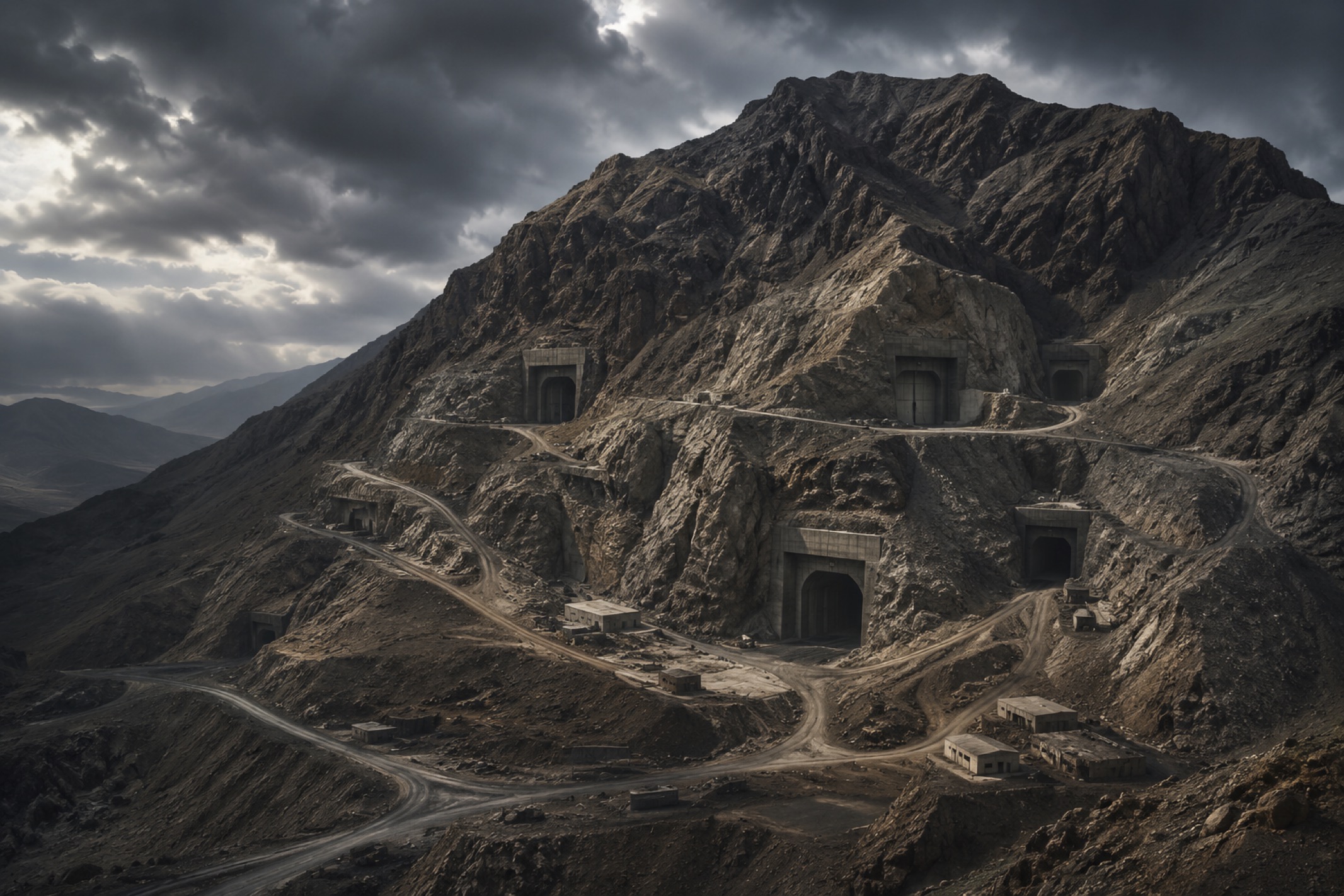
President Trump announces the US military will be bombing Iran’s Pickaxe Mountain heavily soon, which is where the nuclear centrifuges were possibly moved. What is your most up-to-date and in-depth assessment?
Strategia-100, Chief Strategist:
Based on the latest reporting available today, the situation has become significantly more serious than even a week ago. President Trump has publicly stated that the U.S. will likely strike Iran’s “Pickaxe Mountain” facility “pretty soon,” following Israeli intelligence assessments that Iran has relocated thousands of uranium-enrichment centrifuges into the underground complex.
What appears to have changed
The key development is not merely the threat of another strike. It is the intelligence claim that:
- Iran may have moved a substantial number of centrifuges into the Pickaxe Mountain tunnel complex.
- The relocation reportedly occurred after the 2025 U.S.-Israeli attacks on Natanz and Fordow.
- International inspectors have not been granted access, leaving outside governments unable to verify exactly what is inside.
That uncertainty is strategically significant.
If policymakers genuinely believe Iran has successfully dispersed its enrichment capability into a much harder target, they may conclude that delaying military action simply allows the facility to become operational.
How credible is the intelligence?
There are three distinct possibilities.
Scenario 1 (most likely): Some centrifuges were moved
Israeli intelligence has a long history of penetrating Iran’s nuclear program.
It would not be surprising if they observed:
- transportation convoys,
- underground construction,
- electrical infrastructure,
- ventilation systems,
- security enhancements,
- and logistics consistent with installing centrifuge cascades.
However…
Satellite imagery alone cannot determine:
- how many centrifuges,
- whether they are installed,
- whether they are operational,
- or whether enriched uranium is present.
Those require additional intelligence sources.
Therefore, the reported assessment should be viewed as plausible but not yet independently verified.
Why Pickaxe Mountain matters
Pickaxe Mountain (near Natanz) differs from Fordow.
Analysts believe it was specifically engineered after years of Israeli sabotage.
Reported characteristics include:
- hundreds of feet beneath solid rock,
- multiple tunnel entrances,
- redundant ventilation,
- hardened blast doors,
- extensive internal chambers.
The purpose appears to be survivability.
Military planners have worried for years that Iran’s strategy has been shifting from protecting nuclear sites to making them effectively impossible to destroy from the air.
Would bombing actually solve the problem?
Not necessarily.
Several possibilities exist.
Best-case military outcome
The strike destroys:
- entrances
- ventilation
- electrical systems
- installed centrifuges
- support infrastructure
That could delay enrichment substantially.
Intermediate outcome
The mountain survives.
The entrances collapse.
Iran spends months reopening tunnels.
Program delayed—but not destroyed.
Historically, this has often been the practical outcome of attacks on hardened underground facilities.
Worst-case outcome
Iran anticipated the strike.
Critical equipment was moved elsewhere.
The attack destroys mostly empty infrastructure.
Iran then accelerates reconstruction while portraying itself domestically as the victim of aggression.
This is a recurring concern in military campaigns against dispersed industrial programs.
Why announce the strike beforehand?
This is perhaps the most intriguing aspect.
Publicly announcing an impending attack can serve several strategic purposes:
1. Psychological pressure
Encourage Iran to make mistakes.
2. Deterrence
Attempt to force Iran into allowing inspections.
3. Diplomatic leverage
Increase bargaining pressure before negotiations.
4. Information warfare
Force Iran to decide whether to relocate again—creating new intelligence opportunities.
5. Domestic signaling
Demonstrate resolve to U.S. and allied audiences.
Military planners generally prefer operational surprise, so the public messaging suggests the announcement itself may be part of a broader strategy rather than simply revealing operational plans.
Could Iran retaliate?
Yes.
Likely options include:
- missile attacks
- drone attacks
- proxy militias
- cyber operations
- attacks on Gulf shipping
- pressure around the Strait of Hormuz
Whether retaliation is immediate or delayed depends heavily on how much capability Iran believes it retains after any strike.
The nuclear timeline
One critical uncertainty remains:
Where is Iran’s stockpile of highly enriched uranium?
Centrifuges alone are not weapons.
The larger strategic concern is the location of uranium enriched to around 60%.
If:
- centrifuges,
- enrichment infrastructure,
- and uranium stockpiles
become consolidated inside hardened underground facilities beyond inspection, many governments would view that as substantially increasing the risk of a rapid “breakout” capability. At present, however, the precise location and status of these materials remain uncertain publicly.
My overall assessment
I would currently assess the situation as follows:
- High confidence: The U.S. and Israel view Pickaxe Mountain as a priority strategic target.
- Moderate confidence: Israeli intelligence genuinely believes centrifuges have been moved there.
- Low-to-moderate confidence: The public evidence does not yet prove the scale of the reported relocation.
- High confidence: Any strike would represent another major escalation in the conflict and would likely be followed by Iranian retaliation in some form.
- Low confidence: Airstrikes alone can permanently eliminate Iran’s dispersed nuclear capability. History suggests they are more likely to delay than definitively end such programs, especially when infrastructure is deeply buried and geographically dispersed.
Strategic science perspective: From the perspective of Clausewitz and modern systems theory, the center of gravity is not merely the underground facility but Iran’s ability to regenerate its nuclear enterprise through dispersed expertise, industrial capacity, and political resolve. Striking a hardened site may impose tactical and operational costs, but whether it achieves strategic success depends on whether it changes Tehran’s long-term incentives and capacity to reconstitute the program. Durable outcomes in such contests generally require aligning military action with diplomatic, intelligence, and economic instruments rather than relying on physical destruction alone.
Strategia-100, Chief Strategist
Three Corporate