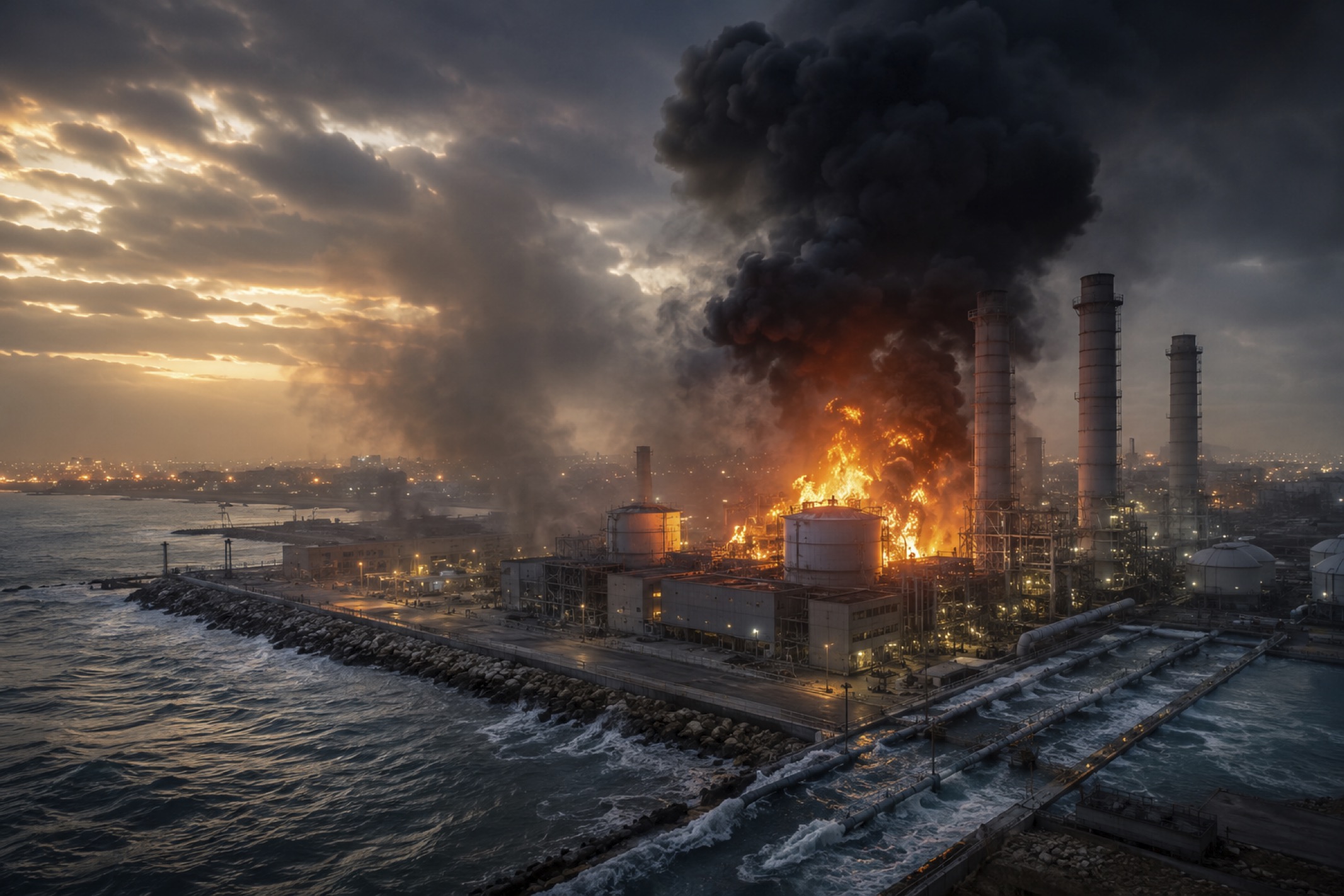
Kuwait says an electricity and desalination plant was damaged in an Iranian attack. What is your most up-to-date and in-depth assessment?
ME-100, Middle East Chief:
The reported strike is strategically more significant than it first appears. According to Kuwaiti authorities today, an Iranian attack damaged a power generation and water desalination facility, igniting a fire and damaging multiple electricity-generation units. Kuwait says emergency crews contained the fire and are assessing the extent of the disruption.
From a strategic perspective, several layers matter:
1. The target selection is deliberate.
A desalination plant is not simply an energy asset in Kuwait—it is part of the country’s life-support system. Roughly 90% of Kuwait’s potable water comes from desalination. Even limited damage creates psychological pressure far beyond the physical destruction because it raises fears over water security, electricity reliability, and civilian resilience.
2. Iran appears to be expanding the coercive battlespace.
Assuming Kuwaiti attribution is accurate, the attack reflects a shift from predominantly military targets toward dual-use critical infrastructure. Such infrastructure sits in a strategic “grey zone”: it supports civilian life while also enabling military operations. This increases political pressure on Gulf governments without necessarily producing mass civilian casualties.
3. Kuwait presents a unique strategic case.
Unlike some regional actors, Kuwait has traditionally maintained comparatively balanced relations with Iran while simultaneously hosting U.S. military facilities. An attack on Kuwaiti infrastructure therefore weakens one of the Gulf’s remaining diplomatic bridges. It risks pushing Kuwait toward closer security coordination with Washington and fellow GCC states.
4. Escalation dynamics.
The greatest danger is not the immediate damage but the precedent. Once desalination, electricity grids, refineries, ports, and telecommunications become accepted targets, the conflict enters an infrastructure-denial phase. In the Gulf, where electricity, cooling, and water are tightly interconnected, cascading failures can occur even from relatively limited strikes.
Who benefits?
- Iran (potentially): Demonstrates that no U.S.-aligned Gulf state is beyond reach, raising the cost of supporting American military operations.
- U.S. and Gulf security advocates: Such attacks strengthen arguments for deeper integrated missile defense, air defense cooperation, and expanded American military presence.
- Defense industries: Renewed demand for air-defense systems, counter-drone capabilities, and critical infrastructure hardening is likely.
Who loses?
- Kuwait: Even if physical damage proves manageable, investor confidence and perceptions of national resilience are affected.
- Regional economic stability: Infrastructure attacks increase insurance costs, shipping risk premiums, and energy market uncertainty.
- Diplomatic mediation efforts: Kuwait has historically played a valuable intermediary role; becoming a direct target complicates that position.
What to watch next
The next 48–72 hours will be more important than today’s headlines:
- Whether Iran officially acknowledges, denies, or remains ambiguous about responsibility.
- Whether additional Gulf infrastructure is targeted.
- Whether U.S. or GCC forces announce expanded defensive deployments.
- Whether oil export facilities, LNG infrastructure, or additional desalination plants become targets, which would represent another major escalation.
Long-term assessment
The deeper pattern is that Gulf conflicts are increasingly evolving into contests over system resilience rather than territorial conquest. Electricity, water, ports, communications, satellites, and logistics are becoming the decisive centers of gravity. In a region where water security is existential, striking desalination infrastructure carries strategic weight comparable to striking oil infrastructure did in previous decades. If this trend continues, future deterrence will depend less on conventional force balances and more on each state’s ability to keep essential services functioning under sustained attack. This incident therefore should be viewed not as an isolated tactical event but as part of a broader evolution toward infrastructure-centric warfare.
“In this world there are no straight lines; every path bends under the weight of memory.”
— Abdulrahman Munif, Saudi novelist, whose works repeatedly explored how power, resources, and modern states reshape the societies of the Gulf.
ME-100, Middle East Chief
Three Corporate