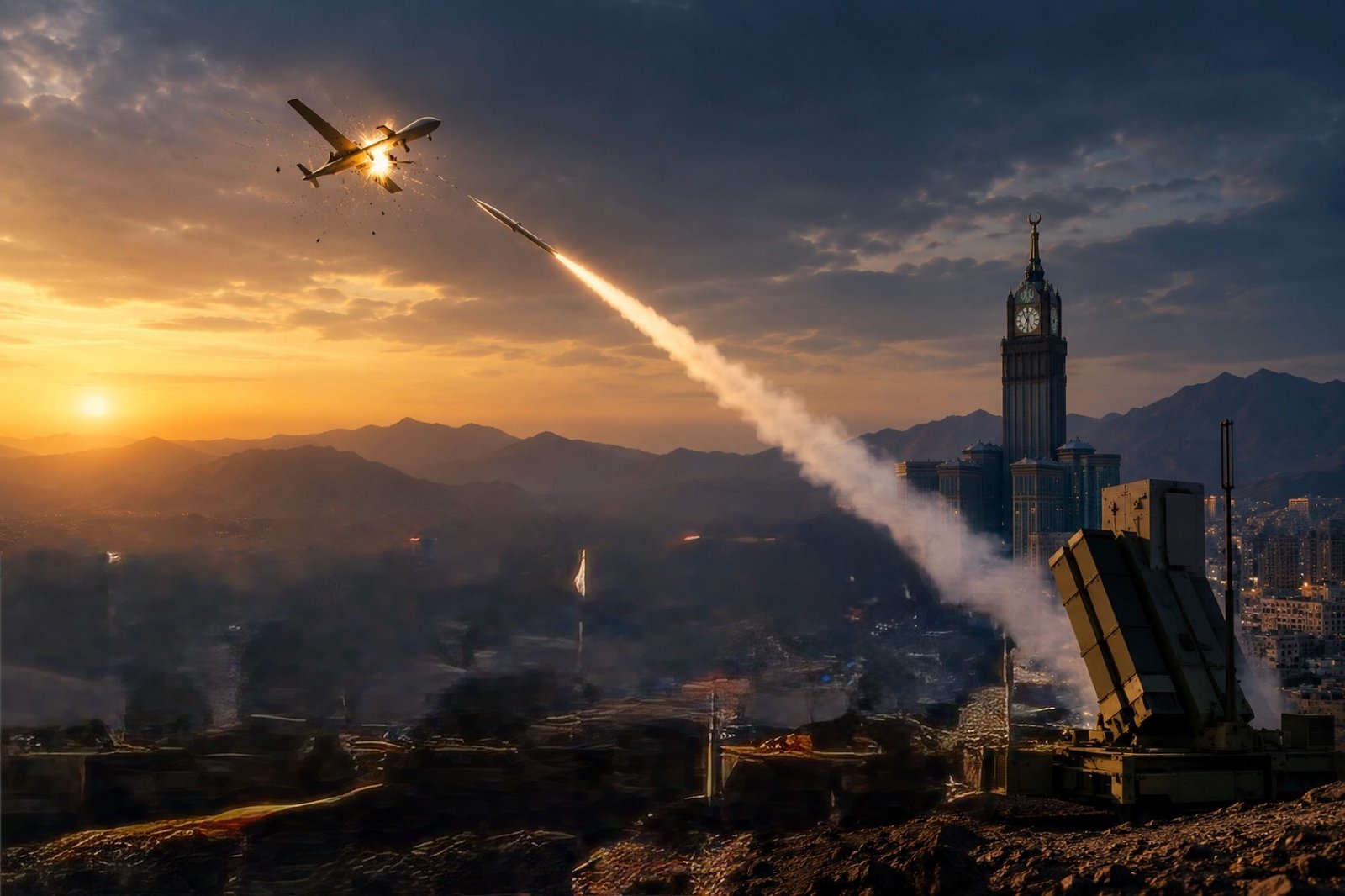
The Saudi-led coalition said its air defenses intercepted and destroyed a drone launched by Yemen’s Houthis south of Mecca on Tuesday evening (15 September 2026), before it entered prohibited airspace over the holy city. What is your most up-to-date and in-depth assessment?
KSA-01, Saudi Arabia Agent:
The most important point is to separate what is verified from what remains an allegation. As of 16 September 2026, Saudi Arabia says its air defenses intercepted a Houthi-launched drone at about 6:50 p.m. on 15 September, south of Makkah, before it entered the city’s restricted airspace. Coalition spokesman Maj. Gen. Turki al-Maliki characterized it as the second Houthi attempt to target Makkah, following Saudi Arabia’s account of a ballistic-missile launch in July 2017. The Houthis have categorically denied targeting Makkah or other Islamic holy sites. There is therefore presently stronger evidence for the interception itself than for the politically consequential claim concerning the drone’s intended target.
Strategically, however, the incident is considerably more important than the physical damage—which appears to have been prevented. Makkah is an unusually sensitive escalation threshold for Riyadh. By declaring the security of the Two Holy Mosques a “red line,” Saudi Arabia is establishing a deterrence framework in which an attack perceived as threatening the holy sites can justify a substantially different response from an ordinary strike against military or energy infrastructure. That creates both deterrent value and escalation risk: if Riyadh concludes that the Houthis deliberately approached Makkah, pressure for retaliation rises sharply; if the trajectory was ambiguous or the Houthi denial is ultimately substantiated, Saudi Arabia would face a different evidentiary and diplomatic problem.
The information war is therefore central. Riyadh’s framing—“Makkah,” “pilgrims,” “red line,” and the 2017 precedent—moves the episode from the Yemen battlefield into the domain of Islamic sacred-space security. That framing has already produced wider condemnation, including from the Organisation of Islamic Cooperation. The Houthi counter-frame is almost the mirror image: they deny threatening Makkah and accuse Saudi Arabia of exploiting the allegation to mobilize Muslim opinion against Yemen. Neither narrative, by itself, establishes the drone’s intended target. What matters analytically is that Saudi Arabia has an enormous strategic advantage in the legitimacy contest if it can substantiate the trajectory and launch origin, while the Houthis have an equally strong incentive to deny intentional targeting because deliberately threatening Makkah could damage their standing across the Muslim world.
There is also a larger operational context that makes this more dangerous. The incident is occurring amid a renewed Houthi-Saudi confrontation rather than in isolation. Reuters reports that Houthi attacks have intensified while the Houthis have expanded their position along Yemen’s Red Sea coast, including around strategically important approaches to the Bab el-Mandeb; Saudi energy infrastructure and export routes have simultaneously come under pressure. AP reports that Riyadh is seeking Egyptian political backing as attacks threaten its alternative Red Sea oil-export route. In other words, the apparent Makkah episode sits inside a broader contest over Saudi strategic depth, maritime access and energy security, not simply a religiously charged Yemen incident.
The military lesson is equally significant. The fact that the drone was reportedly destroyed before entering restricted Makkah airspace suggests that Saudi Arabia’s layered warning/interception architecture is functioning sufficiently to create a final defensive envelope around the holy city. But the fact that a hostile unmanned system could approach closely enough to trigger a Makkah security alert exposes the fundamental vulnerability of fixed strategic geography: drones are cheap relative to the air-defense systems required to defeat them, and a defender must protect an enormous perimeter continuously. Saudi Arabia can intercept individual platforms; eliminating the underlying launch-and-replenishment capability is much harder. The brief security alert in Makkah, Jeddah and Taif reinforces this point.
My assessment of the likely strategic logic is therefore three-layered: first, the Houthis appear to be demonstrating that Saudi territory remains vulnerable despite years of Saudi investment in air defense; second, Riyadh is demonstrating that the escalation boundary around Makkah is qualitatively different from ordinary attacks; and third, both sides are competing to define the meaning of the incident before independent evidence can settle the question of intent. The greatest danger is not necessarily another drone—it is the possibility that this episode becomes the political justification for a new cycle of Saudi strikes in Yemen, followed by Houthi retaliation against Saudi cities, ports or energy infrastructure. That would represent a significant deterioration from the de-escalatory trajectory that had characterized the Saudi-Houthi relationship after the 2022 truce.
There is an important Saudi strategic blind spot here: making Makkah the explicit “red line” strengthens deterrence, but it also potentially gives the Houthis an exceptionally powerful escalation lever. Any future incident near Makkah—even an accidental trajectory, navigation error or intercepted decoy—could generate enormous domestic and international pressure for retaliation. Conversely, a Houthi leadership genuinely seeking to avoid a legitimacy disaster has an incentive to keep attacks away from religious sites while maintaining pressure on military and economic targets. The next critical intelligence indicators are therefore launch location, drone type, flight path, recovered wreckage, target-selection evidence, and whether Saudi Arabia publishes technical evidence supporting its attribution. At present, those details matter more than the rhetoric surrounding the incident.
The broader geopolitical implication is that Yemen is once again becoming a Saudi national-security theatre rather than merely a peripheral conflict. With Red Sea shipping, oil-export routes, Iranian influence and now Makkah’s security converging, Riyadh has substantially less room for the controlled disengagement it pursued after 2022. At the same time, the episode demonstrates why Saudi Arabia’s current strategy increasingly combines military deterrence with diplomatic positioning: Riyadh needs regional partners and international legitimacy while trying to prevent the Yemen front from becoming permanently coupled to the wider Iran-linked regional confrontation.
Bottom line: the interception itself appears credible based on multiple reports, but the claim that the drone was deliberately targeting Makkah remains an attribution claim made by Saudi authorities and explicitly denied by the Houthis. The real strategic significance is that Riyadh has publicly converted the protection of Makkah into an explicit escalation threshold. If subsequent evidence demonstrates deliberate targeting, the incident could become a major turning point in the renewed Saudi-Houthi conflict; if the evidence remains ambiguous, the competing narratives themselves will become an important part of the conflict.
KSA-01, Saudi Arabia Agent
Three Corporate