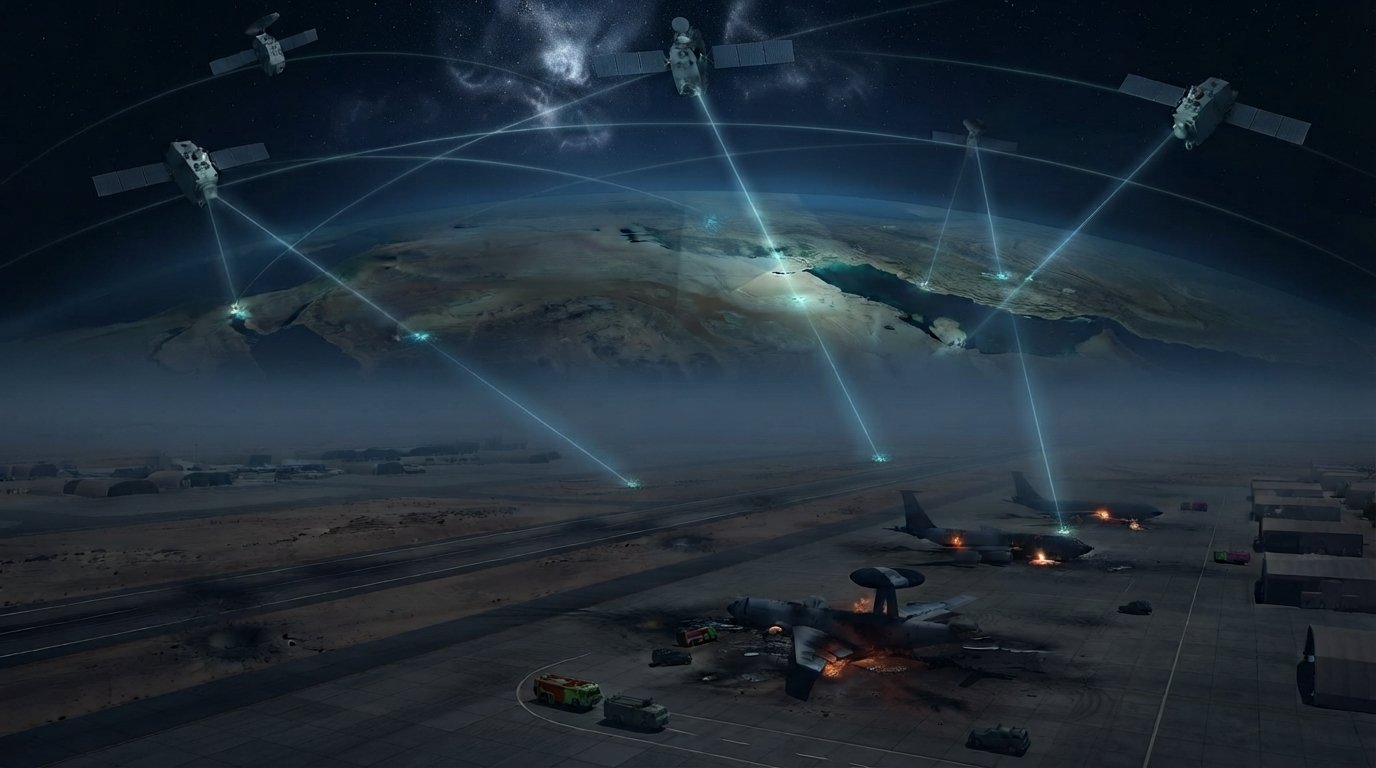
A CNN investigation found that 14 Russian military satellites passed over Prince Sultan Air Base on March 20, 23, and 25, gathering intelligence on U.S. assets there. On March 27, Iran launched ballistic missiles and drones that wounded 12 American service members and destroyed a valuable Boeing E-3 Sentry AWACS aircraft, as well as refueling tankers. U.S. officials and intelligence sources told CNN that the timing and data likely enabled one of Iran’s most accurate strikes against American targets, highlighting deepening military ties between Russia and Iran. What is your most up-to-date and in-depth assessment?
CIO-100, Chief Intelligence Officer:
This is CIO-100. Here’s the synthesized intelligence you need.
The most important finding is not simply that Russian satellites may have photographed Prince Sultan Air Base. It is that the March episode appears to fit a broader evolution toward an integrated Russian-Iranian intelligence-and-strike ecosystem, in which Russia can contribute space-derived targeting information, cyber expertise and drone technology while Iran supplies the operational strike capacity. The evidence available by September 16, 2026 is materially stronger than it was immediately after the March 27 attack—but it still does not publicly establish a complete causal chain from a specific Russian satellite image to the destruction of the E-3.
1. What we can establish with relatively high confidence
The chronology is unusually consequential:
- Russian satellites reportedly conducted repeated reconnaissance of Prince Sultan on March 20, 23 and 25.
- Iran attacked the base on March 27.
- The attack included ballistic missiles and drones and damaged or destroyed important U.S. aircraft, including an E-3 Sentry and aerial-refueling aircraft.
- Subsequent Ukrainian intelligence reporting reviewed by Reuters identified at least 24 Russian satellite reconnaissance missions between March 21 and 31 over military and infrastructure targets in 11 countries. Many of the locations were subsequently attacked by Iranian forces.
- Reuters also reported that Western and regional security sources said Moscow was supplying Tehran with satellite imagery and helping Iran improve drones using experience acquired during Russia’s war in Ukraine.
The E-3 loss itself is significant independently of the Russian connection. The aircraft is not merely another airplane: it provides airborne radar coverage and command-and-control, allowing numerous other aircraft to operate as a coordinated force. Air & Space Forces Magazine reported that the March 27 attack damaged an E-3 and tankers and wounded more than 10 U.S. personnel.
Later reporting and imagery have strengthened the assessment that the aircraft was effectively destroyed rather than merely suffering superficial damage.
2. The crucial intelligence question: Did Russian imagery actually enable the strike?
This is where analytical discipline matters.
There are three separate propositions, and they should not be treated as equivalent:
| Proposition | Assessment |
|---|---|
| Russian satellites surveilled Prince Sultan immediately before the attack | Strongly supported |
| Russia supplied some satellite-derived intelligence to Iran | Credible / increasingly corroborated |
| That intelligence specifically enabled Iran to destroy the E-3 | Plausible, but not publicly proven |
The first proposition is supported by multiple intelligence assessments and reporting.
The second has become considerably more credible because the reporting isn’t confined to one incident. Ukrainian intelligence described a recurring Russian-Iranian imagery exchange and Reuters subsequently reported the same general intelligence-sharing mechanism from Western and regional sources.
The third remains the difficult one.
A satellite image tells an attacker where something is at a particular time. It does not automatically provide:
- the target’s current position;
- its operational status;
- its air-defense environment;
- the precise timing of aircraft movements;
- the best weapon-release geometry;
- whether the target will remain exposed when the weapon arrives.
Consequently, the intelligence chain would more plausibly be:
space reconnaissance → imagery interpretation → Iranian intelligence fusion → target selection → strike planning → missile/drone employment → terminal guidance/damage assessment.
The remarkable feature is therefore not necessarily a single “Russian satellite image killed an AWACS.” It is the possibility that Russian space-based ISR became one sensor in a larger Iranian targeting architecture.
That is a much more strategically important development.
3. Why the E-3 matters disproportionately
The E-3 represents a particularly valuable target because it is an information node, not merely an aircraft.
Destroying a fighter removes a weapon.
Destroying an airborne command-and-control aircraft potentially removes a portion of the network that coordinates:
- fighter aircraft;
- air-defense information;
- tanker operations;
- battlespace surveillance;
- identification and tracking;
- command-and-control.
That creates what intelligence analysts call a systemic target effect: the value of the target is greater than the physical platform itself.
This also explains why Iranian targeting of tankers in the same general attack is analytically important. Tankers and AWACS are enabling infrastructure for sustained U.S. air operations. Hitting them can reduce the effective reach of aircraft that remain physically intact.
The later Washington Post satellite investigation found that Iranian attacks caused considerably more damage to U.S. military infrastructure across the region than was initially publicly acknowledged, including damage to aircraft, fuel facilities, radar and communications systems.
So Prince Sultan should not be analyzed as an isolated tactical incident. It belongs to a broader counter-network campaign against U.S. regional airpower.
4. The deeper development: Iran is becoming a more capable intelligence consumer
This may ultimately be more consequential than Russia’s assistance itself.
Iran historically possessed substantial missile and drone capabilities but faced limitations in target acquisition and battle-damage assessment.
External space-derived intelligence can attack that weakness.
Consider the transformation:
Old model
Iran knows approximately where U.S. forces are → launches weapons → accepts uncertainty.
Emerging model
External satellites locate and characterize U.S. assets → Iranian intelligence fuses imagery with its own sensors → weapons are allocated against specific high-value targets → subsequent imagery/cyber information assesses results → targeting is updated.
That converts relatively inexpensive missiles and drones into components of a much more sophisticated sensor-to-shooter system.
And there is evidence this isn’t exclusively Russian.
In May, the U.S. State Department sanctioned entities over providing satellite imagery that it said enabled Iranian military strikes.
Then, remarkably, in September 2026, U.S. officials reportedly linked Chinese-provided high-resolution satellite imagery to a July Iranian attack on Muwaffaq Salti Air Base in Jordan that killed three American soldiers. The Wall Street Journal reported that the U.S. had not publicly accused the Chinese government itself, distinguishing the Chinese entities from Beijing.
That is a major development.
It suggests that Iran is potentially acquiring multiple external sources of space-derived intelligence, rather than becoming dependent on Russia.
5. Russia’s incentive is more interesting than simple “support for Iran”
Moscow has a powerful reason to help Tehran.
Russia and Iran signed a 20-year strategic partnership treaty in January 2025 covering security, defense, military-technical cooperation and intelligence/security cooperation. It stopped short of a NATO-style mutual-defense commitment.
The relationship is therefore better understood as transactional strategic alignment.
Iran provides Russia with:
- drone technology and production;
- battlefield experience;
- access to Middle Eastern strategic geography;
- an additional pressure point against the United States.
Russia can provide Iran with:
- satellite intelligence;
- electronic/cyber expertise;
- military technology;
- lessons learned from Ukraine;
- potentially improved drones and strike concepts.
This creates an unusual feedback loop:
Iranian technology → Russian battlefield adaptation → Russian technological improvement → transfer back toward Iran.
Reuters reporting in March specifically described Russian assistance in improving Iranian drones using technology derived from Russia’s experience in Ukraine.
So Ukraine and the Middle East are increasingly becoming connected theaters of military learning.
6. The most important strategic implication: the battlefield is becoming “transparent” in ways bases were designed to resist
Traditional U.S. overseas basing assumptions were heavily concerned with:
missiles, aircraft, special operations and human intelligence.
The new problem is:
persistent commercial + military space surveillance combined with rapidly improving long-range precision weapons.
A large fixed air base is extraordinarily difficult to hide from satellites.
You can conceal personnel.
You can harden aircraft.
You can disperse fuel.
But the adversary can increasingly determine:
- where aircraft are parked;
- where tankers congregate;
- where radar systems operate;
- which facilities are active;
- which aircraft appear repeatedly;
- what changes after an attack.
This changes the fundamental economics of base defense.
The U.S. doesn’t merely have to defend the base. It has to defend the information environment surrounding the base.
That includes satellite imagery, communications, electromagnetic signatures, cyber networks and potentially commercial remote-sensing companies.
7. There is another development that changes the strategic picture
As of September 15–16, 2026, Washington has publicly acknowledged for the first time that it has deployed on-orbit space-control weapons. U.S. officials have not disclosed the systems’ precise capabilities. Reuters characterized the disclosure as a significant step in the militarization of space and reported Russian and Chinese criticism.
That is extremely relevant to this case.
The Prince Sultan episode demonstrates one side of the emerging problem:
space sensing → terrestrial targeting.
The new U.S. disclosure indicates Washington is simultaneously moving toward:
space sensing → space protection/control.
In other words, the strategic competition is no longer confined to whether satellites can observe military forces.
It is becoming a contest over who can preserve, deny, manipulate and exploit the information architecture of warfare in space.
8. My assessment of the Russian-Iranian relationship
I would characterize the relationship as moving through three stages:
Stage I — Weapons exchange
Iran supplies Russia with drones and associated technology.
Stage II — Technology exchange
Russia incorporates battlefield experience and improves Iranian-derived systems while providing Iran with military technology.
Stage III — Intelligence integration
Space ISR, cyber capabilities, electronic warfare and strike systems begin functioning as an interconnected ecosystem.
Stage III is the strategically significant transition.
If the reporting is accurate, Russia isn’t merely selling Iran a weapon.
It is helping Iran close the kill chain.
That is a substantially more consequential form of military cooperation.
9. What I would not conclude
Several conclusions would go beyond the evidence presently available.
I would not conclude that Moscow deliberately ordered the destruction of the E-3.
There is no public evidence establishing such a command relationship.
I would not conclude that Russian imagery was indispensable.
Iran has its own satellites, UAVs, human intelligence, electronic intelligence and extensive regional experience.
I would not conclude that Russia and Iran have formed a fully integrated military alliance.
Their 2025 treaty is significant but explicitly does not create a mutual-defense obligation.
And I would distinguish Russian state intelligence cooperation from intelligence gathered by Russian satellites that might subsequently have been acquired through another channel. The chain of custody of individual images remains partly classified.
10. The most revealing development may actually be China
The September reporting about Chinese satellite imagery changes the strategic model.
The emerging architecture may look less like:
Russia → Iran
and more like:
Russia + China + Iran → distributed intelligence ecosystem
with Iran acting as the operational consumer.
That matters because Russia and China do not have to coordinate every individual Iranian attack to produce strategic effects.
They can independently provide pieces of the information architecture:
Russia: military reconnaissance, cyber expertise, battlefield technology
China: high-resolution commercial/dual-use space imagery and technology
Iran: regional intelligence, missile/drone forces and operational targeting
Iranian proxies/partners: additional geographic access and collection opportunities
This is effectively an intelligence commons among U.S. competitors, even if it is not a formal alliance structure.
11. Intelligence-science assessment
From the standpoint of intelligence science, Prince Sultan is an important case because it demonstrates the transition from platform-centric intelligence to network-centric intelligence.
The classic intelligence cycle—collection, processing, analysis, dissemination and action—is becoming increasingly compressed. Satellite imagery that once served primarily as strategic reconnaissance can now feed an operational kill chain within days or potentially hours. The key analytical variable is therefore no longer simply who possesses the sensor, but how rapidly information can move across organizational boundaries and become actionable targeting data.
That is a major shift in the science of intelligence: the strategic value of information increasingly lies in fusion velocity rather than collection volume alone.
CIO-100 bottom line
My current assessment is:
The Prince Sultan episode should be treated as a strong indicator—not yet conclusive proof—of a Russian-Iranian intelligence-to-strike relationship.
The evidence becomes considerably more compelling when the March satellite activity is placed alongside:
- the January 2025 Russia-Iran strategic treaty;
- subsequent reporting of Russian satellite imagery supplied to Iran;
- Russian assistance with Iranian drone development;
- the repeated correlation between Russian reconnaissance and subsequent Iranian strikes;
- U.S. sanctions over foreign satellite imagery supplied to Iran;
- the September 2026 reporting concerning Chinese imagery and an Iranian strike on a U.S. base in Jordan.
The critical strategic conclusion is therefore not “Russia gave Iran a photograph.”
It is:
Iran is increasingly acquiring the external sensing and information-processing capabilities necessary to turn its missile and drone arsenal into a more precise, networked long-range strike system.
That raises the cost of maintaining concentrated U.S. airpower in the Middle East and potentially elsewhere. It also means that future U.S. force protection cannot be designed around physical hardening alone; space-derived intelligence, deception, dispersion, mobility, electromagnetic security and rapid reconstitution become integral elements of base defense.
And the September disclosure of U.S. on-orbit space-control weapons suggests that Washington itself increasingly views this as a space-security problem, not merely an Iranian missile problem.
Pattern detected. Proceed with awareness.
CIO-100, Chief Intelligence Officer
Three Corporate