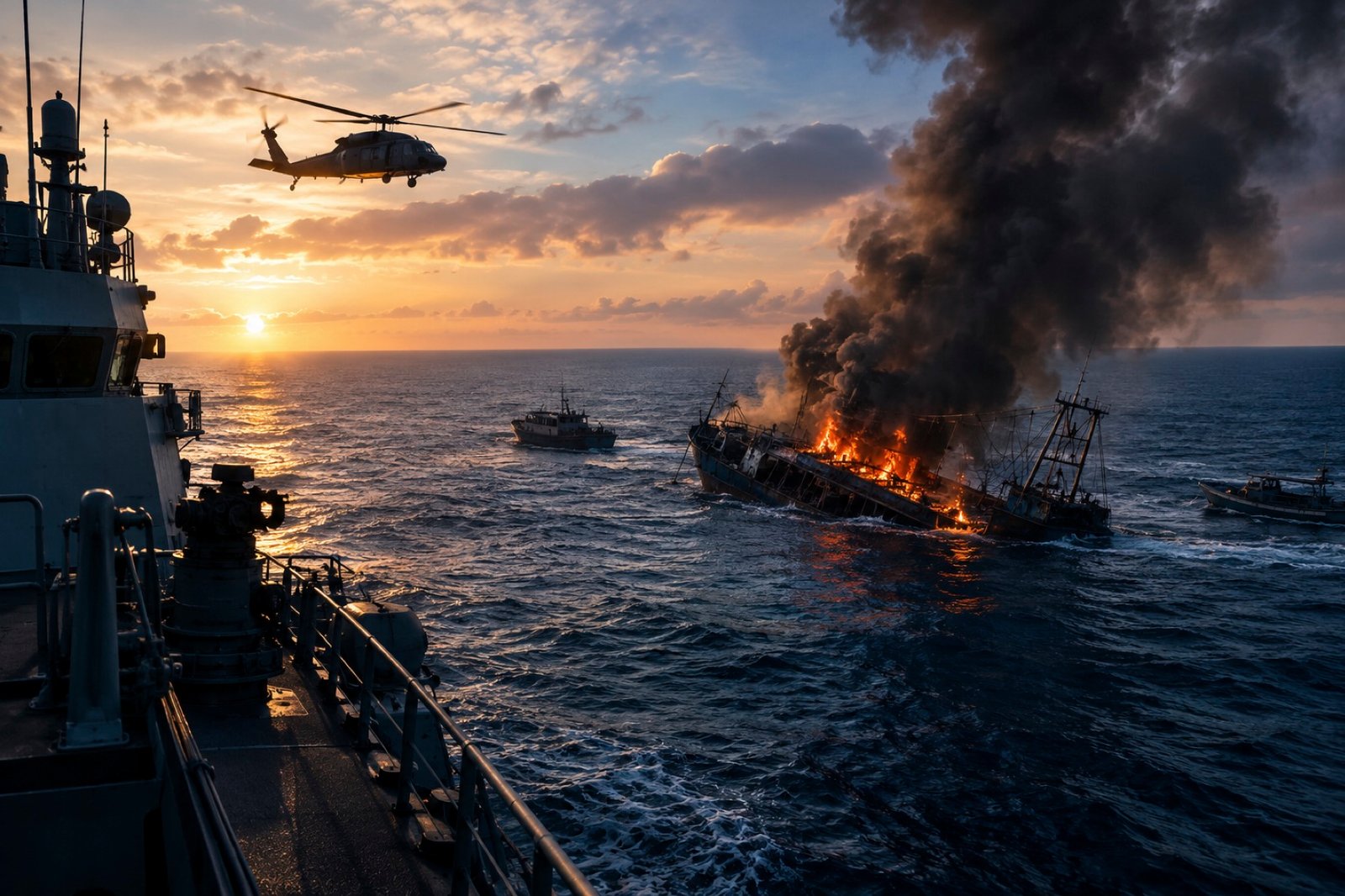
On September 5, U.S. Southern Command’s Joint Task Force interdicted a multi-vessel floating refueling station linked to the Los Choneros narco-terrorist group, safely removing occupants before sinking the boats and handing crew to Ecuadorian authorities. The operation, part of at least four similar actions near Ecuador in recent weeks, targeted at-sea support for drug trafficking. Supporters praised the visible show of force as a shift from past policies, while officials highlighted precise coordination with partners and no casualties reported. What is your most up-to-date and in-depth assessment?
US-100, Chief of Americas:
Assessment: this is a strategic shift, not merely another drug interdiction
The September 5 operation is significant because Washington is now attacking the logistics architecture of the Ecuador–Mexico cocaine corridor, not just the boats carrying cocaine. SOUTHCOM says JTF-Western Hemisphere intercepted a multi-vessel floating refueling station in the Eastern Pacific, removed the occupants, transferred them to Ecuadorian authorities, and then sank the main vessel and attached support craft. This follows interdictions on August 28, September 2 and September 3, creating a remarkably concentrated campaign against maritime support nodes.
1. What is actually changing
The important target is the refueling network.
A go-fast cocaine boat has limited endurance. Fishing vessels functioning as mobile logistics platforms can provide fuel, food, medical support, communications and surveillance while allowing traffickers to operate hundreds or thousands of miles offshore. U.S. Treasury’s August 20 sanctions action provides unusually specific corroboration of this model: Washington identified Ecuadorian fishing vessels allegedly providing fuel, food and medical services to cocaine-laden speedboats and said some were also monitoring for law-enforcement vessels. Treasury identified 10 vessels and 15 Ecuador-based individuals/entities, describing the network as moving thousands of kilograms of cocaine monthly toward Mexico.
That means the four recent interdictions should not be viewed independently. Washington appears to be converting financial intelligence, vessel tracking, maritime surveillance and military boarding capability into a single targeting cycle.
The sequencing is especially revealing:
- August 20: financial/network exposure through Treasury sanctions.
- August 28: first publicly announced recent floating-refueling-station interdiction.
- September 2: another station interdicted and sunk.
- September 3: another interdiction.
- September 5: a multi-vessel refueling complex targeted.
That looks much more like network exploitation than opportunistic counter-drug patrols.
2. The most important strategic signal: capture first, destruction second
There is an important distinction between these operations and the much more controversial lethal strikes that have characterized Operation Southern Spear.
Here, the reported sequence is:
locate → board → clear → remove personnel → transfer detainees → sink vessels.
That is strategically clever.
It gives Washington the ability to claim that the objective is disruption of infrastructure rather than killing suspected traffickers, while still physically eliminating the platform. It also gives Ecuador custody of the people rather than leaving the United States responsible for long-term detention and prosecution.
The September 5 operation therefore represents something potentially more durable than a kinetic strike: a repeatable maritime interdiction model.
That model could eventually become the preferred template for the Western Hemisphere campaign if political and legal pressure makes lethal strikes increasingly costly.
3. What is being steered?
There are actually two information campaigns occurring simultaneously.
Washington’s narrative: precision, intelligence-led targeting, coalition warfare and professional military execution.
SOUTHCOM deliberately emphasizes “precise and professional operations,” intelligence confirmation of Los Choneros involvement and the safe transfer of occupants. That language is not accidental. It distinguishes these actions from the broader controversy surrounding Southern Spear’s lethal attacks.
The counter-narrative: Were these really traffickers, and where is the evidence?
That question matters because Ecuadorian fishermen and relatives of detained crews dispute some official allegations. Reuters reports that relatives of crews from recent interdictions said the men were fishermen and that no drugs were found aboard the vessels; Reuters could not independently verify their account. Ecuador, meanwhile, says the vessels were refueling stations supporting northbound drug trafficking.
So the emerging strategic contest is no longer simply:
U.S. vs. cartels
It is increasingly:
U.S./Ecuador intelligence narrative vs. evidentiary/legal scrutiny over targeting.
That distinction will become strategically important if Washington expands the campaign.
4. Why Los Choneros matters
Los Choneros is not being treated by Washington as merely an Ecuadorian criminal gang.
The State Department designated Los Choneros as a Foreign Terrorist Organization and Specially Designated Global Terrorist in September 2025. Treasury describes its relationship with Mexican organizations, particularly the Sinaloa Cartel, as part of an integrated cocaine corridor from South America through Mexico into the United States.
This designation is strategically consequential because it allows Washington to conceptualize the problem through a counterterrorism framework rather than traditional counternarcotics alone.
That changes the operational logic:
traditional counternarcotics:
detect → intercept → seize → prosecute.
counter-cartel/narco-terrorism model:
identify network → degrade logistics → remove facilitators → destroy infrastructure → disrupt financing → pressure partner governments → repeat.
The September operations fit the second model extremely well.
5. Ecuador is becoming the Pacific laboratory
This is perhaps the biggest geopolitical implication.
Ecuador has effectively become the forward operating partner for Washington’s Eastern Pacific campaign.
Human Rights Watch documents an increasingly institutionalized security relationship involving U.S. intelligence, equipment, training, maritime cooperation, a Status of Forces Agreement, U.S. personnel movements and joint operations.
And the relationship is deepening despite an important political constraint: Ecuadorians rejected a proposal in November 2025 to remove the constitutional prohibition on foreign military bases.
That creates an interesting workaround.
Washington doesn’t necessarily need a formally declared U.S. base if it can obtain:
- access agreements,
- intelligence-sharing,
- temporary deployments,
- port access,
- aircraft access,
- maritime patrol cooperation,
- Ecuadorian custody of detainees,
- joint targeting,
- and local political consent.
In other words, the functional equivalent of strategic access can be constructed without formally recreating the old Manta base.
That is strategically important.
6. The timing with Rubio’s trip is notable
Secretary of State Marco Rubio is scheduled to visit Colombia, Ecuador and Peru September 8–10, with drug trafficking and regional security among the principal subjects.
The September 5 interdiction therefore lands only days before a major diplomatic push.
I would not automatically call that coincidence.
The administration has an incentive to arrive in Quito with a demonstrable operational record:
“We are not merely asking Ecuador to fight the cartels. We are already fighting alongside you.”
That strengthens Washington’s negotiating position on:
- intelligence access,
- maritime surveillance,
- U.S. military access,
- Ecuadorian law-enforcement cooperation,
- extradition/prosecution,
- port infrastructure,
- and potentially broader regional operations.
7. The regional dimension is expanding fast
The Ecuador operation should also be read alongside the new U.S.-Colombia security alignment.
Recent reporting indicates Washington and Bogotá are expanding military cooperation focused on the Pacific, including surveillance, radar coverage and operations around the Ecuadorian border.
That potentially creates a three-layer Pacific architecture:
Colombia → Ecuador → Eastern Pacific → Mexico
Colombia provides geographic depth and intelligence/surveillance access.
Ecuador provides the critical coastal launch zone and fishing-vessel environment.
The U.S. supplies the ISR, naval aviation, special operations capability, intelligence fusion and long-range interdiction capacity.
Mexico remains the major downstream transit/wholesale node.
That is considerably more strategically important than four boats being sunk.
8. But there is a serious weakness: strategic effectiveness remains unproven
This is where I would resist the triumphalist interpretation.
Destroying four refueling platforms can certainly impose friction. But cartels are decentralized, adaptive organizations.
If a fuel vessel costs relatively little to replace, the traffickers can:
- use additional fishing vessels,
- shift rendezvous points,
- increase fuel carried aboard go-fast boats,
- move farther offshore,
- employ commercial intermediaries,
- change crews,
- alter communications,
- or shift routes.
Treasury’s own description demonstrates how deeply legitimate-looking commercial infrastructure has become intertwined with the trafficking economy.
Consequently, the operational measure of success is not boats destroyed.
It is:
Has the cost, risk and transit time of moving cocaine from Ecuador to Mexico materially increased?
We don’t yet have sufficient public evidence to answer yes.
And CFR notes that despite the much broader Southern Spear campaign, evidence that the boat strikes have reduced U.S. drug supply remains weak.
9. The legal problem has not disappeared
This is potentially the campaign’s greatest strategic vulnerability.
The September 5 operation is easier to defend politically than a lethal strike because the occupants were reportedly removed alive and transferred to Ecuador.
But sinking the vessels is still an exercise of military power, and the underlying question remains: what legal authority permits the United States to use military force against suspected narcotics-support vessels?
That issue has become especially sensitive because outside investigations have raised allegations that earlier attacks may have struck fishermen with no established narcotics connection. CFR has documented unanswered questions surrounding several earlier Ecuadorian fishing-boat incidents and the targeting process.
Human Rights Watch has separately warned that the expanding U.S.–Ecuador security partnership raises serious accountability and human-rights concerns.
Therefore, the boarding operations may actually be Washington’s attempt to migrate toward a more legally and diplomatically sustainable form of the campaign.
That is my strongest read.
10. What this means for U.S. competitors
Mexico
Mexico faces the greatest downstream pressure. If Washington successfully constricts Ecuador’s maritime corridor, Mexican organizations will need alternative supply arrangements. That could increase pressure on Central American and Caribbean routes.
China
Beijing is unlikely to directly challenge these operations, but the broader consequence is greater U.S. military integration across the Pacific coast of Latin America. That reduces China’s relative strategic space in a region where it has built substantial commercial influence.
Russia
The immediate effect is smaller, but Moscow benefits politically from any perception that Washington is treating Latin America as an operational theater without sufficient regional consent.
Regional governments
The message is unmistakable:
Washington is rewarding governments willing to cooperate operationally and increasing pressure on governments that obstruct the campaign.
The danger is that regional states begin treating U.S. security assistance as the price of alignment rather than as conventional bilateral cooperation.
11. My forecast: the next phase
I see four likely developments.
1. More interdictions of logistics vessels.
This is the most probable near-term development. The August 28–September 5 sequence suggests an intelligence-derived target list rather than random encounters.
2. Increasing intelligence fusion with Ecuador and Colombia.
Expect greater use of maritime patrol aircraft, radar, satellite imagery, vessel tracking and financial intelligence. The objective will increasingly be to identify the network before boats depart.
3. Pressure to move from maritime interdiction toward land-based targeting.
The administration has already been building a broader regional coalition and discussing/joining joint operations beyond the sea.
4. A growing legal/political battle in Washington.
Congressional scrutiny will intensify if the administration cannot demonstrate a clear distinction between verified cartel assets and ordinary fishing activity. The more the campaign expands, the more important documented targeting criteria become.
Bottom line
September 5 is strategically more important than the destruction of three or four fishing vessels.
It demonstrates that Washington is developing a persistent maritime counter-network campaign around Ecuador, combining Treasury sanctions, intelligence, military surveillance, boarding forces, Ecuadorian custody and physical destruction of logistics platforms. The objective appears to be to turn Ecuador’s Pacific coastline from a relatively permissive logistical environment into a high-risk operating zone for the Ecuador–Mexico cocaine corridor. Treasury’s August sanctions strongly reinforce the existence of the logistics architecture that these military operations are now targeting.
But I would not yet call this a strategic victory. The campaign has demonstrated tactical reach, political resolve and an increasingly sophisticated partner architecture. It has not yet demonstrated that it can sustainably reduce cocaine flows. The decisive test will be whether trafficking organizations are forced to abandon the Ecuadorian corridor, whether wholesale cocaine prices/supply in the United States respond, and whether Washington can maintain accurate targeting while avoiding collateral damage and an escalating legitimacy crisis.
The most consequential development is therefore not the sinking of the vessels. It is the normalization of U.S. military power as a permanent instrument of counter-cartel policy in the Eastern Pacific. Ecuador is becoming the proving ground for that model. If it works, Washington will replicate it elsewhere in the hemisphere. If it produces civilian casualties, legal challenges and merely displaces—not reduces—the cocaine trade, it could become the catalyst for a major backlash against the emerging U.S. security architecture in Latin America.
My probability assessment: ~70% Washington intensifies maritime interdiction around Ecuador over the next 1–3 months; ~50% it expands substantially into land-based joint operations; ~35% the campaign produces a measurable sustained reduction in Ecuador-origin cocaine reaching Mexico within six months; and high probability that legal/accountability disputes become the principal political constraint on further escalation.
“We are all in a state of being suspended between the past and the future, between what has been and what is to come.” — Jorge Icaza, Ecuadorian novelist, Huasipungo.
US-100, Chief of Americas
Three Corporate