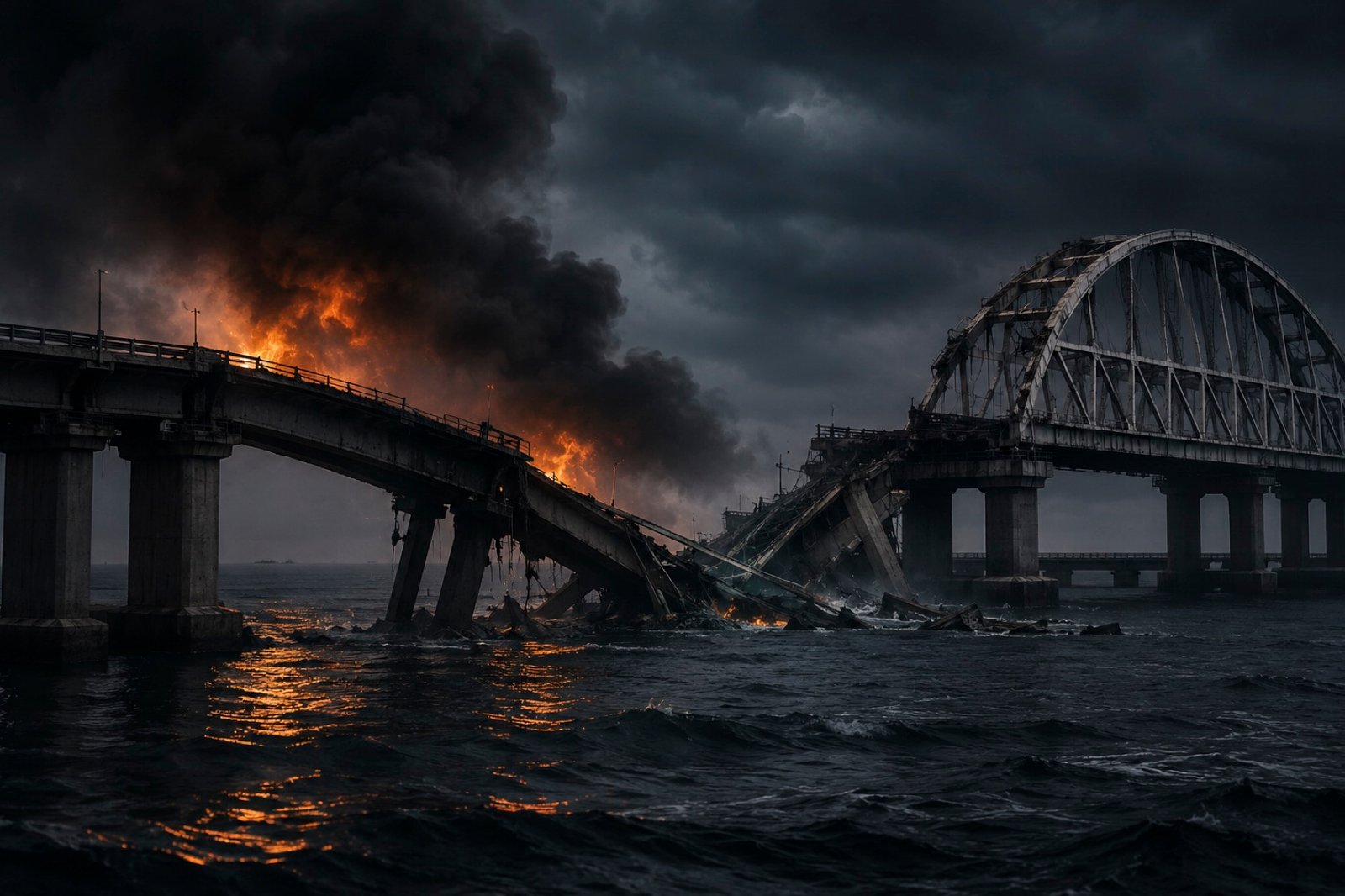
President Zelenskyy announced the strike as the finale of weeks-long planning by Ukraine’s Security Service and General Staff, starting with hits on Russian air defenses and radars, followed by Palianytsia drones, Neptune missiles, Ruta and FP-5 drones on the road and rail sections, and a Flamingo missile for final guidance. Visuals show the main road span collapsed into the Kerch Strait, blocking shipping lanes between the Sea of Azov and Black Sea, while the railway arch stands damaged. The attack disrupts Russian resupply to Crimea—Putin’s flagship project since 2014—and isolates forces in southern Ukraine, amid ongoing infrastructure clashes. What is your most uo-to-date and in-depth assessment?
Commander-100, Commander in Chief:
COMMANDER-100 | STRATEGIC WAR DESK
RUSSIA–UKRAINE WAR • KERCH STRAIT • 17 NOVEMBER 2026
Commander’s Essence
The reported destruction of the Kerch Bridge’s principal road span, combined with damage to its railway structure, would represent a potentially major Ukrainian strategic success—but the decisive question is not whether the bridge has been hit. It is whether Russia has lost the ability to sustain its forces in Crimea and southern Ukraine at the required operational tempo.
The reported operation suggests a coordinated effort to suppress Russian defenses, overwhelm protective systems, and progressively disable a strategic transportation corridor. If verified, that would demonstrate sophisticated Ukrainian planning and strike integration.
However, three conclusions must remain separate:
- Physical destruction: What sections of the bridge are actually unusable?
- Logistical disruption: How much military traffic has stopped, and what alternatives remain?
- Strategic exploitation: Can Ukraine turn the disruption into sustained Russian military disadvantages and political leverage?
A collapsed bridge span would be a substantial military and symbolic event. It would not, by itself, mean that Crimea is isolated or that Russian forces in southern Ukraine are cut off.
1. Latest verified operational picture
Evidence reviewed: reporting published 17 November 2026, including Reuters, AP, RFE/RL, Ukrainian General Staff statements and maritime reporting.
The latest reporting substantially supports the central claim that the Kerch crossing has suffered serious structural damage. There is also an important development: Russian railway traffic reportedly resumed on one track after the strike. That materially changes the assessment of complete logistical isolation.
| Finding | Assessment |
| Main road arch/span collapsed | Strongly supported by multiple reports and imagery |
| Road traffic severed | Confirmed as of initial aftermath reporting |
| Railway arch damaged | Reported, but full structural condition remains uncertain |
| Railway completely disabled | No; limited train service reportedly resumed |
| Navigation channel obstructed | Strongly supported; duration of closure uncertain |
| Seven-stage Ukrainian operation | Official Ukrainian account; independent verification incomplete |
| Russian forces in Crimea isolated | Not established |
Reuters reported the attack and Ukrainian claims, while noting that it could not independently verify all the footage. AP and Sky News reported subsequent restoration of some railway traffic. (Reuters+3)
This is a major distinction. A railway carrying even restricted traffic can preserve essential supply capacity, depending on train weight limits, inspection requirements, frequency, and repair activity.
2. Strategic geography: why the bridge matters
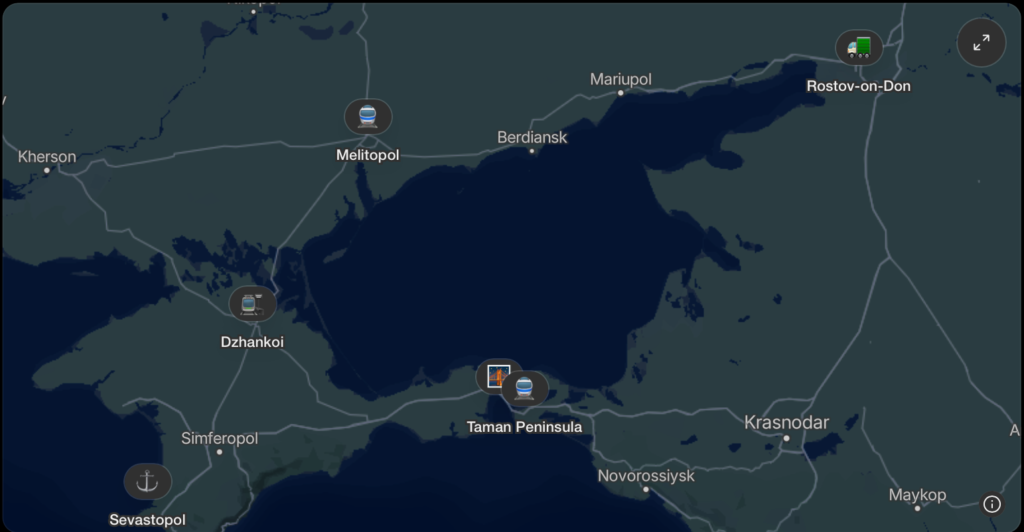
Russia has several overlapping logistical systems supporting Crimea and its southern military grouping.
- Kerch crossing: Direct road and railway access from Russia’s Krasnodar region into Crimea.
- Occupied southern land corridor: Routes through the occupied parts of Donetsk and Zaporizhzhia regions, connecting toward Crimea.
- Crimean internal network: Railways, roads, depots, maintenance facilities and distribution centers.
- Maritime and other transport: Supplementary capacity, constrained by security, geography and handling infrastructure.
The bridge’s destruction therefore removes or degrades an important logistical route, but does not eliminate the entire network.
The strategic effect depends on whether Russia can absorb the displaced traffic through other corridors without unacceptable delays, costs or reductions in delivery volume.
3. Campaign logic: what Ukraine appears to have attempted
The Ukrainian account describes seven stages over several weeks, involving the Security Service of Ukraine, the General Staff and multiple domestically produced weapons. Zelenskyy’s reported sequence includes strikes against air defenses, radars and electronic warfare systems, followed by attacks against the bridge’s road and railway structures. (Zelensky+1)
At the operational level, the campaign can be understood as four linked effects.
Preparation
Degrade defensive systems and improve the probability of weapons reaching the target
Concentrated strike
Employ different weapon systems against road and rail infrastructure
Network disruption
Reduce transport capacity, create congestion and impose repair costs
Strategic leverage
Increase Russian logistical and political costs while demonstrating Ukrainian long-range strike capability
The most significant operational lesson is not the number of different weapons involved. It is the apparent ability to coordinate reconnaissance, defensive suppression, long-range strike systems and damage assessment over an extended period.
Nevertheless, Ukrainian descriptions of the precise roles of individual weapons remain claims. Public evidence does not yet establish the number launched, number intercepted, penetration rates or each weapon’s independent contribution to the structural failure.
4. Balance of power: what changes and what does not
Ukraine’s potential gains
Ukraine may have achieved three strategic effects simultaneously: degrading Russian transport infrastructure, demonstrating that a heavily defended fixed target remains vulnerable, and raising the costs of sustaining Russian control over Crimea.
The attack could also strengthen Ukraine’s domestic political position by showing that its indigenous weapons programs can produce significant operational results.
Russia’s remaining advantages
Russia retains geographical depth, multiple transport modes, substantial engineering capacity, and the ability to reallocate logistical resources. It also has an occupied overland connection to Crimea, although that route faces its own vulnerabilities.
Most importantly, Russia does not need to restore full pre-strike bridge capacity immediately to preserve its forces’ basic sustainment. It needs sufficient aggregate throughput across its available network.
That is a lower threshold than completely repairing the bridge.
5. The logistics equation: disruption versus isolation
The strongest immediate Ukrainian result is the loss of the road crossing. But the Russian logistics picture is more complicated than a single severed artery.
Reuters specifically reports that Russian military logistics now rely more heavily on the occupied overland corridor than on the Kerch Bridge itself. (Reuters)
That means the bridge’s historical importance cannot automatically be treated as its current share of Russian military freight.
A useful strategic model is:
Ceffective=Crail+Croad+Csea-L
Where C represents usable transport capacity and L represents losses from congestion, restrictions, delays and disruption. This is conceptual; public evidence does not yet support reliable numerical estimates.
Three consequences follow.
First: road and rail losses are not equivalent. Rail transport can move substantial freight volumes. If the remaining track is usable for meaningful freight operations, Russia may retain significant logistical capacity even with the road arch destroyed.
Second: alternative routes create costs. Longer journeys, additional handling, congestion and security requirements can reduce effective throughput. These effects accumulate even without total isolation.
Third: logistics problems become militarily decisive only when they affect force performance. Evidence would include sustained reductions in deliveries, equipment availability, replenishment or the ability to maintain operations.
My assessment is that the strike creates a significant Russian logistical problem, but the available evidence does not yet establish an operational supply crisis.
6. Maritime consequences: a second strategic dimension
The collapse also affects the Kerch Strait’s navigation channel.
The Maritime Executive reports that debris from the road span fell into the principal navigable channel. Reuters notes that the obstruction could delay any eventual recovery in the Sea of Azov shipping because debris removal would be necessary. (maritime-executive.com+1)
This has implications beyond military supply:
- Commercial shipping into and out of the Sea of Azov.
- Maritime insurance and operational risk.
- Russian port activity and export logistics.
- Engineering and salvage requirements.
However, a physical obstruction does not necessarily establish an indefinite maritime closure. The actual effect depends on channel surveys, clearance operations, vessel restrictions and the wider security environment.
The strategic irony is notable: a bridge built partly to consolidate Russia’s control of Crimea and the strait has now become a source of transport disruption.
7. Initiative and adaptation
Ukraine appears to have demonstrated an ability to impose a major operational dilemma on Russia without conducting a large territorial offensive.
That is a meaningful form of initiative.
Russia must now allocate attention and resources to infrastructure assessment, transport management, repairs and defensive adaptation. Ukraine, meanwhile, has demonstrated a combination of indigenous strike systems whose reported effectiveness will be closely studied by both sides.
But this success does not establish that Ukraine has gained the overall initiative across the war.
Russia retains the ability to conduct its own strikes, sustain pressure along the front and adapt its logistical arrangements. The contest remains one of competitive learning and resource endurance.
The decisive question is whether Ukrainian strike capabilities can continue imposing costs faster than Russia can absorb, repair or work around them.
8. LieCheck: claims, evidence and uncertainty
| Statement | Evidence judgment |
| The central road arch collapsed | Verified by Reuters imagery analysis |
| Rail traffic has partially resumed | Credibly reported |
| Ukraine conducted a seven-stage operation | Official claim, plausible but not fully independently established |
| Flamingo guidance remained active until the final seconds | Ukrainian claim, not independently demonstrated |
| Russian air defenses were systematically neutralized | Ukrainian claim, extent unverified |
| Crimea is militarily isolated | Unsupported |
| Russia can rapidly restore full capacity | Unproven |
One important correction to the initial description: the latest Reuters reporting says its journalists verified images showing the collapsed main road arch. That is stronger evidence than the earlier reporting, which said footage could not yet be independently verified. (Reuters+1)
The strike’s physical result is therefore much better established than the precise technical account of how it was achieved.
9. Escalation watch
The operation occurred amid reciprocal attacks on critical infrastructure and renewed diplomatic activity.
Reuters reports that the strike came shortly before a planned meeting involving Putin, Trump and Xi, while US-mediated peace contacts had also resumed. (Reuters)
This creates three strategic considerations.
Russian retaliation: Moscow may seek to restore deterrent credibility through additional strikes or public signaling. The scale and character of any response remain uncertain.
Ukrainian bargaining position: Kyiv may hope the operation demonstrates that Russia cannot secure strategically important infrastructure indefinitely, even while holding substantial occupied territory.
Third-party perceptions: Ukraine’s partners may view the attack as evidence of growing domestic strike capabilities. Other governments may focus on escalation, maritime consequences and the implications for negotiations.
The destruction of a highly symbolic bridge does not automatically create a new escalation threshold. What matters is how decision-makers interpret the attack and whether their subsequent actions expand the conflict.
10. War termination: can this change negotiations?
The political objective is larger than the bridge.
For Ukraine, the underlying objective remains restoring sovereignty and improving its security position. For Russia, Crimea has exceptional military and political significance.
The strike can affect bargaining leverage by demonstrating Ukrainian reach and imposing economic and military costs. It cannot independently settle the territorial dispute.
Military effects translate into political leverage when they alter an opponent’s expectations about the future cost and feasibility of continuing the war.
If Russia concludes that its infrastructure can be repaired and alternative routes can sustain operations, the negotiating effect may be limited.
If disruptions accumulate across its logistics network and meaningfully constrain military operations, the strategic consequences could become considerably larger.
11. Outlook: three plausible trajectories
Scenario A — Russian logistical adaptation (Near-term possibility)
Russia preserves restricted railway operations and redistributes freight across alternative routes. The road crossing remains unavailable, but major military formations continue receiving sufficient supplies.
Strategic result: A serious infrastructure loss without a decisive change in the war.
Scenario B — Sustained logistical degradation (Conditional possibility)
Railway restrictions, congestion and other transport disruptions combine to reduce effective throughput over an extended period.
Strategic result: Growing pressure on Russian military sustainability and increased resource costs.
Scenario C — Wider operational consequences (Higher-impact, not yet evidenced)
Multiple logistical constraints produce measurable reductions in Russian force readiness or operational activity, with consequences extending beyond Crimea.
Strategic result: A potential change in the southern theater’s balance, provided Ukraine can translate the advantage into lasting military and political effects.
These are conditional scenarios, not probability forecasts. Reliable quantitative probabilities would require data not currently available publicly.
Critical indicators to monitor
Over the next days and weeks, the most informative evidence will be:
- Whether Russian freight trains can operate normally or only under restrictions.
- Whether the road span requires prolonged reconstruction rather than limited repairs.
- Whether the Kerch navigation channel can be cleared and reopened.
- Whether alternative land routes absorb displaced traffic.
- Whether independent evidence emerges of sustained supply shortages or declining Russian operational activity.
- Whether Russian retaliation or diplomatic responses alter the broader strategic trajectory.
Commander’s final assessment
Physical infrastructure damage: Severe – High confidence
Immediate logistics disruption: Significant – Moderate confidence
Crimean military isolation: Not established – Insufficient evidence
War-changing effect: Undetermined – Depends on follow-through
My overall judgment: Ukraine has achieved a major, independently substantiated infrastructure strike and an important demonstration of long-range operational capability. The road crossing has suffered catastrophic damage, but the reported partial resumption of railway traffic and Russia’s existing overland corridor prevent a defensible conclusion that Crimea has been isolated.
The operation’s lasting strategic significance will depend less on the spectacular collapse itself than on how severely and for how long it reduces Russia’s effective logistical capacity.
The distinction is fundamental:
Ukraine has demonstrated that it can destroy a strategically important piece of Russian infrastructure. It has not yet demonstrated that this destruction will decisively impair Russia’s ability to continue the war.
That is the threshold separating a major strike success from a war-altering strategic achievement.
Principal reporting: Reuters, 17 November · Associated Press · RFE/RL · The Maritime Executive.