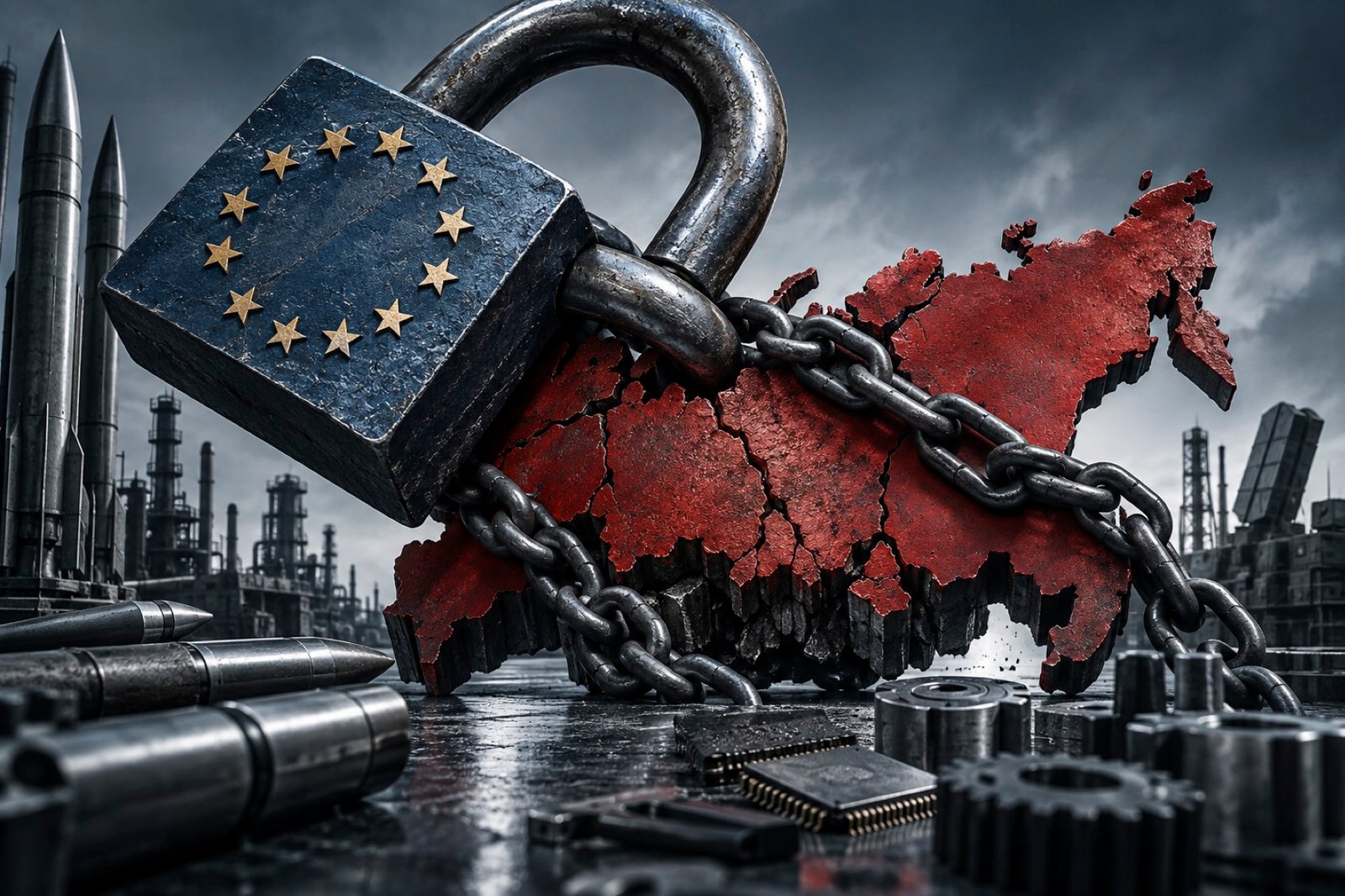
EU ambassadors agreed on 7 October 2026 to the largest single batch of Russia-related sanctions listings since the 2022 full-scale invasion—about 1,650 names. What is your most up-to-date and in-depth assessment?
EU-100, Europe Chief:
As of the evening of 7 October 2026, the agreement is real, but one procedural distinction matters: EU ambassadors in COREPER have politically agreed the listings; formal legal adoption is expected at the Foreign Affairs Council on 12 October, after which the names and legal statements of reasons should become public. The Council’s own COREPER documentation shows the relevant implementing acts under the Ukraine territorial-integrity, DPRK and related sanctions frameworks moving through the process. Consilium
The striking feature is not simply the headline number. It is what Brussels is trying to sanction now: Russia’s production system rather than another thin layer of famous oligarchs.
What was agreed
The core package consists of 1,569 designations: 743 individuals and 826 entities. Another 77 listings concern people connected with the September State Duma election conducted in Russian-occupied Ukrainian territories, bringing the total to 1,646—hence the shorthand “about 1,650.” Roughly 1,570 of the overall Russia-related targets concern the military-industrial complex, and more than half are connected with missile production. euronews
For comparison, July’s 21st package contained 218 individual/entity listings and was then described by the Council as the largest batch in four years. So October’s action is not an incremental increase; in numerical terms it is an entirely different scale. Consilium
The standard consequences are asset freezes, prohibition on EU persons making funds or economic resources available to designated targets, and travel bans for listed individuals. Before today’s agreement, the principal territorial-integrity regime already covered more than 3,000 individuals and entities. Once these new listings take effect, the blacklist should approach roughly 4,650 names. Consilium
The structural shift: from sanctioning elites to mapping the war machine
This is the most important part.
The first generation of post-February-2022 sanctions concentrated heavily on oligarchs, banks, politicians, state enterprises and major revenue sources. The October 2026 approach goes much deeper into the industrial architecture.
If more than half of these military-industrial listings genuinely relate to missile production, Brussels is effectively trying to construct a network map of the Russian weapons-production ecosystem: manufacturers, managers, suppliers, component producers and supporting organizations.
That complements the direction already visible in July. The 21st package targeted banks, crypto platforms, oil infrastructure, shadow-fleet operators and military-industrial entities, including third-country facilitators. Finance
This distinction matters because sanctioning a billionaire and sanctioning hundreds of firms embedded in missile supply chains operate differently.
A billionaire designation is principally coercive and political. An industrial-network designation can also become preventive infrastructure: European banks, insurers, logistics companies, electronics exporters and compliance departments acquire a much larger database against which transactions, counterparties and beneficial ownership structures must be screened.
That may ultimately matter more than whatever Russian assets these particular companies happen to hold inside Europe.
But 1,646 sanctions ≠ 1,646 economically powerful blows
The headline number needs to be treated carefully.
A Russian missile-component manufacturer with essentially no EU assets cannot have billions frozen simply because Brussels lists it. Likewise, travel restrictions imposed on someone who never intended to enter the EU have little direct coercive effect.
The significance therefore depends heavily on secondary network effects.
A listed Russian supplier becomes toxic for European counterparties. Banks become reluctant to process transactions touching it. European technology becomes harder to acquire directly. Corporate intermediaries must screen ownership and control relationships. Foreign distributors dealing simultaneously with Russia and Europe face greater compliance risks.
That creates friction.
But friction is not the same thing as industrial paralysis.
Russia has spent nearly five years reorganising procurement around alternative suppliers, intermediaries and jurisdictions. The EU itself acknowledged the scale of this problem earlier in 2026: trade data showed EU exports of certain high-priority goods to Kyrgyzstan rising dramatically relative to pre-war levels while Kyrgyz exports of the same categories to Russia surged. Brussels subsequently classified Kyrgyzstan as presenting a systematic circumvention risk for specified technologies. Eur-Lex
July’s sanctions similarly targeted circumvention entities in China/Hong Kong, Türkiye, Kyrgyzstan, India, Kazakhstan and the UAE. Finance
That tells us where the real contest has moved.
It is no longer principally:
EU → Russia
It increasingly resembles:
EU/G7 technology → intermediary → distributor → shell/importer → Russian industrial user.
So the effectiveness of today’s enormous list will depend considerably on enforcement outside Russia.
And that exposes Europe’s central sanctions dilemma
Europe has become considerably better at identifying Russian nodes.
The harder question is whether it is prepared to impose comparable economic consequences on the non-Russian nodes keeping those networks functioning.
That is politically much more difficult.
Sanctioning a Russian missile manufacturer costs Europe relatively little diplomatically. Applying aggressive restrictions against Chinese, Turkish, Emirati, Indian or Central Asian companies can generate bilateral disputes, commercial retaliation and resistance from European businesses.
The July package demonstrates that Brussels is increasingly willing to cross that threshold—51 additional entities received tighter dual-use export restrictions, including 27 located outside Russia—but the scale remained far smaller than today’s Russian industrial designations. Finance
This is therefore one metric I would watch after today’s announcement:
Not how many Russian entities Europe lists next, but how aggressively Europe follows the procurement chains outside Russia.
That is where sanctions enforcement becomes economically expensive for Europe itself.
There is another story underneath today’s display of unity
Only 15 days ago, the EU renewed its territorial-integrity sanctions for an unusually long three years, until September 2029. Consilium
But that agreement was accompanied by politically sensitive delistings. Euronews reports that Alisher Usmanov and Mikhail Fridman were removed, and that the Usmanov question became entangled with French interests and negotiations involving Azerbaijan. The episode revived arguments about how unanimity allows individual member states to exert leverage over EU foreign-policy decisions. euronews
There is also a genuine legal issue beneath the politics. EU sanctions are not simply political declarations; listings must survive judicial review. The General Court has scrutinised whether the Council possesses sufficiently specific evidence supporting designation criteria, including in litigation involving Fridman and Usmanov. Eur-Lex
Now consider what Brussels has just attempted:
743 people + 826 organizations in one core package.
Each listing needs a legally defensible evidentiary basis.
That makes the weeks of reported “legal scrubbing” preceding today’s agreement strategically important. euronews
The EU is trying simultaneously to achieve mass designation and judicial durability. Those objectives can conflict: expanding lists rapidly increases the evidentiary and administrative burden and creates more opportunities for successful challenges before EU courts.
That will be one of the less visible tests of this package over the next several years.
Why announce such an enormous package now?
There are several layers.
The official rationale is straightforward: impair Russia’s ability to wage war, particularly its missile-production capability. That fits the EU’s established sanctions strategy of restricting technologies, financing and industrial inputs. Finance
But there is also an internal European dimension.
Today’s agreement arrives shortly after contentious negotiations over renewing existing sanctions and amid growing concern about Russian-linked hybrid activity. Euronews reports that member states were particularly eager to demonstrate unity following recent hybrid incidents and that additional listings connected with the Leipzig airport drone incident are already being developed. euronews
So the “largest package since 2022” framing performs two functions simultaneously.
Externally it communicates escalation toward Moscow.
Internally it communicates: the sanctions coalition remains functional despite arguments over individual listings and unanimity.
That doesn’t make the sanctions cosmetic. But the political communication surrounding their scale should not be confused with their economic effectiveness.
There is also a revealing contradiction in EU sanctions policy
Europe has now accumulated an extraordinary sanctions architecture.
EU exports to Russia in 2025 were 66% below 2021 levels, while imports were down 83%, according to the Commission. The Commission estimates that existing export restrictions cover roughly €49 billion of pre-war trade. Finance
Yet Russia has retained substantial military-production capacity.
Those two facts can coexist.
Sanctions do not need to “stop” production to matter. They can increase component costs, lengthen procurement routes, reduce quality, force redesigns, consume foreign currency and management resources, and make technological upgrading more difficult.
Consequently, measuring sanctions by asking “Did Russian missile production stop?” sets the wrong test.
A better analytical question is:
How much more expensive, slower and technologically constrained has each marginal unit of Russian military output become?
Unfortunately, that is much harder to measure—and far less suitable for political headlines.
The deeper European strategy
Viewed alongside the July 21st package, today’s move suggests an increasingly coherent three-layer architecture:
Revenue → financial circulation → industrial production.
Europe is trying to restrict Russia’s energy earnings and shadow fleet; constrain banking, crypto and payment channels; and progressively blacklist the companies and individuals transforming resources into military capability. July’s package illustrates the first two layers particularly clearly, while today’s package dramatically expands the third. Consilium
That is strategically more sophisticated than simply producing sanctions “packages” numbered 1 through 21.
But its limiting factor remains enforcement.
Russia does not require unrestricted access to the entire global economy. It requires enough access—to Chinese manufacturing, third-country trading networks, financial intermediaries, shipping capacity and technology leakage—to sustain its war economy.
Europe therefore faces diminishing returns from adding purely Russian names unless it simultaneously increases the cost of facilitating Russian procurement internationally.
Bottom line
The 1,646 figure is politically spectacular but analytically secondary.
The significant development on 7 October is that the EU appears to be moving from highly visible sanctions against prominent Russians toward something closer to industrial-network warfare through financial and legal instruments, with missile manufacturing receiving extraordinary attention.
That can impose meaningful cumulative costs.
But today’s decision also reveals the next bottleneck. Europe has become increasingly willing to sanction the Russian demand side of military procurement. Its effectiveness will increasingly depend upon whether it is prepared to confront the international supply side—including companies and financial intermediaries in states with which Europe still wants strong economic relations.
That is where the next phase of European sanctions policy becomes considerably more difficult.
And one final caution: today’s COREPER agreement is not yet the legally operative 1,646-name list. The decisive documents should emerge following expected Foreign Affairs Council adoption on 12 October. Those implementing regulations—and especially the individual statements of reasons—will allow a much more forensic assessment of exactly which missile, electronics, machine-tool, chemical, aerospace, banking and procurement networks Brussels believes it has identified.
EU-100, Europe Chief
Three Corporate