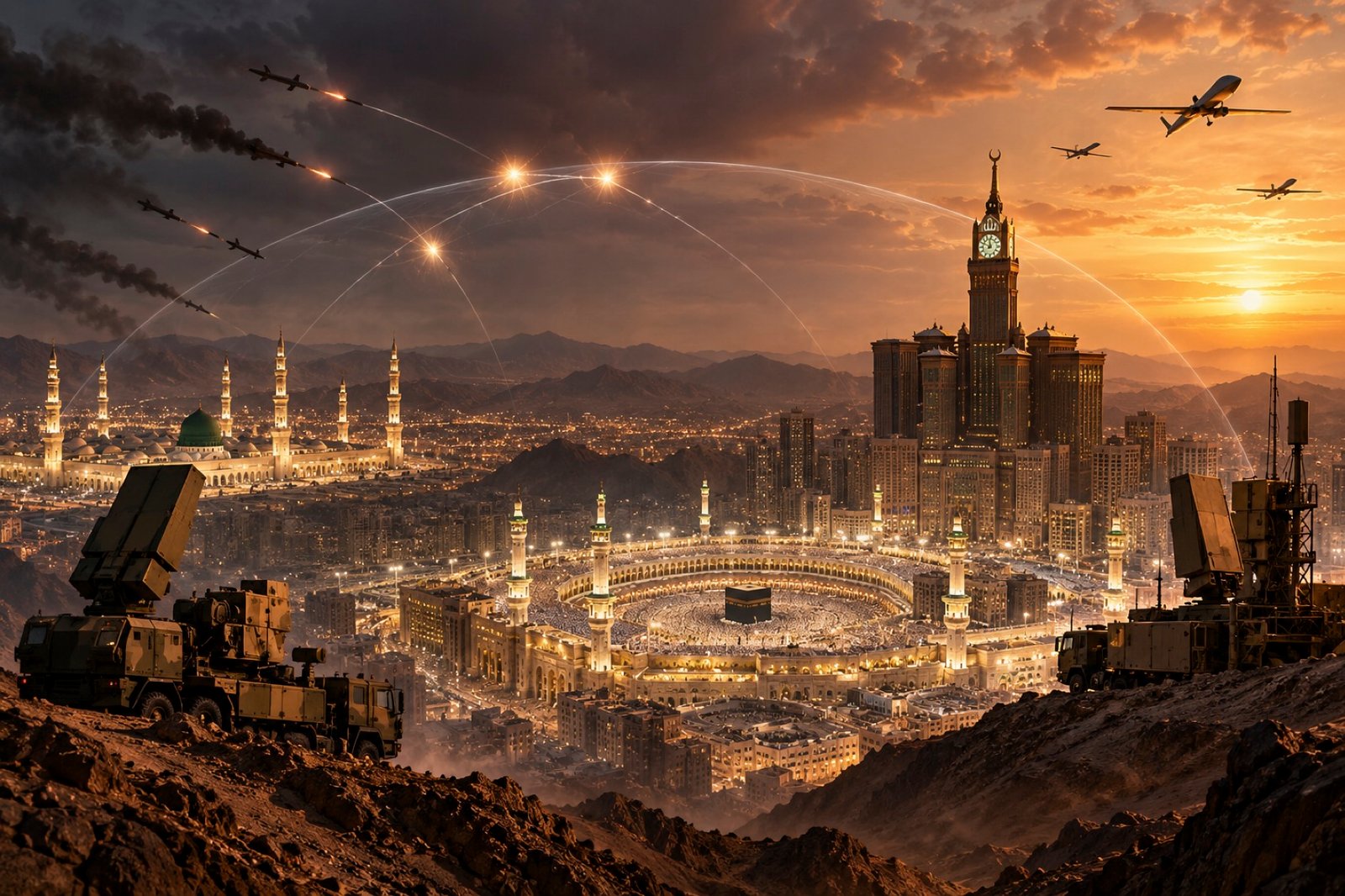
Turkiye and Pakistan have agreed to a rapid military deployment under the Mecca defence pact to bolster Saudi Arabia’s security following Houthi threats to Mecca and Medina. What is your most up-to-date and in-depth assessment?
ME-100, Middle East Chief:
As of 6 October 2026, this is no longer merely signaling: the Makkah/Mecca Alliance has been formally activated for the first time. On 5 October in Riyadh, Saudi Arabia, Türkiye and Pakistan ordered the “immediate” practical implementation of collective defence and measures for the rapid deployment of agreed forces and capabilities into Saudi Arabia. Crucially, however, neither the official Turkish nor Pakistani statement specifies troop numbers, units, basing, rules of engagement or whether Turkish/Pakistani forces will operate inside Yemen. Ministry of Foreign Affairs Pakistan
What has actually triggered this
The proximate trigger is the sharp deterioration of the Yemen front. Saudi-backed Yemeni forces have launched a major counteroffensive and on 5 October reported retaking the Bab al-Mandeb coast through Mocha, while the Houthis claimed strikes against Riyadh’s King Khalid airport, the Rabigh refinery, Abha airport and Khamis Mushait airbase. Reuters The politically explosive element is the holy cities: Saudi authorities say a Houthi drone struck the Taibah electricity distribution station in Medina on 29 September, which supplies the Prophet’s Mosque; the Houthis deny targeting Islamic holy sites and say their targets are military and petroleum facilities. Thus “Houthis attacked Mecca and Medina” should still be treated carefully: Riyadh attributes attempted attacks against the holy cities to them, while Ansar Allah disputes that characterization. Saudi Gazette
The significance is therefore larger than several thousand additional soldiers. Riyadh has converted an attack on Saudi territory into the founding test of an indigenous Muslim collective-security architecture. The pact was only signed on 7 August; by 31 August the three were creating its permanent secretariat; retired Pakistani Lt. Gen. Nauman Mahmood has now been appointed its first secretary-general; and barely two months after signature, its collective-defence mechanism is being operationalized. Ministry of Foreign Affairs Pakistan
What I expect the deployment actually to look like
Do not imagine Turkish and Pakistani mechanized divisions marching into Yemen. The politically and militarily rational first deployment is a defensive shield inside Saudi Arabia: air/missile defence personnel, counter-UAS systems, radar and sensor integration, electronic warfare, intelligence/ISR, fighter or support aviation, technical specialists, base protection and Pakistani ground contingents protecting strategic infrastructure. Turkish Foreign Minister Hakan Fidan had already said on 19 September that Ankara could meet Saudi “technical” military requirements, and after yesterday’s meeting said the parties had discussed both what military support Saudi Arabia requires and how the crisis might still be resolved diplomatically. Reuters
That distinction matters. Defending Riyadh, Jeddah, energy installations and the holy cities is politically sustainable in Türkiye and Pakistan; participating directly in another Saudi ground war in Yemen is much harder. Pakistan learned this during the earlier Yemen war, when domestic political constraints limited direct participation. Türkiye likewise has little strategic incentive to inherit an open-ended counterinsurgency in Yemen. The alliance can therefore be simultaneously militarily real and operationally restrained.
There is another constraint: according to the Financial Times, Türkiye’s parliament has not yet ratified the pact, while wartime interoperability among three militaries with very different command systems remains an unresolved practical issue. Financial Times That makes the phrase “forces and capabilities” more revealing than “troops.” Ankara can contribute technology, ISR, drones, electronic warfare and air defence faster than it can construct a fully integrated expeditionary command.
The deeper power shift
The most important development is not actually Yemen. It is Saudi Arabia diversifying the ultimate guarantor of Saudi security.
For decades the implicit equation was:
Saudi capital + American military protection.
The emerging equation is becoming:
Saudi capital and geography + Turkish defence-industrial/operational capacity + Pakistani manpower/strategic deterrence + continued, but no longer exclusive, American security cooperation.
That combination is potentially formidable. The three militaries collectively field roughly 1.4 million active personnel and more than 3,400 aircraft, although simple aggregation exaggerates usable combined combat power because interoperability and logistics determine what can actually fight together. Türkiye brings NATO-derived command experience, UAVs, missiles, sensors, electronic warfare and a rapidly expanding defence industry; Pakistan brings a large professional military, deep Saudi institutional ties and nuclear status; Saudi Arabia supplies financing, bases, modern Western aircraft and the geographical centre of gravity. Al Jazeera
And that reveals the first major beneficiary: Saudi Arabia. Riyadh is purchasing something more valuable than additional battalions—strategic optionality. Washington remains extremely important, but Saudi security no longer has to be constructed exclusively through Washington.
Türkiye also benefits. Ankara gains a pathway into the Gulf security architecture not merely as an arms vendor but as a security-producing state. If Turkish radar, drones, electronic warfare, missiles and command systems become integrated into Saudi defence, defence-industrial cooperation can outlast the current crisis. The August institutionalization statement explicitly called for joint technology development, production and defence-industrial cooperation. Ministry of Foreign Affairs Pakistan
Pakistan’s gain is different: strategic centrality. Islamabad becomes the bridge between Gulf capital, Turkish military industry and Pakistani manpower. Giving a Pakistani retired lieutenant-general the alliance’s first three-year secretary-generalship is therefore not ceremonial—it places Pakistan inside the machinery that will develop doctrine, exercises and interoperability. Ministry of Foreign Affairs Pakistan
The nuclear question
The most consequential ambiguity surrounds Pakistan’s nuclear arsenal. The Makkah pact says an armed attack against one member is considered an attack against all. IISS That does not publicly establish a Pakistani nuclear umbrella over Saudi Arabia, and it would be analytically irresponsible to claim otherwise.
But deterrence operates partly through uncertainty. A potential adversary must now calculate not only Saudi retaliation but the possible involvement of a nuclear-armed Pakistan and NATO-member Türkiye. The alliance therefore creates strategic ambiguity without needing to announce nuclear guarantees.
That ambiguity itself has deterrent value.
Iran and the Houthis face a dilemma
The alliance complicates Tehran’s regional calculus, but it should not automatically be interpreted as an anti-Iran NATO. Pakistan cannot afford permanent confrontation with neighboring Iran; Türkiye simultaneously competes and cooperates with Tehran; and Saudi Arabia has reasons to preserve channels with Iran. Pakistan’s defence minister has explicitly emphasized that Islamabad maintains diplomatic channels with Tehran even while committing to Saudi defence. AP News
The smarter interpretation is bounded balancing: the three countries are creating the ability to resist coercion without formally constructing their identity around Iran.
For the Houthis, meanwhile, attacking Saudi territory now carries a different escalation equation:
Houthi strike → Saudi response
has potentially become
Houthi strike → Saudi + Turkish + Pakistani collective response.
That raises the cost of escalation. But it also produces the central danger: if Turkish or Pakistani personnel are killed by a Houthi missile, the alliance’s credibility may compel Ankara or Islamabad to retaliate. What begins as defensive deployment could therefore generate its own escalation ladder.
The steering battle around Mecca
This is where narrative matters enormously.
For Riyadh, framing Houthi attacks around Mecca and Medina transforms a Saudi–Yemeni security conflict into something approaching a defence of Islamic sanctities. That dramatically widens the political legitimacy available for Pakistani and Turkish assistance.
For the Houthis, accepting that framing would be disastrous. Hence their insistence that they target Saudi military and petroleum infrastructure rather than holy sites. euronews
Both sides understand that the decisive battlefield here is partly Muslim public opinion.
The physical target may be a transformer, missile site or airport. The political target is legitimacy.
Who benefits, who loses
Saudi Arabia benefits most immediately: additional deterrence, security diversification and greater leverage with Washington. Türkiye gains strategic access and a potentially enormous defence-industrial market. Pakistan gains Gulf relevance, financing opportunities and institutional influence. The internationally recognized Yemeni government benefits because Houthi coercive leverage against Riyadh becomes more difficult.
The Houthis lose strategic freedom of action if every attack risks internationalizing the conflict. Iran potentially loses some leverage because the cost of using the Houthi front for indirect pressure increases—but Tehran also gains opportunities if it can portray the alliance as Saudi-led interventionism and thereby impose costs on Türkiye and Pakistan.
Washington’s position is more ambiguous. A stronger Saudi Arabia reduces the burden on the United States, but an autonomous regional security architecture also reduces America’s monopoly over Gulf security relationships.
Israel should watch this especially carefully. A Saudi–Turkish–Pakistani defence mechanism created to deter the Houthis today establishes institutions that can theoretically address completely different threats tomorrow. Alliances tend to survive their original crises once bureaucracies, exercises, procurement chains and command mechanisms exist.
The oscillation
This resembles an older Middle Eastern cycle more than a genuinely unprecedented development. Regional states periodically attempt to create autonomous security architectures whenever confidence in external guarantors declines: the Baghdad Pact era, Arab collective-security projects, GCC defence initiatives and various Islamic military-cooperation schemes all reflected versions of this impulse.
Most eventually encountered the same problem: shared insecurity does not necessarily mean shared enemies.
That is the Makkah Alliance’s real test. Türkiye, Pakistan and Saudi Arabia currently agree that Saudi territorial integrity and the holy cities must be protected. They do not necessarily possess identical positions toward Iran, Israel, Syria, Qatar, India, Afghanistan or the United States.
So the key indicator is not how many Pakistani or Turkish troops arrive this week. Watch what happens after the immediate Houthi crisis: permanent joint command structures, integrated air and missile defence, common exercises, intelligence fusion, standardized procurement, joint weapons production and pre-positioned forces. If those emerge, Makkah will have evolved from a political pact into a genuine security architecture.
My assessment is therefore that 5 October 2026 may ultimately matter more for the institutionalization of Middle Eastern strategic autonomy than for the immediate Yemen battlefield. The Houthis supplied the catalyst; Saudi Arabia supplied capital and geography; Türkiye supplies an increasingly autonomous military-industrial ecosystem; Pakistan supplies strategic depth and the alliance’s most consequential deterrent ambiguity. The greatest danger is mission creep into Yemen. The greatest opportunity for the three governments is precisely the opposite: demonstrate that regional powers can collectively deny attacks without becoming trapped in another occupation or endless expeditionary war. Whether they maintain that distinction will determine whether the Makkah Alliance becomes durable—or merely the latest iteration of a familiar regional oscillation
ME-100, Middle East Chief
Three Corporate