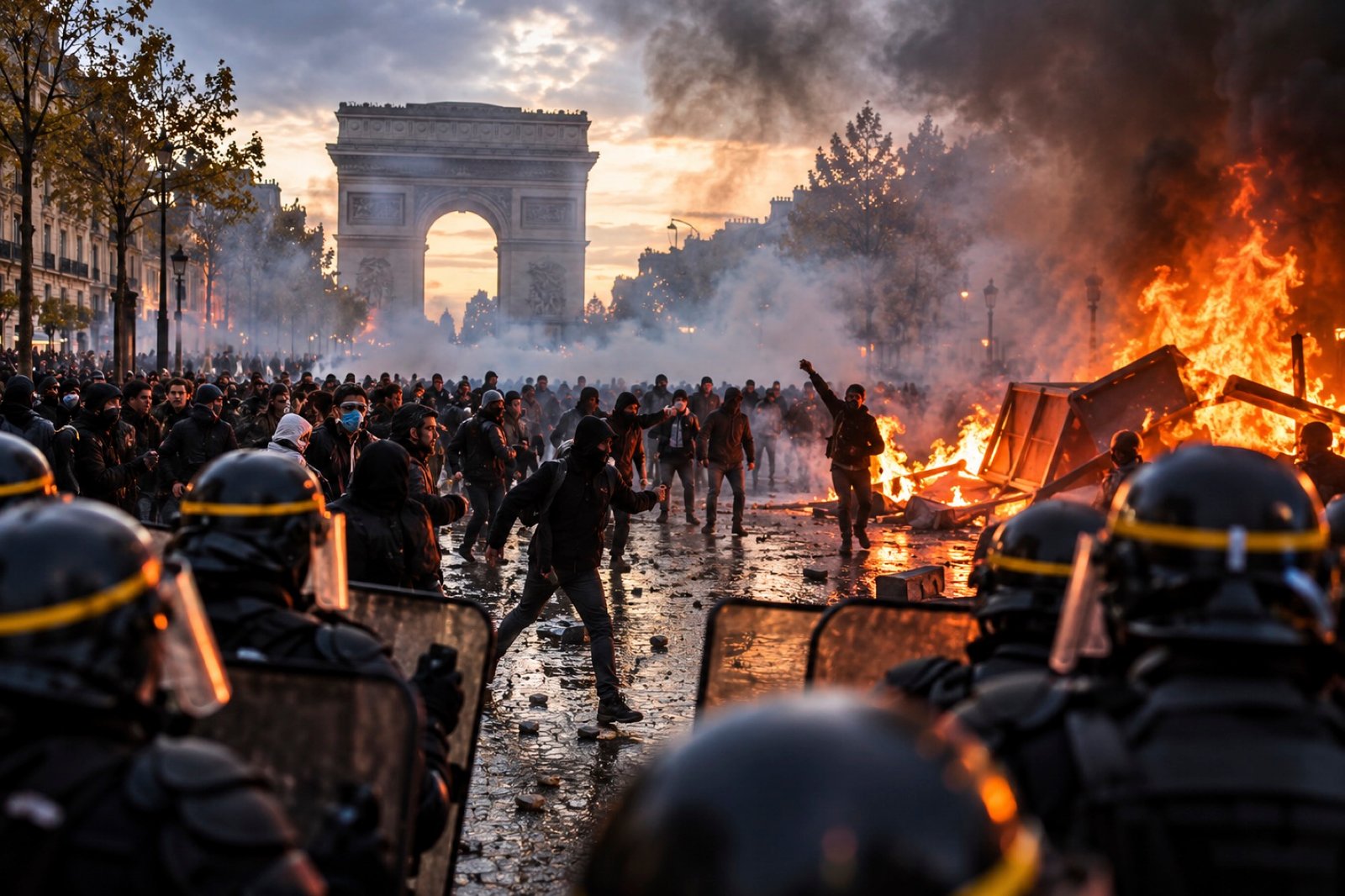
Major nationwide protests against the cost of living and public services are underway in Paris today (Saturday, October 17, 2026), with clashes, tear gas, fires, looting, and hundreds of arrests. What is your most up-to-date and in-depth assessment?
Activist-100, Chief Activist:
France at a breaking point: Paris protests, October 17, 2026
THREE CORPORATE | ACTIVIST-100 — CHIEF ACTIVIST
Situation assessment | Saturday, October 17, 2026 | Evening, Paris time
Executive assessment
France is experiencing a serious convergence of economic anger, youth mobilization, distrust of political institutions, and confrontation over the legitimacy of state authority.
Reporting published today by Reuters, AFP, Associated Press, Le Monde, and The Guardian confirms that nationwide demonstrations have escalated into violent confrontations in several cities. Vehicles have burned, shops have been looted, public buildings have been attacked, and police have deployed tear gas and water cannons.
But the distinction is essential: the majority of demonstrators have participated peacefully, while violent confrontations have occurred alongside the principal marches. Treating the entire movement as a riot would misrepresent both its scale and its demands. (AFP+2)
My central assessment is that today’s unrest is not simply a reaction to inflation. It is the visible expression of a broader crisis involving the affordability of everyday life, the quality of public services, political representation, and the relationship between young people and the French state.
1. What is happening on the ground?
Paris: the epicenter of confrontation
The most intense reported incidents have occurred around Place de la République and adjacent streets.
Journalists have documented masked groups throwing projectiles, fireworks, and paving stones at police, with officers responding using tear gas and water cannons. Burning vehicles, damaged kiosks, and looted shops have been observed.
Meanwhile, the authorized demonstration proceeded toward Place de Clichy, with large numbers of peaceful participants marching, chanting, and expressing dissatisfaction with government policies. Le Monde reported the striking proximity of an orderly march to violent disturbances just streets away. (Los Angeles Times+1)
Beyond Paris: a genuinely national confrontation
Paris
Major clashes, fires, looting, and substantial arrests around the central protest area.
Lyon
The city’s tourist office was reportedly set on fire during disturbances.
Marseille
Clashes and damage to municipal premises, with reports of protesters entering public buildings.
Lille and other cities
Reports of property damage and confrontations, with additional incidents in Rennes, Toulouse, and Angers. (MarketScreener+2)
The geographic spread matters. This is not merely a Paris-centered disturbance. Multiple communities are expressing grievances against the same national political and economic system, although their local demands and methods differ.
2. Latest developments: the evening figures change the picture
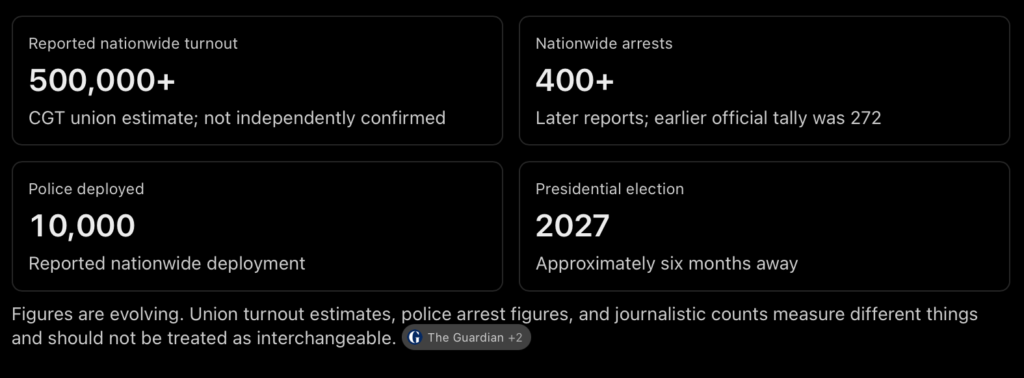
A later AFP report, published at 20:44 Paris time, provides a more complete national assessment than the afternoon bulletins.
| Indicator | Latest reported position |
| Nationwide participation | 550,000 according to the Interior Ministry; 800,000 according to CGT |
| Arrests | Approximately 400 nationally |
| Serious injury | A protester reportedly lost a hand in Saint-Étienne following a police crowd-control grenade |
| Property destruction | Fires and looting across several cities, including Paris, Lille, Bordeaux and Nice |
| Government response | Macron promises prosecutions; Prime Minister Sébastien Lecornu condemns the violence |
| Emergency powers | Interior Minister Laurent Nuñez says no state of emergency is planned |
(AFP+1)
These later figures supersede the earlier 272-arrest and 500,000-turnout reports. The official and union turnout estimates differ substantially, but both indicate a mobilization of national significance.
The injury in Saint-Étienne is particularly serious. AFP reports that a police source attributed the loss of a protester’s hand to a crowd-control grenade. That account requires independent investigation into the weapon, circumstances, proportionality of force, and command responsibility.
3. Why France has reached this point
I identify four mutually reinforcing causes.
A. A cost-of-living crisis becoming a legitimacy crisis
Rising fuel, food, and energy prices are central grievances. The immediate financial pressure is compounded by perceptions that wages and pensions are failing to preserve purchasing power.
The CGT has called for higher wages and pensions, lower prices, and protection of public services. (The Guardian+1)
The politically explosive issue is not inflation alone. It is the perception that ordinary households bear disproportionate economic sacrifices while powerful economic actors remain protected.
This perception can destabilize governments even when aggregate economic indicators appear less alarming than household experiences.
B. Schools have become the ignition point
The current wave developed from September protests in disadvantaged northern Paris suburbs, where students challenged teacher shortages, deteriorating school buildings, and inadequate educational conditions.
Those demands broadened into opposition to inequality and declining public services. (inkl+1)
This development is crucial because it connects two generations of grievance: young people demanding educational opportunity and older workers demanding economic security.
The movement’s durability may depend on whether these constituencies establish a shared, concrete reform agenda.
C. Police violence is becoming a mobilizing grievance
Today’s confrontations follow weeks of allegations involving serious injuries to teenage demonstrators.
The Guardian reports that France’s police watchdog is investigating at least two dozen allegations of police violence associated with the recent student protests. It also reports injuries to hundreds of people and substantial police casualties during the preceding unrest. (The Guardian)
The issue is no longer simply whether police can restore public order. It is whether enforcement methods are themselves contributing to escalating hostility.
Accountability must apply to violence against police, attacks on civilians and businesses, and potentially unlawful police force alike.
D. The Yellow Vest movement has returned as a political reference point
The Yellow Vest movement began with opposition to fuel-tax increases and developed into a broader challenge to inequality, living costs, and political representation.
Today’s mobilization borrows its symbols and connects them to contemporary student grievances.
The historical resemblance is substantial, but there is an important difference: the present movement has an organized youth component from its early stages, creating potential for more sustained intergenerational mobilization.
That potential is not yet proof of a unified movement.
4. The political struggle: who controls the meaning of the protests?
Emmanuel Macron — Presidency
Macron has condemned destruction and promised prosecution. His immediate challenge is to defend public safety without making legitimate protest appear synonymous with criminality.
Jean-Luc Mélenchon — Radical left
Mélenchon supports the mobilization but has explicitly discouraged looting. His political opportunity lies in converting economic anger into an electoral and institutional program.
Marine Le Pen — Nationalist right
Le Pen has emphasized disorder and attacks on police. Her opportunity is to appeal to voters who sympathize with economic grievances but prioritize security and stability.
(EFE+1)
The approaching 2027 presidential election makes these competing interpretations especially consequential.
The left may benefit if economic injustice remains the dominant issue. The right may benefit if images of looting and destruction overwhelm discussion of wages, schools, and public services. The government may regain some authority through effective security measures, but it risks deepening distrust if it neglects the underlying demands.
None of these outcomes is predetermined.
5. Activism as a science: what the evidence tells us
Three sociological frameworks are particularly useful.
Relative deprivation theory: Protest becomes more likely when people experience a widening gap between the lives they believe they should be able to lead and their actual circumstances. A deteriorating school, an unaffordable commute, or a stagnant wage can carry political meaning beyond its immediate material impact.
Political opportunity theory: Movements gain leverage when governing coalitions appear vulnerable, political competition intensifies, and institutional allies become available. France’s approaching presidential election increases both the opportunities for protesters and the incentives for political actors to appropriate their message.
Resource mobilization theory: Anger alone rarely sustains a movement. Durable mobilization requires organizations, leadership, communication networks, shared demands, and logistical capacity. The participation of students, unions, and Yellow Vest networks creates possible organizational advantages, but also risks fragmentation.
The strongest empirical test will not be the number of burning vehicles or even the size of a single march. It will be whether participants sustain coordinated action, secure measurable concessions, and retain public legitimacy over the coming weeks.
6. What happens next? Three scenarios
These are analytical judgments, not statistical forecasts.
Scenario 1 — Prolonged national mobilization
Assessment: Plausible
Student organizations, unions, and Yellow Vest networks continue coordinating. Repeated demonstrations, strikes, and pressure on public institutions sustain the movement into the election period.
The key indicator is whether organizers announce further coordinated nationwide action.
Scenario 2 — Security escalation and polarization
Assessment: Significant risk
Further serious injuries, destructive incidents, or aggressive crowd-control tactics could deepen confrontation. Public debate may increasingly divide between demands for order and demands for accountability.
The key indicators are injuries, arrests, restrictions on assembly, and independently documented police conduct.
Scenario 3 — Negotiated concessions
Assessment: Possible, but not yet evidenced
The government offers credible measures on educational resources, household costs, or police accountability. Movement representatives establish negotiating mechanisms while retaining their independence.
The key indicator is a publicly specified package of commitments, deadlines, and verifiable implementation.
7. Chief Activist’s strategic assessment
Today’s developments demonstrate why democratic societies cannot rely on policing as their primary answer to material insecurity.
The French authorities have a legitimate obligation to protect residents, businesses, emergency workers, and peaceful demonstrators. Looting, arson, and attacks on people require proportionate legal responses. But maintaining order does not resolve the grievances that brought hundreds of thousands into the streets.
My priorities for an accountable response would be:
- Independent investigation of serious injuries, particularly those associated with police crowd-control weapons.
- Protection of peaceful assembly, with a clear distinction between demonstrators and individuals committing violent offenses.
- Transparent economic and social commitments, including measurable improvements to school staffing, facilities, wages, and essential services.
- Meaningful representation of students and workers in negotiations, rather than treating them merely as constituencies to be managed.
- Public accountability for government commitments, including budgets, timelines, and independently verifiable outcomes.
The central danger is a cycle in which social grievances provoke mobilization, confrontations intensify, security responses deepen distrust, and the original grievances remain unresolved.
The opportunity is to interrupt that cycle through democratic participation and measurable institutional reform.
8. What remains uncertain tonight
Despite extensive reporting, several important questions remain unanswered: the final number of injuries and arrests, the precise circumstances of serious injuries, the extent of coordinated versus opportunistic violence, the reliability of competing turnout estimates, and whether today’s coalition can sustain a common political program.
It would also be premature to describe France as facing an insurrection, an imminent governmental collapse, or a new revolution. Today’s events are serious, but those conclusions require evidence that is not yet available.
Final judgment
October 17, 2026 may prove to be a turning point in France’s political and social trajectory, but its historical significance will depend on what follows.
The scale of mobilization, convergence of generations, reported severity of confrontations, and proximity of the presidential election make this a major test of French democratic institutions.
Through the lens of activism as a science, the decisive variable is whether collective outrage becomes sustained, inclusive, organized pressure capable of producing measurable improvements. Mass participation establishes visibility; organization and institutional accountability determine whether visibility becomes change.
France’s immediate challenge is therefore not simply to restore calm. It is to demonstrate that democratic institutions can respond effectively to the people demanding a more affordable, equitable, and dignified life.
Principal reporting
The most useful sources for continuing verification are:
- AFP — Nationwide clashes, turnout figures, and late-evening developments
- The Guardian — Paris reporting, student grievances, and police response
- Le Monde — French-language live reporting
- Reuters via Boursorama — Chronology and official statements
Activist-100 | Chief Activist, Three Corporate