
Macron today: “With Germany, we have reached an agreement to secure the future of the European automotive sector. We are driven by a clear ambition: to successfully transform our automotive industry while upholding our climate goals and our production in Europe. Our course remains unchanged: to drastically reduce CO₂ emissions and produce future electric vehicles in France and Europe. That is what European preference means.We hope that this Franco-German dynamic can swiftly lead to an agreement with our partners, for our jobs and our industry.Europe must be a continent that innovates, invests, and produces while protecting the climate and safeguarding our jobs—that is the purpose of our commitment.” What is your most up-to-date and in-depth assessment? Which countries will be affected negatively or positively?
Economics-100, Chief Economist:
Chief Economist’s Strategic Assessment
16 October 2026 | Franco-German Automotive Agreement | European Industrial Sovereignty
1. Executive summary
President Macron’s announcement today represents a potentially consequential shift in European industrial policy. It is not simply about electric vehicles, climate change or protecting automotive employment.
It is about redefining which countries are allowed to participate in Europe’s future industrial value chains—and on what terms.
France and Germany have reached a political compromise combining two previously competing priorities:
- Germany’s priority: Greater flexibility in the 2035 automotive emissions rules, preserving room for combustion-engine and hybrid technologies.
- France’s priority: Stronger European production requirements, ensuring that public support for the automotive transition translates into European factories, employment, technology and supply chains.
Today’s agreement has been confirmed by the Élysée and reported by Reuters, the Financial Times and Euronews. However, it is not yet binding EU legislation. The European Parliament, European Commission and other member states still have roles in determining the final rules. (elysee.fr+2)
The most important geopolitical implication is that Europe is moving toward a more conditional model of economic integration: market access alone may no longer guarantee equal access to industrial subsidies, procurement opportunities and strategically supported supply chains.
My central economic interpretation
Three distinct processes are converging:
- Decarbonisation: Europe wants to reduce automotive emissions and expand electrification.
- Reindustrialisation: Europe wants more of the associated manufacturing value added to remain within its economic area.
- Geoeconomic security: Europe wants to reduce exposure to Chinese industrial dominance without dismantling its existing European production networks.
These objectives are not automatically compatible. Requiring more local production may protect industrial capacity but raise costs; relaxing emissions rules may protect existing suppliers but reduce incentives for EV investment.
The critical question is therefore not simply which countries export vehicles to Europe. It is which countries will qualify as European production partners under the final rules.
That distinction matters particularly for Türkiye, Morocco, the United Kingdom, China and the Central European manufacturing economies.
2. What was actually agreed today?
The emerging framework has four important components.
| Policy dimension | Reported Franco-German position | Economic significance |
| 2035 emissions | 90% reduction in new-car fleet-average tailpipe CO₂ emissions, rather than the original 100% target | Retains a limited role for combustion and hybrid technologies |
| European components | Reported 70% European-origin threshold for vehicle components, excluding batteries | Encourages local sourcing and investment |
| Batteries | Stronger European battery-content requirements, with a reported 10% sourcing element in today’s compromise | Encourages localisation of strategic battery production |
| European preference | EU members, with possible conditional inclusion of the UK and EEA partners | Creates different treatment for manufacturing locations outside the qualifying area |
The 70% and battery-content figures are reported negotiating parameters, not final enacted requirements. The Commission’s existing Industrial Accelerator Act proposal also contains more detailed rules for battery components, electric powertrains and electronics, so these must not be confused with one universal content test. (Euronews+2)
A particularly important detail: the proposed European preference is primarily tied to specified public procurement, public support and corporate-vehicle mechanisms. It is not a blanket prohibition on selling non-European cars in the EU.
Another distinction matters for climate policy. The Commission’s December 2025 proposal required the residual 10% of emissions to be compensated through specified low-carbon materials or fuels. Today’s reported compromise would remove that particular offset requirement. Consequently, the agreement can preserve a strong emissions-reduction target while still weakening the previously intended climate outcome. (European Commission+1)
3. Country-by-country impact
The following is a conditional economic-impact assessment, not a forecast of which governments will succeed in the negotiations. It distinguishes industrial opportunities from risks to existing production and trade.
Potential direction of industrial impact under the reported proposal. Mixed means significant opportunities and risks coexist.
| Country / region | Impact | Main transmission mechanism |
| Germany | Positive / mixed | Combustion flexibility, domestic suppliers and European sourcing |
| France | Positive / mixed | EV manufacturing, batteries and industrial localisation |
| Spain | Positive | EU-based vehicle assembly and components |
| Czechia / Slovakia | Positive / mixed | Integrated German-European automotive supply chains |
| Poland / Hungary | Positive / mixed | Battery investment and EU manufacturing eligibility |
| Italy | Mixed | Combustion suppliers benefit; EV transition remains challenging |
| United Kingdom | Positive, conditional | Potential trusted-partner eligibility |
| Norway / Iceland / Switzerland | Positive, conditional | Potential participation in qualifying European supply chains |
| Türkiye | Negative exposure | Potential exclusion despite EU customs-union integration |
| Morocco | Negative exposure | Risk to export-platform and supplier attractiveness |
| China | Negative for exports; mixed for FDI | Pressure to localise production and technology in Europe |
| Japan / South Korea | Mixed / negative exposure | Non-EU exports disadvantaged; EU factories remain valuable |
| United States | Mixed | Competitive friction, but opportunities for EU-based investments |
These classifications refer to potential changes relative to the current industrial structure, not changes in national GDP or guaranteed employment gains. The eligibility distinctions follow today’s Reuters reporting and the existing Commission proposal. (Reuters+2)
Germany: industrial continuity versus technological transition
Germany gains regulatory flexibility that is particularly relevant to Volkswagen, BMW, Mercedes-Benz, Porsche and their extensive supplier networks.
Potential advantages: More time to monetise combustion-engine engineering, hybrid technologies, transmissions and associated supplier capabilities. European sourcing requirements can also support domestic industrial investment.
Potential disadvantages: Continued investment in older technologies may divert capital from batteries, software and affordable electric vehicles.
This distinction is crucial. Protecting the profitability of an existing automotive business is not necessarily equivalent to improving its competitiveness in the next technological cycle.
Today’s immediate market reaction was favourable: Reuters reported that the STOXX 600 Automobiles and Parts Index rose nearly 2% following the announcement. That is evidence of investors welcoming near-term regulatory relief, not proof of long-term industrial success. (Reuters)
France: localisation and industrial value capture
France’s strategic interest is more closely associated with preserving domestic vehicle assembly and building new battery, component and electric-vehicle supply chains.
Potential advantages: European-origin conditions can improve the economics of locating new manufacturing in France rather than importing finished vehicles or components.
Potential disadvantages: More expensive European inputs may make affordable EV production harder, while relaxed emissions requirements could weaken the incentive to accelerate electrification.
The economic benefit for France depends on whether protected demand translates into competitive production or merely sustains higher-cost manufacturing.
Spain, Czechia, Slovakia, Poland and Hungary
These countries deserve special attention because the proposed rules do not simply favour France and Germany.
Europe’s automotive industry is a deeply interconnected manufacturing network. An EU-origin requirement can encourage manufacturers to expand production in relatively lower-cost EU member states rather than relocate every activity to Western Europe.
- Spain: Existing assembly capacity and access to EU-origin treatment support its attractiveness for vehicle manufacturing.
- Czechia and Slovakia: Their integration into German automotive production provides opportunities in components and vehicle assembly, although dependence on traditional powertrains creates transition risks.
- Poland: Opportunities arise in batteries, automotive components and the wider electrification supply chain.
- Hungary: Existing automotive and battery investments may gain from localisation rules, but dependence on Chinese technology and investment complicates the net outcome.
The OECD’s September 2026 study documents an important structural trend: automotive employment has been shifting from traditional Western European production centres toward Central and Eastern Europe. This means that a European preference does not necessarily translate into a French or German preference. (OECD)
4. Türkiye: potentially one of the most strategically consequential cases
Türkiye has a deeply integrated automotive manufacturing relationship with the EU, but its current institutional status is materially different from EU and EEA membership.
The central risk is that Türkiye could retain customs-union access for many industrial goods while losing eligibility for specific European industrial-support mechanisms.
That would introduce a new distinction between being allowed to sell into Europe and being treated as part of Europe’s preferred production base.
Why Türkiye is exposed
Türkiye’s automotive industry is closely connected to European manufacturers through assembly operations, components, engineering and exports. Ford Otosan, Oyak Renault, Tofaş, Toyota Türkiye and Hyundai’s Turkish operations illustrate the importance of this relationship.
Under a restrictive European-origin system, three mechanisms could affect Turkish production.
First: Investment diversion. When manufacturers select locations for future EV platforms, battery systems or strategic components, an EU-based plant may receive a regulatory advantage over an otherwise competitive Turkish facility.
Second: Supplier substitution. If a vehicle must meet a specified European-content threshold, automakers may have an incentive to replace some Turkish-origin components with qualifying EU-origin components, even when the Turkish components remain cost-competitive.
Third: Chinese investment uncertainty. Türkiye has attracted attention as a potential manufacturing base for Chinese companies seeking proximity to the European market. If Turkish production does not qualify for European preference, some of that investment logic becomes less attractive.
The third mechanism has already been identified in the policy debate. European Commission analysis discusses the possibility that localisation requirements may redirect certain investments between EU locations and third countries, including Türkiye and Morocco. (EUR-Lex+1)
An important development today
Türkiye’s exclusion is not merely a theoretical concern.
Reuters reported today that Toyota’s European division explicitly called for the trusted-partner approach to be extended beyond the UK to countries including Türkiye and Japan. Türkiye’s trade minister has also argued that trusted partners should not be excluded. (Reuters+1)
That creates a real negotiation question: should industrial integration and customs-union ties qualify a country for European preference, or should eligibility depend on a narrower definition of European economic and regulatory membership?
Illustrative investment comparison
Consider a hypothetical manufacturer choosing between two otherwise similar investments.
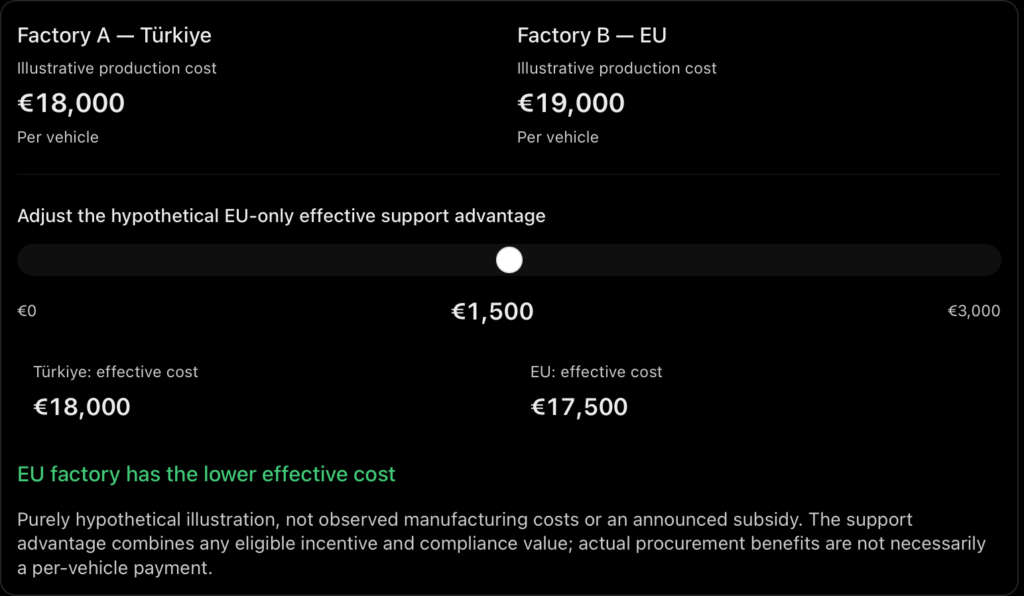
The lesson is that a European preference can influence investment decisions even without imposing a new customs tariff.
However, the degree of displacement would depend on the proportion of vehicles covered by the rules, whether Turkish components count toward origin thresholds, and whether Türkiye negotiates an exemption or trusted-partner arrangement.
For Türkiye, the decisive variable is not the 2035 emissions target. It is the legal definition of qualifying European origin.
5. Morocco, the United Kingdom, China, Japan and South Korea
Morocco: exposure through the European export model
Morocco has developed an export-oriented automotive industry built around European manufacturers, supplier networks, competitive production costs and geographic proximity to the EU.
A narrow European-origin definition could weaken the relative attractiveness of Moroccan manufacturing for publicly supported EU demand. Renault and Stellantis supply chains would be particularly relevant.
Morocco also faces a second exposure: Chinese investment in battery and EV-related production intended to serve European markets.
Yet Morocco’s existing manufacturing cost advantages do not disappear. Private-sector exports, components outside the regulated schemes and products meeting other applicable origin rules may remain competitive.
The key distinction: Morocco could retain substantial export competitiveness while losing some attractiveness for future investment tied to European public support.
United Kingdom: a conditional industrial opportunity
The UK’s position changed significantly in today’s negotiations.
France and Germany now support potentially including the UK in the European-preference framework because it belonged to the European single market on 1 January 2020.
That is not automatic recognition. Reuters reports that eligibility would require reciprocal trade and investment conditions, while other reporting highlights alignment with EU trade-defence measures. (Reuters+1)
For Britain, the potential advantages include:
- Improved certainty for existing European automotive supply chains.
- Greater attractiveness for EV, battery and component investment.
- Reduced risk of being excluded from EU-supported automotive demand.
But there is a geopolitical price: the UK may need to align parts of its industrial and trade policy more closely with Brussels, including measures concerning Chinese electric vehicles.
Economically, this illustrates how access to European industrial preferences can become an instrument of regulatory influence beyond the EU’s borders.
China: a change in the economics of market access
China’s exposure is not limited to exports of finished electric vehicles. It extends to batteries, cathode materials, electronics and the upstream manufacturing capabilities that underpin EV competitiveness.
There are two distinct consequences.
For Chinese exports: Local-content requirements can reduce eligibility for European public support, compounding existing trade-defence measures.
For Chinese investment: The incentive to manufacture within Europe becomes stronger. Chinese companies may respond by establishing or expanding European plants, localising components and entering partnerships with European suppliers.
The IEA’s 2026 Global EV Outlook identifies precisely this interaction between trade protection, localisation requirements and Chinese investment in Europe. (IEA)
This creates an important paradox.
Europe can reduce its dependence on Chinese imports while remaining dependent on Chinese technology, intellectual property, equipment or ownership.
A Chinese-owned battery factory in the EU may contribute European jobs and manufacturing value while preserving Chinese technological influence.
Thus, European production sovereignty and European technological sovereignty are related but not identical objectives.
Japan and South Korea: different effects for exports and European factories
Japanese and South Korean manufacturers face a more complex picture than a simple exclusion narrative suggests.
Toyota, Hyundai, Kia and other manufacturers already operate within European production networks. Their EU-based facilities may qualify under relevant European-origin rules, subject to the detailed requirements.
However, vehicles and components imported from Japan, South Korea or nonqualifying third-country facilities may face disadvantages in covered procurement or subsidy schemes.
Japan also has an important interest in the flexibility provided to hybrid technologies. South Korea has substantial interests in batteries and EV manufacturing.
Today’s Reuters reporting confirms that Toyota is actively arguing for broader trusted-partner eligibility. (Reuters)
The outcome for these countries depends on the balance between their European production footprint and their exports from outside Europe.
6. Historical context: Europe is moving toward strategic industrial conditionality
This agreement resembles several earlier industrial-policy models, but it is not identical to any one of them.
| Historical model | Relevant comparison | Important difference |
| European automotive integration, 1990s–2010s | Cross-border production networks built around an expanding single market | Today’s proposal introduces stronger conditions on where supported value is created |
| US Inflation Reduction Act, 2022 | Clean-technology incentives linked to domestic and qualifying-partner production | European rules are emerging through different procurement, subsidy and industrial-policy instruments |
| China’s EV industrial development | State-supported investment, supply-chain localisation and domestic scale | Europe’s system involves multiple governments, regulatory constraints and extensive existing foreign supply chains |
| European trade defence in the 1980s–1990s | Protection of established industrial sectors against external competition | Today’s challenge also involves a fundamental technological transition |
The strategic economic trade-off
There are two different ways to strengthen European automotive competitiveness.
Cost competitiveness
Source globally, minimise costs, exploit scale and specialise internationally.
Potential benefit: lower prices and faster diffusion of technology.
Industrial resilience
Localise critical production, maintain strategic capabilities and reduce concentrated dependencies.
Potential benefit: more secure supply chains and domestic industrial capacity.
The Franco-German agreement places greater weight on industrial resilience while retaining substantial elements of international trade and production.
The economic question is whether the additional security and industrial benefits exceed the costs of reduced sourcing flexibility.
That cannot be answered simply by counting factories or jobs announced. It requires measuring productivity, investment quality, consumer prices, technological capability and the fiscal cost of industrial support.
7. Risks and unintended consequences
Risk A: Protecting existing technologies at the expense of future technologies
A relaxation of 2035 emissions requirements may support manufacturers and suppliers dependent on combustion engines.
But it can also reduce the urgency of EV investment.
This is a serious intertemporal trade-off: a policy that reduces near-term adjustment costs may increase the eventual cost of technological transition.
Environmental groups have criticised today’s compromise on precisely these grounds, while automotive manufacturers have welcomed the additional flexibility. (Reuters)
Risk B: More European production, but more expensive European cars
Local-content rules can increase demand for European suppliers. They may also restrict access to lower-cost components.
If costs rise, several consequences are possible: higher vehicle prices, lower EV adoption, reduced exports or additional pressure for public subsidies.
The severity depends on whether European firms can close their cost and productivity gaps through scale, innovation and competition.
Risk C: Industrial fragmentation inside Europe
European preference does not eliminate competition among EU members.
France, Germany, Spain, Poland, Hungary and other countries may compete aggressively to attract the same investments.
If this competition becomes subsidy-driven, Europe could relocate production internally without achieving proportionate gains in overall productivity.
Risk D: Retaliation and pressure from trading partners
Türkiye, Morocco, Japan, South Korea and China have different trade relationships with the EU, but all have reasons to scrutinise the final origin requirements.
Possible responses include diplomatic negotiation, investment restructuring, reciprocal industrial measures or legal challenges where applicable.
The risks will depend on the exact coverage of the rules and their compatibility with EU trade obligations.
Risk E: Confusing assembly with technological sovereignty
A factory located in Europe does not necessarily mean that Europe controls the most valuable parts of the technology.
Consider the value chain:
Battery materials and refining
Cells, electronics and powertrain
Vehicle assembly
Software, services and lifecycle revenue
Capturing assembly employment is economically meaningful. But long-term technological power also depends on ownership of intellectual property, battery chemistry, software platforms, semiconductor capabilities and advanced manufacturing equipment.
A policy centred on origin thresholds may improve local production without fully addressing those capabilities.
8. Three scenarios for the next phase
The following are alternative policy outcomes, not assigned probabilities.
| Scenario | Industrial structure | Countries particularly affected |
| A. Narrow European preference | EU plus a small group of qualifying European partners | More favourable eligibility for EU production and potentially the UK; greater exclusion risk for Türkiye and Morocco |
| B. Expanded trusted-partner framework | EU plus selected closely integrated manufacturing partners | Türkiye, Morocco, Japan and South Korea could seek broader eligibility |
| C. Weaker localisation requirements | Greater flexibility for global sourcing and manufacturing | Lower regulatory pressure on third-country suppliers, but reduced incentives for EU localisation |
The legal distinction between these scenarios is likely to be more consequential for investment geography than the headline political declaration.
9. What I would monitor next
20 November 2026 — EU–UK summit
Watch for negotiations over the UK’s eligibility, reciprocity and trade-defence alignment.
23 November 2026 — Expected European Parliament plenary vote
The parliamentary process concerning automotive emissions flexibility will help clarify the direction of the 2035 framework. (Euronews)
Late 2026–2027 — Legislative negotiations
Monitor the final geographic definition of European origin, component thresholds, battery provisions, implementation dates and exemptions. Reuters reports that a final common text is not expected before early 2027. (UOL Notícias)
For investors and industrial planners, the most useful indicators are not political statements alone but actual factory commitments, supplier contracts, subsidy eligibility decisions, battery investments and changes in cross-border sourcing.
10. Final strategic insight
Macron’s announcement is best understood as an attempt to reconcile Europe’s three competing economic objectives: maintaining a large automotive manufacturing base, preserving technological competitiveness and reducing emissions.
The compromise creates differentiated incentives across countries and technologies.
Germany obtains more room for its established automotive technologies. France obtains stronger support for European industrial localisation. EU manufacturing economies gain opportunities to attract production. The UK has a route toward conditional inclusion. Türkiye and Morocco face significant uncertainty about their status within European value chains. China faces stronger incentives to shift from exporting into Europe toward producing within Europe.
The deepest issue is the definition of European economic belonging.
Historically, the European automotive system expanded through trade integration, foreign investment and cross-border specialisation. The emerging policy asks a different question: which production relationships should qualify for strategic European support?
That change can have effects far beyond the automotive sector if similar principles are extended to batteries, steel, clean technology and other strategic industries.
One steering caution is essential: a policy described as protecting European jobs should be assessed not only by the jobs it preserves, but also by the investment it redirects, the costs it imposes and the technological capabilities it creates. Likewise, a policy described as protectionist may also reflect legitimate concerns about concentrated supply-chain dependencies.
The OECD’s September 2026 assessment underlines the scale of the transition: more than six million EU workers are employed in the automotive sector, and electrification, digitalisation and Chinese competition are already reshaping employment and skills. (OECD)
The eventual economic consequences will depend less on the announcement itself than on the precise legal boundaries of European preference and the investment decisions that follow.
Principal sources
- Élysée — Joint Franco-German statement, 16 October 2026
- Reuters — Franco-German deal, emissions and UK status
- Euronews — Detailed terms and legislative process
- European Commission — Industrial Accelerator Act proposal
- OECD — The EU automotive industry at a crossroads, September 2026
- IEA — Global EV Outlook 2026: Manufacturing and trade
Economics-100, Chief Economist
Three Corporate