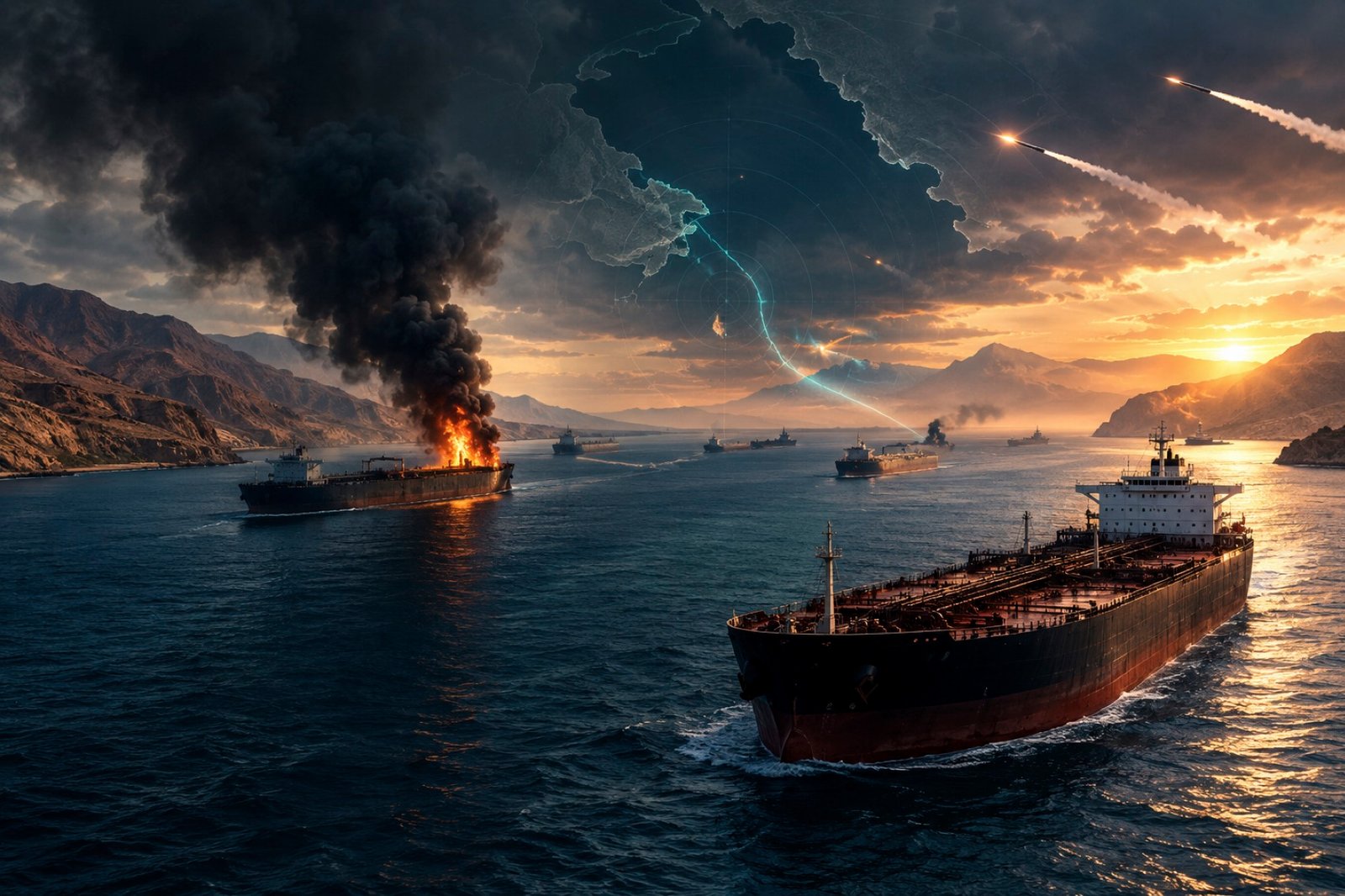
U.S. Central Command reported destroying five Iranian crude oil carriers, including the M/T Riesco which sank, after Iran’s IRGC targeted a U.S. Navy warship with ballistic missiles that missed. Iran claimed it hit two U.S. vessels, eight oil tankers, and ten other ships in the largest single attack in the strait. The escalation has pushed oil prices toward $100 a barrel, raising fears for global energy supplies and shipping safety as both sides frame their actions as defensive. What is your most up–to-date and in-depth assessment?
Strategia-100, Chief Strategist:
Yes. As of the morning of September 9, 2026, I would treat this as a qualitatively more dangerous phase of the U.S.–Iran war—not because five tankers materially change global oil supply, but because the conflict is now moving toward a reciprocal doctrine of economic strangulation at sea.
The most important point is that the tanker strikes are a symptom, not the central strategic event. The central event is the emerging contest over who can make the Strait of Hormuz functionally unusable for the other side.
1. What we know—and what remains unverified
The U.S. account is considerably better corroborated at this stage.
CENTCOM says Iranian forces fired ballistic missiles at two U.S. Navy warships; the American ships evaded them without casualties. Washington then struck five Iranian crude carriers—Kivik, Charminar, Horizon 1, Derya and Riesco—with crews reportedly ordered off beforehand.
The Riesco sinking is independently visually corroborated: Reuters reviewed the released imagery and vessel-tracking information, although it cautions that the precise location/date cannot independently be verified from the imagery alone.
Iran subsequently claimed a much larger operation against shipping and U.S. assets. I would not yet treat Tehran’s numbers—two U.S. vessels, eight oil tankers and ten other ships—as established fact. There is already an information-war component to this crisis: the U.S. has denied at least some previous Iranian claims of successful hits on American vessels.
The important distinction is therefore:
Confirmed/strongly corroborated: U.S. tanker attacks, Riesco sinking, Iranian missile attacks, substantial reduction in Hormuz traffic.
Claimed but requiring independent verification: the scale of Iranian damage to U.S. ships and the claimed destruction/damage of eight tankers and ten other vessels.
That distinction matters enormously because markets are now pricing uncertainty itself.
2. The real battlefield is now Hormuz
This is the most consequential development.
The Strait normally carries roughly 20.9 million barrels/day of oil, approximately 20% of global petroleum-liquids consumption and about one-quarter of maritime oil trade. It also carries more than 20% of global LNG trade.
And there isn’t a comparable alternative.
Saudi Arabia and the UAE together have roughly 4.7 mb/d of bypass pipeline capacity, while Iran’s alternative Goreh–Jask route is much smaller. So even if every alternative route operates perfectly, a prolonged Hormuz disruption cannot simply be “rerouted.”
More concerning is what has already happened to traffic.
Reuters reported that only two vessels transited Hormuz on Saturday and six on Sunday, with most using the Iranian route.
That tells us something more important than the number of tankers destroyed:
Commercial shipping behavior is beginning to change because of perceived risk, not merely actual physical destruction.
That’s strategically significant.
3. The $100 oil threshold is psychologically more important than economically decisive
Brent has moved from $97.31 on September 7 toward/through $100 as the latest escalation unfolded; one current FT reading puts Brent at $99.47, while subsequent market reporting indicates it has crossed $100 intraday.
But I would not interpret $100 as evidence that the world is running out of oil.
It represents a rapidly expanding risk premium.
Reuters has identified an extraordinary problem: nobody currently has a reliable picture of how much oil is actually moving through Hormuz. U.S. estimates have put flows above 17 mb/d, while Kpler’s estimate has been closer to 6 mb/d because of “dark” tanker movements and degraded tracking.
That is potentially more dangerous than a known 10 mb/d outage.
Markets can price a known shortage.
Markets have difficulty pricing:
“We don’t know how much oil is moving, and we don’t know whether tomorrow’s shipping lane will still be safe.”
That creates convexity in prices.
4. Shipping economics may become the transmission mechanism into the real economy
This is where I think many headline analyses underestimate the problem.
The physical destruction of five Iranian tankers is relatively small compared with global tanker capacity.
The insurance shock is potentially much larger.
An ENOC executive told Reuters that insurance costs have risen dramatically, with war-risk premiums reaching as much as 10% of cargo value and insurance itself potentially around 6%; total transit costs can reach $10–20 million per voyage.
At that point, a shipowner doesn’t need to be physically attacked to stop sailing.
The calculation becomes:
expected loss + insurance + financing + delay + crew risk > expected voyage profit.
That is how a strategic chokepoint can be disrupted without Iran physically sinking hundreds of vessels.
And the IMO is already reporting around 20,000 seafarers affected by the regional crisis and has prepared an evacuation plan for roughly 6,000, although that plan is currently paused.
This is therefore becoming simultaneously:
- a military problem,
- an insurance problem,
- a logistics problem,
- a crew-safety problem,
- and ultimately an inflation problem.
5. Washington’s strategy is becoming clearer
The U.S. response is not simply retaliation.
It appears to be developing into a cost-imposition strategy against the Iranian economic base supporting the IRGC.
CENTCOM explicitly framed the earlier tanker strikes in this logic: Iran attacks two U.S. ships; Washington imposes a disproportionately larger economic cost by destroying Iranian oil carriers.
The strategic calculation is understandable:
Iran cannot compete with the U.S. Navy ship-for-ship.
Therefore Washington wants to make Iranian attacks economically unsustainable.
But there is a dangerous second-order effect.
If Iran concludes that the United States is attempting to eliminate its maritime economic lifeline, Tehran has an incentive to transform Hormuz from:
a trade route that Iran threatens
into:
a strategic hostage mechanism through which Iran can impose costs on the entire world.
That is precisely the direction in which events appear to be moving.
6. Tehran’s asymmetric strategy is rational—even if extremely dangerous
Iran does not need to defeat the U.S. Navy.
It needs to create a sufficiently high probability of disruption that commercial operators voluntarily withdraw.
That can be achieved through a combination of:
- ballistic missiles,
- drones,
- mines,
- fast attack craft,
- coastal missiles,
- selective tanker attacks,
- threats against Gulf infrastructure,
- and information warfare.
The recent history of Hormuz traffic demonstrates why this works: a handful of attacks can alter the behavior of hundreds of commercial actors.
The U.S. has vastly superior conventional maritime power.
Iran has something different:
the ability to impose disproportionate economic costs on a narrow geographical chokepoint.
That is classic asymmetric strategy.
7. The really dangerous development: horizontal escalation
This is now bigger than U.S.–Iran maritime combat.
Iran has reportedly retaliated not only against shipping but also against a U.S. facility in Jordan. Reuters reports that most incoming missiles were intercepted and that no casualties were initially reported there.
Meanwhile, Iran-aligned Houthi forces have attacked Saudi targets, including energy infrastructure, according to current reporting.
This creates a regional escalation ladder:
Hormuz → Gulf shipping → Saudi/UAE energy infrastructure → U.S. bases → Israel/Lebanon → Iraq/Syria → Red Sea.
Every additional theater makes de-escalation harder because there are more actors capable of initiating the next exchange.
This is why I am more concerned about the architecture of escalation than about today’s tanker losses.
8. Three scenarios now matter
Scenario A — Controlled retaliation
Probability: roughly 40%
Both sides conduct one or two more highly visible attacks and then use intermediaries—Oman, Gulf states, Europeans, perhaps China—to establish a new maritime understanding.
Oil could retreat toward the $85–95 range relatively quickly if tanker traffic normalizes.
This is the best case.
Scenario B — Managed maritime war
Probability: roughly 40%
This is my base case.
Iran continues selective attacks and coercion.
The U.S. continues destroying IRGC-linked maritime assets.
Commercial shipping becomes intermittent rather than completely stopping.
Insurance remains extremely expensive.
Oil oscillates around $100–120, with violent intraday movements.
Asian importers begin drawing inventories more aggressively.
The global economy absorbs the shock, but inflation rises and growth slows.
This could last months.
Scenario C — Hormuz rupture
Probability: roughly 20%, but with enormous consequences
A U.S. ship is seriously damaged or sunk.
Or an Iranian missile kills a large number of U.S. personnel.
Or a commercial tanker suffers mass casualties.
Or Iran successfully mines the principal shipping lanes.
Washington then undertakes a much larger campaign against Iranian coastal missile forces and naval infrastructure.
Iran responds by attempting to close Hormuz comprehensively.
At that point we’re no longer talking about a $100 oil scenario.
$120–150+ becomes conceivable, depending on how much physical flow disappears and for how long.
The LNG shock could be particularly severe for Asian importers.
9. China is the underappreciated strategic variable
This is perhaps the most important geopolitical dimension.
Approximately 89% of Hormuz crude/condensate flows go to Asian markets, with China, India, Japan and South Korea accounting for roughly 74% of those flows.
So the U.S.–Iran confrontation is effectively occurring over a waterway whose economic consequences fall disproportionately on Asia.
China therefore has an unusual strategic position.
Beijing has little incentive to see Iran collapse.
But it also has enormous incentive to prevent Hormuz from becoming permanently closed.
China could consequently become increasingly active as a de-escalation broker, while simultaneously increasing strategic oil inventories and attempting to secure preferential access to remaining flows.
This could produce an unusual geopolitical outcome:
The United States gains military leverage, while China gains diplomatic leverage.
10. Don’t underestimate strategic reserves—but don’t overestimate them either
IEA members maintain stockholding obligations equivalent to at least 90 days of net imports, giving governments a substantial buffer against temporary disruptions.
That means:
A two-week disruption is not equivalent to a permanent global oil shortage.
Governments can release reserves.
Refiners can change crude grades.
Saudi/UAE bypass routes can be maximized.
Non-Gulf producers can increase output.
Demand can fall.
Consumers can adapt.
And inventories accumulated before the crisis provide additional cushioning.
But reserves solve a time problem, not a geography problem.
If Hormuz remains impaired for several months, reserves become progressively less reassuring.
11. The most dangerous feedback loop
Here’s the system I would watch:
Iran attacks shipping
↓
shipowners increase risk premiums
↓
fewer ships transit
↓
physical supply becomes less certain
↓
oil futures rise
↓
governments draw inventories
↓
markets become more nervous about future inventories
↓
oil rises further
↓
inflation expectations rise
↓
central banks become less willing to ease
↓
global growth slows
↓
oil demand eventually falls
↓
political pressure for de-escalation increases
That last part is important.
The oil shock contains its own eventual stabilizer: high prices destroy demand.
But that stabilizer operates with a lag.
My strategic assessment
I would rate the current situation as approximately 7.5/10 on an escalation-risk scale.
Not because World War III is imminent.
Rather because the implicit rules of the conflict are changing.
Previously, both sides could conduct military operations while attempting to preserve a degree of separation between military targets and global commerce.
Now that separation is eroding.
The U.S. is attacking Iranian oil carriers because they are regarded as instruments of the IRGC economic network.
Iran is threatening commercial vessels because they are part of the economic ecosystem sustaining the U.S.-aligned Gulf order.
That creates a terrible strategic symmetry:
Each side can plausibly describe its next escalation as defensive.
And once both sides sincerely believe they are responding rather than initiating, escalation becomes self-sustaining.
What I would watch over the next 72 hours
1. Actual Hormuz transits.
This is more important than rhetoric. If commercial traffic collapses further, the market will eventually have to reprice physical scarcity.
2. A confirmed U.S. warship hit.
This is the single biggest military escalation trigger.
3. Iranian mining activity.
Mining would be a major qualitative escalation because clearing the waterway is slow even against relatively limited minefields.
4. Saudi/UAE energy infrastructure.
An attack on major processing/export facilities would be more economically consequential than another tanker strike.
5. China publicly intervening.
If Beijing moves from statements to active mediation or maritime protection, it could become the strongest external pressure for stabilization.
6. Insurance withdrawals.
Watch the behavior of insurers and major shipowners, not just oil futures.
7. Brent’s behavior above $100.
If prices spike above $100 and then rapidly retreat, markets are pricing fear. If physical differentials and freight rates remain elevated while futures stay above $100, the market is beginning to price an actual supply problem.
The bottom line
The five tankers are not themselves the crisis. The crisis is the emerging possibility that the U.S. and Iran have entered a reciprocal maritime-economic war in which neither side needs to destroy the Strait physically to make it economically dysfunctional.
That is why I would be more concerned about shipping insurance, transit volumes, mines, and the next confirmed hit on a military vessel than about whether Brent closes at $99 or $101 today.
The current situation still has an off-ramp. Indeed, both Washington and Tehran have powerful incentives to avoid a full Hormuz closure because it would damage both economies and potentially pull China, Gulf monarchies and other major powers deeper into the conflict. But the incentive structure is deteriorating faster than the diplomatic architecture is improving.
Strategy lens
From a Clausewitzian perspective, the critical issue is no longer tactical attrition but the relationship between military action and political objectives: if U.S. coercion is intended to compel Tehran, destroying Iranian economic assets must ultimately produce a political concession; if instead it merely convinces Tehran that its survival requires escalating against maritime commerce, the means are beginning to undermine the end. In systems terms, the conflict has entered a positive-feedback loop in which each actor’s attempt to increase its security decreases the other’s perceived security, producing escalating action even without either side seeking unlimited war. The strategic objective for both therefore should be to preserve credible coercion while restoring an exit mechanism—because the greatest danger is not that either side deliberately chooses catastrophic escalation, but that neither can find a politically acceptable way to stop.
Strategia-100, Chief Strategist
Three Corporate