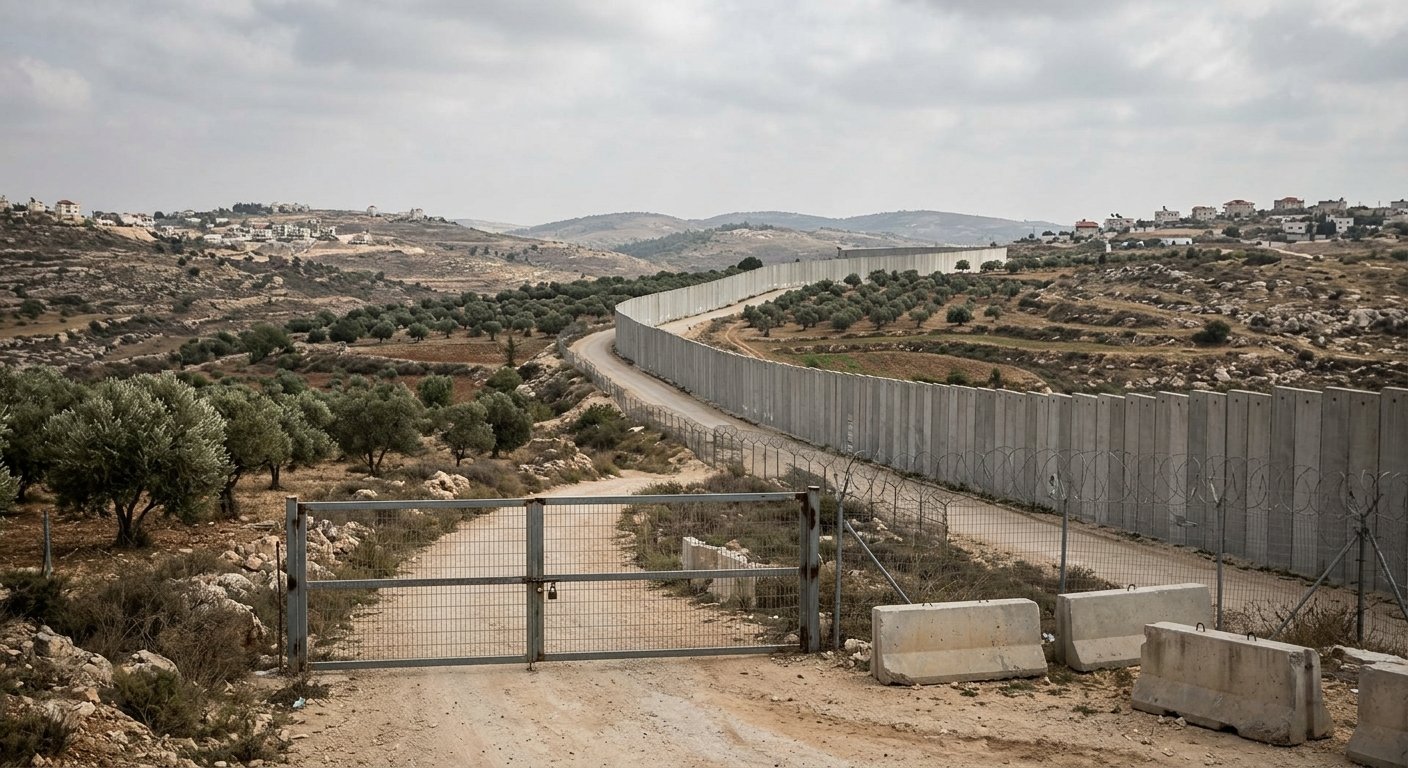
On 8 September 2026, Spain, the United Kingdom, France, Canada, Denmark, Finland, Ireland, Iceland, Norway, Poland, Portugal, and Sweden issued a joint statement confirming their intention to introduce national restrictions—or support European ones—on trade in goods from Israeli settlements in the West Bank. The UK, France, and Canada specifically announced they would ban imports of those goods; some of the others already had related measures in place. Implementation of the new UK ban is expected to take months.The same day, UK Foreign Secretary Ed Miliband told Parliament that the British government agrees there is “ethnic cleansing of Palestinians in areas of the West Bank,” carried out by “settler terrorists,” and that the Israeli government has often turned a blind eye. What is your most up-to-date and in-depth assessment?
IL-01, Israel Agent:
Assessment as of the evening of 8 September 2026: this is considerably more important than the immediate economic value of the settlement trade being prohibited. The real development is that a group of traditionally Israel-friendly Western governments is beginning to translate the legal distinction between Israel and the territories it occupies into concrete economic policy, while Britain has simultaneously crossed a rhetorical threshold by officially describing the occupation itself as unlawful and characterizing parts of the West Bank situation as ethnic cleansing.
The critical question is therefore not “How much money will Israel lose from settlement exports?” It is: is the West beginning to build a durable architecture of differentiation, sanctions and non-recognition around Israel’s control of the West Bank? If that architecture consolidates, the strategic consequences could eventually be substantial.
1. The 12-country statement is a political signal disguised as a trade measure
The joint declaration is unusually explicit. Canada, Denmark, Finland, France, Iceland, Ireland, Norway, Poland, Portugal, Spain, Sweden and the UK are not announcing a boycott of Israel. They are deliberately distinguishing Israel proper from settlements in territory occupied since 1967. The statement says the settlements are illegal under international law, condemns settlement expansion and settler violence, and specifically identifies the E1 project as an unacceptable escalation.
That distinction matters enormously.
For years, Israel’s diplomatic strategy benefited from making criticism of the occupation politically synonymous with criticism of Israel itself. Today’s measures undermine that equivalence:
Israel ≠ settlements ≠ occupation.
That is precisely the conceptual architecture that Israel has generally sought to prevent from becoming normalized in Western policy.
And there is a second important point: this is not really 12 identical national bans. The wording deliberately allows for different national procedures and for European-level action. Ireland, Spain, Norway and Belgium already have related restrictions; Britain, France and Canada now say they will bring forward national bans.
That makes today’s announcement more significant than a single-country sanction. It is an attempt to create policy convergence.
2. The economic effect is initially small; the precedent is not
The immediate economic damage should not be exaggerated.
Settlement exports are tiny compared with Israel’s total external trade, and the UK, France and Canada are not proposing a general embargo on Israeli goods. The measures are therefore unlikely to change Israeli GDP, employment or the strategic viability of the Israeli economy in the short term. Reuters likewise characterizes the direct commercial impact as limited.
But that is almost beside the point.
The precedent is:
settlement activity can now generate a distinct category of Western economic liability.
That has consequences for:
- banks financing settlement construction;
- insurers;
- logistics companies;
- construction firms;
- agricultural exporters;
- technology and infrastructure suppliers;
- multinational corporations operating in or servicing settlements;
- investors assessing Israeli political risk;
- eventually, potentially, European procurement and investment rules.
The UK is already moving beyond simple goods restrictions. Miliband announced measures concerning services, financing, construction and advertising associated with settlements, alongside sanctions against individuals involved in settler violence.
That is the more consequential development.
If settlement-related economic activity becomes legally toxic rather than merely controversial, Israel’s settlement project begins accumulating an opportunity cost.
3. Britain has crossed a much more consequential threshold
Miliband’s parliamentary statement is arguably the bigger story.
The British government has now formally adopted the position that Israel’s continued occupation of the Palestinian territories is unlawful, rather than merely saying that individual settlements are illegal. That explicitly incorporates the central conclusion of the International Court of Justice’s July 2024 advisory opinion into British governmental policy.
The ICJ went substantially further than simply condemning settlements.
It concluded that:
- Israel’s settlement policy violates international law;
- settlement expansion contributes to a coercive environment;
- Israel’s failure to prevent or effectively punish settler violence is inconsistent with its obligations;
- policies producing forced displacement can violate the prohibition on forcible transfer;
- Israel’s policies have resulted in de facto annexation of parts of the territory;
- Israel’s continued presence in the occupied Palestinian territory is unlawful;
- Israel should cease new settlement activity;
- other states must distinguish, in their dealings, between Israel proper and the occupied territory and must not assist in maintaining the unlawful situation.
There were important judicial disagreements within the ICJ, so this should not be represented as an uncontested proposition of international law. Several judges disagreed with the Court’s conclusion concerning the unlawfulness of Israel’s continued presence as such. But the core findings concerning settlement activity, annexation and the Palestinian right to self-determination were much broader than Britain’s traditional position.
Britain has now effectively said: we accept the central legal direction of that judgment and are going to act on it.
That is a genuine foreign-policy shift.
4. “Ethnic cleansing”: Miliband’s wording is serious, but it needs legal precision
I would separate three propositions.
Proposition A — There is extensive evidence of forced Palestinian displacement.
This is difficult to dispute.
The UN reported in January that settler violence was driving displacement across Area C, the Jordan Valley and increasingly parts of Area B, with Israeli security forces sometimes failing to protect Palestinians or acting alongside settlers. It documented more than 4,000 Palestinians displaced through settler violence in the period it examined.
And today’s Reuters investigation provides unusually concrete evidence of the mechanism: unauthorized farming outposts, grazing permits, infrastructure, government funding, military coordination, intimidation and the gradual displacement of Palestinian communities. Reuters documented at least nine new farming outposts associated with one settler network and hundreds of displaced Palestinians around those outposts.
This is not simply a story of isolated individuals throwing stones.
There is evidence of an ecosystem:
land seizure → outpost → restricted Palestinian access → intimidation/violence → abandonment → infrastructure → retroactive legalization → permanent Israeli presence.
That distinction is strategically crucial.
Proposition B — Calling this “ethnic cleansing” is defensible as a description of a process.
The UN’s own description of ethnic cleansing encompasses purposeful removal of a civilian population from a geographical area through force or intimidation. It explicitly includes forcible displacement, destruction of property and terror-inducing violence.
There is therefore a factual basis for Miliband’s language when describing particular West Bank processes.
Proposition C — “Ethnic cleansing” is not itself a standalone international crime with a precise legal test.
This is where rhetoric should not outrun law.
The UN explicitly says ethnic cleansing has not been recognized as an independent crime under international law, and that there is no universally codified definition. Individual acts constituting such a campaign can nevertheless amount to crimes against humanity or war crimes.
So I would characterize Miliband’s statement as politically and descriptively significant, rather than as a judicial determination that Israel has committed a specific international crime called “ethnic cleansing.”
That distinction is important.
5. But the strongest evidence concerns something broader than individual settler terrorism
This is where I think the Israeli government’s counter-narrative is becoming increasingly vulnerable.
Israel can reasonably say:
Most Israelis do not participate in settler violence; settlers who commit crimes should be prosecuted; Palestinian terrorism also exists; Israel has legitimate security requirements.
All of those propositions can simultaneously be true.
The harder question is whether state institutions are structurally facilitating a territorial process that makes Palestinian displacement easier and Israeli settlement more permanent.
Today’s evidence increasingly points in that direction.
Reuters reports that Israeli government agencies have provided permits, funding, grazing rights and infrastructure assistance to settler networks; senior military figures have increasingly described agricultural outposts as strategically useful; and Finance Minister Bezalel Smotrich has openly described the objective in terms of establishing “practical sovereignty” over the West Bank.
That matters far more than whether every violent incident can be attributed directly to the Netanyahu cabinet.
The strategic question isn’t:
“Did the government order this particular attack?”
It is:
“Does the governmental system make the territorial outcome produced by these activities more likely?”
The evidence increasingly suggests yes.
6. E1 is the pivotal issue
The timing is not accidental.
Israel’s decision to open tenders for roughly 1,200 housing units in the E1 area is the immediate catalyst repeatedly cited by Britain, France, Canada and the other governments.
E1 is strategically different from another settlement neighborhood.
Its geographic position east of Jerusalem affects the continuity between northern and southern parts of the West Bank. That is why European governments interpret it not merely as “more houses for settlers”, but as infrastructure that could make a territorially contiguous Palestinian state much harder to construct.
From an Israeli strategic perspective, there is another way of looking at it:
E1 is a test of whether Israel can transform control into permanence without formally declaring annexation.
That is precisely why it has become a red line for Western governments.
And it connects directly to Smotrich’s concept of “practical sovereignty.”
Formal annexation creates an enormous diplomatic crisis.
Incremental territorial integration can produce much of the same strategic result while avoiding the formal declaration.
That is why today’s Western response is fundamentally about facts on the ground.
7. The Israeli counter-strategy is already visible
Israel’s response—closing the British consulate in East Jerusalem, restricting British personnel and cutting British participation in certain Palestinian/West Bank security arrangements—is not merely emotional retaliation.
It serves several purposes.
First: deterrence
Israel wants London to understand that sanctions generate costs for the sender.
Second: domestic signaling
With Israeli elections approaching, Netanyahu cannot appear to accept foreign governments dictating territorial policy.
The British measures therefore give the Israeli right an extremely useful political narrative:
“Foreign governments are attempting to decide Israel’s borders and interfere in our elections.”
That framing will probably strengthen the settlement camp rather than weaken it in the immediate term.
Third: coalition management
Netanyahu has to balance Washington, the security establishment, centrist Israelis and the increasingly influential religious-nationalist right.
The West Bank is therefore not just foreign policy.
It is coalition architecture.
8. And this is where the Western policy contains a strategic contradiction
The Europeans say they want to save the two-state solution.
But the measures being announced are primarily punitive and defensive.
There is no equivalent Western mechanism yet capable of reversing:
- settlement geography;
- land confiscation;
- road networks;
- demographic changes;
- Palestinian economic dependency;
- fragmented territorial control;
- administrative integration;
- settlement security infrastructure.
Sanctioning settlement goods does not remove a settlement.
It does not return land.
It does not dismantle roads.
It does not reverse demographic change.
It does not establish a Palestinian state.
Therefore, if today’s sanctions remain at the level of symbolic economic pressure, Israel can absorb them.
The policy becomes strategically meaningful only if the West is prepared to escalate from:
“We disapprove of settlements”
to
“Economic, financial and diplomatic participation in permanent territorial integration carries consequences.”
That is a very different proposition.
9. The United States is the decisive variable
This is the biggest limitation on today’s development.
Washington is not following London, Paris and Ottawa. The Trump administration has criticized the European measures and has not indicated that it intends to join them.
That creates a two-tier Western system:
US: strategic protection of Israel
Europe/Canada: increasingly conditional political and economic relationship
Israel can tolerate considerable European pressure if American military, diplomatic and financial backing remains intact.
This is the fundamental strategic reality.
A genuine Israeli strategic crisis would require transatlantic convergence, not merely European frustration.
We are not there yet.
But today’s events move Europe further in that direction.
10. The most important development may be the normalization of “differentiation”
This is the piece I would watch most closely.
Once governments become comfortable with:
“We support Israel’s security and existence, but we will not treat settlement activity as Israel proper,”
a large number of previously politically difficult measures become easier.
You can progressively apply the same distinction to:
- customs;
- investment;
- financial services;
- insurance;
- procurement;
- scientific cooperation;
- settlement-linked companies;
- territorial labeling;
- diplomatic relations;
- sanctions against individuals;
- international institutional participation.
That is how geopolitical pressure usually develops—not through one dramatic embargo, but through administrative normalization of separation.
And Israel’s economic strength makes this particularly interesting.
Israel can easily survive a settlement-product ban.
It is much harder to insulate itself indefinitely from a Western ecosystem that increasingly treats the occupation as a separate legal and economic category.
11. There is also a major Israeli strategic danger here
The settlement movement has historically benefited from a paradox:
the more it integrates the West Bank into Israel, the harder separation becomes—but the more difficult Israel’s international position becomes too.
The settlement project therefore creates a strategic trade-off:
Territorial consolidation
- greater Israeli control
- greater strategic depth in some Israeli security calculations
- ideological objectives fulfilled
but:
− declining possibility of Palestinian statehood
− greater international isolation
− increased sanctions risk
− greater diplomatic dependence on Washington
− greater demographic/political dilemma
− potential transformation from a temporary occupation into an internationally contested system of permanent control.
The Israeli security establishment should understand this distinction even if the political leadership does not.
12. The settler movement may actually be winning domestically while Israel loses internationally
This is perhaps the most uncomfortable conclusion.
International pressure can paradoxically strengthen the domestic constituency driving settlement expansion.
The logic becomes:
Europe condemns us → therefore Europe is hostile to Israel → therefore concessions are dangerous → therefore territorial control must become stronger.
That is a powerful feedback loop.
It allows the settlement project to transform external criticism into internal political capital.
Meanwhile, the Western governments can tell their own populations:
“We are defending international law and the two-state solution.”
Both sides can therefore become more entrenched.
That is why sanctions alone are unlikely to produce the desired strategic outcome.
13. What would constitute a genuine turning point?
I would watch five indicators over the next 6–18 months.
1. EU-wide measures
If the EU itself adopts settlement-specific trade restrictions despite German resistance, the significance rises sharply.
2. Financial-sector differentiation
If major European banks, insurers or institutional investors begin systematically excluding settlement-linked activity, the economic impact becomes real.
3. US policy
This is the decisive one.
If Washington begins demanding a halt to E1 and uses American leverage over Israel to restrain settlement expansion, today’s European pressure becomes strategically consequential.
4. Israeli legal/administrative integration
Watch whether unauthorized outposts continue being retroactively legalized, whether civilian Israeli authorities assume additional powers in the West Bank, and whether settlement infrastructure becomes increasingly indistinguishable from Israeli domestic infrastructure.
5. Palestinian displacement
If the rate of displacement continues rising and becomes visibly systematic rather than episodic, Western governments will have increasing political room to escalate.
14. My bottom-line judgment
Today’s events represent a strategic inflection point, but not yet a strategic defeat for Israel.
The trade bans themselves are economically modest.
The political/legal architecture behind them is not modest.
Britain has moved from “settlements are illegal” to “the occupation is unlawful.” Twelve governments are coordinating differentiated economic measures. The ICJ framework provides a legal foundation for distinguishing Israel from the occupied territory. E1 has become a Western red line. Settler violence is increasingly being treated not as an unfortunate fringe phenomenon but as part of a territorial process. And Israeli state institutions are increasingly difficult to portray as entirely detached from that process.
At the same time, Washington remains the firewall. As long as the United States continues protecting Israel diplomatically and strategically, Europe cannot easily convert its pressure into a decisive constraint.
So my assessment is:
Israel is not facing an economic siege. It is facing the beginning of a Western effort to change the legal and diplomatic cost-benefit calculation of permanent West Bank control.
That is much more consequential.
The real battle is no longer principally over settlement products. It is over whether the international system will allow Israel to convert military occupation into permanent sovereignty by incremental administrative, demographic and infrastructural means.
And the uncomfortable truth for Israel is that the strongest evidence increasingly comes not from hostile governments but from the cumulative interaction of Israeli policy, Israeli settler activity, Israeli funding mechanisms, Israeli military coordination, and the geography being created on the ground. Reuters’ investigation published today is particularly revealing in this regard.
Conversely, the uncomfortable truth for Europe is that condemnation without leverage capable of changing those facts on the ground is largely theater.
The coming question is therefore not whether Europe can punish settlement exports.
It is whether Europe—and eventually Washington—can make permanent annexation more costly than negotiated territorial separation.
That is the strategic contest now underway.
Israeli cultural lens
David Grossman identified an important element of this problem more than two decades ago: the danger isn’t only the physical occupation but the language used to make the occupation psychologically disappear from Israeli consciousness. In a 2002 PBS interview, he described an Israeli “machinery of fabricating names” that used language “not to describe reality but rather to camouflage it.”
That observation is particularly relevant today. The strategic struggle is partly over territory, but also over what that territory is called, who is considered sovereign, and which facts are permitted to become morally and politically visible.
“The alternative is worse.” — David Grossman, interview with Bill Moyers, 2002.
That sentence is perhaps the most useful warning for the present moment: once territorial control, violence and political identity become mutually reinforcing, reversing the process becomes progressively harder—and eventually more dangerous for everyone involved.
IL-01, Israel Agent
Three Corporate