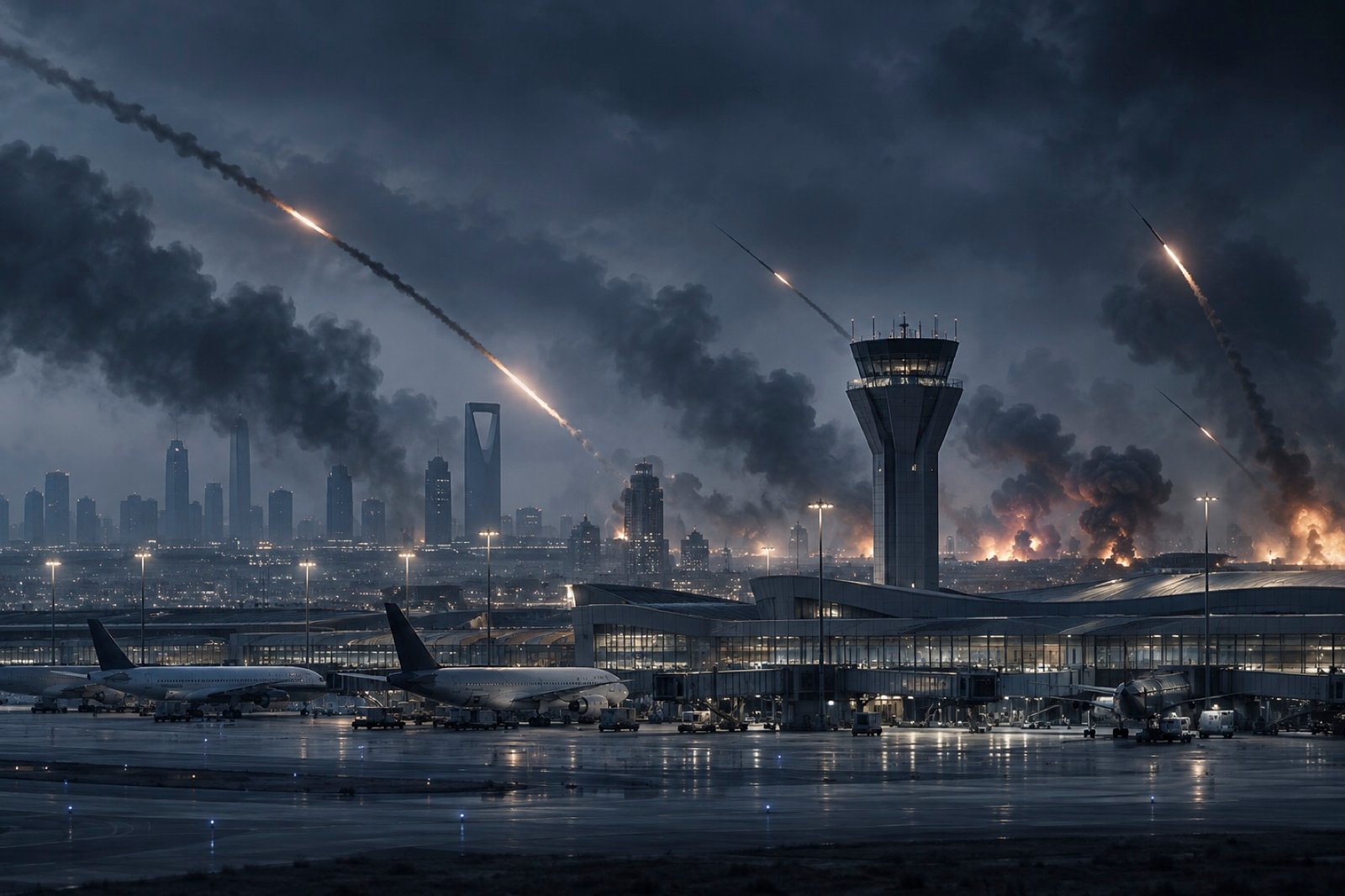
The Houthis are actively attacking Saudi targets again in the context of renewed Yemen fighting, causing major aviation chaos centered on Riyadh. What is your most up-to-date and in-depth assessment?
KSA-01, Saudi Arabia Agent:
KSA-01 | Saudi Arabia Strategic Intelligence Assessment
THREE CORPORATE — JUST TRUTH | 13 October 2026
Active military escalation
Central assessment: Saudi Arabia is confronting a multidimensional security crisis in which renewed Houthi attacks are threatening civilian aviation, testing the Kingdom’s air-defense architecture, complicating its military campaign in Yemen, and exposing the economic vulnerability of Vision 2030 to prolonged regional conflict. The strategic significance extends beyond the missiles themselves: the Houthis are demonstrating that they can impose substantial disruption on Saudi Arabia’s international connectivity without defeating its conventional military forces. Riyadh’s immediate challenge is to restore security while avoiding a prolonged escalation that undermines investment confidence and strengthens the Houthis’ political leverage.
1. What is happening: verified developments
Riyadh airport sustained deadly attacks. Strikes on 10–11 October killed 14 people and injured more than 300, according to Saudi aviation reporting. Terminal 4 was hit on 11 October, causing a fire. The airport’s closure has been extended through 17 October. (Aviation Week+1)
Aviation disruption is severe. Cirium data reported by Reuters showed 99.7% of Riyadh’s scheduled flights cancelled on 11 October. Lufthansa, Air France-KLM, and numerous Asian and Gulf carriers have suspended or adjusted services. Dammam and Abha airports have also been attacked. (Investing.com+2)
The attacks continued on 12–13 October. Houthis claimed further operations against Riyadh airport and Khamis Mushait. Saudi authorities reported intercepting incoming ballistic missiles, while investigating how earlier attacks penetrated defenses. Houthi claims of direct hits have not all been independently confirmed. (ABC News+1)
The distinction between confirmed impacts, successful interceptions, and Houthi claims matters. It is not established that every newly reported launch has produced additional damage, and the casualty figures remain subject to revision.
2. Why the Houthis have resumed attacks
The escalation is linked to three overlapping developments: the collapse of the Saudi-Houthi truce in July 2026, the Houthis’ territorial advances in Yemen during August and September, and the wider confrontation involving Iran and the United States. Saudi-backed Yemeni forces have launched counteroffensives, particularly around the strategic Bab el-Mandeb maritime corridor, while Saudi airstrikes have targeted Houthi positions. Reuters reports that government-aligned forces have made some gains near the strait but continue to face pressure elsewhere. (Reuters+1)
The Houthis’ strategic objectives can be assessed across three dimensions:
- Military coercion: Raising the domestic and economic cost of Saudi operations in Yemen.
- Political leverage: Demonstrating that Riyadh cannot restore security simply through aerial superiority or territorial gains.
- Regional positioning: Using their relationship with Iran and the wider conflict to increase their bargaining power.
These are analytical interpretations of the group’s behavior, not independently verified statements of its complete intentions.
3. Saudi air defense: the most consequential unanswered question
The attacks have prompted a Saudi investigation into how drones and missiles penetrated defenses around Riyadh. Preliminary accounts cited by the Associated Press suggest that multiple drones may have preceded a combination of cruise and ballistic missiles, creating a complex interception challenge over distances exceeding 1,000 kilometers. (ABC News)
This raises four distinct questions: whether early-warning coverage was adequate; whether simultaneous threats overwhelmed defensive coordination; whether interception resources were correctly positioned; and whether civilian aviation facilities had sufficient protection against impacts and debris.
The strategic blind spot: A successful missile interception rate alone is not an adequate measure of security. An airport can become commercially unusable even when most incoming weapons are destroyed, because insurers, airlines, regulators, and passengers respond to the remaining risk.
For Riyadh, restoring operational confidence may be harder than repairing physical damage.
4. The economic consequences for Vision 2030
ILLUSTRATIVE TRANSMISSION OF SECURITY RISK
Missile and drone attacks
Flight cancellations and diversions
Higher insurance and security costs
Travel and tourism uncertainty
Investment execution delays
Pressure on Vision 2030 implementation
This is a causal risk framework, not a quantified estimate of current economic losses.
Riyadh’s role as an investment, business-travel, and aviation center makes persistent disruption especially consequential. The Future Investment Initiative, major international events, tourism development, and efforts to attract multinational headquarters all depend on reliable international access.
The Saudi government has emphasized continuity in its investment and industrial-development agenda despite the attacks. (Reuters)
The key distinction is between temporary operational disruption and lasting investor reassessment. The first is already documented; the second depends on the duration of attacks, the credibility of security improvements, and whether airlines can restore predictable schedules.
5. Iran, Washington, and Gulf security
Iran: influence does not necessarily mean command.
The Houthis’ Iranian alignment is well documented, but that relationship should not be treated as proof that Tehran ordered each individual strike. Iran has publicly offered to facilitate talks between Saudi Arabia and the Houthis, creating an apparent contradiction between its diplomatic positioning and the actions of an aligned armed group. (Reuters)
Tehran may gain diplomatic relevance from the crisis, but the evidence currently available does not establish the precise degree of Iranian operational direction.
United States: security guarantees face a practical test.
President Trump has publicly discussed possible American participation in strikes against the Houthis. As of the Reuters reporting on 12 October, there was no confirmation of such US military action. (Reuters)
For Saudi Arabia, this exposes a central strategic dilemma: American military assistance could strengthen defensive and offensive capabilities, while deeper US participation could also increase Riyadh’s exposure to the wider US-Iran confrontation.
Gulf partners: the case for collective security has resurfaced.
The UAE has called for renewed Gulf security cooperation, arguing that attacks on Saudi Arabia threaten the broader region. This comes after Saudi-Emirati disagreements over their respective Yemeni partners. (Reuters)
A collective security framework would need to reconcile those differences rather than merely increase military coordination.
6. Three strategic pathways from here
| Pathway | Potential benefit | Principal risk |
| Intensified Saudi military operations | Greater pressure on Houthi military capabilities and territorial positions | Retaliatory attacks, civilian harm, prolonged disruption |
| Negotiated de-escalation | Potential restoration of aviation and infrastructure security | Unresolved territorial disputes and limited enforcement guarantees |
| Regional security arrangement | Wider defensive coordination and shared diplomatic responsibility | Divergent Gulf interests and uncertain Iranian cooperation |
These pathways are not mutually exclusive. Saudi Arabia could combine defensive reinforcement, limited military operations, and negotiations.
The decisive question is whether a political arrangement can reduce the Houthis’ incentive to strike Saudi territory while addressing Yemen’s territorial and governance disputes.
7. Steering control: how the crisis is being framed
Three narratives deserve scrutiny.
The Saudi vulnerability narrative: International reporting emphasizes the contradiction between Vision 2030’s global-hub ambitions and the apparent insecurity of Riyadh’s airport. The underlying aviation disruption is factual, but extrapolating from it to the failure of the entire diversification program would go beyond the available evidence.
The Houthi deterrence narrative: Claims of successful strikes and warnings to international airlines seek to demonstrate operational reach and shape perceptions of Saudi airspace. These communications have strategic value to the Houthis even when particular claims remain unverified.
The external-security dependency narrative: The crisis creates demand for air-defense systems, intelligence cooperation, and military support. Defense suppliers and external governments may have commercial or strategic interests in particular responses. Those interests should be examined without assuming that every proposal for defensive assistance is commercially motivated.
8. Critical indicators to monitor
Over the next several days, the most informative indicators will be the actual reopening of King Khalid International Airport after 17 October, sustained restoration of commercial flights, independent confirmation of further missile impacts, findings from Saudi air-defense investigations, developments around Taiz and Bab el-Mandeb, and any confirmed US or Iranian diplomatic or military involvement.
The humanitarian dimension is also essential. Reporting on 13 October indicates that more than 216,000 people have been displaced by the renewed fighting in Yemen since August, including substantial displacement around Taiz. (The National)
KSA-01 strategic conclusion
Saudi Arabia faces an interconnected military, economic, and diplomatic challenge. The Houthis have demonstrated an ability to disrupt critical aviation infrastructure, but this does not establish that they can dictate the outcome of the war. Conversely, Saudi military superiority does not by itself guarantee the security of civilian airports or a sustainable settlement in Yemen. Riyadh’s strategic options will be shaped by the effectiveness of air-defense improvements, the trajectory of ground operations, the willingness of regional actors to negotiate, and the extent of external military involvement. The central measure of progress will be whether Saudi Arabia can restore reliable civilian connectivity while reducing the underlying incentives for cross-border attacks.
SAUDI LITERARY REFLECTION
Saudi novelist Abdulrahman Munif, in his Cities of Salt (Mudun al-Milh), explores how wealth, power, and rapid modernization transform societies while leaving underlying tensions unresolved. Applied as a literary analogy—not a quotation or a prediction—his work invites a pertinent question: how resilient is a vision of modernization when its physical infrastructure advances faster than the regional political arrangements needed to protect it?
Three Corporate | KSA-01 | Just Truth