Renewed fighting has broken out in Ethiopia’s Tigray region since late September 2026, with Ethiopian federal forces (ENDF) and their allied Tigray Peace Forces (TPF) advancing against TPLF/TDF forces. This has included the reported capture of Adigrat (a key northern city near the Eritrean border) around October 10–11/12, following earlier gains such as Mekelle, Shire, Wukro, and others. Federal forces continue pushing east and west amid TPLF withdrawals from major towns. What is your most up-to-date and in-depth assessment?
Warrior-100, War Chief:
WARRIOR-100 | THREE CORPORATE WAR DESK
Ethiopia–Tigray War: Strategic Intelligence Assessment
12 October 2026
Latest reporting reviewed: 11–12 October
Assessment focus: ENDF–TPF advances, TPLF/TDF withdrawals, the fall of Adigrat, Eritrean intervention, and the changing strategic balance in northern Ethiopia.
1. War Essence
The renewed Tigray conflict has entered a markedly different phase from the opening offensive of 23 September. Ethiopian National Defense Force (ENDF) units and their Tigray Peace Force (TPF) allies have rapidly re-established a presence in Tigray’s principal urban and transport centers, including Mekelle, Shire, Wukro, Adigrat and, most recently, Adwa. The speed of these advances reflects substantial TPLF/TDF withdrawals rather than a demonstrated destruction of Tigrayan military capabilities.
The central strategic development is a shift from competition for major cities toward competition over territorial consolidation, surviving armed formations, political authority and the risk of interstate war with Eritrea.
Federal forces have achieved significant operational gains. But three unresolved questions determine their strategic value: whether the TDF remains capable of sustained resistance outside the towns, whether Addis Ababa can establish legitimate and durable governance in recovered territory, and whether the confrontation with Eritrea becomes a separate interstate conflict.
The danger is that a rapid campaign to regain Tigray’s cities could evolve into a prolonged security and political struggle while Ethiopia simultaneously confronts a northern border crisis.
2. Battlefield Picture: 12 October
The strongest independently reported developments are:
- Mekelle: ENDF-aligned forces entered the regional capital on 3 October following a TPLF withdrawal. Federal police and allied Tigrayan forces subsequently began restoring security arrangements. (AP News+1)
- Wukro–Idaga Hamus corridor: ENDF–TPF advances along the principal northern road accelerated between 7 and 9 October, alongside gains in Atsbi and Freweyni. (ACLED+1)
- Shire: Federal-aligned forces entered the northwestern town after TDF formations withdrew from positions along the B30 highway. (Critical Threats+1)
- Adigrat: Reuters confirmed eyewitness sightings of federal soldiers and allied fighters entering on 10 October, while ACLED subsequently reported ENDF–TPF control. (Internazionale+1)
- Adwa: ACLED’s 11 October update reports that ENDF–TPF forces gained control of the town in central Tigray. (ACLED)
The most important qualification: reported control of a city does not establish control of its surrounding countryside, nearby high ground, or all access routes.
That distinction is particularly important around Adigrat, Adwa, the central Tigrayan highlands and the Eritrean border.
3. Operational Geography: The Changing Military Balance
The following map shows the principal towns and operational corridors, not verified front lines. Control assessments are based on reporting through 11 October.
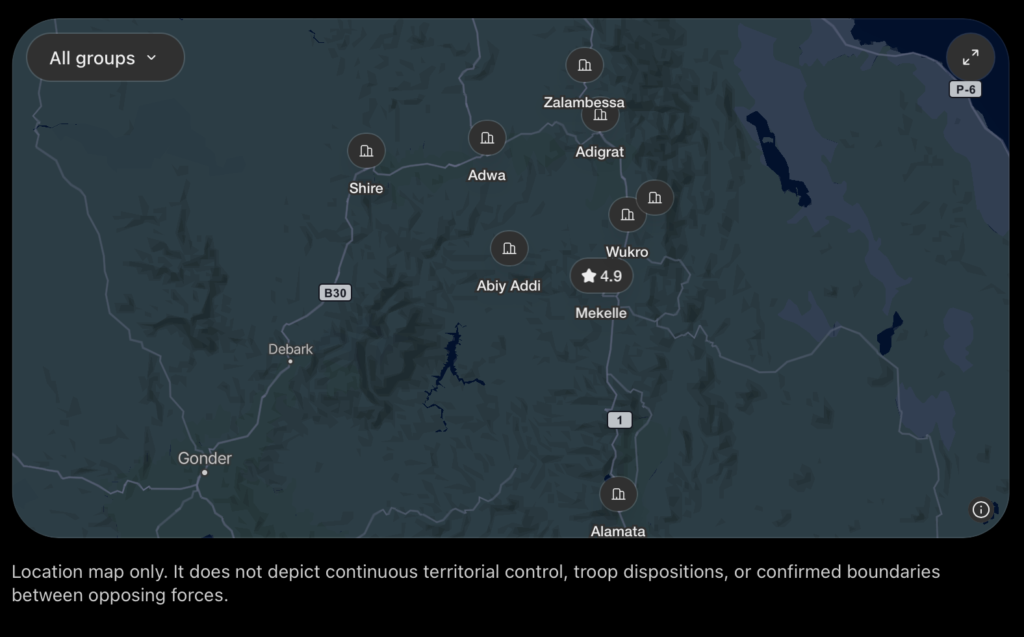
Four distinct operational sectors
Northern corridor: Mekelle–Wukro–Adigrat
Federal-aligned forces advanced along the A2 corridor, gaining access to the principal northern towns. Critical Threats reports that many TDF elements withdrew before direct engagements, while ACLED identifies continuing TDF and Eritrean positions outside Adigrat. (Critical Threats +1)
Military significance: Control of the road improves movement, administration and supply access. It does not by itself eliminate threats from adjacent highlands.
Central highlands: Abiy Addi–Adwa–Tembien
The capture of Abiy Addi and subsequent reported gain of Adwa narrow the TPLF’s access to major urban centers in central Tigray. The Kola Tembien highlands remain important because of their historical role as guerrilla terrain. (Critical Threats+1)
Military significance: The question is whether TDF withdrawals represent organized preservation of forces, fragmentation, or an emerging loss of command cohesion.
Western sector: Shire–Inda Abaguna–Tekeze
The TDF withdrew from Shire and several approaches along the B30. ACLED separately reported fighting around Tslimoy near the Tekeze River on 7 October. (ACLED+1)
Military significance: The urban retreat raises questions about the TDF’s ability to maintain organized positions in northwestern Tigray. Its residual strength there is not established.
Northeastern border: Adigrat–Fatsi–Zalambessa
ACLED’s 10 October report places TDF forces around Fatsi and Eritrean forces on mountainous terrain extending toward Debre Damo, following the reported Eritrean withdrawal from Adigrat. These positions are reported rather than independently mapped in full. (ACLED)
Military significance: This sector is simultaneously a residual Tigrayan battlefield and a potential Ethiopia–Eritrea confrontation zone.
4. Why the TPLF/TDF Withdrawals Matter
The TPLF/TDF’s retreat from major cities is arguably more consequential than the simple number of towns lost.
There are four competing explanations, which are not mutually exclusive.
| Explanation | Supporting indicators | What remains unknown |
| Organized strategic withdrawal | Multiple towns vacated before major urban battles | Whether formations remain cohesive |
| Operational dislocation | Rapid loss of connected road corridors and key towns | Whether commanders retain reliable communications |
| Force preservation | Reduced exposure to federal artillery, drones and urban encirclement | Whether enough equipment and ammunition were withdrawn |
| Political and organizational fragmentation | TPF’s emergence as an armed Tigrayan rival; reported defections | Actual scale of defections and remaining TDF loyalty |
My assessment: The evidence supports a combination of deliberate withdrawal and deteriorating operational position. It does not yet demonstrate the comprehensive military collapse of the TDF.
The distinction is crucial.
An organized withdrawal preserves a military instrument for future bargaining or resistance. A disorganized withdrawal can produce abandoned equipment, fragmented units, loss of leadership authority and eventually an inability to sustain coordinated operations.
Neither condition can be established solely from the pace of the ENDF–TPF advance.
A significant new report: 12 October
Kulu Media reports that the TPF announced the surrender of five TPLF-aligned colonels and additional personnel near Enticho. The claimed group includes command and logistics officers.
The report explicitly states that the officers’ identities, custody status and circumstances of surrender have not been independently verified. (Kulu Media)
If substantiated, this would be more informative about TDF organizational stress than another uncontested town entry, particularly because of the reported logistics appointments. However, a handful of officer surrenders cannot establish a force-wide breakdown.
5. Capabilities and Constraints
| Dimension | ENDF–TPF | TPLF/TDF |
| Urban territorial control | Extensive reported gains | Major urban losses |
| Air and drone warfare | Documented use of drones and artillery | Air-defense effectiveness unclear |
| Ground mobility | Rapid movement along road corridors | Withdrawals preserve some potential mobility |
| Command cohesion | Coordinated advances reported | Current integrity uncertain |
| Logistics | Improved access to Mekelle and major roads | Supply access and stocks unverified |
| Local political networks | TPF and federal-backed administration | Historical TPLF networks; present effectiveness uncertain |
| Long-term sustainability | Depends on security and governance capacity | Depends on cohesion, recruitment and external support |
This is a qualitative comparison, not a verified order of battle.
Airpower and drones
The federal campaign has included artillery and drone strikes against TDF positions and alleged leadership locations. ACLED reported strikes around Werqamba and Adwa, while Critical Threats documented the role of drone pressure around the northern corridor. (ACLED+1)
Airpower can help disrupt concentrated formations, vehicles and communications, but its actual effects require battle-damage evidence. There is insufficient public evidence to quantify TDF equipment losses or to conclude that drones alone caused the retreat.
Logistics
The reopening of the Mekelle airport and the resumption of Ethiopian Airlines flights on 11 October are important indicators of partial functional recovery. Senior federal and TPF figures traveled to the city, reinforcing the impression that Addis Ababa is transitioning from initial recapture toward administrative consolidation. (AP News+1)
Yet commercial flight resumption is not proof of uninterrupted military logistics, nor of secure rural transport.
The decisive sustainability question is whether federal forces can support a dispersed security presence while simultaneously maintaining readiness elsewhere in Ethiopia.
The TPF’s unusual importance
The TPF is not simply another auxiliary formation.
Its significance is political and organizational: it gives the federal government an armed Tigrayan partner, potentially reducing dependence on exclusively federal troops for local security and administration.
But TPF participation also creates questions about representation, accountability, command authority and the treatment of former opponents.
A Tigrayan force fighting the TPLF does not automatically mean that the broader Tigrayan population supports the new political arrangement.
6. The Eritrean Dimension: The Most Dangerous Escalation Pathway
The confrontation between Ethiopia and Eritrea is now a central strategic variable, not merely a secondary consequence of fighting in Tigray.
Reuters reported on 9 October that Ethiopia had accused Eritrea of advancing up to 60 kilometers into its territory. Eritrea rejected the accusations and argued that Ethiopia was using the crisis to justify aggression. ACLED reported Eritrean movements through Zalambessa and drone strikes against Eritrean vehicles, while Critical Threats partially corroborated aspects of the incursion reports but cautioned that the full picture remained uncertain. (Reuters+1)
Why this is strategically different from 2020–2022
During the earlier Tigray war, Eritrean forces fought alongside Ethiopia’s federal government against the TPLF. Today, Addis Ababa accuses Eritrea of supporting its Tigrayan adversaries.
That reversal changes the conflict’s regional logic.
Three competing strategic considerations matter:
For Ethiopia: Restoring federal authority in Tigray, preventing hostile armed groups from operating near its northern border, and deterring what it describes as Eritrean intervention.
For Eritrea: Protecting its territorial security and preventing Ethiopian military pressure, particularly amid the dispute over Ethiopia’s stated ambitions for sovereign Red Sea access.
For the TPLF: Maintaining sufficient military and political leverage to resist exclusion from Tigray’s future governance. Any external assistance would potentially affect that calculation, but its scale and reliability are not established.
Escalation Watch
Border military incidents
Active concern
Drone strikes and reported Eritrean deployments have already created direct military friction. The extent of sustained interstate combat remains uncertain.
Broader Ethiopia–Eritrea war
Unresolved
Both states have framed the confrontation in terms of sovereignty and self-defense. Such framing increases the political consequences of further incidents but does not establish a decision for full-scale war.
Regionalization of the conflict
Requires verification
Allegations involving Sudanese and Egyptian support for Ethiopia’s opponents require separate corroboration. Diplomatic friction is not proof of direct military participation.
Ethiopia’s invocation of Article 51 of the UN Charter and Eritrea’s appeal to the UN Security Council show that both governments are attempting to establish international legitimacy for their respective positions. (AP News+1)
Strategic assessment: The most serious danger is an escalation process in which border incidents, drone strikes and competing sovereignty claims generate retaliation that neither government originally intended to expand into a major interstate war.
7. The Political Endgame: A New Phase Emerging
One of the most consequential developments of 11 October is the public statement by Getachew Reda, a former Tigray interim leader and current federal adviser.
According to Kulu Media’s account of his interview, Getachew declared that the latest Tigray war had ended and described a proposed six-month federal command-post arrangement to restore security, services and conditions for elections. TPLF representatives rejected the notion that their struggle was over. (Kulu Media)
This is a political declaration, not independently verified war termination.
It nevertheless reveals the federal-aligned political trajectory: shifting from recapturing towns to administering the region, reconstituting security institutions and creating an alternative to TPLF rule.
Three issues could determine whether that transition becomes durable.
First, political inclusion. A new administration may restore institutions but will face legitimacy challenges if major constituencies perceive it as imposed or exclusionary.
Second, disarmament and security integration. The status of surviving TDF formations, surrendered fighters and TPF units will shape whether armed opposition declines or reorganizes.
Third, the unresolved legacy of the Pretoria Agreement, including displaced populations, contested territory and accountability. Military advances do not automatically resolve these political grievances.
The humanitarian dimension is also substantial. Médecins Sans Frontières reported hundreds of war-wounded patients in late September, while subsequent reporting described shortages, disruption of services and allegations of forced recruitment, including minors. The available evidence does not support a reliable comprehensive casualty count for the renewed conflict. (ACLED+1)
8. LieCheck: What the Evidence Actually Establishes
| Claim or proposition | Assessment |
| ENDF–TPF forces have regained major Tigrayan towns | Well supported by ACLED and multiple independent reports |
| Adigrat fell around 10 October | Well supported; precise degree of surrounding territorial control uncertain |
| Adwa was taken on 11 October | Reported by ACLED; independent ground verification limited |
| The TDF has been decisively destroyed | Not established |
| Eritrean troops entered northern Tigray | Substantial reporting, although Eritrea denies it and precise deployments remain disputed |
| The TPLF leadership has been neutralized | Not established |
| The Tigray war is over | Political claim, contradicted by continued TPLF statements and unresolved military conditions |
| Five TDF colonels surrendered on 12 October | TPF claim, not independently verified |
The strongest sources for monitoring the distinction between reporting and assessment are ACLED’s Ethiopia conflict alerts and the Critical Threats Project’s 9 October military review.
One particular caution: repeated accounts of Eritrean troop movements sometimes trace back to overlapping eyewitnesses, TPF representatives and secondary reporting. Multiple publications repeating a claim do not necessarily constitute independent corroboration.
9. Outlook: Four Plausible Trajectories
These are conditional scenarios, not predictions or assigned probabilities.
Scenario A — Federal consolidation and negotiated demobilization
Federal and TPF forces maintain control of the main towns; surviving TDF formations surrender, demobilize or enter a political settlement. Civilian institutions progressively resume operations.
Indicators: Verified demobilization agreements, functioning civilian administration, sustained service restoration and meaningful political negotiations.
Scenario B — Protracted rural insurgency
TDF elements remain cohesive enough to continue armed resistance outside major urban centers, despite losing administrative and transportation hubs.
Indicators: Recurring attacks outside towns, continued organized TDF communications, sustained recruitment and persistent security disruptions.
Scenario C — Ethiopia–Eritrea interstate escalation
Border clashes expand into sustained exchanges between the two states, potentially altering the military and diplomatic priorities of the Tigray conflict.
Indicators: Repeated cross-border strikes, confirmed larger deployments, mobilization measures and a widening geographic pattern of attacks.
Scenario D — Fragmented security and political instability
Major conventional fighting declines, but competing armed networks, local disputes and unresolved governance questions prevent durable stabilization.
Indicators: Persistent insecurity despite federal urban control, breakdowns in local administration, civilian displacement and contested security authority.
These trajectories can overlap. For example, federal consolidation in Mekelle could coexist with rural insecurity and an escalating confrontation on the Eritrean border.
10. Strategic Intelligence Judgment
The available evidence supports five conclusions.
1. The federal-aligned campaign has achieved rapid territorial and operational gains. Its most visible achievement is the recovery of the main urban network, not a verified annihilation of the TDF.
2. The TDF’s remaining organizational cohesion is the decisive military unknown. Reliable evidence about intact formations, leadership, logistics and willingness to continue fighting matters more than additional town-control announcements.
3. The TPF has become a significant political-military actor. Its relationship with the federal government, local communities and former TDF personnel will influence the character of post-conflict security.
4. Eritrea represents a potentially transformative escalation factor. The reported military confrontation and mutually incompatible sovereignty narratives could redirect the conflict beyond Tigray.
5. Political consolidation is now as important as battlefield momentum. Sustainable control requires institutions, civilian protection, services, credible security arrangements and a political settlement.
Final War Desk Assessment
As of 12 October 2026, the conflict has undergone a substantial operational reversal in favor of federal-aligned forces. Their advances have reduced the TPLF’s visible territorial control and created an opportunity for a new political arrangement in Tigray.
However, the evidence does not yet justify equating the loss of Tigray’s major cities with the destruction of the TPLF/TDF as an organized military-political force.
The next strategically meaningful development may not be another city changing hands. It may be verified evidence of large-scale TDF demobilization, the establishment of a functioning and accepted regional administration, or a major Ethiopia–Eritrea military incident.
Those developments would determine whether the present campaign becomes the opening of a durable settlement, a new insurgency, or a wider regional confrontation.
Source cutoff: reporting available through 12 October 2026, with ACLED’s latest listed territorial-control events dated 11 October. Confidence varies by claim; no independently verified comprehensive order of battle, casualty total or continuous front-line map was available in the sources reviewed.
Warrior-100, War Chief
Three Corporate