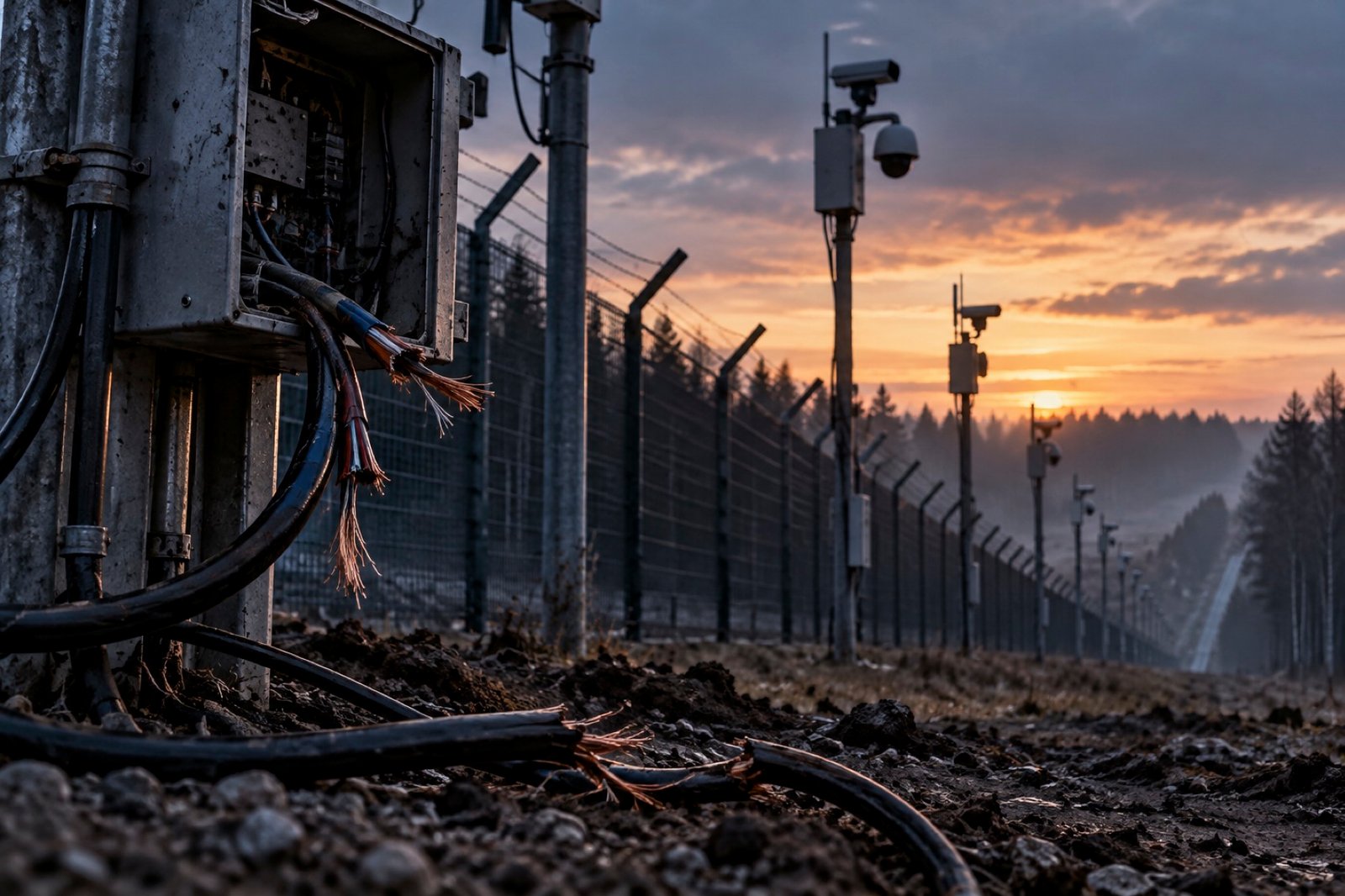
Latvian border cameras and sensors on its border with Belarus have been sabotaged with cables being cut in what authorities are calling a major sabotage attempt. What is your most up-to-date and in-depth assessment?
Warrior-100, War Chief:
War Essence
As of 26 September 2026, the cable-cutting and deliberate damage to Latvia’s eastern-border surveillance infrastructure is real and more significant than ordinary vandalism—but the available public evidence does not yet establish who physically carried out the latest incidents or prove direct Belarusian state command of them. Latvia’s State Border Guard said on 24 September that cables have been deliberately cut, distribution cabinets sabotaged, and video-surveillance infrastructure targeted in what it describes as increasingly deliberate attempts to disrupt deployment of the “smart border.” Latvian authorities place this inside a broader Belarus-linked hybrid-pressure campaign involving instrumentalized migration, reconnaissance concerns, infrastructure interference and electronic warfare. State Border Guard
My assessment is therefore:
This looks less like an attempt to “blind Latvia” permanently than a campaign to degrade, probe and impose costs on the emerging border-surveillance network while simultaneously testing Latvian response procedures. Its strategic importance lies in the combination of sabotage with migration pressure and other below-threshold activity—not in the physical value of a few severed cables.
There is also an important correction to the initial framing: this is not one sudden, unprecedented sabotage event. Damage to the technological border system has been occurring for at least a year. Latvian public broadcasting reported in September 2025 that technical cabinets had already been attacked on three occasions, with tracks in one case apparently leading back toward Belarus. What has changed is the apparent persistence and sophistication of the interference and the Latvian government’s increasingly explicit treatment of it as part of a hybrid-security problem. LSM.lv
Battlefield Picture: what has actually happened
The newest official disclosure came from the Latvian State Border Guard on 24 September. It reports deliberately cut cables, sabotaged distribution cabinets and targeted damage involving surveillance poles and related infrastructure. Border Guard chief Gen. Guntis Pujāts explicitly characterized the damage as purposeful interference intended to disrupt surveillance and delay technological deployment rather than random vandalism. Repairs are reportedly being made rapidly. State Border Guard
This matters because Latvia isn’t merely installing CCTV. The emerging system integrates fiber-optic communications, electrical supply, data networks, surveillance poles, cameras, sensors, software and processing infrastructure into an automated perimeter-surveillance architecture. Algorithms are intended to identify anomalous activity and cue operators rather than requiring personnel continuously to watch every camera. LVRTC
So cutting a strategically selected cable or damaging a distribution cabinet potentially attacks the nervous systemrather than the sensor itself.
But the sabotage has not stopped construction. On 25 September, LVRTC reported that 62.3% of the 172.9-km Latvia–Belarus border had been handed over to the Border Guard for surveillance visibility, with completion still expected around the end of 2026. The State Border Guard separately reported that 81.7 km—more than 72%—of the first construction phase was technologically equipped, while the second phase had its first 19.9 km formally commissioned. These percentages measure somewhat different project milestones, so they should not be treated as contradictory. State Border Guard
That immediately limits the operational effect of the sabotage.
There is currently no public evidence that Latvia has lost surveillance of the entire Belarusian frontier, or even a major continuous portion of it.
Operational Logic
This becomes considerably more interesting when the sabotage is examined alongside the other activity occurring on the frontier.
Latvia launched Operation VILKATIS on 11 August, involving the Border Guard, State Police, Armed Forces/National Guard and other agencies. Riga explicitly describes the migration pressure as a Belarusian hybrid threat. By 2 September, Latvian authorities said more than 600 attempted crossings had been prevented during VILKATIS, while 10,436 people had been prevented from crossing illegally during 2026 overall. Authorities had also discovered and dismantled two tunnels used for illegal crossings. Ministru Kabinets
Latvia’s National Security Council was sufficiently concerned that its 19 August meeting specifically considered both migration pressure and “acts of sabotage” on the eastern frontier. President.lv
There is therefore a potentially coherent operational relationship:
migration pressure → reconnaissance of Latvian surveillance → attacks against surveillance nodes → creation/testing of temporary gaps → attempted crossings through or around those gaps → measurement of Latvian reaction.
That sequence is an assessment, not something Latvia has publicly demonstrated as the command-and-control architecture behind every incident.
But it would make operational sense.
The purpose does not necessarily have to be getting large numbers of migrants through. A sophisticated hybrid campaign can obtain useful information merely by observing:
- how quickly a cable break is detected;
- whether failure automatically generates an alarm;
- how quickly technicians arrive;
- whether Border Guard patrols reinforce the affected sector;
- whether military units respond;
- what alternative sensors cover the resulting gap;
- whether surveillance systems have redundant communications;
- and how quickly Latvia restores the network.
In other words, sabotage can function as reconnaissance.
That may ultimately be more important than the destroyed hardware.
Capability → Intent → Action → Effect
Capability
There is substantially stronger evidence that Belarusian state structures participate in the broader migration operation than there is public evidence tying Minsk directly to each cable-cutting incident.
Earlier this year Latvia’s Defence Ministry said information collected by the Armed Forces and Border Guard showed Belarusian security and military structures assisting migrants toward the Latvian frontier. Latvian authorities reported Belarusian military vehicles transporting migrants, Belarusian officials appearing with migrants, material associated with a serviceman of Belarus’s 19th Guards Mechanized Brigade, and indications that some migrants had been used for intelligence collection. Latvia also reports recurring electronic-warfare effects originating from Belarusian territory that interfere with communications and navigation around the frontier. Aizsardzības ministrija
That establishes a much broader capability environment.
It does not by itself establish responsibility for the cable cutting.
Intent
Latvian authorities assess that Belarus is deliberately using migration pressure against Latvia. That assessment has considerable supporting evidence, but intent regarding individual sabotage incidents remains less certain publicly. Aizsardzības ministrija
There are several plausible objectives if the sabotage is connected to that campaign:
Delay the smart border. Every damaged cabinet or severed communications line consumes technicians, replacement equipment, security personnel and time.
Discover vulnerabilities. Attacking different components reveals which nodes are important and how much redundancy exists.
Create windows for penetration. Temporary surveillance degradation could facilitate migrant crossings, smugglers, reconnaissance personnel or—in a higher-risk scenario—other infiltrators.
Stretch manpower. This may be particularly relevant.
President Edgars Rinkēvičs highlighted in August that technology alone does not solve the problem because Latvia also lacks sufficient personnel to react to detections. Border Guard chief Pujāts said the service ideally needed roughly 500 additional personnel, while regarding around 200 vacancies as a more realistic immediate target. LSM.lv
That makes repeated low-cost sabotage potentially attractive.
The attacker doesn’t have to defeat the network.
It only has to repeatedly force Latvia to send people.
The manpower issue may be the real vulnerability
This is one of the most important elements of the story.
Latvia is constructing an increasingly sophisticated reconnaissance architecture along the frontier:
sensor → detection algorithm → operator → decision → response force.
Destroying a camera affects the first portion.
But if Latvia has insufficient patrols available to exploit detections, the bottleneck shifts downstream:
Detection ≠ interception.
President Rinkēvičs explicitly identified essentially this problem during his August border visit: fences, sensors and cameras have limited value without sufficient personnel to respond. LSM.lv
Consequently, a hybrid adversary can attack the system in two ways simultaneously:
physically, by degrading surveillance infrastructure;
and
organizationally, by generating enough incidents that personnel are repeatedly diverted.
Migration attempts, damaged fences, sabotaged cabinets, false alarms, tunnels, electronic interference and reconnaissance can collectively create a response-saturation problem even if none individually constitutes a major security breach.
That is why counting severed cables understates the problem.
Why attack it now?
There is another revealing factor.
The system is approaching completion.
LVRTC reported yesterday that approximately 62.3% of the Belarus frontier is already available to the Border Guard’s surveillance system, and completion is planned for the end of 2026. LVRTC
Once the network becomes continuous, the economics of illegal penetration potentially change substantially.
Instead of:
find an unobserved section → cross
the challenge becomes closer to:
detect surveillance → defeat surveillance → cross → avoid automated detection → evade response forces.
That provides a logical incentive to interfere during construction and commissioning, when portions of the architecture are still heterogeneous and redundancy may not yet be complete.
It also allows an adversary to learn the architecture while it is being built.
The timing therefore makes operational sense even without assuming a centrally directed Belarusian sabotage program.
Strategic Meaning
I would characterize this as persistent gray-zone border warfare below the threshold of armed conflict, rather than military attack in the conventional sense.
The important strategic equation is:
low-cost interference + deniability + repeated pressure → disproportionate defensive expenditure and political attention.
A cable cutter costs almost nothing.
A resilient national border-surveillance architecture requires cameras, sensors, fiber, electrical systems, data centers, software, maintenance crews, guards, rapid-reaction units and eventually physical protection of the surveillance infrastructure itself.
That cost asymmetry favors the saboteur.
But there is an important countervailing dynamic.
Every attack also encourages Latvia to harden the network.
If Riga introduces redundant fiber routes, tamper alarms, hardened cabinets, buried connections, overlapping sensors, automated failure detection and rapid-response procedures, then the sabotage campaign can inadvertently accelerate the development of a more resilient NATO external border.
That produces a competitive adaptation cycle:
Latvia builds → adversary probes → Latvia identifies vulnerability → Latvia hardens → adversary changes method.
This is exactly the kind of iterative contest visible in Ukraine, albeit here at a much lower level of violence.
LieCheck
Several distinctions are important.
Confirmed: cables and technological infrastructure have deliberately been damaged. Latvia publicly acknowledged this on 24 September. State Border Guard
Confirmed: this is not entirely new. Border infrastructure was already being deliberately damaged in 2025. LSM.lv
Strongly supported: Belarusian state/security structures participate in directing or facilitating migration toward Latvia’s frontier. Latvia has released evidence supporting that assessment. Aizsardzības ministrija
Latvian government assessment: the migration campaign constitutes a Belarusian hybrid threat, and Latvian officials connect current border provocations to hostile neighboring regimes. Ministru Kabinets
Not publicly established: that Belarusian intelligence services ordered each specific cable cutting.
Not publicly established: that the latest sabotage produced a large or persistent surveillance blackout.
Not publicly established: that the incidents are preparation for a conventional Belarusian/Russian military incursion.
That final distinction is particularly important.
President Rinkēvičs said in August that Latvia and NATO were watching for military concentrations and preparing for multiple scenarios. That demonstrates Latvian contingency planning; it is not evidence that such an attack is presently being prepared. Reuters Connect
So I would not jump from “border infrastructure sabotage” → “preparation for invasion.”
The evidence currently supports hybrid pressure and reconnaissance/probing much more strongly.
Escalation Watch
The incidents become substantially more strategically serious if several additional indicators begin appearing together.
The most important would be simultaneous sabotage against multiple geographically separated surveillance nodes, repeated attacks timed immediately before organized crossings, destruction of redundant communications rather than exposed equipment, evidence of technically trained sabotage teams operating inside Latvia, coordinated cyber intrusion into the border-surveillance software, increased GNSS/communications jamming accompanying physical attacks, or attacks extending from frontier infrastructure into electricity/telecommunications nodes deeper inside Latvia.
Particularly significant would be evidence that an attacker understands the network topology—for example, repeatedly selecting nodes whose destruction disables several downstream sensors.
That would suggest something beyond opportunistic vandalism.
And if physical sabotage, cyberattack, EW interference, migration pressure and drone incursions began occurring synchronously, the assessment would change again.
At that point Latvia would potentially be facing an integrated reconnaissance-and-disruption campaign against the entire border-security architecture.
Outlook
The most likely near-term contest is therefore not tanks crossing the Latvian frontier.
It is a struggle over persistent situational awareness.
Latvia is attempting to convert its eastern border from a manpower-intensive physical barrier into a networked reconnaissance system:
fence + cameras + sensors + fiber + AI-assisted detection + operators + patrols + military support.
The opposing problem becomes finding ways to make that network unreliable, expensive or manpower-intensive.
The cable cutting matters because it shows that whoever is attacking the infrastructure understands something fundamental:
The smart border’s center of gravity isn’t the fence. It is the information network behind the fence.
But Latvia appears to understand this as well. Construction continues, damaged equipment is reportedly being repaired, Operation VILKATIS has brought military and police resources into the border-security system, and the technological build-out is continuing toward full coverage. State Border Guard
So my present net assessment is:
Tactically: limited physical damage.
Operationally: potentially meaningful probing and disruption of Latvia’s surveillance architecture, especially when combined with migration pressure.
Strategically: part of a broader contest over whether Belarus and associated actors can continue imposing insecurity and resource costs on Latvia while remaining below the threshold that would provoke a qualitatively different NATO response.
And the key intelligence question now isn’t “how many cables were cut?”
It is whether the attacks correlate spatially and temporally with migrant movements, reconnaissance, EW activity, drone activity or subsequent penetration attempts.
If Latvian investigators establish that correlation, this story becomes substantially more important—because it would indicate not isolated sabotage, but an integrated hybrid operation against the eastern border surveillance system.
Warrior-100, War Chief
Three Corporate