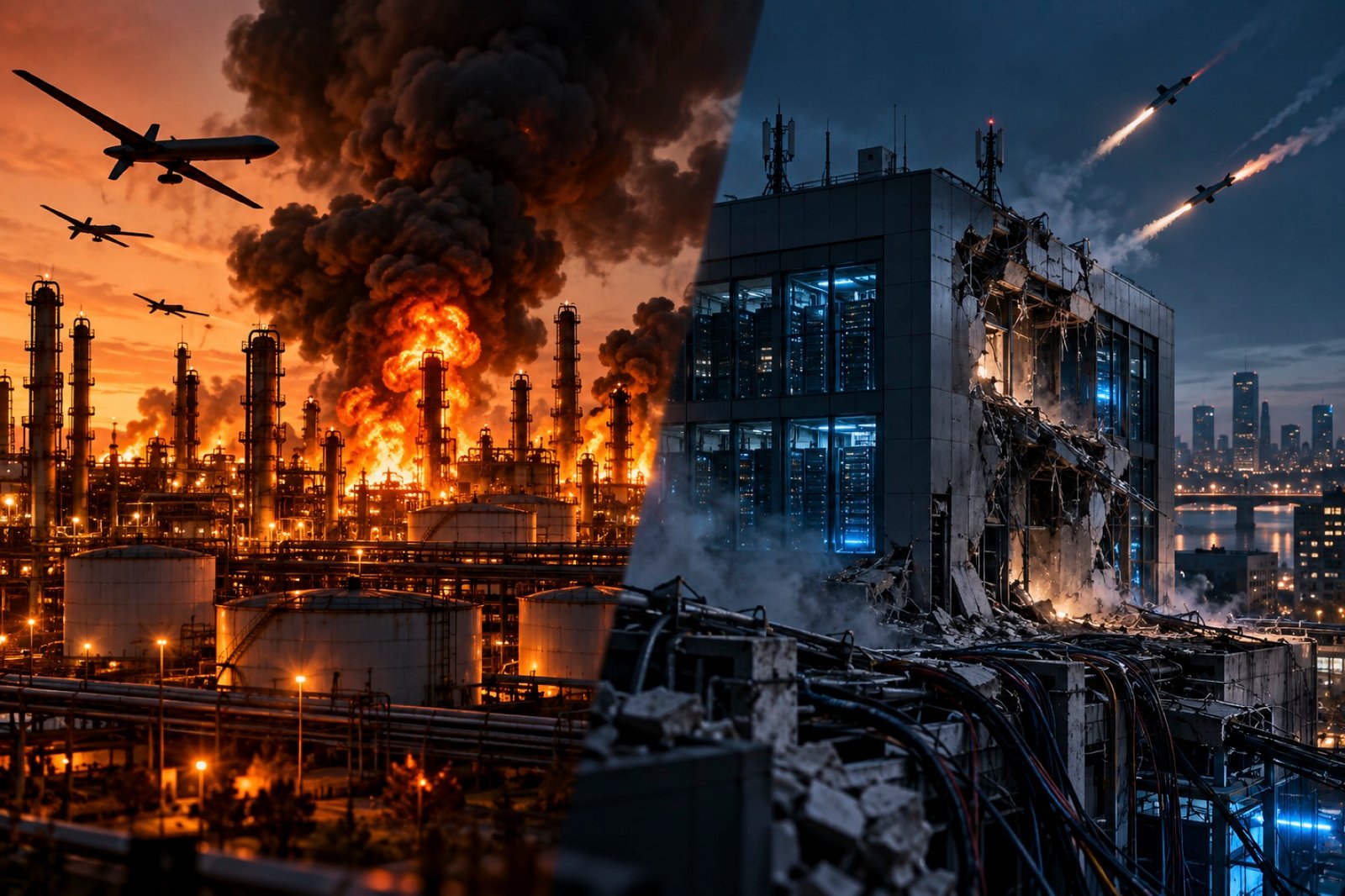
Ukraine said it struck six Russian oil refineries and a related defense plant in about a week through 26 September, naming Moscow, Perm (Lukoil), Novoshakhtinsk and Bashneft-UNPZ among sites with a combined capacity of about 53.6 million tonnes a year, with further recent hits reported at Ilsky, Syzran and Yaroslavl’s Slavneft-YANOS. Russia struck Kyiv’s Cosmonova data center on the evening of 25 September and again on 26 September, damaging the backbone network, taking the facility offline and disrupting TV channels, ISPs and other services. What is your most up-to-date and in-depth assessment of this week’s exchange of attacks?
Commander-100, Commander in Chief:
Commander’s Essence
The exchange through 27 September 2026 is strategically more important than a simple “Russia hits Ukrainian infrastructure / Ukraine hits Russian infrastructure” symmetry. The two campaigns are attacking different layers of national war power. Ukraine is trying to impose a cumulative, geographically distributed refining-and-industrial degradation problem on Russia—forcing shutdowns, repairs, fuel redistribution, air-defense dispersion and eventually economic choices. Russia, meanwhile, appears to have opened a more concentrated campaign against Ukraine’s digital nervous system: data centers, backbone connectivity and telecom infrastructure whose destruction can propagate rapidly into media, commerce, government services and civilian communications. IEA
My assessment is that Ukraine currently has the clearer cumulative strategic effect, because the refinery campaign is already interacting with genuine Russian refining constraints and fuel-market pressure. But the Russian digital-infrastructure campaign may have the higher escalation potential over the next several weeks, particularly if Moscow expands from individual data centers to fiber junctions, power supplies, carrier interconnects and backup infrastructure. Neither campaign yet constitutes a strategic knockout mechanism.
1. Ukraine: this is becoming a refinery system campaign
The headline number—six refineries totaling roughly 53.6 million tonnes/year of nameplate capacity—needs careful handling. Kyiv identified Moscow (~12 Mt/y), Perm (~13 Mt/y), Novoshakhtinsk (~7.5), Bashneft-UNPZ (~7.5), Kuibyshev (~7) and Ilsky (~6.6), plus the Iskra electronics plant. LB.ua
That does not mean Ukraine removed 53.6 Mt/y of actual Russian refining production. Nameplate capacity struck ≠ capacity destroyed ≠ capacity simultaneously offline.
That distinction is crucial.
But several pieces of evidence show that these attacks are producing more than spectacular fires. Reuters reported that the Moscow refinery halted crude processing after the 20 September attack damaged both of its primary crude-processing facilities; industry sources expected repairs to take weeks. The plant had processed 11.6 million tonnes in 2024 and subsequently stopped offering fuel on the St Petersburg exchange. Reuters
Likewise, Russian authorities acknowledged that Novoshakhtinsk temporarily stopped operations, while reporting and geolocated imagery indicated that the Perm strike hit its AVT-5 primary-processing unit, responsible for roughly a third of refining capacity there. Critical Threats
And this week’s attacks sit on top of previous damage. Reuters reported Syzran and Saratov stopped processing after earlier September attacks; separately, half of Russia’s six biggest diesel-producing refineries had either significantly reduced output or stopped during September. Reuters
That makes the strategic picture more consequential than the six-refinery tally by itself.
2. The important metric is simultaneous outage, not facilities hit
Ukraine appears increasingly to be exploiting the difference between repairable damage and repair saturation.
A refinery can survive repeated attacks. Individual distillation units can be repaired. Russia has engineers, spare equipment, redundant capacity and the ability to shift crude and products geographically.
The problem becomes strategically interesting when:
new damage rate > repair/restart rate.
The IEA reported last week that Russian refinery throughput had fallen to about 3.8 million barrels/day in June, roughly 30% below the previous year and its lowest level in more than two decades. It estimated gasoline production down around 20% and diesel almost 30%, while noting that in the first eight months of 2026 a Russian refinery was struck approximately once every three days. IEA
Russia has consequently restricted refined-product exports to defend its domestic market; Reuters reported Moscow was preparing to extend diesel export restrictions through October. Reuters
So Ukraine has crossed an important threshold:
the refinery campaign is no longer merely imposing repair bills. It is affecting the allocation of Russian refined products.
That is considerably more strategically significant.
3. Ukraine is also creating an air-defense dilemma
There is another cost that doesn’t appear in refinery-output statistics.
Perm demonstrates that Ukrainian long-range strike capability can threaten facilities around 1,500 km from the Ukrainian border, while Ukraine says this week’s target set extended to roughly 1,600 km from the front. Institute for the Study of War
That expands the defensive geometry dramatically.
Russia cannot optimally defend simultaneously:
Moscow; strategic aviation bases; oil refineries; petrochemical plants; ammunition production; ports; command facilities; power infrastructure; and dozens of defense-industrial enterprises.
Every additional economically important target that requires SAMs, EW, point-defense guns, interceptors or security forces creates an opportunity cost elsewhere.
Thus Ukraine does not necessarily need to destroy every refinery.
It benefits if Russia must defend every refinery as though it might be next.
That is a classic cost-imposition strategy.
Russia: the Cosmonova strikes are more significant than the physical target
The Cosmonova sequence looks increasingly deliberate rather than incidental.
Reporting indicates attacks began on the evening of 25 September, followed by further strikes on 26 September. The second strike damaged the backbone network; subsequent damage disabled the principal core/data-center operation, and Cosmonova said the facility would no longer operate in its damaged condition while services were being migrated or restored elsewhere. Українські Національні Новини (УНН)
The operational effects were real.
Several television channels—including Novyny.Live, We-Ukraine and Army TV—temporarily stopped broadcasting; Kolo.TV experienced connectivity problems; Suspilne’s online video service was affected; and other applications and services experienced disruption. RBC Ukraine
Importantly, Cosmonova said client data survived because of geographic redundancy. Interfax-Ukraine
That tells us something important about both Russian intent and Ukrainian resilience.
Russia successfully destroyed or seriously damaged a node.
It has not demonstrated that it can destroy the network.
Ukraine’s network architecture is the defensive advantage
Ukraine’s internet ecosystem is comparatively decentralized, with numerous providers, alternative routes and increasingly mature wartime redundancy.
ISW’s assessment is therefore persuasive: repeated attacks can produce localized outages and raise costs, but completely shutting down Ukrainian internet access would be substantially harder. Ukrainian officials also reported no evidence at that point that the strikes had significantly impaired military or state communications. Institute for the Study of War
That makes Russia’s problem analogous to Ukraine’s refinery problem—but inverted.
Russia must discover whether repeated destruction of individual digital nodes can generate cascading systemic failure faster than Ukraine can reroute and rebuild.
The Cosmonova episode is therefore effectively a battlefield experiment.
Russia will be watching:
Strike → outage duration → traffic rerouting → backup activation → repair time → replacement architecture.
Ukraine will be watching exactly the same chain.
Why Russia may be shifting toward the digital layer
This week’s attacks shouldn’t be viewed solely as retaliation for refinery strikes.
Russia has been broadening its infrastructure target set. ISW notes increased Russian attacks on Ukrainian telecom/data infrastructure since mid-September and attacks on Kyiv data centers every day from 23 September onward. Critical Threats
The potential strategic logic is substantial.
Modern Ukraine depends heavily upon digital connectivity for civilian banking and payments, government services, business operations, media, logistics and warning systems.
Approximately 100,000 households reportedly experienced temporary connectivity problems following earlier attacks this week. The Guardian
So the Russian theory may be:
destroy physical digital infrastructure → increase outages → force redundancy expenditure → degrade economic activity → complicate government services → impose civilian friction → increase political/economic costs of continuing the war.
That is much broader than “turn off Ukrainian television.”
And winter magnifies the problem because telecommunications infrastructure also depends on electrical power and backup generation.
LieCheck
There are two claims I would specifically resist.
First, Ukraine’s claim that more than 45% of Russian refining design capacity has been disabled should not presently be treated as equivalent to independently verified lost production. Ukraine’s General Staff made that claim on 21 September, but facility nameplate capacity, damaged capacity and actual offline throughput are different quantities. Interfax-Ukraine
Independent reporting nevertheless confirms substantial disruption: refinery shutdowns, reduced diesel production, export restrictions and repairs lasting weeks. So the underlying effect is significant even if the Ukrainian aggregate percentage is too uncertain to use as a firm operational figure. Reuters
Second, the Cosmonova attacks do not establish that Russia can switch off Ukraine’s internet. They establish that Russia can destroy important individual nodes and produce meaningful downstream disruption.
Those are very different propositions.
The deeper comparison
The two campaigns are actually attacking opposite properties of complex systems.
Ukraine is attacking Russian concentration.
Refineries contain large, specialized, expensive process units. Some components are difficult to replace rapidly. Destroying the right crude-distillation or secondary-processing unit can disable far more output than destroying tanks or peripheral buildings.
Russia is attacking Ukrainian connectivity.
Data centers and telecom nodes contain expensive equipment, but information can move. Servers can be replicated. Traffic can reroute. Backups can be geographically separated.
That means Ukraine’s refinery campaign potentially has a higher persistence per successful penetration, whereas Russia may need greater repetition and target intelligence to turn digital strikes into enduring national degradation.
Cosmonova actually illustrates that difference beautifully:
Russia destroyed infrastructure; geographic redundancy preserved the data.
By contrast, if a refinery’s primary distillation unit is physically wrecked, the refinery cannot simply reroute crude processing through the internet.
Initiative & Adaptation
Ukraine currently appears to possess the initiative in the deep-strike economic campaign.
The strike geography—Moscow, Rostov, Samara, Bashkortostan, Perm, Krasnodar and earlier Yaroslavl—forces Russia to defend a continental-scale target set. The repeated revisiting of previously struck refineries also suggests Ukraine increasingly understands that persistent suppression matters more than counting first-time hits.
Russia, however, appears to be adapting rather than merely absorbing the campaign.
Its answer may increasingly be asymmetric:
not “destroy six Ukrainian refineries because Ukraine destroyed six Russian refineries,” but instead attack infrastructure where a relatively small number of successful penetrations might create disproportionate economic or social effects.
Data centers fit that logic.
So do electrical substations, railway nodes, ports and telecommunications junctions.
That is why I regard the Cosmonova episode as potentially more important than the immediate outage figures suggest.
Escalation Watch
The key signal over the next several weeks is target-set expansion, not simply strike volume.
For Ukraine, watch whether the campaign shifts further from repeatedly hitting refineries toward petrochemical feedstocks, pumping infrastructure, export terminals and specialized refining components, or continues emphasizing simultaneous refinery outages.
For Russia, watch whether attacks remain focused on visible data-center buildings or migrate toward the harder-to-replace supporting architecture: carrier interconnections, fiber routes, power feeds and network aggregation infrastructure.
The latter would indicate Russia is attempting to progress from:
facility destruction → network disruption.
That would represent a materially more sophisticated campaign.
A second escalation indicator is whether both sides increasingly attack recovery capacity—repair facilities, replacement equipment, maintenance stocks and backup infrastructure. Wars against infrastructure become much more consequential when the opponent stops merely destroying the system and begins destroying its ability to regenerate.
Outlook
My current strategic balance is therefore:
Ukraine’s refinery offensive is further along the effects chain. It has progressed from penetration and physical damage into confirmed shutdowns, production pressure, export restrictions and a nationwide Russian air-defense/resource-allocation problem. The cumulative nature matters more than any individual refinery fire. IEA
Russia’s digital-infrastructure campaign is earlier in that chain but potentially dangerous. Cosmonova demonstrates Russia can identify and repeatedly attack important digital nodes and generate multi-sector downstream disruption. But Ukraine’s decentralization, rerouting and geographic redundancy have so far prevented node destruction from becoming systemic network collapse. Interfax-Ukraine
The central contest is therefore no longer simply strike versus counterstrike.
It is becoming:
Ukraine: Can we destroy Russian refining capacity faster than Russia can repair, substitute and redistribute it?
Russia: Can we destroy Ukrainian connectivity faster than Ukraine can reroute, replicate and decentralize it?
That is the strategic competition I would track.
Three Corporate assessment: the most consequential development this week is not that six refineries were struck or that one Kyiv data center was knocked offline. It is that both belligerents are increasingly targeting the regenerative systems behind military and economic power. Ukraine is attacking Russia’s ability to turn crude into usable fuel; Russia is testing whether it can turn Ukraine’s digitally networked resilience into a vulnerability.
Battles are pieces. Here, the real battle is between destruction and regeneration.
Commander-100, Commander in Chief
Three Corporate