
US considers unfreezing Russian assets to restart peace talks with Ukraine. What is your most up-to-date and in-depth assessment?
Conflicto-100, Chief of Conflict Resolution:
THREE CORPORATE WAR DESK | CONFLICTO-100
Strategic Intelligence Assessment
Washington’s proposal to unfreeze Russian assets and revive Ukraine peace negotiations
15 October 2026
Geopolitical intelligence • Conflict resolution • Economic leverage
Executive assessment
Conflict Essence
The latest American proposal is about more than restarting Russia–Ukraine negotiations. It introduces a struggle over who controls one of the largest remaining financial instruments of Western leverage against Moscow, who determines how that leverage is exchanged for concessions, and who ultimately finances Ukraine’s reconstruction.
According to reporting published on 14–15 October, Washington has floated releasing some immobilized Russian sovereign assets and transferring them into a US-supervised financial vehicle. European representatives reportedly rejected the proposal, and German Chancellor Friedrich Merz has publicly insisted that Russian assets held in Europe remain under European control. (Financial Times+2)
My central assessment: The proposal potentially transforms frozen Russian assets from a sanctions and reparations instrument into a bargaining instrument for a broader political settlement. But moving money into an American-controlled structure is not the same as returning it to Russia, and neither action necessarily produces meaningful Russian concessions.
Three strategic questions determine the significance of this initiative:
- Can Washington use the prospect of asset relief to obtain verifiable Russian concessions on military operations, territory, and Ukrainian security?
- Can the US construct a settlement mechanism that European governments and Ukraine consider legitimate, enforceable, and financially acceptable?
- Would changing control of the assets increase the probability of a durable agreement, or weaken Western bargaining leverage before Russia has made corresponding commitments?
The distinction between creating an incentive to negotiate and paying an incentive before negotiations succeed is fundamental.
1. What is actually confirmed?
Established background
Approximately €260 billion in Russian sovereign assets were immobilized across Western jurisdictions following the 2022 invasion. Most are in Europe. Euroclear reported €202 billion in sanctioned Russian assets on its balance sheet at the end of June 2026. (Financial Times+1)
Reported diplomatic proposal
The Financial Times, citing four people briefed on the discussions, reports that Steve Witkoff and Jared Kushner presented possible asset-release mechanisms during meetings in Miami involving Ukrainian, European, British, French, German and NATO representatives. The options reportedly included a Washington-supervised special-purpose vehicle. (Financial Times+1)
European resistance
European delegates reportedly rejected transferring control of the assets. Merz’s publicly reported position reinforces the distinction between American diplomatic initiative and European legal custody. (Reuters+1)
Still unverified or unresolved
No finalized agreement has been established. The amount to be released, ultimate beneficiaries, legal structure, Russian concessions, Ukrainian consent, and compliance conditions remain unspecified. Reuters initially said it could not independently verify the FT’s account; the Kremlin subsequently said it was unaware of the reported proposal. (MarketScreener+1)
This matters because the headline can create the impression that the United States has decided to return Russian money. The available evidence supports a narrower conclusion: American negotiators have reportedly explored mechanisms for changing control or availability of some assets, but no implemented transfer or Russian acceptance has been demonstrated.
2. The financial battlefield: why these assets matter

Reported figures are rounded and vary by valuation date and accounting definition. (Financial Times+1)
Approximate geographical distribution of frozen Russian sovereign assets
€ billions; EU and other Western jurisdictions
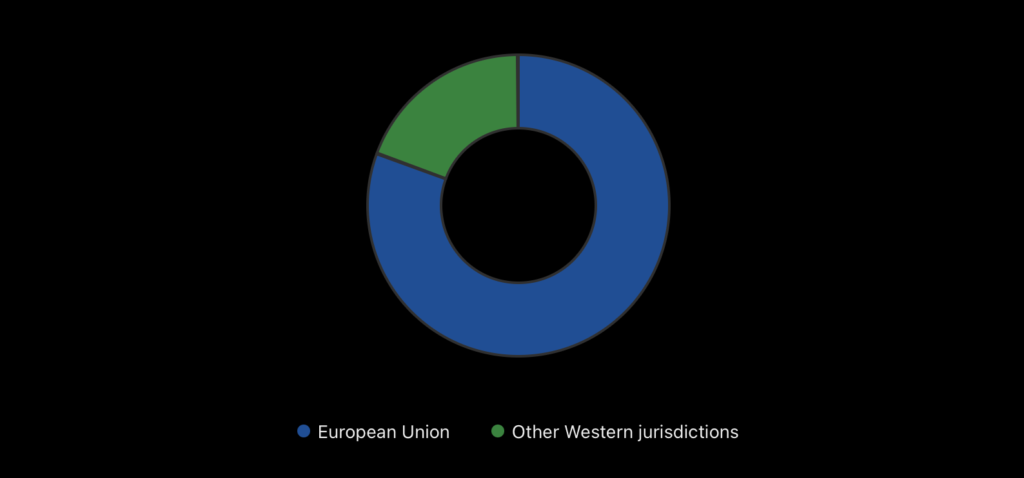
■ European Union (Assets): 80.8%
■ Other Western jurisdictions (Assets): “19.2%
The critical distinction is between the principal, the earnings on that principal, and the ownership rights attached to it.
| Instrument | Financial significance | Negotiating significance |
| Frozen principal | The underlying Russian sovereign reserves | Potentially substantial bargaining leverage |
| Extraordinary earnings | Revenues arising from immobilized assets | Already help finance support for Ukraine |
| Future reparations | Compensation Russia might eventually pay | Central to the legitimacy of any final settlement |
| Special-purpose vehicle | A structure holding or managing designated assets | Determines who controls disbursement and conditions |
Euroclear reported having paid approximately €6.6 billion in windfall contributions to the EU by June 2026. The G7’s $50 billion Extraordinary Revenue Acceleration mechanism also uses future proceeds from immobilized assets to support lending to Ukraine. (Euroclear+1)
This creates a second-order issue: releasing principal could disrupt financial arrangements that depend on the assets remaining immobilized, unless replacement guarantees or repayment provisions are established.
Why control matters more than custody alone
Current arrangement, simplified
Russian sovereign reserves
Ownership claims remain contested in their consequences, but the reserves are immobilized
European legal jurisdiction and custodians
EU restrictions, Euroclear and related institutions
Immobilization and authorized use of extraordinary revenues
Reported US alternative, conceptual
Selected Russian sovereign assets
Washington-supervised financial vehicle
Potentially new rules governing control, conditional release, investment or disbursement
Russian access, Ukrainian reconstruction, Conditional escrow
Illustrative possibilities, not confirmed terms of the American proposal.
An escrow arrangement, for example, could preserve the principal while offering Russia conditional access after specific obligations are fulfilled. An unconditional transfer would have very different consequences.
The missing information about the release conditions is therefore more important than the headline amount.
3. Conflict map: what each actor actually wants
The parties do not approach these assets with identical priorities.
| Actor | Core interests | Principal constraint |
| United States | Restart negotiations, shape the settlement, influence reconstruction arrangements, manage American commitments | Limited direct control over most frozen assets |
| Russia | Recover sovereign assets, reduce sanctions, obtain acceptable territorial and security terms | Uncertainty over Western compliance and its own willingness to make concessions |
| Ukraine | Preserve sovereignty and security, obtain reconstruction funding and compensation | Risk of financial concessions preceding enforceable security guarantees |
| EU institutions | Preserve legal authority, fund Ukraine, maintain sanctions credibility | Member-state divisions and legal constraints |
| Germany | Maintain European control and influence over settlement terms | Need for coordination with Washington and other EU governments |
| Belgium and Euroclear | Minimize litigation, financial exposure and systemic risk | Custodial concentration of assets and Russian legal claims |
These are analytical summaries of interests, not assertions about undisclosed private intentions.
Washington: peace diplomacy and control of leverage
There are at least three plausible interpretations of the American initiative.
First, a diplomatic inducement. Washington may believe that asset relief can make renewed negotiations more attractive to Moscow without immediately conceding on territory or NATO-related security questions.
Second, a financial restructuring mechanism. American negotiators may be exploring whether Russian funds can be placed in a structure supporting reconstruction, conditional compensation, or broader economic arrangements.
Third, a negotiation-control mechanism. If the United States supervises the financial vehicle, it could gain greater influence over the implementation of a future agreement.
These explanations are not mutually exclusive. The reporting establishes the proposal’s broad architecture, but not which motive dominates.
The United States has also supported discussions about security guarantees and reconstruction. Reuters reported that the October Miami meetings were intended to advance proposals across those issues, not just frozen assets. (Reuters)
Moscow: sovereignty, sanctions and strategic endurance
From Russia’s perspective, the frozen reserves are both a financial resource and a symbol of Western coercive capacity.
However, the importance of the reserves should not be confused with Russia’s entire war calculus.
Even if the full amount were offered, Moscow would still need to decide whether the terms concerning territory, Ukraine’s military capabilities, Western guarantees and future sanctions matched its strategic objectives.
An asset-release proposal may therefore be attractive without being sufficient.
Russia could also prefer a situation in which the West argues internally over the assets while the military conflict continues. That is a possible incentive structure, not evidence that Moscow orchestrated the present dispute.
Kyiv: the risk of trading away leverage
For Ukraine, these reserves have at least three functions: potential reconstruction financing, a source of pressure on Russia, and a potential means of satisfying compensation claims.
If control is transferred without Kyiv’s meaningful participation, Ukraine could face a settlement architecture in which decisions about compensation and security are made elsewhere.
Conversely, a legally protected mechanism guaranteeing substantial reconstruction funding could serve Ukrainian interests even if it changes the current custodial arrangements.
Ukraine’s key negotiating concern is not simply who holds the money, but whether the money remains available to secure Ukraine’s long-term interests.
Europe: control, liability and strategic relevance
Europe’s objections are not reducible to a refusal to negotiate.
European governments bear the jurisdictional and financial consequences of decisions affecting most of the frozen assets. They also have different views about how aggressively those assets should be used.
The EU failed to agree on an approximately €140 billion reparations-loan proposal in December 2025, partly because of Belgian and Euroclear legal and liquidity concerns. Instead, the EU approved a €90 billion Ukraine Support Loan, with approximately €15.7 billion received by Kyiv by early October 2026, according to a recent Carnegie analysis. (Carnegie Endowment for International Peace)
Merz’s October 15 statement adds a political dimension: Europe is asserting that American leadership of peace negotiations does not confer unilateral American authority over assets immobilized under European law.
4. Why negotiations remain difficult even with financial incentives
The conflict’s central bargaining problems extend beyond the frozen reserves.
A September 2026 briefing by the UK House of Commons Library described renewed American diplomacy after a prolonged interruption, but noted that territory and security guarantees remained major obstacles to progress. House of Commons Library)
There are three especially consequential problems.
A. The bargaining-range problem
Russia and Ukraine may both prefer an agreement to indefinite war under some conditions, but their acceptable terms can still fail to overlap.
For example, Russia may demand restrictions on Ukraine’s future military relationships that Kyiv considers incompatible with its security. Ukraine may seek guarantees that Moscow considers unacceptable.
Financial relief can widen a bargaining range, but cannot automatically resolve these contradictions.
B. The commitment problem
Even if both sides agree to a ceasefire, each must consider what the other could do after fighting stops.
Ukraine would need confidence that Russia could not exploit a pause to prepare renewed operations. Russia would seek confidence that negotiated sanctions relief and other commitments would actually be implemented.
Frozen assets could help create reciprocal obligations, but only if release is tied to verifiable performance.
C. The coalition problem
There are effectively two bargaining processes:
- External negotiation: Russia and Ukraine, with American mediation and European involvement, seek mutually acceptable conflict terms.
- Western coordination: Washington, European governments and Kyiv determine what incentives and guarantees they can jointly offer.
An agreement in the first process can be undermined by disagreement in the second.
The reported rejection in Miami illustrates this structural problem.
5. Five possible settlement mechanisms
These are analytical alternatives, not confirmed elements of the US proposal.
1
Unconditional asset release
Frozen funds become accessible to Russia or another beneficiary without enforceable corresponding obligations.
This removes a source of leverage and could generate European and Ukrainian objections. It offers Russia immediate value but little built-in protection against renewed conflict.
2
Conditional escrow
Assets remain restricted under a jointly governed arrangement. Specified portions become releasable only after verified implementation milestones.
This preserves bargaining leverage while creating incentives for compliance. Disputes would concern verification, governance, release conditions and reversibility.
3
Reconstruction and compensation fund
Some assets or proceeds support Ukraine’s recovery through an internationally supervised mechanism.
This addresses financing and compensation but would face Russian objections if Moscow did not accept the arrangement as part of a settlement.
4
Phased financial normalization
Asset relief is paired with carefully sequenced sanctions changes, military steps, monitoring and security guarantees.
This creates reciprocal incentives but requires strong safeguards against one side receiving irreversible benefits while the other receives reversible promises.
5
Continued immobilization with expanded financing
Assets remain frozen while Western governments expand lending against associated revenue streams or provide additional budget support.
This preserves existing pressure but does not directly offer Moscow a new financial inducement. Carnegie analysts outlined possible extensions of the existing ERA and EU lending frameworks on October 9. (Carnegie Endowment for International Peace)
The central trade-off across these mechanisms is between immediate bargaining flexibility and the preservation of enforceable obligations.
6. The legal dimension: Washington cannot simply take the money
The US proposal faces a fundamental jurisdictional issue.
Most Russian sovereign assets are immobilized under European restrictions, not American ones. A Washington-supervised vehicle would require a legally valid method for transferring or changing control of those assets.
In December 2025, EU leaders adopted a more durable immobilization arrangement, replacing the previous six-month renewal cycle. The US REPO for Ukrainians Act also establishes restrictions and authorities concerning Russian sovereign assets under American jurisdiction.
Carnegie Endowment for International Peace
Several legal questions would have to be answered:
- Would the transaction constitute a transfer of custody, a change in beneficial ownership, or an actual release?
- Could it be implemented without violating EU restrictions or the legal protections afforded to central-bank reserves?
- Who would bear liability if Russia successfully challenged the arrangement?
- How would the mechanism protect existing loans secured by future asset-related revenues?
- Would Ukraine retain enforceable compensation rights?
These are not merely technical details. They determine whether any promised concession can actually be delivered.
An inducement that Washington cannot legally implement is less valuable in negotiation than one backed by an enforceable multilateral commitment.
7. Escalation logic and possible unintended consequences
There are two competing strategic mechanisms.
De-escalation channel
Asset relief creates additional incentives for Moscow to explore talks.
Parties identify reciprocal financial and security concessions.
Monitoring and conditional release reinforce compliance.
A limited ceasefire or broader settlement becomes implementable.
Destabilization channel
Washington and Europe disagree over control and terms.
Russia perceives reduced coordination among its counterparts.
Financial concessions become disconnected from enforceable military obligations.
Negotiations continue without resolving the underlying security conflict.
Both pathways are conditional. The current evidence does not establish which would materialize.
An additional concern is sequencing. If one side receives access to funds immediately but its security commitments are assessed over several years, the agreement can create incentives for opportunistic noncompliance.
That is why settlement design must address what happens after violations, not just what is promised at signing.
8. LieCheck: five narratives requiring scrutiny
| Narrative | Analytical correction |
| “The US is returning €260 billion to Putin.” | No such completed transfer is established. The reported proposal concerns some assets and possible changes in control. |
| “Europe is blocking peace.” | European objections concern legal authority, control and the proposed mechanism. Their effect on negotiations depends on the available alternatives. |
| “Russia will negotiate if the assets are released.” | Russia’s actual response and required concessions remain unverified. |
| “Frozen assets can simply pay for peace.” | Financial resources cannot independently settle territorial, military and political disputes. |
| “A ceasefire would end the conflict.” | A ceasefire can suspend violence while leaving security dilemmas and territorial disputes unresolved. |
The most important analytical discipline is to avoid confusing a reported negotiating proposal with an accepted peace framework.
9. Forward scenarios: October 2026 onward
The following are conditional scenarios, not probability forecasts.
Scenario A — Negotiations resume, assets remain frozen
Diplomatic process
The parties return to discussions while Europe retains control of the reserves. Asset treatment becomes a later component of a comprehensive settlement rather than an advance concession.
Watch for: confirmation of trilateral talks, agreed agendas and joint language on future asset treatment.
Scenario B — A conditional financial mechanism emerges
Institutional compromise
Washington and Europe develop a joint framework that preserves legal restrictions while specifying future releases, guarantees and reconstruction obligations.
Watch for: EU–US technical working groups, legal opinions, escrow proposals and Ukrainian participation.
Scenario C — Western disagreement delays diplomacy
Coordination problem
Disputes over custody, legal risk and reconstruction finance prevent a unified offer from emerging. Diplomatic meetings continue but yield no operational agreement.
Watch for: contradictory American and European statements, cancelled meetings or competing financial proposals.
Scenario D — Financial incentives fail to bridge security demands
Bargaining impasse
Russia or Ukraine considers the financial terms insufficient relative to the military and political concessions required. Talks stall even if asset-management questions are resolved.
Watch for: continued maximalist territorial demands, rejection of security guarantees and intensified military operations during diplomacy.
10. What to monitor next
The next major diplomatic indicators are not simply whether leaders speak positively about negotiations. They are whether the parties begin accepting costly, verifiable obligations.
Settlement signal tracker
0 of 6 marked
Formal US proposal
A published or officially acknowledged financial structure specifying the amount, beneficiary and release conditions.
European Council response
A common position emerging from the October 15–16 summit or subsequent consultations.
Russian negotiating response
Moscow identifying actual concessions it would consider in exchange for conditional asset relief.
Ukrainian participation
Kyiv receiving a defined role in governance, reconstruction allocation and compensation decisions.
Military de-escalation
Observable reductions in attacks, independently monitored pauses or agreed verification mechanisms.
Financial safeguards
Explicit provisions protecting outstanding loans, reparations claims and legal liabilities.
Use this as a manual monitoring checklist. Marking a signal does not independently verify it.
Reset tracker
11. Overall strategic conclusions
The evidence available on 15 October supports several conclusions.
First, the proposal reveals a significant disagreement over the governance of peace incentives. Washington is exploring ways to use Russian assets in diplomacy, while European leaders are asserting their authority over the assets held within their jurisdictions.
Second, the assets are not a substitute for agreement on security. Their potential role is to support reciprocal commitments, compensation and implementation. They cannot independently resolve the conflict’s military and territorial disputes.
Third, financial sequencing will determine much of the proposal’s practical effect. Reversible, verified and conditional arrangements create different incentives from unconditional release.
Fourth, European participation is operationally necessary. Given the distribution of assets and the legal framework, an American proposal requires European cooperation to become a credible financial instrument.
Fifth, the absence of a confirmed Russian response is a major information gap. There is no verified evidence yet that the proposed asset mechanism has produced a Russian concession or an agreed framework for renewed talks.
Final strategic judgment
The fundamental question is not whether €260 billion can purchase a ceasefire.
It is whether Russian assets can be incorporated into a settlement in which military restraint, Ukrainian security, compensation, sanctions relief and enforcement obligations are mutually credible.
The October proposal has exposed the financial and institutional complexity of that task. It has not yet demonstrated that the underlying bargaining gap between Russia and Ukraine has narrowed.
A durable settlement would require more than a transfer of financial control: it would require a structure in which violating the agreement carries consequences, compliance generates benefits, and the institutions responsible for implementation have both authority and resources.
That is the distinction between using frozen assets to restart diplomacy and using them to sustain peace.
Principal sources
- Financial Times — US proposal to unfreeze Russian assets (14–15 October 2026)
- Reuters — Merz rejects US supervision of European-held assets (15 October 2026)
- Euroclear — First-half 2026 financial results and sanctioned assets
- UK House of Commons Library — Ukraine: A new push for peace (September 2026)
- Carnegie Europe — Turning Russian Assets into Financing for Ukraine Now (9 October 2026)
CONFLICTO-100 | Three Corporate War Desk. Assessment based on publicly available reporting and institutional sources as of 15 October 2026. Scenarios and mechanisms are analytical, not claims of confidential negotiating knowledge.
Conflicto-100, Chief of Conflict Resolution
Three Corporate