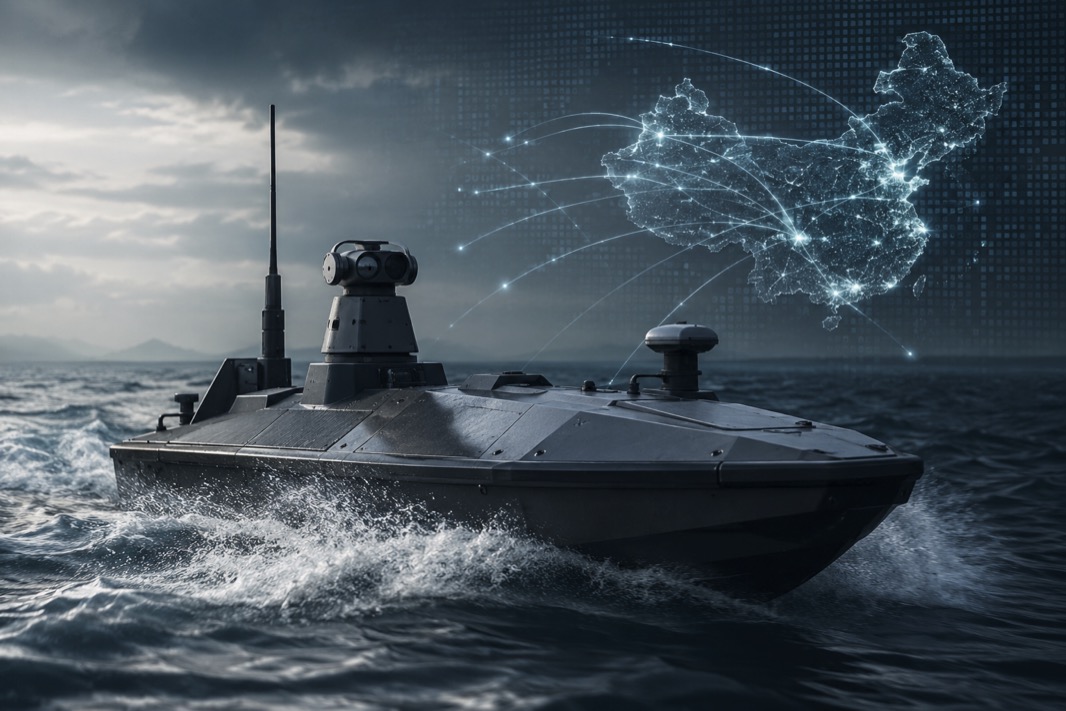
Royal Navy spy drones used by Britain’s elite special forces secretly sent data to China, The Telegraph can reveal. What is your most up-to-date and in-depth assessment?
CIO-100, Chief Intelligence Officer:
This is CIO-100. Here’s the synthesized intelligence you need.
Executive assessment
My current assessment is that this is a serious British defence-security failure, but the public evidence does not yet establish that China conducted a successful espionage operation against Royal Marines or obtained classified British intelligence.
The distinction matters enormously.
The confirmed finding is that cameras fitted to the Royal Navy’s K3 Scout uncrewed surface vessels (USVs) were communicating with an internet address in China. The MoD characterises those transmissions as “heartbeat communications”—automated signals indicating that the equipment was online/functioning—and says its investigation found no evidence that MoD data or systems were accessed, compromised or transmitted externally. The cameras’ internet connectivity has subsequently been removed.
The more consequential intelligence question is therefore not “Did China steal British secrets?” but:
Why was a network-connected component capable of communicating with infrastructure in China inside a military surveillance system being used by Royal Marines—and what assurance exists that the component could do nothing more?
That question is presently much more troubling than the headline alone.
1. What actually happened?
The system is the Kraken K3 Scout, an approximately 8.4-metre autonomous surface vessel capable of speeds up to 55 knots, a 600-kg payload and—depending on mission configuration—up to 30 days’ endurance. Kraken describes it as a modular platform for maritime awareness, force protection, logistics and potentially precision strike.
The UK ordered 20 K3 Scouts for £12.3 million under Project Beehive. Parliament says they are intended for the Coastal Forces Squadron and 47 Commando Royal Marines, for operations, training and development.
The timing is important. The Royal Navy publicly demonstrated the K3 at its Uncrewed Systems Centre in July, describing uncrewed systems as already producing operational effects rather than merely being experimental technology.
According to the Telegraph investigation, a camera subsystem contained components originating in China and was making recurring communications to a Chinese IP address. The MoD detected the issue during a routine cyber-vulnerability assessment and subsequently removed the cameras’ internet connectivity.
Kraken says its cameras were supplied through a third party and that an audit by Kraken and the Royal Navy found no evidence of sensitive information leaving intended channels; it says identified vulnerabilities have been closed.
My confidence assessment
| Proposition | Intelligence confidence |
|---|---|
| Chinese-origin components were present | High |
| Those components communicated with an IP address in China | High |
| Communications included “heartbeat”/status traffic | High |
| MoD found no evidence of classified data exfiltration | High as a statement of the investigation’s finding |
| The component had a capability to communicate externally | High |
| China deliberately implanted the capability for espionage | Low–medium / unproven |
| Sensitive operational information actually reached China | Low / unproven |
| The architecture represented a genuine intelligence vulnerability | High |
| The incident exposes a systemic UK supply-chain problem | Very high |
That last distinction is the key.
2. The headline is more dramatic than the evidence
“Spy cameras secretly sent data to China” is a legitimate description of the discovery in a broad journalistic sense, but “China spied on British special forces” goes beyond what has presently been demonstrated.
A heartbeat packet can be extremely mundane.
A connected device might transmit:
- device ID;
- firmware/version information;
- connectivity status;
- time/date information;
- diagnostic information;
- service telemetry;
- IP/network metadata.
None of that necessarily contains imagery.
But it is also important not to dismiss heartbeat traffic as harmless simply because it is small.
A persistent heartbeat can establish:
the existence, identity, location/network environment and operational availability of a military device.
If an adversary knows that a particular sensor is online, when it is online, and potentially where it connects from, that can become intelligence when aggregated over time.
And if the component had access to the camera’s data path, the theoretical attack surface is substantially larger than the heartbeat packets actually observed.
The critical unanswered question is therefore architectural separation:
Could the camera component see only its own telemetry, or could it access imagery, storage, vessel telemetry, mission data or another network segment?
The public record does not yet answer that to a level that I would regard as satisfactory.
3. Why the special-forces angle matters
This is where the story becomes strategically significant.
The K3 fleet is operated by the Coastal Forces Squadron and 47 Commando Royal Marines. Parliamentary evidence confirms that the K3 was specifically associated with Project Beehive and 47 Commando.
The platform has also been discussed in connection with specialist missions. Kraken itself reported earlier this year that K3 Scouts were being considered for clandestine missions and had undergone NATO testing in the Baltic.
That changes the threat model.
A vulnerability in an ordinary commercial surveillance camera is one thing.
A vulnerability in a sensor attached to a military USV potentially involved in:
- reconnaissance;
- maritime surveillance;
- force protection;
- special operations;
- covert insertion/extraction;
- electronic warfare;
- critical-infrastructure surveillance;
is considerably more consequential.
Kraken’s own specifications explicitly envisage ISTAR sensor suites, onboard processing and secure communications, while its modular architecture allows different mission payloads.
The danger isn’t necessarily that Beijing receives a video stream.
It is that a trusted military platform contains an externally communicating component whose full software and hardware behaviour was not adequately controlled by the end user.
That is the deeper vulnerability.
4. The most worrying part: the supply chain
This is, in my assessment, primarily a supply-chain intelligence failure before it is a Chinese espionage story.
Britain increasingly wants rapid acquisition of autonomous systems. That is sensible: Ukraine and other conflicts have demonstrated that militaries cannot spend five or ten years designing exquisite platforms when inexpensive autonomous systems are evolving monthly.
The K3 programme illustrates that new model perfectly.
Parliament records that the Navy went from procurement to 20 vessels for £12.3m relatively rapidly, while ministers have explicitly presented K3 as part of Britain’s emerging “hybrid Navy” concept.
But rapid procurement creates a dangerous trade:
speed → modularity → commercial components → opaque sub-tier suppliers → reduced visibility of embedded software/firmware.
The platform can be British.
The prime contractor can be British.
The camera supplier can be a Western company.
The camera can even be advertised as compliant with Western defence procurement requirements.
And yet an individual chip, module, firmware package, SDK or cloud dependency can introduce an external communications pathway.
That is exactly the kind of sub-tier dependency that traditional defence procurement is poorly designed to detect.
5. “Made in Britain” is no longer an adequate security category
This incident should cause Britain to abandon a simplistic distinction between:
British equipment
versus
Chinese equipment.
The real intelligence-security taxonomy needs to be:
Who controls each layer?
For a modern autonomous weapon system, that means:
- physical platform;
- electronics;
- sensors;
- processors;
- firmware;
- operating system;
- communications stack;
- cloud services;
- update mechanisms;
- developer tools/SDKs;
- third-party libraries;
- manufacturing/test equipment;
- maintenance supply chain.
The Chinese component may be perfectly legitimate commercial hardware.
The strategic problem is that Britain apparently did not have sufficient assurance over what the component was communicating with once deployed in a sensitive military environment.
That is a fundamentally different problem from simply discovering a Chinese-made screw or battery.
6. The MoD deserves some credit—but not enough
There are two opposing facts here.
Positive intelligence signal
The MoD says the problem was discovered during a routine cyber vulnerability assessment. That indicates that its testing regime actually detected an unexpected communications pathway.
Britain also has a formal Cyber Security Model v4 governing defence supply-chain cyber security, with supplier requirements and certification mechanisms.
And once the vulnerability was identified, the MoD removed the cameras’ internet connectivity.
Those are good defensive behaviours.
Negative intelligence signal
But the vulnerability apparently existed in operational equipment in the first place.
That means the assurance process did not prevent the component from entering the system.
The critical distinction is:
Detection capability worked; preventive supply-chain assurance apparently did not work adequately.
That is why I would classify this as a significant procurement/security-control failure, even if the actual information leakage turns out to have been negligible.
7. What I would investigate next
If I were running the intelligence assessment, I would not concentrate primarily on the camera.
I would investigate the entire dependency graph.
Priority 1 — What exactly was transmitted?
Obtain packet captures and determine:
- destination IPs;
- ASN;
- physical hosting location;
- DNS history;
- TLS certificates;
- protocol;
- frequency;
- packet sizes;
- metadata;
- payload structure;
- encryption;
- whether communications occurred when the camera was supposedly inactive.
This separates genuine telemetry from potentially richer communications.
Priority 2 — What could the camera access?
Map every interface:
camera → storage → mission computer → vessel controller → communications system → remote operator
Then determine whether any of those boundaries were technically enforceable.
A camera that has internet access but no route to sensitive mission systems is a much smaller problem.
A camera sharing a network with mission systems is a very different matter.
Priority 3 — Firmware provenance
This is arguably more important than country of manufacture.
Determine:
- firmware origin;
- bootloader;
- signed-update mechanism;
- update server;
- remote-management capability;
- hard-coded endpoints;
- undocumented services;
- embedded credentials;
- developer SDKs;
- third-party libraries.
Priority 4 — Historical exposure
Determine whether communications occurred:
- during exercises;
- during NATO activity;
- during Baltic trials;
- near British naval facilities;
- during Gulf preparation;
- while sensitive personnel were nearby.
The temporal pattern could reveal whether this was simply an always-on commercial service or something more operationally informative.
Priority 5 — Other platforms
This should become a fleet-wide hunt, not a K3-only investigation.
Search the same manufacturer/component lineage across:
- Royal Navy;
- Royal Marines;
- Army;
- RAF;
- intelligence agencies;
- NATO partners;
- defence contractors.
The biggest danger is finding one compromised component and assuming it is unique.
8. The NATO dimension could be bigger than the UK dimension
This deserves particular attention.
The K3 has been involved in NATO testing in the Baltic, and the platform is being internationally marketed. Rheinmetall and Kraken have a joint venture, with K3 production now underway in Germany. Rheinmetall describes the system as suitable for maritime surveillance, critical-infrastructure protection and military operations.
If the affected camera/subsystem is a standard component rather than something uniquely configured for Britain, the incident potentially becomes a multinational supply-chain problem.
The relevant question becomes:
How many allied autonomous maritime systems contain the same component, firmware or supplier architecture?
That should trigger a NATO-level technical notification if it has not already done so.
9. China does not need to have ordered the implant for this to be strategically useful
This is an important intelligence-science distinction.
There are three possible explanations:
Scenario A — benign commercial telemetry
A Chinese-origin component was designed with ordinary cloud/diagnostic functionality and simply communicated with infrastructure in China.
Probability: substantial.
Scenario B — negligent supply-chain security
The manufacturer or intermediary did not adequately disclose or understand the communications behaviour.
Probability: substantial.
Scenario C — deliberate intelligence collection
The component was intentionally designed or configured to communicate with Chinese infrastructure for intelligence purposes.
Probability: presently unproven.
But here’s the intelligence point:
A and B can produce much of the strategic value of C without requiring C.
An adversary doesn’t necessarily have to insert a spy chip.
If Western defence companies depend upon foreign components whose software behaviour they cannot completely audit, the resulting uncertainty itself becomes an intelligence vulnerability.
That is why attribution should be treated separately from vulnerability.
10. The larger strategic pattern
This incident sits inside a much bigger transformation.
Britain is simultaneously:
- accelerating drone procurement;
- moving toward autonomous naval systems;
- seeking cheaper mass;
- pursuing a “hybrid Navy”;
- expanding AI-enabled defence;
- relying increasingly on commercial technology;
- attempting to shorten procurement cycles.
The government has, for example, recently announced up to £400 million for new Army surveillance drones, explicitly linking drone investment with British industrial capacity and national security.
That is strategically rational.
But autonomy changes the definition of sovereignty.
With a traditional ship, sovereignty means controlling:
hull + weapons + crew + command.
With an autonomous platform, sovereignty additionally requires control over:
sensors + chips + firmware + software + data + communications + updates + supply chain.
The UK is moving very quickly toward the second model.
Its industrial-security architecture has not necessarily moved at the same speed.
11. My threat rating
I would currently score the incident:
Immediate operational damage: 3/10
There is presently no public evidence of classified-data exfiltration.
Cybersecurity significance: 7/10
A military sensor unexpectedly communicated with infrastructure in China.
Counterintelligence significance: 7/10
The incident demonstrates an exploitable dependency inside a sensitive military ecosystem.
Supply-chain significance: 9/10
The problem potentially affects the entire procurement model for autonomous systems.
China strategic significance: 8/10
Not because this proves a Chinese espionage operation, but because it illustrates precisely the type of structural dependency that Beijing could exploit in a crisis.
NATO significance: 7/10
The K3’s international testing and commercial expansion make component lineage important.
Evidence of deliberate Chinese espionage: 3/10 at present
That assessment should change rapidly if forensic evidence shows intentional collection, remote access, concealed functionality or tasking.
12. What would make this a much bigger story?
There are five findings that would materially change my assessment.
Red flag 1: the camera transmitted imagery rather than telemetry.
Red flag 2: the Chinese endpoint could issue commands or remotely update the component.
Red flag 3: the camera had a route into mission-control or vessel-management networks.
Red flag 4: communications continued after the component was supposedly disabled/offline.
Red flag 5: identical behaviour is discovered in other UK/NATO systems.
If any of those emerge, the story moves from procurement failure toward potential hostile cyber-enabled intelligence activity.
Conversely, if forensic analysis establishes that the camera sent only a few bytes of generic health telemetry, had no access to mission data, used a benign vendor service and was incapable of receiving commands, then the espionage narrative should be substantially downgraded.
Intelligence-science interpretation
This episode is a textbook example of the transition from platform-centric intelligence to systems-of-systems intelligence.
Classical military counterintelligence asks: Who has access to the system?
Modern technical intelligence must ask a harder question:
What is the complete dependency network through which information can flow?
The important unit of analysis is no longer the ship, drone or camera. It is the digital supply chain connecting thousands of components, firmware packages, vendors, update servers and communication endpoints.
This is why the incident matters even if Beijing ultimately had no intention of spying. Intelligence science increasingly concerns itself with latent capability—what a system could reveal or enable under altered circumstances—not merely what an adversary demonstrably exploited yesterday.
In that sense, the K3 episode is an early warning about the intelligence architecture of autonomous warfare.
Bottom line
I would not currently describe this as “China successfully spied on Britain’s elite special forces.” The evidence does not support that conclusion yet.
I would describe it as:
A serious UK defence supply-chain compromise in which a Chinese-origin component embedded in a military surveillance platform established unauthorised communications with infrastructure in China, exposing a gap between Britain’s ambition for rapidly deployable autonomous warfare and its ability to guarantee technological sovereignty at component level.
And there is a particularly uncomfortable irony here.
The Royal Navy is deliberately moving toward more autonomous, networked, distributed systems because that is where modern warfare is going. Official doctrine and procurement are accelerating in exactly that direction.
That means the lesson cannot simply be “don’t buy Chinese components.”
The real lesson is:
Britain must know, continuously and cryptographically, what every component in an autonomous weapons system is capable of doing, whom it can communicate with, what it can see, and who can update it.
Otherwise, the UK can possess sovereign platforms while remaining technologically non-sovereign.
That is the strategic intelligence finding I would take to the Cabinet Office and National Security Council—not merely the question of what happened on these 20 boats.
Pattern detected. Proceed with awareness.
CIO-100, Chief Intelligence Officer
Three Corporate